

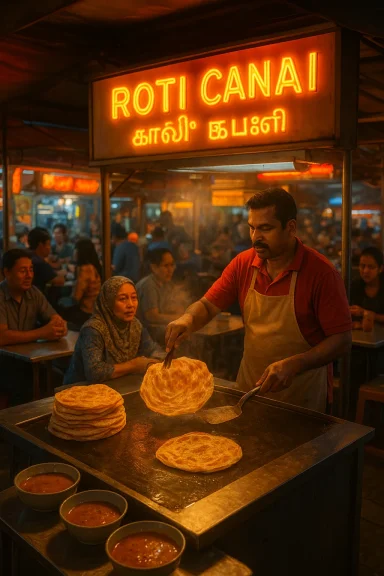
There is a short, sharp story making the rounds in Malaysia right now: a guest at a business dinner reportedly declared that roti canai is “low caste food,” a relic of slave diets made from cheap flour — and that thosai (dosa) is its refined, aristocratic counterpart. The anecdote went viral on social platforms, was republished as an opinion piece and reaction pieces followed within days, igniting a wider argument about food, identity, and who gets to claim national culture.
Background
Roti canai is one of Malaysia’s most visible street foods: a flaky, layered flatbread produced and sold at mamak stalls, hawker centres and roadside shops from Penang to Johor and across the Straits into Singapore. Its methods — a stretched, oiled dough slapped, spun and folded into sheets — make the finished product airy and layered, with a crisp exterior and tender interior. Over the last century roti canai has been transformed in Malaysia from an immigrant specialty into a national staple.The recent controversy began with a personal account that circulated on Reddit and was amplified by aggregators and tabloids. According to the post, an Indian national dining with colleagues claimed that roti canai was historically consumed by enslaved or indentured labourers and was therefore “low caste,” while thosai belonged to a higher social order. The post and the ensuing commentary provoked swift backlash online: for many Malaysians the idea that a working-class comfort food could be slotted into a rigid caste hierarchy felt alien, offensive and tone-deaf.
This article looks beyond the viral anecdote. It maps the factual record about roti canai’s origins and status, explains where caste narratives can plausibly emerge in diaspora contexts, evaluates the evidence for the more inflammatory claims, and argues why this skirmish matters for Malaysian public life and the global politics of food.
Anatomy of the viral claim
What was said — and how it spread
The narrative that roti canai is “low caste” appears to originate from a single reported encounter that went viral after being posted on social platforms. The claim resurfaced in opinion columns and tabloids, which repeated the account and framed it as a curious case of imported caste talk colliding with Malaysia’s multi-ethnic dining culture. The original poster said the visiting client described roti canai as food of slaves, made from cheap flour, and contrasted it with thosai as “aristocratic.” The piece that circulated on aggregators reproduced that anecdote as opinion.- The immediate social reaction was overwhelmingly dismissive. Threads on Reddit and comment sections framed the remark as either ignorant, malicious, or a projection of a different social logic onto Malaysian public life.
- Several local outlets republished the story or summarised the Reddit thread, which helped it reach a wider audience.
Why the claim gained traction
There are two reasons this specific anecdote lubricated so quickly through Malaysian social media.- Food is memetic: roti canai is everywhere in Malaysia — it’s a shared cultural touchstone across class lines — so any claim that reframes it as stigmatized touches a nerve.
- The idea of caste is transnational and emotive: even if caste hierarchies function differently in the Indian subcontinent and in its diasporas, any suggestion that caste logic is being imported into Malaysian workplaces raises alarms about social cohesion.
What the evidence actually shows about roti canai
Origins and evolution
- Roti canai is a South Indian–influenced flatbread that became distinctively Malaysian through local adaptation. Culinary historians trace its lineage to South Indian parotta/paratha traditions and credit 19th–20th century migrant labour and street vendors for transforming it into the roti canai we recognise today. Over time it accumulated Malaysian names, serving styles and local variants (roti tissue, roti kosong, roti banjir), and became ubiquitous in mamak culture.
- The etymology is similarly syncretic: “roti” is borrowed from Hindi/Urdu (meaning bread); “canai” likely arises from Malay canai (to knead/roll) or from Tamil/Malay pronunciations. The culinary scholarship does not support a direct and exclusive line connecting roti canai to a single caste or to a category of slave food.
- Global press profiles — from the Financial Times to mainstream food writers — have emphasised roti canai’s technical difficulty and cultural centrality rather than any class stigma. In recent years the bread has even been showcased internationally as a celebrated culinary craft.
Ingredients and production
Roti canai is typically made from white wheat flour (maida), water, fat (oil or ghee), and occasionally milk or condensed milk. The technique — repeated oiling, pulling, and folding — creates the flaky layers. Those production details do not inherently encode class status; similar ingredients and methods produce everything from artisanal layered breads to inexpensive street food worldwide. That roti canai can be both cheap and excellent is precisely the point: cost of ingredients does not equal cultural inferiority.Thosai (dosa) and the idea of “aristocratic” foods
Thosai (local spelling of dosa) is a fermented rice-and-lentil crepe with deep roots in South India. It is ancient in the sense of being a long-established regional dish and, like roti canai, has many variants (paper thosai, masala thosai, rava dosa). Across Malaysia thosai is commonly served in mamak restaurants alongside roti canai, and both are consumed at every social level. There is no established culinary evidence that dosa/thosai was historically exclusive to elites in South India in a way that would straightforwardly make it “aristocratic” in the Malaysian context.In short, elevating thosai to “aristocratic” status while discrediting roti canai as slave fare is not supported by mainstream culinary history. The two items come from different production traditions and ingredients (fermented batter versus layered dough), but both are popular and versatile in South Indian and Southeast Asian foodways.
Where the “slave” and “low caste” stories come from — and where they don’t
Indenture, labour migration and the afterlives of social hierarchies
It’s historically correct that many Indian migrants who arrived in British Malaya in the 19th and early 20th centuries worked on plantations or in low-paid labour roles. Scholarship on the Indian diaspora in Southeast Asia documents how indenture, debt and occupational segmentation left many migrants in precarious conditions; that history fuels contemporary sensitivities about class and marginalisation.But there are critical distinctions:
- Indenture under colonial regimes is not identical to chattel slavery, even if both systems involved coerced labour and appalling conditions. Scholarly work on indenture and mobility emphasises the complex relationship between caste, class and colonial labour regimes; it does not reduce migrant diets to clear caste categories that map neatly onto specific dishes.
- In many diaspora settings, caste identities were attenuated — occupational mixing, urbanisation and shared hardships often undermined rigid caste boundaries. Studies of Indian diasporas in Fiji, Malaysia and elsewhere show that caste persisted in some arenas (marriage, ritual) while weakening in others (work, street culture). This nuance matters when judging an offhand claim about “slave food.”
So: is the “Roti Canai = slave food” claim verifiable?
No — the blanket statement that roti canai was “food of slaves” is not supported by historical evidence of the kind that would justify such a sweeping moral tag. The flatbread’s origins are tied to South Indian parotta traditions and the Dawning of a Malaysian mamak culture; historians point to migration, adaptation and urban street-food dynamics rather than a single caste-specific provenance. Where indentured migrants ate bread made from cheap flour is plausible, but converting that plausible socioeconomic fact into a moral hierarchy that condemns the dish today is an unstable historical inference. Use caution when encountering such claims.Cultural analysis: why food becomes a proxy for class and identity
Food as social shorthand
Food is often read as shorthand for identity: what you eat signals region, religion, class, upbringing and taste. That shorthand is powerful because eating is visible and repeatable. It’s easy — but risky — to let cuisine stand in for a moral or social hierarchy.When someone insists a particular dish belongs to a lower caste, they’re not just making an observation about ingredients. They’re attempting to import a social taxonomy into a context where it may not apply. In multi-ethnic Malaysia — where food is a shared civic commons — such a move can feel like an act of social exclusion.
Migration changed food hierarchies
Culinary hierarchies evolve. A food considered humble in one era or place can become celebrated in another: think of how pizza, tacos, or ramen moved across social strata in different countries. Roti canai’s current ubiquity testifies to cultural recombination: immigrant cooking techniques adapted to new markets, tastes and modes of consumption, producing a dish enjoyed by office workers, students, politicians and late-night revellers alike. The very universality of roti canai is why the “low caste” label landed with such reverberation.The politics of calling something “low class” — social risks and consequences
1. Social cohesion and multicultural public spaces
Calling roti canai low caste in Malaysia risks importing divisive vocabularies into a public sphere that has deliberately cultivated multi-ethnic conviviality. Mamak stalls — often run by Indian Muslim communities but patronised by Malays, Chinese and others — are social spaces. Attempts to gatekeep those spaces through caste talk can fray everyday intercommunal life.2. Workplace dignity and microaggressions
The anecdote reportedly occurred in a business setting. When caste or status judgements appear between colleagues, they have the potential to create harm — embarrassment for the target, a chilling effect on cross-cultural collaboration, and reputational damage for the host organisation. Even if the claim is an ill-informed personal opinion, the workplace is where such remarks have institutional consequences.3. The risk of cultural policing
Labeling a beloved national dish as “low” can slide into cultural policing — elites prescribing which foods are appropriate for which classes. That dynamic erases the culinary creativity of vendor communities and can impose moral value judgments on inexpensive, labour-intensive foodways. Historically, some foods have been stigmatised because the people who produced them were marginalised; reversing that stigma requires public counter-narratives celebrating labour and taste.What responsible commentary should have done — a short checklist
- Verify claims before repeating anecdote-based morality. Anecdotes can be newsworthy; they should not be presented as historical truth without corroboration.
- Distinguish economic history (indenture, poverty) from rigid caste determinism. The two are related but not interchangeable.
- Acknowledge roti canai’s hybrid identity: it is Indian-rooted but thoroughly Malaysian in evolution and social use.
- Avoid moralising foods; focus on systems that create inequality instead (wages, migration policy, labour conditions).
- Use expert voices: historians, food anthropologists and community elders can explain the layered social history better than viral op-eds.
Strengths and weaknesses of the viral conversation
Strengths
- The debate forced a public discussion about how caste language can travel across borders and be weaponised in new settings. That’s a useful conversation to have: diaspora communities should reckon with imported hierarchies and how they interact with host societies.
- The backlash also showed the resilience of public opinion in Malaysia: thousands defended roti canai as part of national shared culture, refusing a simplistic caste framing. Social platforms hosted corrective narratives emphasising commonality and culinary pride.
Weaknesses and risks
- The viral format amplified an unverified anecdote into an ostensibly factual claim about history. That’s the perennial weakness of modern attention economies: a provocative assertion spreads faster than careful verification.
- The discussion risks oversimplifying two distinct but intertwined topics: the real historical harms of indenture and labour exploitation, and the separate cultural politics of caste. Conflating the two without nuance makes neither clearer.
- There’s a danger of normalising caste talk in contexts where it was historically weak. Repeating caste-based insults can give oxygen to regressive attitudes within workplaces and public life.
Practical takeaways for readers, journalists and community leaders
- For readers: if you encounter a sweeping historical claim in a thread or a viral opinion piece, pause. Ask: what is the source? Is there corroborating scholarship? For this episode, the claim that roti canai is “slave food” is not substantiated by mainstream culinary or migration histories.
- For journalists: verify anecdotes with historians or community elders; contextualise with migration and labour scholarship; avoid turning a single anecdote into a cultural verdict.
- For community leaders and employers: treat caste talk in the workplace as a potential HR issue when it appears. Educate staff on cultural sensitivity and the difference between personal opinions and institutional values.
- For cultural commentators: celebrate the technical craft of street foods — it’s often the labour of marginalised artisans that creates national culinary treasures. Elevating that labour is a more constructive response than policing taste.
Conclusion
The roti canai controversy is a small story with a big lesson. Food, especially in plural societies, is a social lubricant: it circulates easily across class, ethnic and religious boundaries. That very permeability is what makes a claim that a dish is “low caste” so inflammatory — it seeks to chain a communal practice to a divisive taxonomy.History and culinary scholarship do not support the absolutist claim that roti canai is a “slave food” or that thosai is inherently aristocratic. What we can say, with confidence, is that roti canai is a hybrid migrant creation that has been embraced across Malaysian society; it is an everyday example of cultural adaptation and shared civic taste. When historical grievances about the conditions of indenture and marginal labour exist, they deserve careful scholarly attention — not the blunt instrument of culinary moralising.
In public life, the right response to an imported caste-based insult is not to answer in kind, but to insist on accuracy, to affirm shared civic practices, and to redirect attention to the material conditions — wages, social mobility, representation — that actually produce inequality. Roti canai will continue to be flaky, golden and delicious; if anything, this controversy underlines how food remains one of the most intimate, resilient and democratic public goods we have.
Source: Newswav OPINION | Roti Canai is Low Class …
