

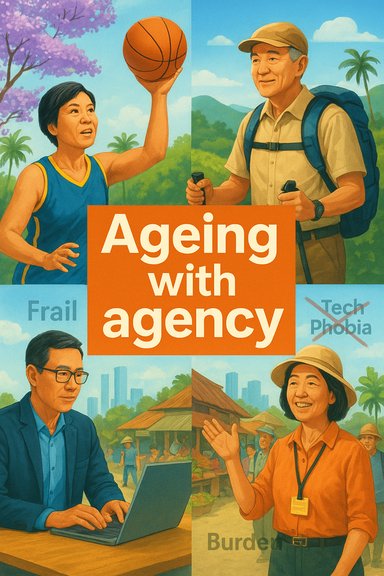
Not many Malaysians like being called “old,” and the language around ageing in Malaysia — as in many places — is loaded with assumptions that are often demeaning, patronising and plainly false; a recent feature in a national newspaper collected four firsthand accounts from Malaysians in their 50s to 60s that lay bare how everyday interactions, workplace expectations and family dynamics keep ageist myths alive while sidelining a more accurate, useful story about ageing.
Background: why this conversation matters now
Malaysia is not talking about ageing as an abstract demographic issue — it is living the transition. The nation’s official statistics show a steady rise in the share of older adults: the proportion of people aged 60 and above rose to about 11.6% in 2024 and is projected to reach roughly 17.3% by 2040. By mid-century, the cohort will form an even larger share of the population. These demographic shifts are reshaping labour markets, healthcare demand, social services and family structures across the country. Ageing is also an urgent policy and social issue because ageism — negative stereotypes, prejudice and discrimination based on age — has measurable harms. International health bodies and academic reviews link ageist attitudes to poorer physical and mental health, reduced access to care, higher social isolation and measurable costs to societies. Tackling ageism is therefore not only a matter of fairness, but of public health, workforce policy and economic resilience.Overview of the newspaper feature: lived experience meets myth-busting
The Star’s piece presents five common ageist stereotypes and follows them with the lived responses of four Malaysians — a 56‑year‑old marketing director, a 64‑year‑old hiker, a 68‑year‑old freelance tour guide and a 55‑year‑old entrepreneur — who reject those labels in distinct but resonant ways. The stereotypes covered are:- Old means weak or frail
- Older people can’t keep up with technology
- Retirees are unproductive or “over the hill”
- Older adults are invisible and undesirable, especially in matters of romance and appearance
- Seniors are a burden on family and state
What the evidence shows — separating stereotype from fact
The lived experiences in the feature match broad evidence and data on several fronts: demography, health impacts of ageism, digital inclusion, economic opportunity and social attitudes. Below, each stereotype from the feature is checked against empirical findings and policy context.Stereotype 1 — “Old means weak or frail”
- Reality check: While some physiological changes occur with age, physical capacity varies enormously across individuals and is influenced by lifestyle, chronic disease management, access to preventive care and social determinants of health. Many older adults remain highly active well into their 70s and beyond; structured exercise, rehabilitation and public‑health interventions can preserve strength and mobility for years. Anecdotes of people who hike, coach sports or lead walking tours are consistent with this heterogeneity.
- Policy and practical implication: Presuming fragility can reduce agency and discourage activity, paradoxically increasing the risk of deconditioning and poorer outcomes. Communities and clinicians should assess functional status rather than relying on chronological age as a proxy.
Stereotype 2 — “Older people can’t keep up with technology”
- Reality check: The “technophobic senior” is an increasingly obsolete image. Ownership and use of smartphones and internet services among older cohorts has risen globally since 2010; adoption varies by income, education and prior workplace exposure, but many older adults are comfortable using digital tools for communication, commerce and content creation. In Malaysia, research and commission surveys show a persistent digital divide for older groups, especially among the oldest and lower‑income seniors, but also reveal important gains and substantial heterogeneity in digital engagement. The barrier is often how technology is taught and whether services are designed with older users in mind.
- Practical implication: Condescension and impatience when teaching technology matter. Design and training that respect older learners’ learning style and motivations close the gap far faster than simply pushing devices at them.
Stereotype 3 — “Unproductive and ‘over the hill’”
- Reality check: Retirement is not an end-of-contribution for most people. Many older adults move into mentoring, gig work, entrepreneurship and consultancy, bringing domain expertise, social capital and networks that younger cohorts lack. Economists increasingly refer to the “silver economy” as a space of opportunity — extended healthy lives can support prolonged labour force participation and new markets for products and services geared to an older population. The IMF and other international agencies now emphasise policies that enable longer working lives, reskilling and flexible work arrangements.
- Policy implication: Governments and employers should shift from age‑based exclusion to capability‑based roles, restructure retirement incentives and invest in lifelong learning to harness this talent pool.
Stereotype 4 — “Seniors are invisible and undesirable”
- Reality check: Social norms about beauty, desirability and worth are culturally assigned and mutable. Many older adults deliberately reject invisibility, dressing and partnering on their own terms. The harm arises when institutions — media, marketing, workplace promotion — default to youth as the standard for relevance and attractiveness. This is a social bias, not a biological rule.
- Social implication: Visibility matters. Representation of older adults in advertising, leadership and public life normalises ageing as a continuing stage of achievement and desire rather than decline.
Stereotype 5 — “A burden on family and state”
- Reality check: The narrative of seniors as dependents is incomplete. While some older adults need substantial support, many are independent and prioritize financial and residential autonomy to avoid imposing on children. In cultures with strong filial norms, the assumption that all older adults expect or desire dependency is particularly stigmatising. From a policy perspective, framing seniors as contributors rather than costs opens space for intergenerational contracts that balance care responsibilities, fiscal sustainability and personal autonomy.
Strengths of the Star piece: why human voices matter
- Human grounding: The piece places lived experience front and centre — the single most effective way to dismantle stereotypes is to show counterexamples that readers can relate to. Personal stories (basketball courts, hiking, heritage walks) puncture abstract assumptions.
- Nuanced framing: Instead of denying that ageing involves change, the article reframes ageing as a shift — a useful conceptual move that aligns with gerontology and labour economics. It emphasises agency, not denial.
- Practical tone: The interviewees offer concrete behaviours — staying physically active, learning new tools, launching businesses — that readers can model. This aligns with evidence that positive self‑perception of ageing improves health outcomes.
Gaps and risks: where the narrative could be stronger
While the feature is valuable for public conversation, several limitations are worth noting — not to diminish the piece but to guide how newsrooms, policymakers and community leaders use such stories.1) Selection bias and visibility of privilege
The four interviewees are articulate, active and relatively independent. Their experiences are real and instructive, but they do not represent the most marginalised older adults — those with serious chronic illnesses, cognitive impairment, poverty or social isolation. Relying only on exceptions risks creating a counter‑stereotype that obscures structural needs.2) Policy and systemic drivers receive short shrift
Personal agency matters, but so do structural supports: pensions, universal healthcare access, age-friendly housing, accessible transport and targeted digital literacy programs. A human-interest piece can inspire, but it cannot substitute for the policy analysis required to scale opportunity and mitigate risk.3) Understated intersectionality
Ageism interacts with gender, ethnicity, disability and class. For example, older women often report more invisibility and economic insecurity than men; rural older adults face different barriers than urban ones. A fuller account would probe how stereotypes hit different groups unequally.4) Economic and environmental shocks
The piece optimistically highlights continued productivity among seniors. That remains plausible — but macroeconomic shocks, healthcare capacity limits, climate change effects (for example, heat exposure risk among older adults), and labour market disruption from automation can all alter the promise and risk calculus. Policy must anticipate these structural stressors.Practical recommendations: moving from myth-busting to systems change
Drawing on the article’s insights and on international evidence, the following are practical, evidence‑based steps that Malaysian communities, employers and policymakers can adopt to reduce ageism and better support an ageing population.Design and service delivery
- Build assessments around function rather than chronological age in healthcare and employment decisions. Train professionals to use functional measures (mobility, cognition, ADLs) before assuming incapacity.
- Adopt universal design principles in public digital services (font size, voice interfaces, simple flows) to close the digital divide. Offer patient, peer‑led training for older learners rather than purely tech‑schooled instruction.
Workplace and economy
- Redesign jobs to recognise mentorship, advisory roles and flexible hours as promotable career tracks.
- Invest in lifelong learning credits and reskilling funds for workers over 50 to maintain employability.
- Remove automatic age cutoffs for training and certification eligibility; base access on competence and role requirements.
Health and social care
- Educate clinicians and caregivers on ageism’s harmful impacts and on alternatives to age‑based rationing. Public health campaigns that promote positive images of ageing can reduce internalised ageism and improve mental health outcomes.
Media and culture
- Normalize older people’s visibility in advertising, mainstream programming and policy fora. Showcase diversity of ageing experiences — including stories of continued romance, entrepreneurship and creativity — to shift social norms away from decline narratives.
Risks to watch: where well‑meaning moves can backfire
- Tokenism: Representing older adults only as inspirational exceptions can obscure structural failures and lead to complacency. Policy must match rhetoric with measurable investments (pensions, primary care, transport, digital access).
- Technology without support: Rolling out digital services is valuable, but doing so without accessible interfaces and teaching will widen inequality. Investments in community digital hubs and intergenerational training yield higher returns than device‑only handouts.
- Labor policy mismatches: Encouraging longer working lives without adjusting social protections, anti‑discrimination enforcement and flexible workplace arrangements risks shifting burdens onto older workers rather than enabling choices. Carefully designed incentives and legal protections are required.
A short roadmap for newsroom coverage that pushes change
Public journalism can move the needle on ageism by following three editorial principles:- Balance personal stories with system analysis: human voices matter, but pair them with data and clear policy pathways.
- Use inclusive sourcing: quote older people with diverse incomes, health statuses and geographic locations to avoid privileged narratives dominating the discourse.
- Measure impact: reporters and editors should track whether storytelling leads to concrete actions — policy reviews, community programs, employer commitments — and follow up.
Conclusion: a new narrative about ageing — started, not finished
The Star’s feature matters because it confronts everyday prejudices with practical counterexamples, and it invites readers to see ageing as a period of shift rather than a sudden loss. That local, human storytelling aligns with international evidence: ageism is harmful, but it is also addressable. With Malaysia’s rapid demographic transition now visible in official data, the stakes are high and practical: policies, workplaces and communities must evolve to protect dignity, harness experience and reduce unnecessary exclusion. The path forward blends personal agency and systemic reform — more representation in media, better design of services, function‑based clinical and workplace decisions, and public investments that enable older adults to continue contributing on their own terms. The conversation that began in those four interviews should be the starting line for broader structural changes that let older Malaysians — and older people everywhere — grow better, not merely older.Source: The Star | Malaysia Breaking down ageist stereotypes
