

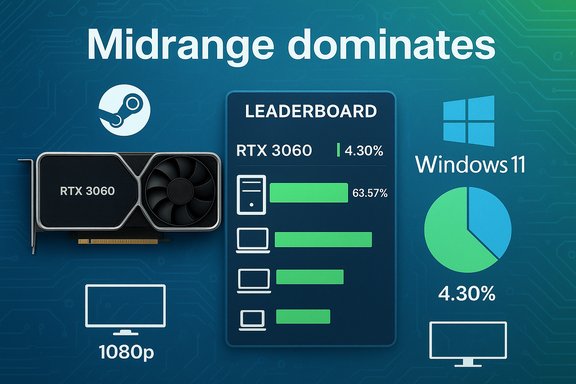
Valve’s October 2025 Steam Hardware & Software Survey shows the NVIDIA GeForce RTX 3060 back at the head of the GPU leaderboard while Windows 11 continues to consolidate its position among Steam users — a snapshot that tells a larger story about midrange dominance, laptop market dynamics, and how supply, pricing and OEM defaults still shape what gamers actually run.
Background
The Steam Hardware & Software Survey is Valve’s monthly, optional telemetry snapshot taken from active Steam clients. It’s a high-signal dataset for the gaming segment specifically: frequent upgraders, prebuilt buyers, and enthusiasts are overrepresented, so the survey is a robust indicator of gamer-facing trends, but not a direct proxy for global desktop market share. This framing matters because the survey’s numbers steer developer decisions, OEM planning, and media narratives even as they remain subject to short-term volatility and classification quirks.- Valve’s data is monthly and voluntary; participation rates and sample composition can produce month-to-month swings.
- The survey reports device-level telemetry such as OS version, GPU make/model, CPU vendor, RAM, and common display resolutions.
- Steam’s audience skew — active gamers — tends to be upgrade-prone and therefore often leads broader desktop adoption curves.
What Valve reported in October 2025
Key headline figures
- Most popular GPU (October 2025): NVIDIA GeForce RTX 3060 — 4.30% of the Steam sample, making it the single most common discrete GPU reported in October.
- Windows 11 (64-bit): 63.57% of Steam respondents in October, showing continued migration to Microsoft’s latest consumer OS.
- Intel vs AMD (CPU vendor split): Intel retains a majority in the Steam sample but AMD’s presence remains strong and has shown periodic gains over 2025. Independent coverage and community analyses have highlighted AMD’s improved standing among gamers, largely owing to X3D variants and strong single-thread and gaming performance in many titles.
Confirming the “reclaim” claim
The characterization that the RTX 3060 “reclaims” the top spot is supported when comparing September and October data: in September, laptop variants of the RTX 4060 family were frequently reported at or above the 3060’s share in some filtered views, while October’s full-table values place the RTX 3060 back at the top of Valve’s overall discrete-GPU table. Community posts and outlet breakdowns that compared monthly snapshots confirm this flip-flop. In short: the 3060’s return to #1 is real but modest in absolute terms — measured in tenths of a percentage point — and therefore highly sensitive to sample noise.How we verified the numbers
To ensure accuracy and context:- The October 2025 figures were read directly from Valve’s official Hardware & Software Survey pages for the month (the interactive Steam tables and summary show GPU and OS percentages).
- Independent PC hardware outlets (including TweakTown and VGTIMES) published roundups that matched Valve’s topline placements and highlighted the RTX 3060’s position and Windows 11’s growth. These reports mirror Valve’s raw table and provide useful editorial interpretation.
- Community aggregators and forum threads (Reddit, Steam community posts, and archived discussion on enthusiast forums) were used to verify month-to-month movement and to capture reader reaction and deployment context. Those conversations also surfaced the usual caveats about laptop vs desktop SKU separation and Steam’s sample bias.
Why the RTX 3060 regained the lead — three forces at work
There’s no single reason the RTX 3060 rose to the top in October, but a short list of interacting market forces explains the outcome.1) Midrange economics and lingering installed base
The RTX 3060 occupies the sweet spot for mainstream gamers: good performance at 1080p/1440p, mature drivers, and widespread OEM and secondhand availability. Many buyers prioritize price-to-performance over bleeding-edge features; that inertia preserves midrange SKUs’ prominence even as newer SKUs arrive. Steam’s data consistently shows xx60/xx70 class cards dominating the top slots, which is a market signal developers and OEMs watch closely.2) Laptop GPU dynamics and SKU classification
A significant wrinkle in Steam tables is the separation of laptop and desktop GPU entries. Laptop SKUs for the same architecture (e.g., RTX 4060 Laptop GPU) can appear separately and sometimes rank higher than desktop equivalents during OEM refresh cycles. That churn explains why an RTX 4060 Laptop SKU may lead in one month while a desktop-focused 3060 leads in another; shipments of new laptop models can temporarily tilt the sample. October’s numbers show the 3060 as the top discrete model overall, but laptop GPU movements remain a critical influence.3) Supply, pricing and the long tail of used hardware
Even after multiple GPU generation refreshes, the used and OEM channels remain thick with previous‑generation midrange cards. Price drops, game bundles, or retailer promotions often push a widely compatible card like the RTX 3060 back into purchase consideration. Meanwhile, supply or regional allocation issues can hamper adoption of newer models. Coverage of AMD’s RDNA 4 and Intel’s entry efforts suggests supply constraints (or classification quirks) have kept some newer SKUs from meaningfully displacing established favorites.Windows 11: the other big story in October
Valve’s October table shows Windows 11 at 63.57% of Steam respondents — a clear majority within the gaming sample. This growth is functionally driven by two major factors:- Microsoft’s end-of-support deadline for Windows 10 compressed upgrade decision-making for many users, pushing upgrades and new purchases toward Windows 11.
- New OEM systems and laptop fleets shipping with Windows 11 by default; gaming laptop refreshes in late summer and early fall accelerate the OS share shift.
Cross-referencing: what other outlets and communities said
- TweakTown’s October roundup called out the RTX 3060’s return to the top and traced the broader chart movements across Nvidia’s midrange families and the emerging RTX 50-series momentum. Tech outlets used Valve’s exact table values and added interpretive context about supply and SKU confusion.
- VGTimes and similar outlets echoed Valve’s headlines, emphasizing Windows 11’s surge and the continuing dominance of midrange Nvidia cards while noting modest month-to-month percentage shifts.
- Tom’s Hardware and other industry press have contextualized AMD’s CPU gains during 2025 and the GPU landscape more broadly; these outlets help explain why CPU vendor mix and GPU lists matter to developers and OEMs.
Practical implications for stakeholders
For PC gamers and buyers
- Buying guidance: For 1080p and many 1440p gamers, the midrange class (RTX 3060 / RTX 4060 families) remains the best value point. The Steam sample’s dominance of these models is a clear market signal.
- Laptop vs desktop trade-offs: Laptop SKUs often drive short-term leaderboard movement; if you’re shopping, compare desktop and laptop variants carefully for thermals and performance per watt rather than relying on name alone.
For developers and QA teams
- Target hardware envelope: With most Steam users still on midrange GPUs and 16 GB of RAM common, developers should optimize default settings for that envelope and make higher settings optional. Upscaling technologies like DLSS/FSR remain essential to reach the broadest audience.
For hardware vendors and OEMs
- SKU planning: OEM laptop refresh cycles materially affect Steam’s leaderboard. Manufacturers that control power/thermal trade-offs at a good price point will continue to shape the installed base.
- Driver and feature support: Nvidia retains a commanding lead on Steam; vendors must sustain driver quality and feature parity to avoid erosion. AMD and Intel’s roadmaps are relevant but slow to move the needle without strong supply and OEM adoption.
Risks, caveats and things to watch
Sample bias and short-term volatility
Valve’s survey is voluntary and gamer-centric; month-to-month swings can be influenced by new laptop shipments, retail promotions, or sampling variance. Small percentage point changes should be interpreted as directional rather than definitive. Analysts and vendors should look at rolling 3–6 month trends rather than a single snapshot before declaring market winners and losers.Model naming, SKU split, and misclassification
Steam’s detection depends on driver and device reporting. Laptop vs desktop variants and generic entries like “AMD Radeon Graphics” can create ambiguity. That’s why some new RDNA 4 models appear under “Other” or are missing from the top 100 lists in press summaries: either supply is limited or device reporting isn’t granular enough yet. Treat model-level rank claims with this context in mind.Supply and regional effects
Vendor supply constraints or regional allocation policies can meaningfully delay new SKU adoption. Steam’s survey reflects what users actually have, not unmet demand. For example, coverage noted that some AMD RDNA 4 cards haven’t made a meaningful top-100 appearance despite reported demand, a discrepancy likely linked to production and distribution, not design shortcomings.Unverifiable or weak claims
- Claims that a specific SKU “dominates globally” should be treated cautiously; Steam’s gamer sample does not equal global installed base. Where a claim is solely based on secondary commentary or on partial filters of Valve’s tables, it has been flagged in reporting as less robust. These ambiguous or sensational claims are explicitly called out in Valve community threads and must be treated with skepticism until corroborated by wider-market trackers.
What to watch next
- Post‑EOL migration effects (Windows 10): Monitor November–December Steam snapshots to see whether Windows 11’s share continues to climb as late upgraders finish migrations and OEM holiday PC sales propagate into the installed base.
- RTX 50‑series momentum: Early signs show RTX 50-series SKUs gaining traction in the last quarters; watch whether supply improves and whether those SKUs displace midrange 40/30-series cards on longer horizons.
- AMD RDNA 4 adoption patterns: If AMD’s RDNA 4 cards remain underrepresented in subsequent Steam snapshots, it will be important to determine whether the cause is supply or reporting/classification issues.
- Laptop refresh cycles: OEM laptop launches (especially in late Q4) often rework the Steam GPU leaderboard. Keep an eye on laptop SKU percentages in Valve’s breakout views.
Final analysis: what the October snapshot actually means
Valve’s October 2025 survey is less a declaration of long-term market victory and more a high-resolution snapshot of a gamer-focused market in motion. The return of the RTX 3060 to the top of the discrete list is meaningful because it reinforces the midrange card’s central role in the gaming ecosystem — it’s the pragmatic choice for the majority of Steam’s active players. At the same time, Windows 11’s majority share on Steam underscores an OS migration that will reshape development and QA matrices over the coming year.The underlying narrative is one of continuity rather than disruption: midrange GPU classes lead, laptop SKU cycles cause short-term leaderboard oscillations, OEM shipping defaults accelerate OS adoption, and supply/pricing still trump pure benchmarks when it comes to what people actually use. For developers and vendors, the practical takeaway is straightforward:
- Optimize for the midrange performance envelope.
- Make advanced graphical features optional or scalable.
- Track laptop SKU movement and regional supply to anticipate short-term installed-base shifts.
Conclusion
October’s Steam Hardware & Software Survey is a reminder that the PC gaming mainstream prizes balance: accessible price, solid performance, and broad driver maturity. The RTX 3060’s return to the top spot underscores how midrange economics and installed bases shape the real world of gaming hardware. At the same time, Windows 11’s majority position within Steam signals an ecosystem shift that developers, publishers, and hardware makers must accommodate in their roadmaps. Interpreting Valve’s monthly snapshots requires nuance — verify, cross-check, and prioritize multi-month trends — but the October 2025 data paints a consistent picture: gamers are upgrading on their own terms, and the midrange remains king.
Source: Пепелац Ньюс https://pepelac.news/en/posts/id8864-steam-hardware-survey-oct-2025-rtx-3060-reclaims-top-spot/
