

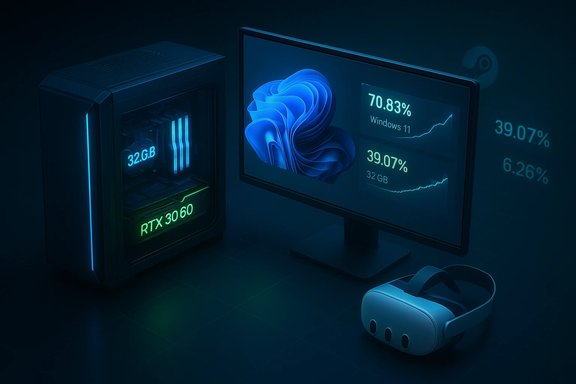
Steam’s December 2025 Hardware Survey delivered a clear — and somewhat abrupt — message: Windows 11 is now the dominant OS among Steam users, vaulting to 70.83% of respondents in the month’s survey while Windows 10 receded and Linux’s slow momentum stalled. The survey also captured consequential shifts in hardware: 32 GB of system RAM is closing in on parity with 16 GB, NVIDIA’s RTX 3060 is the single most common GPU in the Steam sample, and Meta’s Quest 3 sits at the top of SteamVR’s device list — but the numbers require careful reading to separate absolute gains from relative ones. These changes are important for developers, hardware makers and enthusiasts because the Steam Hardware & Software Survey informs purchasing decisions, driver support priorities and the public narrative around platform health.
Steam’s monthly Hardware & Software Survey is voluntary and opt-in; each month Valve samples a subset of active Steam users and reports aggregated device-level telemetry such as OS version, GPU model, RAM capacity, VR headsets and display resolutions. Because participation is optional and the respondent pool skews toward actively gaming users, the survey is not a census of all PCs but it is a widely used industry barometer that often foreshadows broader adoption trends. Read directly, the survey is raw telemetry — useful only when readers accept the sample bias and the small-month volatility that naturally follows a voluntary survey.
Finally, readers should treat Steam’s monthly numbers as a directional, not definitive, measurement: they are powerful when corroborated over multiple months and when media parsing respects the difference between absolute share‑point shifts and relative percent changes. For now, December 2025 reads as a month of accelerated Windows‑11 migration and incremental hardware upgrading — an important data point as the wider ecosystem digests Windows 10’s end of support and the industry continues its steady churn toward newer platforms and components.
Source: Windows Central https://www.windowscentral.com/gami...ges-among-pc-gamers-on-steam-as-linux-stalls/
 Background
Steam’s monthly Hardware & Software Survey is voluntary and opt-in; each month Valve samples a subset of active Steam users and reports aggregated device-level telemetry such as OS version, GPU model, RAM capacity, VR headsets and display resolutions. Because participation is optional and the respondent pool skews toward actively gaming users, the survey is not a census of all PCs but it is a widely used industry barometer that often foreshadows broader adoption trends. Read directly, the survey is raw telemetry — useful only when readers accept the sample bias and the small-month volatility that naturally follows a voluntary survey. What the December 2025 survey actually shows
A big month for Windows 11 — the numbers
- Windows 11 (64-bit): 70.83% of Steam respondents, a month-over-month increase of +5.24 percentage points.
- Windows 10 (64-bit): 26.70%, down -2.36 percentage points.
- All Windows versions combined: 94.95% of the Steam sample.
- Linux: 3.19% of Steam respondents, a slight decline of -0.01 percentage points from the previous month.
Why the surge happened: EOL and device churn
Two proximate explanations explain why many users moved to Windows 11 in December:- Microsoft formally ended mainstream support for Windows 10 on October 14, 2025. That decision increased urgency for users who were delaying migration for security and support reasons, and it appears the migration wave carried into the late-2025 months. Microsoft’s support lifecycle notice and guidance urged upgrades (and offered Extended Security Updates for consumers on eligible devices), creating both a policy push and a messaging tailwind.
- The holiday purchasing window and the growing availability of Windows-based handhelds and portable gaming PCs likely contributed fresh Windows 11 installs — systems that ship with Windows 11 pre-installed or that ship on hardware clearly capable of running Windows 11. Models like the ASUS/ROG and Lenovo handhelds received attention through late 2025 and could have nudged the platform share upward as new devices join the Steam user base. This is plausible from the device trend and market cadence, though Steam’s telemetry itself does not attribute OS changes to particular hardware families.
Linux: stalled progress, but not uniform decline
Linux’s presence on Steam — a frequent talking point since the rise of Steam Deck and Proton — remained essentially flat in December, nudging down by only 0.01 percentage points to 3.19%. That is not a reversal in the long-term trend for certain distributions, but it is a pause in Linux’s gradual gains on Steam overall. SteamOS and Steam Deck-driven interest continues, and a number of Linux distributions still reported small gains within that pool, but the headline number shows a stall at the aggregate level. Important nuance: Valve’s SteamOS (and derivatives) account for a meaningful slice of Linux usage on Steam, yet the total Linux share remains tiny relative to Windows. Also, the sample biases of the survey — plus anti-cheat and driver compatibility concerns for some titles — limit how far these numbers can be used to judge the viability of Linux as a mainstream gaming platform. When reporting Linux figures, always treat small month-to-month deltas as noisy unless they reflect longer-term trends over several consecutive months.Memory and the “32 GB standard” shift
One of the clearest hardware shifts in the December survey is RAM capacity:- 32 GB systems rose to 39.07% of respondents, up +2.11 percentage points.
- 16 GB systems dropped to 40.14%, down -0.80 percentage points.
- 32 GB adoption affects how developers set default texture and cache targets.
- For PC vendors and memory makers, a real shift to 32 GB alters inventory and marketing strategies.
- Memory pricing volatility can accelerate upgrades as enthusiasts buy proactively when they see price trends or promotions.
GPU landscape: RTX 3060 tops the list, mobile GPUs remain huge
December’s GPU breakdown is unambiguous in the Steam telemetry:- NVIDIA GeForce RTX 3060 (desktop) is now the most common single GPU in the Steam sample with 6.26% share, a notable month-over-month gain.
- The RTX 4060 Laptop GPU remains highly represented at 5.50%, but trailing the 3060 in the December snapshot.
- Developers targeting the “average” Steam GPU can tune settings for the RTX 3060-class experience and expect good reach.
- Drivers and vendor support still matter: mobile GPU variants frequently differ in performance and driver packaging, creating optimization headaches for some studios.
VR: Quest 3 at the top — but read the change metric carefully
Steam’s VR panel in December shows Meta Quest 3 as the most common headset among Steam VR users, with 27.58% of the SteamVR headset share, compared to 24.84% for Quest 2. That places Quest 3 roughly 2.7 percentage points ahead in absolute terms. Steam also reports a small absolute-point rise month-over-month for Quest 3 in December. Important reporting clarity: some outlets described the Quest 3’s change using relative percentage growth (e.g., “Quest 3 usage increased by ~24%”), while Steam’s public table lists absolute percentage-point changes (for example, +0.45 percentage points). Both descriptions are mathematically valid but measure different things. Steam’s +0.45 is the change in share points; a 24% figure would be the relative growth compared to the prior month’s share. Misreading one for the other produces misleading headlines. The safe approach is to report both figures distinctly: absolute (percentage points) and relative (percent change from previous value) so readers understand the difference. Key context:- Steam counts headsets used with Steam (via Air Link, Virtual Desktop, or native SteamVR apps). Standalone usage of Quest devices that never connect to Steam is invisible to this survey.
- Steam’s VR user base remains a small slice of the total Steam audience, but the hardware mix heavily favors Meta’s ecosystem at present.
How reliable are these numbers? Understanding volatility and bias
The Steam Hardware Survey is highly valuable but not infallible. Consider these constraints:- The survey is optional and samples a subset of Steam users; therefore month-to-month swings can reflect sampling variance as much as real market movement.
- Absolute percentage-point changes and relative percent changes are often conflated by media and commentary, producing headlines that overstate the underlying shift. Always check whether a reported “+24%” refers to relative growth or absolute share-point change.
- Steam’s audience is not representative of all PCs; it tilts toward active, often higher-performance gamers who update hardware more frequently than the general PC population. Decisions by OEMs and Microsoft about Windows support still have much broader population impacts that won’t be fully visible in Steam’s sample.
What this means for developers, hardware vendors and enthusiasts
- Developers: The continuing march toward Windows 11 dominance means focusing QA and compatibility testing primarily on Windows 11 configurations. The near‑parity of 16 GB and 32 GB memory configurations suggests shipping settings should default to 16 GB minimum but offer optimized presets that assume 32 GB is common in the enthusiast segment.
- Anti-cheat and middleware teams: Steam’s tiny but meaningful Linux numbers and the increasing use of standalone VR headsets remind middleware vendors that cross-platform compatibility and driver behavior matter — but also that Windows remains the priority for the majority of players. Testing fleets should reflect Steam’s device composition.
- Hardware vendors and component suppliers: The RAM and GPU trends are signals. A sustained increase to 32 GB as a de-facto standard would change BOM strategies and channel messaging. GPU vendors should note that mid-range cards like the RTX 3060 continue to dominate actual usage, even as newer generations enter the market.
- Enthusiasts and buyers: If your goal is maximum compatibility and longevity, upgrading to Windows 11 and targeting 32 GB RAM in a build are defensible choices. However, buyers of lower-end or older systems may find Extended Security Updates or alternative OS strategies (including Linux where feasible) a reasonable short-term path. Microsoft’s EOL announcement and guidance remain the reference for that decision.
Notable strengths and risks in the data
Strengths
- Direct telemetry: Steam’s data originates from live user systems and reports actual hardware and OS values, not survey recollections. That gives it high practical relevance to gaming workloads.
- Granularity: The survey lists device models, memory steps and driver/feature support flags — enabling targeted analyses (e.g., mobile vs desktop GPUs, VR headset mix).
Risks and pitfalls
- Over-interpreting short-term noise: Single-month spikes (such as the 5.24-point Windows 11 jump) can be a function of new-device onboarding or sample variation. Treat abrupt monthly jumps as suggestive rather than definitive without multi-month confirmation.
- Confusing absolute and relative metrics: Reporting should avoid phrases like “Quest 3 increased by 24%” unless explicitly clarifying that that is relative growth; Steam’s tables usually show percentage-point changes, not relative percent gains. Misreading these metrics produces misleading headlines.
- Survey coverage limits: Steam doesn’t count untethered device usage that never touches Steam — i.e., stand-alone headset play that avoids PC tethering or cloud streaming is invisible — meaning VR adoption may be underreported for platforms that pivot toward standalone consumption.
Quick takeaways — what to watch next
- Will Windows 11’s share hold above 70%? Watch January and February snapshots to confirm whether December’s jump was a durable wave from EOL-driven upgrades or a one-off surge compounded by holiday device activations.
- Is 32 GB the new norm? If 32 GB continues to grow month-to-month and surpasses 16 GB in the next quarter, publishers should make 32 GB the default testing target for high settings.
- GPU makeup stability: The RTX 3060’s top spot suggests installed base stability for mid-range cards; follow the next few months to see how newer RTX 50-series SKUs filter into the sample.
- VR adoption nuance: Meta’s Quest 3 leading the headset list on Steam is noteworthy, but Steam’s VR user pool is still a small share of the total install base. Track total VR penetration and whether Steam’s VR-user percentage grows meaningfully beyond small monthly hops.
Conclusion
Valve’s December 2025 survey painted a familiar picture with a few decisive shifts: Windows 11’s sudden majority share on Steam, the accelerating adoption of 32 GB RAM, and continued dominance of NVIDIA mid-range GPUs. These are not game‑ending revelations, but they are concrete signals that the gaming PC base — at least the active, Steam‑participating segment — is moving toward newer OSes and more capable hardware. The practical lessons are straightforward: prioritize Windows 11 compatibility, bake 32 GB scenarios into high-end presets, and recognize that mid-range GPUs like the RTX 3060 still represent the “average” gamer’s lived reality.Finally, readers should treat Steam’s monthly numbers as a directional, not definitive, measurement: they are powerful when corroborated over multiple months and when media parsing respects the difference between absolute share‑point shifts and relative percent changes. For now, December 2025 reads as a month of accelerated Windows‑11 migration and incremental hardware upgrading — an important data point as the wider ecosystem digests Windows 10’s end of support and the industry continues its steady churn toward newer platforms and components.
Source: Windows Central https://www.windowscentral.com/gami...ges-among-pc-gamers-on-steam-as-linux-stalls/
