

Rubrik’s Agent Cloud integration with Microsoft Copilot Studio signals the arrival of a practical control plane for the fast-growing—but still immature—world of enterprise AI agents, promising automated discovery, real-time governance and a novel “selective rewind” remediation capability that aims to let IT undo agent-driven mistakes without full restores.
Microsoft’s Copilot Studio has evolved into the enterprise hub for building, publishing and operating AI agents that can read tenant data, call connectors, and write back changes across Microsoft 365, Dataverse, SharePoint and other systems. The platform now assigns agents directory-grade identities (Microsoft Entra Agent ID), supports single sign-on and runtime threat-integration hooks, and exposes instrumented logs and analytics intended to make agents visible to security and IT teams. Rubrik’s announcement positions Rubrik Agent Cloud as an enterprise-grade AgentOps control plane: discover agents across Copilot Studio and other builders, continuously monitor data access and actions, enforce behavior and access policies in real time, and remediate unwanted changes using Agent Rewind, a selective rollback capability that Rubrik says is integrated with its Security Cloud. Rubrik frames the product as “beyond observability” — shifting the value from detection-only to detection plus recovery. This article explains what Rubrik claims, verifies the major technical assertions against Microsoft documentation and independent coverage, evaluates the practical benefits and risks for Microsoft Copilot Studio customers, and provides an operational checklist for IT and security teams planning to enable agentic AI at scale.
At the same time, competing security vendors are building runtime guardrails and DLP integrations; several have publicized Copilot Studio ties that focus on blocking or inline prevention rather than recovery. Organizations will likely adopt layered defenses: prevention at the runtime level, observability and auditing for incident detection, and targeted recovery for fast remediation. Rubrik’s Agent Cloud fits neatly into that layered approach if and only if it can demonstrate robust, repeatable rollback semantics across typical enterprise data domains.
For enterprise teams, the pragmatic path is clear:
Rubrik’s message is a welcome injection of operational realism into the agentic AI conversation: automation accelerates risk as much as it does productivity, and the firms that combine observability, layered controls and fast, precise remediation will be the ones that let organizations scale agentic AI with confidence rather than fear.
Source: Scoop - New Zealand News Business.Scoop » Rubrik Agent Cloud Supercharges Secure Agentic AI Deployments For Microsoft Copilot Studio
 Background / Overview
Microsoft’s Copilot Studio has evolved into the enterprise hub for building, publishing and operating AI agents that can read tenant data, call connectors, and write back changes across Microsoft 365, Dataverse, SharePoint and other systems. The platform now assigns agents directory-grade identities (Microsoft Entra Agent ID), supports single sign-on and runtime threat-integration hooks, and exposes instrumented logs and analytics intended to make agents visible to security and IT teams. Rubrik’s announcement positions Rubrik Agent Cloud as an enterprise-grade AgentOps control plane: discover agents across Copilot Studio and other builders, continuously monitor data access and actions, enforce behavior and access policies in real time, and remediate unwanted changes using Agent Rewind, a selective rollback capability that Rubrik says is integrated with its Security Cloud. Rubrik frames the product as “beyond observability” — shifting the value from detection-only to detection plus recovery. This article explains what Rubrik claims, verifies the major technical assertions against Microsoft documentation and independent coverage, evaluates the practical benefits and risks for Microsoft Copilot Studio customers, and provides an operational checklist for IT and security teams planning to enable agentic AI at scale.What Rubrik announced — the claims in plain language
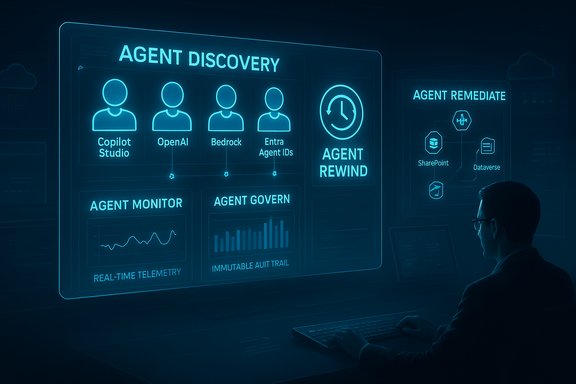
Rubrik’s public materials present three core capabilities for Rubrik Agent Cloud:- Agent Monitor — automatic discovery and mapping of agents built in Copilot Studio, Azure, OpenAI, Amazon Bedrock and similar platforms; continuous monitoring of agent activity and data access; immutable audit trails tying agent actions to identity, data and applications.
- Agent Govern — runtime enforcement of agent behaviour, evaluating agent performance against prompts, applying policies to block or limit destructive actions, and integrating with enterprise identity systems to ensure least-privilege and lifecycle controls.
- Agent Remediate (Agent Rewind) — selective, time-bounded rollback of agent-triggered changes (files, records, configurations) without downtime or full restore operations; claims that rollback can be scoped to the “blast radius” of the agent action so recovery is precise and non-destructive. Rubrik first detailed Agent Rewind in August 2025 and now positions it as a core differentiator for the Agent Cloud integration.
How the announcements line up with Microsoft’s platform primitives
Understanding whether Rubrik’s claims are feasible requires checking Microsoft’s publicly documented Copilot Studio capabilities:- Microsoft treats agents as first‑class identities via Entra Agent ID and supports lifecycle management, which makes it possible for third-party tools to map actions to agent identities. Microsoft’s docs describe assigning identities to agents and using Entra for SSO and app-registration-based access flows. That identity plumbing is a necessary precondition for Rubrik’s discovery and audit claims.
- Copilot Studio exposes runtime hooks and integration points for external security tooling (for example, webhooks and Federated Identity Credentials for third‑party threat detection), which vendors can use to capture agent activity in near real-time. Microsoft’s guidance for enabling external threat detection for Copilot Studio agents shows the platform was designed for integrations that enable monitoring and mitigation at runtime.
- Copilot Studio supports “computer use” and UI‑automation primitives that allow agents to perform actions when APIs are not available; this increases the complexity and attack surface of agent activity because agents may operate against GUI flows instead of well‑typed APIs. Any third‑party remediation system must therefore be able to reason about a wide range of writeback vectors.
Technical verification — cross‑checking the load‑bearing claims
Below are Rubrik’s most load‑bearing technical claims, cross‑referenced with Microsoft docs and independent reporting.- Claim: Automatic discovery and mapping of Copilot Studio agents across Microsoft 365 surfaces.
Verification: Microsoft publishes agent lifecycle and Entra integration documentation showing agents are assigned identities and can be listed in tenant directories; Copilot Studio supports telemetry and logs that surface agent creation and usage. This provides the mechanism required for discovery, though implementation details (polling intervals, event hooks, permissions required) must be validated in tenant testing. - Claim: Real‑time enforcement of agent behavioural policies.
Verification: Copilot Studio offers runtime integration points and configurable policies, and Microsoft is enabling external security providers to interpose on agent workflows. Multiple vendors (including Check Point and others) have announced runtime guardrail integrations for Copilot Studio—confirming the platform supports external enforcement models. However, practical enforcement fidelity, latency and false-positive/false-negative behavior will vary by integration. - Claim: Selective rollback of agent actions (Agent Rewind) without downtime or data loss.
Verification: Rubrik published Agent Rewind in August 2025 as a capability to integrate Predibase infrastructure with Rubrik’s recovery engine to enable targeted undo operations. Independent coverage and Rubrik’s own press materials confirm the feature exists as a concept and demo; however, real-world guarantees about referential integrity, cross‑object rollback semantics (for example, rolling back a SharePoint document while preserving downstream references) require technical validation during POC. Rubrik’s claim is unique in the market; competing observability products typically stop at detection rather than recovery. - Claim: Works across multiple agent builders (OpenAI, Amazon Bedrock, Microsoft).
Verification: Rubrik’s messaging asserts multi‑platform discovery. Microsoft’s Model Context Protocol (MCP) and Copilot Studio connectors do enable cross‑platform tool calls and standardized metadata, but cross‑platform discovery depends on each provider exposing comparable telemetry; expect varying coverage across vendors and early gaps for proprietary or home‑grown agents. Independent industry coverage notes that vendor integrations are being built rapidly, but interoperability is still fluid.
Strengths — why this integration matters for Copilot Studio customers
- Operationalizing AgentOps: Rubrik fills a practical gap between visibility and recovery. Many organizations already have backup/restore and SIEM tools; Rubrik’s promise of selective rollback tailored to agent actions compresses mean time to remediate a destructive agent action and reduces business disruption. This is particularly valuable when agents can make rapid, large‑scale changes.
- Identity‑aware auditing: Because Microsoft now assigns Entra identities to agents, mapping agent actions to identities makes it feasible to enforce access reviews, conditional access and lifecycle policies. Rubrik’s integration of identity, data and application context in its audit trails strengthens post‑incident investigations and compliance reporting.
- Runtime guardrails and orchestration compatibility: Copilot Studio’s runtime hooks allow third‑party enforcement. Multiple vendors are racing to provide runtime protections; Rubrik’s approach is complementary (observability + remediation) rather than purely preventative, which aligns well with layered defense strategies.
- Single pane for hybrid agent fleets: Enterprises that use multiple agent builders (in-house, Microsoft, OpenAI, Bedrock) benefit from a unified control plane that aggregates telemetry and policy management—provided the integrations are complete. Rubrik’s cross‑platform claim, if realized, reduces the operational burden of managing heterogeneous agent fleets.
Risks, gaps and operational caveats
- Rollback is complicated. Undoing changes is not as simple as “restore last snapshot.” Enterprise data is interconnected: a single agent action can cascade across SharePoint, Dataverse, SQL tables, and downstream workflows. Ensuring referential integrity and avoiding partial rollbacks that break business logic is technically hard and requires careful pre‑validation. Rubrik’s demos and press materials are convincing but not the same as repeatable tenant‑scale proofs. Customers should insist on architecture diagrams and live POC runs across representative workloads.
- False sense of security. A recovery capability can encourage looser guardrails if teams assume mistakes are “undoable.” This moral hazard can be dangerous when agents are granted writeback privileges into regulated systems. Governance must require approval gates for high‑risk actions and strict staging before writeback. Independent security coverage has already highlighted novel attack patterns (for example, CoPhish) that exploit agent workflows and OAuth flows—detection alone is insufficient without blocking controls and least privilege enforcement.
- Coverage and latency limits. Not all agent builders emit uniform telemetry. Third‑party connectors, home‑grown agents, and UI‑automation flows may be harder to discover or to map precisely. Rubrik’s integration will likely have edge cases where discovery is delayed or incomplete; teams should map blind spots and maintain fallback processes.
- Scale and performance under load. Enterprises may run thousands to millions of agent interactions. Monitoring, policy enforcement and rollback at scale require efficient, low‑latency pipelines. Rubrik’s solution must be benchmarked under production volumes to ensure it does not introduce operational bottlenecks or false positive blocking at scale. Rubrik’s early access release implies customers should test scale-related SLAs before production rollouts.
- Operational complexity and cost. Adding another control plane (Agent Cloud) imposes additional lifecycle and FinOps responsibilities: who owns the Agent Cloud, how is it billed, and how are support paths handled during incidents? Enterprises must ensure the tool complements—rather than duplicates—existing backup, DLP and SIEM investments.
Practical AgentOps checklist — how to prepare for Rubrik Agent Cloud + Copilot Studio
- Inventory first: create a prioritized catalog of agents, data stores and systems that will accept agent writeback (for example, SharePoint sites, Dataverse tables, Exchange mailboxes). Treat high‑risk systems (financial ledgers, HR, identity stores) as blockade zones for automated writeback until proven safe.
- Define approval gates: require staged rollouts where agents run in read‑only or simulated modes, then escalate to limited writeback under human approval with strong auditing. Use Copilot Studio’s environment and channel controls to separate experimental agents from production ones.
- Map identity and privileges: ensure Entra Agent IDs are captured in your IAM inventory, enforce conditional access and short‑lived credentials for agent execution, and include agents in periodic access reviews. Integrate agent identities into your SOC alerting and incident response playbooks.
- Test remediation workflows: run tabletop exercises and live POCs that simulate agent misbehavior (data deletion, mass edits, exfiltration). Validate Rubrik’s Agent Rewind behavior against representative incidents to check for referential integrity, metadata preservation and downstream system effects. Do not rely on vendor demo claims alone.
- Instrument forensic telemetry: correlate logs from Copilot Studio, Entra sign‑in logs, Microsoft Purview classifications, and Rubrik’s audit trails to produce an immutable chain of evidence for compliance and post‑incident investigations. Ensure retention settings meet your regulatory needs.
- Harden deployment: restrict agent creation rights to trusted makers, implement DLP and content masks for sensitive channels, and restrict publishing to Teams or external endpoints until agents are fully validated. Consider disabling transcript recording or applying sensitive data masking for agent chats when appropriate.
- Rehearse incident response: ensure SOC, backup teams and application owners can coordinate a rollback without creating race conditions—document who approves rollbacks and how to validate post‑rollback consistency. Rubrik’s selective rewind shortens recovery time only when runbooks are clear and rehearsed.
Where Rubrik’s approach could shift the market
Rubrik’s emphasis on recovery as a first‑class capability for agentic AI marks a subtle but important shift: detection and prevention are necessary but not sufficient when systems can change many objects in seconds. A vendor that can reliably map actions to identity and undo only the damage caused by a single agent will reduce incident impact and make conservative pilot programs easier to expand.At the same time, competing security vendors are building runtime guardrails and DLP integrations; several have publicized Copilot Studio ties that focus on blocking or inline prevention rather than recovery. Organizations will likely adopt layered defenses: prevention at the runtime level, observability and auditing for incident detection, and targeted recovery for fast remediation. Rubrik’s Agent Cloud fits neatly into that layered approach if and only if it can demonstrate robust, repeatable rollback semantics across typical enterprise data domains.
Availability, maturity and what to expect next
Rubrik has positioned Agent Cloud and the Copilot Studio integration for limited early access; not all features are available immediately and enterprises should treat current announcements as the start of an evaluation cycle rather than a turnkey production product. Rubrik’s Agent Rewind was announced publicly in August 2025 and is now being folded into the Agent Cloud offering—customers should expect staged availability and careful qualification for mission‑critical systems. Microsoft’s Copilot Studio continues to evolve rapidly—new features, connectors, and governance hooks arrive frequently—so third‑party integrations will need ongoing updates to keep pace. Independent reporting and industry trackers show Microsoft is also advancing its own agent lifecycle tooling (for example, Agent 365 and tenant-level instrumentation), which may influence where enterprises place trust: native platform controls or external specialist control planes. Enterprises should insist on joint architecture validation and clear SLAs before depending on any single vendor for recovery.Final assessment — realistic expectations for IT leaders
Rubrik Agent Cloud’s Copilot Studio integration is an important step toward operationalizing agentic AI safely. Key strengths are identity‑aware discovery, centralized auditing, and the promise of precise rollback—capabilities that directly answer a real operational need. Key caveats are the technical difficulty of safe rollback at scale, the risk of moral hazard if rollback is seen as a get‑out‑of‑jail card, and the need to validate cross‑platform telemetry coverage.For enterprise teams, the pragmatic path is clear:
- Treat Rubrik Agent Cloud as a candidate control plane worth piloting for medium‑ to high‑risk agent scenarios.
- Test rollback and discovery thoroughly in representative tenants before broad writeback permissions are granted.
- Maintain layered prevention (runtime guardrails, DLP, access reviews) alongside observability and recovery.
- Insist on clear runbooks, SLAs and third‑party validations that demonstrate rollback fidelity across your most critical data domains.
Rubrik’s message is a welcome injection of operational realism into the agentic AI conversation: automation accelerates risk as much as it does productivity, and the firms that combine observability, layered controls and fast, precise remediation will be the ones that let organizations scale agentic AI with confidence rather than fear.
Source: Scoop - New Zealand News Business.Scoop » Rubrik Agent Cloud Supercharges Secure Agentic AI Deployments For Microsoft Copilot Studio
