

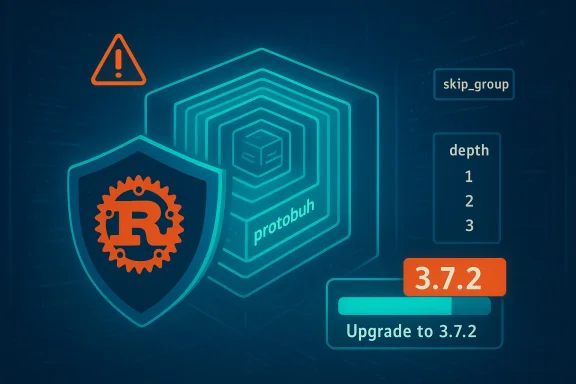
The Rust ecosystem’s widely used protobuf crate contains a denial‑of‑service flaw: CVE‑2025‑53605 affects versions before 3.7.2 and permits uncontrolled recursion in protobuf::coded_input_stream::CodedInputStream::skip_group when processing unknown fields from untrusted input. The maintainers pushed a corrective change (depth checks and recursion accounting) in the 3.7.2 line; operators should assume risk for any software that parses untrusted protobuf data with older crate versions and prioritize upgrades and rebuilds immediately. (rustsec.org) (github.com)
Protocol Buffers (protobuf) is a binary serialization format used pervasively across languages and platforms. The Rust crate commonly referred to as rust‑protobuf (crates.io name: protobuf) implements parsing and serialization for Protobuf messages in Rust. Like any parser that accepts structured nested input, protobuf parsers must protect against maliciously crafted messages that attempt to confuse control flow, force excessive recursion, or trigger pathological memory/stack usage.
CVE‑2025‑53605 was reported publicly in late 2024 and formally cataloged in 2025. It is an availability‑impacting bug: parsing certain crafted inputs can cause the parser’s group‑skipping routine to recurse without bounds and ultimately crash the process (stack overflow) or otherwise render the service unavailable. The issue was tracked in the project’s issue tracker and cross‑referenced by multiple vulnerability databases and advisory systems. The RustSec advisory lists the vulnerability and marks 3.7.2 as the patched minimum. (rustsec.org)
Key facts at a glance:
When a parser encounters an unknown group (a nested sequence delimited by start/end group tags), a skip routine traverses inner tags until it finds the matching end group. If the input contains nested groups ad infinitum (or the parser fails to limit recursive descent), the skip routine can recurse to arbitrary depth. In languages/runtimes with limited call stack or without tail‑call optimizations, that unbounded recursion produces stack overflows and process crashes.
Treat this as a high‑urgency operational task: patch your builds to protobuf >= 3.7.2, rebuild any statically linked artifacts, and harden parsing endpoints with network controls and resource isolation to minimize blast radius until the entire estate is verified. For larger fleets, use SBOM ingestion and automated advisory processing (OSV/GHSA/RustSec feeds) to accelerate triage and ensure no hidden artifacts remain vulnerable. (rustsec.org)
Source: MSRC Security Update Guide - Microsoft Security Response Center
 Background / Overview
Protocol Buffers (protobuf) is a binary serialization format used pervasively across languages and platforms. The Rust crate commonly referred to as rust‑protobuf (crates.io name: protobuf) implements parsing and serialization for Protobuf messages in Rust. Like any parser that accepts structured nested input, protobuf parsers must protect against maliciously crafted messages that attempt to confuse control flow, force excessive recursion, or trigger pathological memory/stack usage.CVE‑2025‑53605 was reported publicly in late 2024 and formally cataloged in 2025. It is an availability‑impacting bug: parsing certain crafted inputs can cause the parser’s group‑skipping routine to recurse without bounds and ultimately crash the process (stack overflow) or otherwise render the service unavailable. The issue was tracked in the project’s issue tracker and cross‑referenced by multiple vulnerability databases and advisory systems. The RustSec advisory lists the vulnerability and marks 3.7.2 as the patched minimum. (rustsec.org)
Key facts at a glance:
- Affected crate: protobuf (Rust).
- Affected versions: versions before 3.7.2 (multiple earlier v3 and older lines are implicated).
- Function at fault: protobuf::coded_input_stream::CodedInputStream::skip_group (parsing of unknown groups). (rustsec.org)
- Primary impact: Denial of Service (stack overflow / crash / service outage), CVSS v3.1 reported around 5.9 (Medium) by several aggregators; some scoring/analysts produce slightly different numbers depending on threat model.
- Patch: release 3.7.2 implements recursion depth accounting and enforces limits. (github.com)
How the bug works — a technical deep dive
Groups, unknown fields, and recursion in the protobuf wire format
Protobuf’s binary wire format supports several wire types, including “start group” / “end group” constructs from older versions of the format. Parsers must be able to skip unknown fields or groups so that newer messages can be read by older code without failing.When a parser encounters an unknown group (a nested sequence delimited by start/end group tags), a skip routine traverses inner tags until it finds the matching end group. If the input contains nested groups ad infinitum (or the parser fails to limit recursive descent), the skip routine can recurse to arbitrary depth. In languages/runtimes with limited call stack or without tail‑call optimizations, that unbounded recursion produces stack overflows and process crashes.
The specific fault in rust‑protobuf
The vulnerable code path was in CodedInputStream::skip_group and related merge/read operations that handled unknown groups. The implementation lacked proper recursion accounting and an enforced maximum depth for nested groups; as a result, an attacker able to supply crafted protobuf input could send deeply nested/recursive group structures that cause the code to call itself repeatedly without bounding the recursion depth. The result is a stack overflow or panic in the Rust process parsing the input. This exact behavior and affected function are explicitly enumerated in the RustSec advisory and in the upstream issue discussion. (rustsec.org)The upstream fix
The maintainer’s corrective commit introduces explicit recursion accounting: calls to skip or merge functions increment a recursion counter (incr_recursion) and decrement it on exit (decr_recursion), and the code paths that previously recursed indefinitely were split into “no‑depth‑check” helpers that are invoked from the guarded outer wrappers. That pattern makes the recursion limit explicit and testable; the change also added unit tests exercising shallow and deep nested group behaviors. The commit is the canonical fix shipped into the 3.7.2 release. (github.com)Real‑world impact and exploitability
Attack surface and prerequisites
- Attack vector: Network (an attacker that can send protobuf messages to a service that parses them).
- Privileges required: None — if a parsing endpoint accepts attacker‑controlled input, exploitation requires only the ability to send crafted data to that endpoint.
- Exploit complexity: Moderate — the attacker must produce syntactically valid protobuf wire data that exercises nested unknown groups, but tools and libraries make producing such messages relatively straightforward for an attacker who understands protobuf encoding. Several vulnerability trackers characterize exploit complexity as non‑trivial but well within the capabilities of many adversaries.
Likely symptoms of exploitation
- Immediate process termination (panic/segfault) or stack overflow.
- Repeated crashes for endpoints that parse untrusted messages, leading to service restarts and availability loss.
- For persistent attack traffic, a sustained denial‑of‑service condition without data corruption — the vulnerability targets availability, not confidentiality or integrity.
Has this been observed in the wild?
As of the time the advisory and catalog entries matured, public reports of in‑the‑wild exploit campaigns specifically weaponizing CVE‑2025‑53605 were limited or absent. Absence of public PoC or mass exploitation does not imply safety: parser DoS flaws are easy to weaponize in targeted outages and are attractive to attackers seeking disruption. Treat the lack of public PoCs as unknown rather than proof of non‑exploitability.Who should be worried (prioritization)
- Public‑facing services that accept protobuf input directly — gRPC endpoints, custom binary RPCs, management / diagnostic endpoints that parse text or binary protobuf.
- Message ingestion pipelines and brokers that deserialize protobuf payloads from potentially untrusted sources (queues, upload endpoints).
- Any packaged or vendor‑supplied binaries, libraries, or containers that embed or statically link the vulnerable protobuf crate — particularly where a system package update won’t affect prebuilt artifacts.
- CI build hosts or image registries that may have built artifacts before the fix: static linking and shading mean you must rebuild to purge the vulnerable code.
Concrete remediation steps (priority playbook)
Follow this prioritized checklist as soon as you can; these steps are practical and sequential so teams can triage and act under time pressure.- Inventory (first 1–3 hours)
- Run dependency scans across your Rust projects: use cargo metadata/cargo tree to identify usages of protobuf and transitive dependents.
- Inspect container images and build artifacts for the protobuf crate or for binaries that may statically link it.
- For mixed‑language environments, prioritize services that expose protobuf parsing endpoints to untrusted clients.
- Patch (hours)
- Upgrade the protobuf crate to >= 3.7.2 in all projects and rebuild. That version contains the recursion depth guard and test coverage. (github.com)
- For packages delivered as containers, rebuild and redeploy images that include the old crate.
- If you consume third‑party binaries that bundle rust‑protobuf, coordinate with vendors for repackaged builds or replace those components.
- Rebuild / Redeploy (hours → days)
- Rebuild fat binaries and any statically linked artifacts with the patched dependency. Replacing the system package alone is insufficient for statically linked or vendored code.
- Short‑term compeyou cannot immediately patch)
- Restrict network access to parsing endpnternal‑only access, service mesh).
- Add rate limits and circuit breakers for parsing routes to reduce impact of repeated crafted inputs.
- Run parsing code in a sandboxed subprocess with strict resource limits (rlimit for stack size, memory, CPU quotas). This contains crashes and avoids whole‑process termination.
- Reject textual/textproto input from untrusted clients; prefer binary wire formats and canonicalized inputs when possible.
- Test and validate (days)
- Add unit/integration tests that feed deeply nested/constructed group messages to parsing code to verify patched behavior.
- Integrate fuzz testing (corpus + coverage‑guided fuzzers) for parsing paths in CI to prevent regressions.
- Long‑term hygiene
- Enforce pinned dependency versions and fail CI on vulnerable versions.
- Generate SBOMs for images and artifacts and ingest vendor VEX/CSAF attestations where available. Note that vendor attestations are product‑scoped and do not substitute for artifact‑level validation.
- Expand fuzz coverage and negative testing in your release pipeline.
Detection, hunting and telemetry
Even without a public exploit, defenders should hunt and monitor for likely signs of exploitation or attempted misuse:- Crash telemetry: frequent panics, stack traces with skip_group or deep recursion traces, and core dumps for processes that handle protobuf input. Collate ah logs; compare with known stack frames for the vulnerable code.
- Resource signals: rapid processes repeatedly restarting, or services exhibiting immediate termination when certain request patterns arrive.
- Network-level monitoring: repeated large or long protobuf payloads from one client, especially if they contain repetitive or patterned tags consistent with nested group constructs.
- Test harnesses: create a controlled test that feeds dee parsing endpoints to confirm patched behavior and to simulate detection rules.
Why this matters — supply‑chain and operational lessons
- Parser bugs are availability bugs: they rarely expose secrets but can cripple services quickly and cheaply for attackers. This class of issue has been repeatedly weaponized when parsing endpoints are exposed. Treat parsers as high‑value attack surfaces that require rigorous negative testing, fuzzing, and input validation.
- Fixed upstream does not equal fixed everywhere: vendors and distributions may need to rebuild and republish packages. Statically linked or vendor‑shaded code inside binary artifacts stays vulnerable until rebuilt. The historical pattern for protobuf vulnerabilities across languages shows operators frequently miss embedded/shaded copies inside fat jars or prebuilt agents. Build inventories and SBOMs are the only reliable remediation path.
- Vendor attestations are product‑scoped: Microsoft and other vendors publish attestations (CSAF/VEX) that explicitly cover specific product images; absence of an attestation for another product does not mean it is safe. Operators must verify artifacts they run instead of assuming blanket safety from one vendor statcal analysis — strengths and residual risks
Strengths
- The maintainers produced a surgical, code‑level fix that adds explicit recursion accounting and tests; the fix reduces the attack surface without wholesale design changes. The upstream commit is clear and limited in scope. (github.com)
- The vulnerability was cataloged quickly by open vulnerability databases (RustSec, GHSA/OSV) and has clear fixed version guidance (>= 3.7.2), which supports automated detection and remediation workflows. (rustsec.org)
Residual risks and operational gaps
- Static linking and vendor‑shading remain the biggest practical risk: an updated system package doesn’t remove the vulnerable code from a prebuilt binary. Organizations that run third‑party binaries or appliances must insist on vendor rebuilds or replacement artifacts.
- Detection is messy: unlike memory‑corruption bugs that sometimes leave forensic artifacts, a parser‑induced crash looks like many other failure modes. Distinguishing attack from accidental malformed input requires coordinated telemetry, test harnessing, and forensic inspection of the failing payload.
- Vendor lag and supply‑chain complexity: even when upstream fixes exist, large downstream distributions and vendors may need months to package and ship rebuilt artifacts, leaving windows of exposure. Keep compensating controls in place (network restrictions, rate limits) until rebuilds are complete.
Practical developer guidance (code and build)
- Immediately update Cargo.toml entries to require protobuf >= 3.7.2 and run cargo update; follow by full rebuild and redeploy.
- Add a CI dependency check to fail builds if a project or its transitive deps resolve to protobuf < 3.7.2.
- If you vendor dependencies or check code into repositories, replace vendored copies or update the vendored files to the fixed release and rebuild.
- Add unit tests that exercise skip_group with nested groups and add fuzz harnesses (libfuzzer / honggfuzz / afl variants) to the parser module.
- When parsing untrusted data, prefer conservative APIs that expose limits (length limits, nesting depth checks) and perform pre‑validation where feasible.
Short checklist for incident responders
- Identify public endpoints that parse protobuf messages; block or rate limit them if necessary.
- Search build artifacts and images for the protobuf crate (cargo metadata, SBOMs, Syft for containers).
- Upgrade crate to 3.7.2 in development repositories and schedule rebuilds for all production binaries.
- For third‑party vendors, request attested rebuilt artifacts or isolate the vendor component until patched builds are available.
- Add crash and process‑supervisor alerts; if servers crash with stack overflow errors containing skip_group frames, treat them as high‑priority incidents.
Closing assessment
CVE‑2025‑53605 is a classic parser‑DoS: it doesn’t leak secrets or allow remote code execution, but it does give remote attackers a reliable way to disrupt availability when parsing endpoints accept attacker‑controlled protobuf data. The upstream fix is straightforward and landed in 3.7.2, but the real operational burden is finding and rebuilding every artifact that embeds the vulnerable crate — a supply‑chain and artifact‑management problem more than a code fix alone. Teams that maintain public protobuf endpoints, vendor static binaries, or run mixed cloud/edge images should prioritize inventory, rebuild, and apply network controls while they remediate.Treat this as a high‑urgency operational task: patch your builds to protobuf >= 3.7.2, rebuild any statically linked artifacts, and harden parsing endpoints with network controls and resource isolation to minimize blast radius until the entire estate is verified. For larger fleets, use SBOM ingestion and automated advisory processing (OSV/GHSA/RustSec feeds) to accelerate triage and ensure no hidden artifacts remain vulnerable. (rustsec.org)
Source: MSRC Security Update Guide - Microsoft Security Response Center
