

For users who split their days between spreadsheets, photo edits, and late-night matches, the combination of AMD Ryzen processors and Windows 11 is increasingly being marketed — and verified — as the smarter way to play, create, and work, blending sustained battery life, on-device AI, and a set of operating‑system optimizations that can materially change real‑world performance.
Over the last 18 months the PC ecosystem has shifted from a CPU‑centric arms race to a more holistic platform conversation: silicon, firmware, OS, drivers, and on‑device AI accelerators are all part of the user experience. AMD’s recent messaging — and the promotional activity cropping up at regional retailers — highlights three overlapping trends:
This article looks beyond the marketing — examining the technical claims, the verifiable results, and the practical consequences for buyers, creators, and corporate purchasers.
But the step change came from software: Microsoft added AMD‑specific branch prediction support to Windows 11 24H2, and backported the change to 23H2 as KB5041587 so more users could access the uplift sooner. Independent reviewers who tested the preview builds reported average improvements in the 8–12% range in CPU‑sensitive gaming at 1080p for chips like the Ryzen 7 7700X and the newer 9700X — results that are consistent across multiple outlets. Those same discussions and community testing logs were widely shared in forum archives during the rollout.
Important nuance: the gains are workload‑dependent. CPU‑bound gaming at lower resolutions tends to show the largest improvements because the GPU is less often the bottleneck. At 1440p or 4K many titles remain GPU‑limited and will see smaller or negligible FPS changes. Some titles even showed regressions in early tests, underscoring that OS‑level CPU optimizations can interact unpredictably with game engines, anti‑cheat systems, and driver stacks.
Microsoft’s documentation now lists Pluton as being available on devices with AMD Ryzen 6000 and later mobile families, Ryzen AI products, and other partner SoCs; Pluton requires OEM enablement and Windows 11 support. AMD first shipped Pluton‑enabled mobile Ryzen 6000 series APUs in 2022 as part of a broader mobile platform refresh; coverage from that time confirms the company’s long‑standing collaboration with Microsoft on Pluton. Practical takeaway: Pluton brings stronger hardware isolation for credentials, secure attestation, and on‑device keys — but its benefits depend on OEM enablement, platform firmware settings, and enterprise policy. It is not a magic bullet; rather, it is a modern building block for device security that integrates with BitLocker, Windows Hello, and other Windows features.
For buyers and IT decision‑makers, the wise approach is pragmatic: evaluate specific workloads, validate OEM firmware enablement (especially for Pluton), confirm the NPU and memory requirements for on‑device AI tasks, and treat time‑limited retail bundles as helpful but secondary incentives. When platform software and hardware are aligned, users gain real benefits — but those benefits arrive as a combination of components, not a single silver bullet.
Source: Nasi Lemak Tech The smarter way to play, create, and work: AMD Ryzen™ and Windows 11 redefine performance | Nasi Lemak Tech
 Background: why this pairing matters right now
Over the last 18 months the PC ecosystem has shifted from a CPU‑centric arms race to a more holistic platform conversation: silicon, firmware, OS, drivers, and on‑device AI accelerators are all part of the user experience. AMD’s recent messaging — and the promotional activity cropping up at regional retailers — highlights three overlapping trends:- Hardware vendors are adding dedicated security and AI subsystems directly into SoCs.
- Microsoft is iterating Windows 11 with platform optimizations that sometimes unlock measurable gains for specific silicon designs.
- OEM and channel promotions are bundling software and accessories to accelerate adoption of the latest Ryzen‑powered Windows 11 laptops.
This article looks beyond the marketing — examining the technical claims, the verifiable results, and the practical consequences for buyers, creators, and corporate purchasers.
Overview: what AMD + Windows 11 promises today
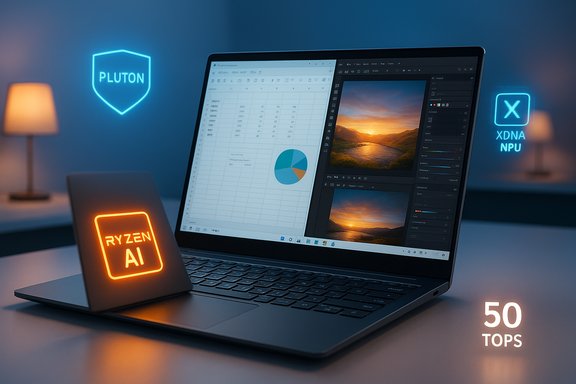
AMD and Microsoft present three core benefits for the modern user:- Seamless multitasking and efficient multi‑core performance for mixed work/play workloads.
- Hardware‑rooted security via built‑in Microsoft Pluton and industry‑grade cryptographic protections.
- On‑device AI and creative tooling through the Ryzen AI family and optimized tools such as Amuse, designed to run Stable Diffusion models locally.
Performance that adapts to mixed use
AMD promotes Ryzen as a platform for users who switch rapidly between tabs, video conferencing, and content creation. The claim that Ryzen chips excel in this environment is supported by the family’s long emphasis on higher core counts and aggressive boost behavior — attributes that translate into tangible multitasking advantages in many productivity benchmarks.But the step change came from software: Microsoft added AMD‑specific branch prediction support to Windows 11 24H2, and backported the change to 23H2 as KB5041587 so more users could access the uplift sooner. Independent reviewers who tested the preview builds reported average improvements in the 8–12% range in CPU‑sensitive gaming at 1080p for chips like the Ryzen 7 7700X and the newer 9700X — results that are consistent across multiple outlets. Those same discussions and community testing logs were widely shared in forum archives during the rollout.
Important nuance: the gains are workload‑dependent. CPU‑bound gaming at lower resolutions tends to show the largest improvements because the GPU is less often the bottleneck. At 1440p or 4K many titles remain GPU‑limited and will see smaller or negligible FPS changes. Some titles even showed regressions in early tests, underscoring that OS‑level CPU optimizations can interact unpredictably with game engines, anti‑cheat systems, and driver stacks.
Smarter security — Pluton and chip‑level trust
The Microsoft Pluton security processor is a purpose‑built hardware root of trust designed to keep cryptographic keys and identity material isolated from the main CPU and firmware attack surfaces. Microsoft’s Pluton design is implemented in collaboration with silicon partners and appears on a growing set of Windows‑focused platforms.Microsoft’s documentation now lists Pluton as being available on devices with AMD Ryzen 6000 and later mobile families, Ryzen AI products, and other partner SoCs; Pluton requires OEM enablement and Windows 11 support. AMD first shipped Pluton‑enabled mobile Ryzen 6000 series APUs in 2022 as part of a broader mobile platform refresh; coverage from that time confirms the company’s long‑standing collaboration with Microsoft on Pluton. Practical takeaway: Pluton brings stronger hardware isolation for credentials, secure attestation, and on‑device keys — but its benefits depend on OEM enablement, platform firmware settings, and enterprise policy. It is not a magic bullet; rather, it is a modern building block for device security that integrates with BitLocker, Windows Hello, and other Windows features.
On‑device AI: Ryzen AI and Amuse
AMD’s Ryzen AI 300 family repositions client‑class processors into the AI‑capable mainstream. The Ryzen AI 300 series (and the commercial PRO variants) incorporate an XDNA NPU and Intel‑competitive GPU subsystems intended to accelerate Microsoft Copilot+ experiences and offline generative workflows. AMD’s own product brief lists peak NPU performance targets (50 TOPS for many Ryzen AI 300 SKUs) and configurations designed to meet Copilot+ hardware thresholds. On the software side, AMD’s Amuse AI toolchain — optimized for Ryzen AI 300 platforms — supports Stability AI models (including Stable Diffusion families) and can offload model execution to the AMD XDNA NPU for local image generation. AMD documented Amuse 2.x/3.x releases that explicitly list support for Ryzen AI 300 series hardware and the SD 3.0/3.5 family of models; Tom’s Hardware and AMD press notes corroborate a coordinated push to run BF16/BF16‑optimized models locally on NPUs. What this means: creators can run certain generative tasks offline without cloud dependency, enabling faster iteration and improved privacy — provided their device meets the NPU TOPS and memory requirements AMD lists. That on‑device model execution is already shipping in software previews and beta tooling and will be a differentiator for mobile laptops aimed at creators.Deep dive: what the benchmarks and tests actually show
A balanced assessment requires cross‑referencing independent labs, manufacturer claims, and community testing.The Windows 11 24H2 / KB5041587 story
- Microsoft and AMD collaborated to add AMD‑specific branch‑prediction code paths to Windows 11 24H2; an optional backport (KB5041587) made the optimizations available to existing 23H2 users. Tom’s Hardware and The Verge covered the backport and called out Hardware Unboxed and KitGuru tests showing meaningful gains.
- Hardware Unboxed’s testing showed average FPS increases near 10% for the Ryzen 7 7700X and roughly 11% for the Ryzen 7 9700X in 1080p CPU‑bound tests; other outlets reported up to ~23% uplifts in certain titles, while some games saw no change or small regressions.
- Community logs and forum threads captured user experiences and edge cases during the preview rollouts; these archives reflect the mixed, workload‑dependent nature of the update and the fact that platform patches can produce variable results across titles and driver revisions.
Productivity and AI workloads
AMD’s internal claims about productivity and AI gains vary by benchmark and context. In the public material AMD provided around the Ryzen AI 300 launch, the company emphasized improvements in AI inference throughput and local generative capabilities supported by the XDNA NPU architecture. Independent coverage from hardware press outlets has validated the presence of an NPU capable of 50+ TOPS on many Ryzen AI 300 models and corroborated the promising on‑device inference metrics for select models. Reality check: application‑level benefits (for example, faster exports in Adobe Creative Cloud, or improved responsiveness in AI‑assisted features) will depend on vendor support and whether apps offload work to the NPU. The software ecosystem is still catching up: AMD’s Amuse toolchain and select app integrations demonstrate potential, but broad acceleration across mainstream creative apps will take time and cooperation from ISVs.Strengths: why this platform is compelling
- Holistic platform optimization: When silicon vendors and OS maintainers collaborate, real end‑user gains are possible without hardware changes. The KB5041587/24H2 example is a high‑profile case where OS tuning materially altered measured performance.
- On‑device AI for creators: The combination of a capable NPU (XDNA) and optimized local tooling (Amuse) puts privacy‑friendly, offline generative workflows within reach for thin‑and‑light laptops. AMD’s public documentation and product blog posts confirm both the hardware targets and the software releases enabling this workflow.
- Integrated hardware security: Pluton integration in Ryzen 6000 and later mobile SKUs gives vendors and enterprises stronger cryptographic anchoring for Windows security features — a notable advantage where device integrity and key protection matter. Microsoft’s documentation and OEM announcements back this up.
- Channel momentum and bundling: In selected regional markets, retailers such as GLOO and iTworld (operated by SNS Network in Malaysia) are pairing Ryzen AI‑equipped Windows 11 laptops with practical bundles — mice, antivirus subscriptions, USB drives, and vouchers — which can lower the immediate cost of entry for consumers. Local coverage and retailer listings show these promotions in limited windows, giving buyers short‑term incentives to upgrade.
Risks, tradeoffs, and things to watch
- OS updates and regression risk
- Platform optimizations can help, but they can also create title‑specific regressions. Early adopters of preview builds sometimes experienced stability or performance inconsistencies in a minority of games. Wait for the fully validated public release if maximum stability is essential.
- Vendor enablement matters for Pluton and NPU features
- Pluton requires OEM enablement in UEFI/firmware; on some platforms, vendors ship with Pluton disabled by default or provide user controls. Enterprises should factor in BIOS/firmware policies and update cadence when evaluating device security.
- On‑device AI is hardware‑specific and software‑dependent
- The Ryzen AI NPU brings potential, but its real‑world value depends on how many apps adopt NPU offload and how well ISVs optimize for XDNA. AMD’s Amuse demos show strong capability, but broad productivity acceleration requires wider software integration.
- Regional promotions and availability
- Channel bundles and instant rebates (as reported by regional outlets) can materially influence purchase decisions, but they’re time‑bound and geography‑specific. Verify eligibility, redemption steps, and in‑store vs. online differences before you buy — promotional T&Cs often vary by retailer. The local SNS Network pages and press coverage document the channel ecosystem and past promotions, but availability changes rapidly.
- Marketing language vs. real‑world outcomes
- Phrases like “up to X% faster” or “industry‑leading NPU” are useful shorthand but must be read in context of test methodology, resolution, driver versions, and workload. Cross‑reference independent test labs for the most reliable picture rather than relying solely on vendor slides.
Practical advice for buyers and IT managers
For the multitasking student or hybrid worker
- Prioritize a Ryzen AI 5/7 laptop if you want balanced CPU performance with on‑device AI capabilities and long battery life.
- Make sure the OEM enables Pluton or provides a clear firmware menu to control it if you have specific privacy or multi‑boot needs.
- If you’re a gamer, check whether the title you play is CPU‑sensitive; if so, installing KB5041587 or upgrading to a Windows 11 build that includes 24H2 optimizations can help — but test for stability in your specific titles.
For creators and streamers
- Consider a Ryzen AI 7 or AI 9 configuration with higher memory (24GB+ recommended for local Amuse workflows) and confirm NPU TOPS on the SKU — AMD’s product briefs list 50 TOPS on many Ryzen AI 300 devices for SD3/SD3.5 Medium model support.
- Use vendor‑supplied imaging and driver bundles to keep XDNA drivers and Amuse up to date; on‑device generative features are sensitive to driver and firmware revisions.
For enterprise procurement
- Validate firmware control and Pluton enablement with the OEM.
- Run a pilot with the specific Windows 11 build you plan to standardize on (23H2 + KB5041587 vs. 24H2 vs. later builds) to verify application compatibility.
- Factor in management and update policies — Pluton and NPU features require firmware‑level trust and vendor update discipline to maintain security assurances.
Promotions and channel notes (regional snapshot)
Retail and channel activity can make Ryzen‑powered Windows 11 PCs more attractive in the near term. Regional reporting captured a promotion (November 1–December 27 window in one market) where purchases at chain retailers GLOO and iTworld via SNS Network included a Logitech G102 LIGHTSYNC mouse, a 1‑year Bitdefender subscription, a Kingston DataTraveler 70 (64GB), and a local food voucher — with higher‑tier processors receiving additional physical gifts. The same coverage also called out instant rebates via official online stores tied to processor tiers (RM50/RM100/RM150 for Ryzen 5/7/9 tiers in the advertised campaign). These offers were time‑limited and retailer‑specific; prospective buyers should validate current availability directly with the retailer. Caveat: promotional bundles, limited‑quantity gifts (e.g., limited AMD gaming mice), and voucher redemption processes often carry specific verification steps and stock constraints. Treat such promotions as helpful incentives, not the primary purchasing rationale.Final analysis: who benefits most, and where expectations should be tempered
The combination of AMD Ryzen processors and Windows 11 is no longer a theoretical advantage — it is a practical platform backed by software changes, hardware security, and early on‑device AI tooling. The strongest beneficiaries are:- Users whose workflows are mixed and CPU‑sensitive (multitaskers, creators working with multiple apps).
- Creators who value offline, private generative AI for mockups and concept work — provided their device meets Ryzen AI NPU and memory requirements.
- Enterprises and security‑conscious users who want hardware‑anchored protections (Pluton) integrated into the platform stack — with the caveat that OEM enablement and firmware policy are essential.
- Don’t rely on OS patches alone to deliver uniform, across‑the‑board performance jumps; gains are real but workload‑dependent.
- On‑device AI benefits are promising but nascent; broad, app‑level acceleration depends on ISV adoption.
- Regional promotions help with short‑term incentives but are transient and often limited by stock, verification, and redemption windows.
Conclusion
AMD’s Ryzen family — especially the Ryzen AI 300 series and later mobile SKUs — combined with Windows 11 platform updates, represents a meaningful step toward a more integrated, secure, and AI‑capable PC. The KB5041587 backport and Windows 11 24H2 optimizations are concrete examples of how OS and silicon collaboration can unlock performance that matters in day‑to‑day tasks. Pluton integration raises the bar for device security, while the Ryzen AI roadmap and AMD’s Amuse tooling preview how offline generative workflows will be possible in mainstream laptops.For buyers and IT decision‑makers, the wise approach is pragmatic: evaluate specific workloads, validate OEM firmware enablement (especially for Pluton), confirm the NPU and memory requirements for on‑device AI tasks, and treat time‑limited retail bundles as helpful but secondary incentives. When platform software and hardware are aligned, users gain real benefits — but those benefits arrive as a combination of components, not a single silver bullet.
Source: Nasi Lemak Tech The smarter way to play, create, and work: AMD Ryzen™ and Windows 11 redefine performance | Nasi Lemak Tech
