

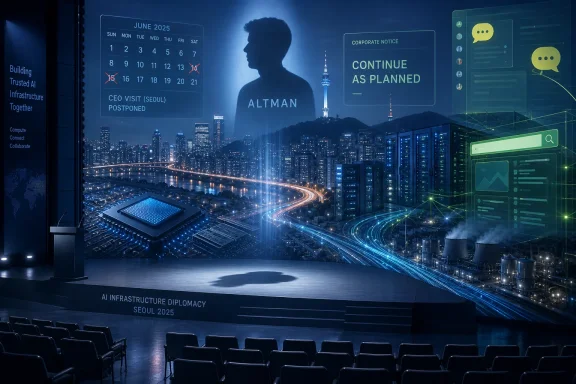
Altman’s Empty Chair Still Casts a Long Shadow
The itinerary was brief, but it was not casual. Altman was expected to arrive in Seoul on the evening of June 14 and spend June 15 meeting with some of the country’s most strategically important technology companies. Reports identified Samsung Electronics, Kakao, and Naver as the core stops, with at least one Korean outlet saying Samsung had prepared a “DX Insight Talk” at its Suwon campus.
That matters because OpenAI’s relationship with Korea has moved beyond polite ecosystem-building. Samsung and SK hynix sit at the center of the memory supply chain that modern AI infrastructure requires. Naver and Kakao control domestic search, messaging, cloud, content, and enterprise relationships that foreign AI companies cannot easily replicate from San Francisco.
OpenAI Korea’s statement tried to keep the story contained. Altman was disappointed, Korea remained an important strategic partner, and cooperation with domestic partners would continue as planned. In corporate crisis language, this is the equivalent of locking every door before the market starts checking the windows.
The postponement does not prove that any partnership is in trouble. But it exposes how much symbolic weight Altman personally carries in OpenAI’s global expansion. When he appears, it is read as commitment; when he disappears, it invites interpretation.
Korea Is Not a Side Quest in the AI Infrastructure War
The most important context is not the postponed trip itself. It is the October 2025 wave of agreements that tied OpenAI more tightly to Korean industrial giants, especially Samsung and SK.
OpenAI’s infrastructure ambitions have become so large that the company can no longer talk only about models, APIs, or consumer subscriptions. It has to talk about wafers, data centers, power, construction, cooling, and sovereign industrial capacity. Korea is one of the few places where several of those conversations can happen in the same week.
Samsung’s October 2025 letter of intent with OpenAI covered global AI data-center infrastructure and related technologies, involving not only Samsung Electronics but also Samsung SDS, Samsung C&T, and Samsung Heavy Industries. That range is telling. The AI buildout is no longer a clean split between “chip company” and “cloud company”; it is a sprawling industrial stack that reaches from advanced memory to construction and even speculative data-center formats.
SK hynix is equally central because high-bandwidth memory has become one of the most constrained inputs in the AI boom. For WindowsForum readers who usually encounter AI as a Copilot button, a ChatGPT window, or an Azure service, this is the hidden layer underneath the product announcements. The model does not run because a keynote says it runs. It runs because power, networking, GPUs, memory, and facility capacity are procured years ahead of demand.
That is why Altman’s Korean meetings were not mere courtesy calls. They sat at the junction between OpenAI’s ambitions and the physical limits of the industry. If OpenAI wants to grow beyond dependence on any one cloud partner, it needs more than software. It needs leverage in the supply chain.
The Personal Reason Is Less Interesting Than the Corporate Reassurance
OpenAI did not disclose the specific personal reason for the postponement, and there is no public basis for treating it as anything more dramatic than that. Executives cancel trips. Schedules change. Personal matters happen even to CEOs whose calendars are treated like diplomatic communiqués.
But companies choose how to frame cancellations, and OpenAI’s framing was carefully defensive. The important phrase was not “personal reasons.” It was “cooperation will continue as planned.”
That reassurance tells us what OpenAI expected people to worry about. A postponed trip could be read as a cooling of negotiations, a delay in infrastructure planning, or a sign that competing priorities elsewhere had displaced Korea. OpenAI Korea moved quickly to cut off that interpretation.
The sensitivity is understandable because AI partnerships in 2026 often exist in a twilight zone between announcement and execution. Letters of intent, memoranda of understanding, strategic collaborations, and exploratory agreements create headlines before they create capacity. They are real enough to affect market perception, but not always concrete enough to survive close inspection.
That makes continuity language important. OpenAI is telling Korean partners, investors, government officials, and competitors that the machinery keeps moving without Altman in the room. Whether that is fully true is the test.
Samsung Wants More Than a Customer
Samsung’s role in this story is often flattened into “OpenAI needs memory.” That is true, but incomplete. Samsung does not merely want to sell components into someone else’s AI empire; it wants to shape the infrastructure layer itself.
The October 2025 partnership language pointed toward data-center development, memory supply, enterprise AI services, construction capabilities, and advanced facility concepts. Samsung SDS brings IT services and cloud integration. Samsung C&T brings construction expertise. Samsung Heavy Industries hints at the more experimental edge of the conversation, including maritime or floating infrastructure concepts that sound strange until one remembers how desperate the AI industry is for power and land.
Samsung Electronics, meanwhile, has every reason to ensure it remains central to the AI hardware buildout. The company has faced fierce competition in high-bandwidth memory, where SK hynix established early strength with Nvidia-linked supply. A high-profile OpenAI relationship gives Samsung another route into the conversation about what next-generation AI infrastructure should require.
For OpenAI, Samsung offers optionality. For Samsung, OpenAI offers narrative acceleration. Each side wants the other for practical reasons, but both also want the market to see the relationship as inevitable.
That is why an Altman visit carries more weight than a standard vendor meeting. His presence can validate a partnership as strategic rather than transactional. His absence does not erase the deal, but it removes the photo that would have refreshed the story.
Kakao and Naver Are the Front Door to Korean Users
The Kakao and Naver meetings point to a different layer of OpenAI’s Korea strategy. Samsung is about infrastructure. Kakao and Naver are about distribution, localization, and domestic trust.
Kakao’s reach through messaging and consumer services makes it one of the most important gateways to Korean digital life. Naver, with its search, commerce, maps, cloud, and content ecosystem, is not simply a Korean equivalent of a Western web company. It is a platform that sits inside everyday behavior and enterprise adoption in ways foreign firms often underestimate.
For OpenAI, partnerships with companies like Kakao and Naver could help solve problems that raw model performance cannot. Language nuance, local regulatory expectations, enterprise procurement, data governance, consumer UX, and domestic competition all matter. The best model in a benchmark table does not automatically become the default assistant in a country with strong incumbent platforms.
For the Korean companies, OpenAI presents both opportunity and threat. Partnering can accelerate product development, improve enterprise offerings, and keep domestic services from looking stale next to global AI competitors. But dependence on a frontier-model provider can also reduce strategic control, especially if the foreign partner moves faster than local governance structures can absorb.
This is the uneasy bargain now playing out across the AI economy. Platform companies want frontier capabilities without becoming mere wrappers. Frontier AI companies want distribution without surrendering the customer relationship.
OpenAI’s Diplomacy Has Outgrown the Startup Playbook
Altman has spent the last several years functioning less like a conventional tech CEO and more like a roaming minister for compute. He meets heads of state, chipmakers, cloud providers, energy players, telecom operators, and regulators. The pitch varies by country, but the underlying ask is consistent: help OpenAI build the capacity to make AI bigger.
That role is unusually personal. OpenAI has a deep bench of executives and researchers, but Altman remains the company’s primary political and commercial symbol. His meetings generate headlines because they suggest alignment at the highest level.
The risk is that personality-driven diplomacy does not scale cleanly. A company building global AI infrastructure cannot have every relationship depend on the CEO’s physical presence. It needs regional leadership, enforceable contracts, operational teams, and partner confidence that survives missed flights and changed calendars.
OpenAI Korea’s statement was therefore more than apology. It was a maturity test. The company had to show that its Korean strategy is institutional, not theatrical.
This is especially important because OpenAI’s partnerships are becoming more complex. The company is no longer merely selling API access or licensing models through Microsoft. It is stitching together a multi-continent industrial coalition while competing with some partners, depending on others, and attempting to keep regulators comfortable with its scale.
The Microsoft Shadow Hangs Over Every OpenAI Partnership
For a Windows-focused audience, the Korean postponement is also a reminder that OpenAI’s center of gravity is no longer confined to its Microsoft relationship. Microsoft remains deeply tied to OpenAI through product integration, cloud infrastructure, and the Copilot ecosystem. But OpenAI has spent the last two years visibly widening its options.
That shift matters for Windows users and IT administrators because the OpenAI-Microsoft relationship has shaped how generative AI appears in the enterprise. Copilot in Windows, Microsoft 365 Copilot, Azure OpenAI Service, GitHub Copilot, and security products all sit downstream from a strategic bet that Microsoft made earlier than most of its peers. If OpenAI diversifies infrastructure and distribution, Microsoft remains powerful but less exclusive in practice.
Korea is part of that diversification. Memory partnerships, data-center planning, and local platform relationships give OpenAI more bargaining power and more routes to market. They also create a world in which the same underlying model provider may appear through Microsoft, Samsung, Kakao, Naver, direct OpenAI subscriptions, and future hardware or agent platforms.
For IT departments, that complicates governance. It is no longer enough to ask whether employees are using ChatGPT or Microsoft Copilot. The same class of AI capability may arrive through collaboration tools, phones, browsers, enterprise SaaS platforms, cloud APIs, and region-specific partners.
The postponed visit changes none of that directly. But it underscores the trajectory: OpenAI is building around Microsoft as well as with Microsoft.
The AI Supply Chain Is Becoming a Geopolitical Map
South Korea’s importance to OpenAI is not just corporate. It is geopolitical. The country is a U.S. ally, a semiconductor powerhouse, a major cloud and platform market, and a government actively interested in AI competitiveness.
That combination is rare. Many countries want AI sovereignty, but few have the hardware supply chain, engineering base, and platform companies to participate meaningfully in frontier AI infrastructure. Korea does.
This gives Korean companies leverage, but it also places them in a difficult position. The AI supply chain is increasingly shaped by U.S.-China tensions, export controls, energy constraints, and national-security anxieties. Partnerships with OpenAI can be commercially attractive while also politically loaded.
OpenAI benefits from aligning itself with trusted allied industrial bases. Korea benefits from being treated as a core node rather than a peripheral market. But both sides have to navigate the fact that AI infrastructure is now strategic infrastructure, not merely commercial technology.
That is one reason the public choreography matters. A CEO visit, a presidential meeting, a signing ceremony, and a factory tour are signals to governments as much as markets. When a trip is postponed, even for personal reasons, the signal becomes temporarily blurrier.
The Postponement Arrives in an Era of AI Overcommitment
The AI industry has become addicted to announcements that imply future capacity. Every frontier player needs more compute, more power, more memory, more data-center space, more enterprise customers, and more regulatory goodwill. The result is a steady stream of deals whose scale is enormous and whose operational details are often thin.
That does not make the deals fake. It does mean they should be read carefully. A letter of intent is not a completed data center. A strategic partnership is not guaranteed supply. A planned meeting is not a signed procurement order.
OpenAI’s Korea commitments sit inside that broader pattern. The company has legitimate reasons to deepen ties with Samsung, SK, Kakao, and Naver. Those companies have legitimate reasons to work with OpenAI. But the industry’s history is full of grand alliances that produced less than the launch-day graphics promised.
This is why the phrase “continue as planned” deserves scrutiny. Which plan? Infrastructure design? Memory procurement? Enterprise AI services? Local consumer integrations? Data-center exploration? Each strand has a different timeline and a different likelihood of becoming visible to users.
The postponement does not weaken those plans by itself. It merely reminds us that announcements are not execution.
Windows Users Will Feel This Indirectly, Then All at Once
Most Windows users will not notice whether Altman met Kakao’s Chung Shin-a on June 15. They will not see a desktop notification saying an executive visit was postponed. The impact of these partnerships, if they materialize, will arrive indirectly.
It may arrive as more available AI capacity, reducing bottlenecks during heavy demand. It may arrive as better memory supply for accelerators that cloud providers use to run enterprise AI workloads. It may arrive as new Samsung devices with deeper AI integrations, or as Korean platform services that use OpenAI models under the hood. It may arrive through Microsoft products if OpenAI’s broader infrastructure reduces pressure on shared compute.
For sysadmins, the more immediate lesson is governance. AI features are spreading across the stack faster than traditional procurement models can track. If OpenAI’s models appear through more partners, organizations need policies that describe data handling and model use by function, not merely by brand name.
The old question was, “Are we allowing ChatGPT?” The new question is, “Where do OpenAI-class models enter our environment, what data can they touch, and who is accountable for the output?” That is much harder.
The Korean story is therefore not distant from Windows administration. It is part of the same supply chain that eventually determines which AI buttons appear in enterprise software, which cloud regions support which features, and how much control organizations retain.
The Cancellation Tests OpenAI’s Local Organization
OpenAI Korea had to do more than issue a polite notice. It had to preserve trust with companies that had likely arranged executive time, internal presentations, security logistics, and press expectations around the visit.
In Asian corporate contexts, face-to-face meetings often carry more symbolic weight than Western observers appreciate. A sudden cancellation can create embarrassment even when the reason is accepted. The handling matters.
OpenAI’s message leaned heavily on respect and continuity. Altman had been looking forward to the visit. Korea remained important. The company hoped he would return soon. Cooperation would proceed.
That is the right script. But scripts are only useful if followed by action. The next test is whether senior OpenAI representatives continue the work in Altman’s absence, whether meetings are rescheduled quickly, and whether any concrete partnership milestones appear over the coming months.
If everything continues smoothly, this becomes a footnote. If timelines slip or the visit is not rescheduled, the postponement will be reinterpreted through a colder lens.
The Real Competition Is for Control of the AI Stack
The deeper story is control. OpenAI wants more control over compute, distribution, and product destiny. Samsung wants more control over its role in the AI hardware era. Kakao and Naver want more control over how global AI enters Korean daily life. Microsoft wants to preserve its privileged position while the partner it backed becomes increasingly ambitious.
None of these goals is irrational. They simply do not align perfectly.
That misalignment is what makes the OpenAI-Korea story worth watching. The public language is partnership; the private negotiation is about dependency. Who depends on whose chips? Who controls the customer? Who owns the integration layer? Who captures margin when AI becomes a routine enterprise utility?
OpenAI’s challenge is that it needs everyone. It needs Microsoft’s enterprise reach, Nvidia’s accelerators, Samsung and SK’s memory, cloud and data-center operators, government goodwill, platform distributors, and developers. The company’s power comes from being central to the AI wave, but its vulnerability comes from needing an enormous coalition to keep that wave moving.
Altman’s travel schedule has become a visible representation of that coalition. One postponed trip does not change the map. It does show how crowded the map has become.
The Seoul Trip That Did Not Happen Still Leaves a Checklist
The practical read is not that OpenAI’s Korean strategy is faltering. It is that the strategy is important enough that even a routine postponement becomes news. The next few months will reveal whether OpenAI’s reassurance was a holding statement or a reliable description of work already in motion.
- OpenAI postponed Sam Altman’s June 14–15, 2026 South Korea visit after citing unavoidable personal reasons, without announcing a new date.
- The planned meetings reportedly included Samsung Electronics, Kakao, and Naver, placing infrastructure and platform distribution in the same diplomatic frame.
- OpenAI Korea said cooperation with domestic partners would continue as planned, a formulation designed to calm speculation about delayed or weakened partnerships.
- Samsung’s relationship with OpenAI is about more than memory supply, because the companies have discussed broader AI data-center infrastructure and related industrial capabilities.
- For Windows users and IT departments, the long-term impact is likely to appear through cloud capacity, Copilot-class services, device integrations, and harder-to-track AI governance problems.
- The key uncertainty is whether OpenAI can make its Korea strategy institutional enough to survive without Altman personally refreshing every relationship.
The postponed Seoul visit is best understood as a stress test, not a rupture. OpenAI’s ambitions now run through countries, supply chains, and platform companies that cannot be managed by keynote momentum alone. If the company’s Korean partnerships keep advancing, Altman’s absence will fade into scheduling trivia; if they stall, this week will be remembered as an early sign that the AI infrastructure boom was easier to announce than to operationalize.