

Samsung’s CES 2026 TV refresh is a clear escalation: brighter OLEDs, higher refresh rates for gamers, and a new metal‑framed flagship that repositions Samsung’s premium OLED strategy for the year ahead.
Samsung unveiled its 2026 OLED family at CES with four new S‑series models: S85H, S90H, S95H, and the newly introduced S99H as the top‑end flagship. The range brings a mix of panel suppliers (Samsung Display QD‑OLED and LG Display W‑OLED), updated industrial design choices, and platform upgrades including HDR10+ Advanced, Eclipsa Audio, and extended software support promises for up to seven years of over‑the‑air updates. These announcements were widely reported across the tech press and picked up in the hands‑on and press briefings at the show. What’s new this year is emphatic: Samsung is pushing self‑emissive panels harder for sustained brightness and gaming performance while adding a hardware accessory option — the Wireless One Connect box — that can expand the practical port count and simplify installations. Simultaneously, Samsung showcased a dramatic 130‑inch Micro RGB reference display (R95H) that doubles as a technological statement about color fidelity and scale. Many of Samsung’s feature claims are corroborated by multiple outlets, though manufacturer numbers still require independent lab verification.
Until those third‑party measurements appear, treat Samsung’s headline figures as manufacturer claims that are plausibly supported by multiple press outlets but not yet fully instrumented. For readers planning purchases, try models in showroom demos where possible, watch for measured reviews, and verify SKU‑level panel sourcing and firmware behavior before committing.
Samsung’s 2026 OLED push is a bold, strategically coherent play: it packages higher brightness, gamer‑friendly refresh rates, and expanded software longevity into a line that attempts to satisfy both living‑room cinephiles and performance‑hungry gamers. The promise is real, but the proof will be in measured lab reports and long‑term usage data — exactly the tests that power buyers and the WindowsForum community will want to see next.
Source: Gizmochina Samsung unveils 2026 OLED TV lineup with new S99H flagship - Gizmochina
 Background / Overview
Samsung unveiled its 2026 OLED family at CES with four new S‑series models: S85H, S90H, S95H, and the newly introduced S99H as the top‑end flagship. The range brings a mix of panel suppliers (Samsung Display QD‑OLED and LG Display W‑OLED), updated industrial design choices, and platform upgrades including HDR10+ Advanced, Eclipsa Audio, and extended software support promises for up to seven years of over‑the‑air updates. These announcements were widely reported across the tech press and picked up in the hands‑on and press briefings at the show. What’s new this year is emphatic: Samsung is pushing self‑emissive panels harder for sustained brightness and gaming performance while adding a hardware accessory option — the Wireless One Connect box — that can expand the practical port count and simplify installations. Simultaneously, Samsung showcased a dramatic 130‑inch Micro RGB reference display (R95H) that doubles as a technological statement about color fidelity and scale. Many of Samsung’s feature claims are corroborated by multiple outlets, though manufacturer numbers still require independent lab verification.What Samsung announced: model-by-model
S99H — the new flagship
- Sizes: 55", 65", 77", 83".
- Panel mix: QD‑OLED for the smaller sizes; LG Display Tandem W‑OLED used for the 83" SKU.
- Resolution / refresh: 4K with support up to 165Hz.
- Brightness: Samsung claims up to 35% higher peak brightness compared to last year’s S95F.
- Design: metal frame (a deliberate departure from the ultra‑thin bezel trend).
- Coating & connectivity: Glare Free 3.0 anti‑reflection treatment and support for a Wireless One Connect accessory.
S95H — high‑end QD‑OLED refresh
- Sizes: 48", 55", 65", 77", 83".
- Panel strategy: dual supplier — QD‑OLED for most sizes, LG Tandem W‑OLED for specific SKUs (notably 48" and 83").
- Improvements: quoted 35% brightness gain over the S95F, flush‑to‑wall mounting options, and optional Wireless One Connect compatibility.
S90H — mid‑range OLED with gaming tilt
- Sizes: 42" to 83" (ranges vary by region).
- Key changes: 15% brightness increase over its predecessor, upgrade to 165Hz on relevant SKUs, and Glare Free 3.0 anti‑reflective coating. Panel supplier varies by size (mix of QD‑OLED and W‑OLED).
S85H — entry OLED
- Strategy: the S85H remains the entry point to Samsung’s OLED portfolio, using LG W‑OLED panels across the range and supporting 100Hz or 120Hz refresh rates depending on size. It’s positioned to bring OLED into more accessible price bands while preserving Samsung’s software features.
Key platform and ecosystem upgrades
- HDR10+ Advanced — Samsung is expanding its HDR format stack with HDR10+ Advanced on select 2026 models. This is pitched as a successor to HDR10+ that better addresses very high peak luminance panels. Coverage confirms Samsung’s intention to prioritize HDR10+ Advanced across headline models, though content‑ecosystem adoption is a separate challenge.
- Eclipsa Audio — A new spatial audio format Samsung is introducing alongside hardware‑level tuning on flagship models. Eclipsa Audio appears to be marketed as an “integrated” spatial solution for the largest sets (notably the 130‑inch R95H) as well as a feature in premium OLEDs. Claims must be evaluated in hands‑on audio tests.
- Tizen OS 10.0 and extended updates — Samsung pledges up to seven years of OTA updates for 2026 TVs, and the lineup will ship with Tizen OS 10.0 and the expanded Vision AI Companion and smart integrations (Microsoft Copilot, Matter hub support, Alexa, AirPlay 2). Several outlets repeated the multi‑year update promise, which is meaningful for long‑term platform viability.
- Gaming features — Samsung emphasizes AI Auto Game Mode, FreeSync Premium, NVIDIA G‑Sync compatibility, VRR, and 165Hz panel support for select SKUs. These additions underline Samsung’s intent to court PC and console players who want higher refresh and adaptive sync at 4K. However, note that running 4K at 165Hz without compression has strict HDMI bandwidth requirements; implementations may rely on DSC or reduced chroma/bit‑depth modes.
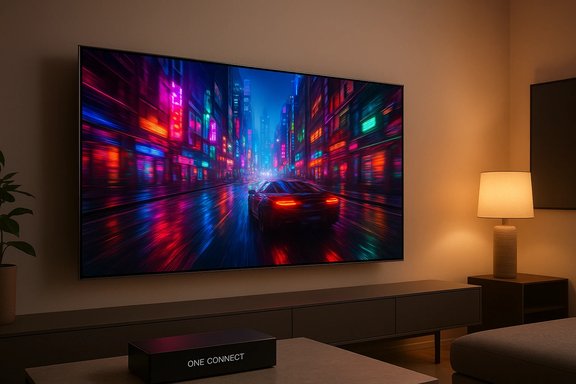
- Connectivity — The Wireless One Connect box returns as an optional accessory, allowing up to eight HDMI 2.1‑capable connections when paired with the TV’s own internal ports. This arrangement can simplify wiring and expand available ports but adds accessory dependency and wireless range considerations.
Verifying the headline technical claims
When a manufacturer touts numbers like “35% brighter” or “165Hz at 4K,” the details matter. Independent verification is essential for buyers and reviewers; here’s how the key claims stack up across multiple trusted reports:- The S99H/S95H 35% brightness claim appears consistently in Samsung’s CES briefing materials as reported by major outlets, but it is a manufacturer comparison against the previous S95F model and has not yet been validated by third‑party measurements. Treat this as a manufacturer‑reported delta until instrumented lab tests are available.
- 165Hz at 4K is increasingly common across 2026 premium TVs and monitors. Independent coverage confirms Samsung’s support for 4K/165Hz modes on relevant OLED SKUs, but practical use on consoles (which largely cap at 120Hz for 4K) is limited today — this spec is primarily valuable for PC gamers and future consoles/firmware. Also check whether Display Stream Compression (DSC) is required to maintain full chroma and bit‑depth at 165Hz; that information is model‑specific and must be confirmed at retail.
- The panel supplier mix (QD‑OLED for mid sizes, LG Tandem W‑OLED for some SKUs and the 83") is corroborated by several independent outlets that inspected Samsung’s official part listings and CES briefs. Panel source affects uniformity, tone mapping, and long‑term behavior; verify the exact SKU you buy if a single supplier is important to you.
- Glare Free 3.0 anti‑reflection coating and Wireless One Connect are consistently listed across reports; the real world benefit of Glare Free surfaces is observable in demo rooms, but they can slightly alter perceived contrast and black depth compared with glossy screens — this is a subjective trade‑off buyers should evaluate in person.
- Eclipsa Audio and HDR10+ Advanced are platform claims that Samsung is promoting with the 2026 line. Independent outlets report the software features and audio branding are present in Samsung’s marketing materials, but hands‑on testing and objective audio measurements will be necessary to judge parity with discrete soundbar/AV receiver setups.
Strengths: what stands out in Samsung’s 2026 OLED line
- Brighter self‑emissive TVs: pushing QD‑OLED and W‑OLED to higher peak levels reduces one of the historical limits of OLED — highlight pop — and narrows the gap with mini‑LED for HDR spectacle. Samsung’s marketing of a 35% boost for flagship models indicates a real push on materials and driving electronics.
- True gaming focus: 165Hz, FreeSync Premium, and G‑Sync compatibility on OLED is an important upgrade for PC gamers and forward‑looking console owners; Samsung is aligning TV specs with the higher refresh rate ecosystem.
- Connectivity flexibility: the Wireless One Connect box gives practical expansion for systems with multiple inputs (consoles, streaming devices, PCs). When it works well, it reduces wall clutter and allows installers to place AV gear remotely.
- Platform longevity: promising seven years of Tizen updates is a consumer‑friendly move that strengthens the TV as a platform device, not a disposable appliance. It increases the long‑term value proposition if Samsung follows through.
- Design differentiation: the metal‑framed S99H pushes a different aesthetic than the current bezel‑minimal trend. It may appeal to buyers who want a defined, gallery‑style presence rather than the “invisible” TV look.
Risks, unknowns, and practical caveats
- Manufacturer figures ≠ independent measures: claims like “35% brighter” and VDE/BT.2020 certification (for Micro RGB) are best treated as manufacturer‑led until professional labs publish instrumented results. Peak nits can be quoted in different ways (spot, full‑screen, APL‑weighted), so require careful parsing.
- Burn‑in and long‑term OLED behavior: Samsung continues to push OLED harder. While QD‑OLED and software mitigations reduce burn risk, OLED remains susceptible to image retention under extreme static content or prolonged use in “art mode.” Samsung’s expansion of the Art Store to OLED (reported for 2026 models) suggests engineering confidence, but long‑term field data is still limited. Buyers who display static images for extended durations should follow vendor guidance and consider usage patterns carefully.
- HDR format fragmentation: Samsung continues to drive HDR10+ Advanced rather than adopting Dolby Vision. Content availability and cross‑platform server support will determine whether this matters in practice, but it remains a strategic divergence for buyers who favor Dolby Vision titles on other ecosystems.
- HDMI bandwidth and DSC dependence: running 4K/165Hz with full chroma and 10‑bit color may require Display Stream Compression (DSC) or reduced chroma/bit depth on HDMI 2.1 ports. That’s fine for many PC uses, but console owners and color‑critical workflows should verify the exact TV mode behavior (and whether DSC is used).
- Wireless One Connect caveats: while the Wireless One Connect box expands ports and simplifies cabling, it introduces an additional wireless link (likely Wi‑Fi 7‑class) that could be sensitive to line‑of‑sight, interference, and range. Reports state a typical practical limit around 10 meters for reliable operation — confirm installation requirements before purchase.
- Price and availability: Samsung’s premium moves (especially the 130‑inch Micro RGB R95H) are halo products with limited distribution and likely premium pricing. Expect initial supply constraints for flagship SKUs; pricing was not broadly announced at CES.
Practical buying checklist (for WindowsForum readers and enthusiasts)
- Confirm the exact SKU you’re buying — panel supplier (QD‑OLED vs W‑OLED) can vary by size and region.
- Wait for independent lab reviews to verify claimed brightness gains, sustained HDR behavior, color volume, and input lag performance.
- For gamers: verify whether the TV supports 4K/165Hz with full chroma and bit depth, or whether DSC/reduced chroma is required. Check FreeSync/G‑Sync certification and measured lag in the modes you intend to use.
- If you plan to use Wireless One Connect: check practical range and line‑of‑sight requirements for your room; confirm the accessory’s included connectivity (USB, Ethernet, optical).
- Test Glare Free 3.0 in a showroom if possible — it reduces reflections but can slightly shift perceived contrast; personal preference matters.
- If you’ll use the TV in art mode or with static UI elements, follow burn‑in mitigation guidance and consider warranty/repair terms.
- For the highest‑end Micro RGB displays (R95H/130"), plan for professional installation, wall reinforcement, and AV integration — these are architectural devices, not drop‑in consumer buys.
How Samsung’s approach compares to rivals
Samsung’s strategy for 2026 is two‑pronged: double down on brighter, higher‑refresh OLEDs (pushing QD‑OLED and W‑OLED) while simultaneously using Micro RGB and gallery framing to reposition large LCD‑derived products. LG and other manufacturers continue to refine thin‑profile WOLEDs and microLED approaches. The result is a more diverse premium landscape where the buyer must balance absolute black (OLED’s strength) versus color volume and peak brightness (the Micro RGB/mini‑LED advantage). Samsung’s inclusion of higher refresh rates and gaming certifications narrows the gap between TVs and monitors for enthusiast PC gaming, but differences in panel technology and firmware tuning remain decisive for colorists and cinephiles.Final analysis and recommendation
Samsung’s 2026 OLED lineup — crowned by the S99H and supported by S95H, S90H, and S85H — is an ambitious mix of engineering and ecosystem bets. The most notable technical thrusts are higher sustained brightness for OLED, 165Hz support for high‑frame‑rate gaming, and a renewed accessory strategy with the Wireless One Connect box to keep ports plentiful and installations tidy. These advances are well‑documented in multiple independent press reports and CES coverage, but the critical, measurable questions remain: how well do the new OLEDs sustain HDR highlights under real‑world APL, how effective is Glare Free 3.0 in everyday living rooms, and how does Eclipsa Audio compare to dedicated AV systems? Buyers who prioritize the latest gaming features and future‑proofing (4K/165Hz, VRR, FreeSync/G‑Sync) should be excited — but should also verify specific HDMI and DSC behavior for their consoles/PCs. Buyers focused on absolute cinematic black levels should still consider measured contrast performance and HDR tone mapping in lab reviews before spending on flagship SKUs. For the 130‑inch Micro RGB statement product and the higher‑brightness claims across the OLED family, independent lab tests will be the deciding factor in whether Samsung’s marketing numbers translate into real‑world viewing advantages.Until those third‑party measurements appear, treat Samsung’s headline figures as manufacturer claims that are plausibly supported by multiple press outlets but not yet fully instrumented. For readers planning purchases, try models in showroom demos where possible, watch for measured reviews, and verify SKU‑level panel sourcing and firmware behavior before committing.
Samsung’s 2026 OLED push is a bold, strategically coherent play: it packages higher brightness, gamer‑friendly refresh rates, and expanded software longevity into a line that attempts to satisfy both living‑room cinephiles and performance‑hungry gamers. The promise is real, but the proof will be in measured lab reports and long‑term usage data — exactly the tests that power buyers and the WindowsForum community will want to see next.
Source: Gizmochina Samsung unveils 2026 OLED TV lineup with new S99H flagship - Gizmochina
