

Samsung’s latest Odyssey family stakes out an ambitious line between spectacle and utility, introducing what the company calls the first 6K glasses‑free 3D gaming monitor alongside an esports‑focused speed demon that claims a 1,040Hz boost mode — bold technical milestones that reshape the conversation about what a gaming monitor can be. The new 2026 Odyssey range comprises five headline products: the Odyssey 3D (G90XH), the speed‑first Odyssey G6 (G60H), and three Odyssey G8 variants (G80HS, G80HF, G80SH), each aimed at different user priorities — immersion, raw responsiveness, or high‑resolution creative workspace. Samsung’s corporate announcement frames the lineup as a direct step beyond what was available even a year prior, and it will be shown at CES 2026 in Las Vegas.
Samsung’s Odyssey series has been the company’s public face for gaming‑focused display innovation for several years: the family has pushed high refresh rates, curved ultrawide form factors and QD‑OLED panels into mainstream gaming setups. The 2026 collection is positioned as the most radical yet: combining an eye‑tracking, lenticular approach to glasses‑free 3D at what Samsung calls 6K resolution, with ultrafast refresh innovations that target competitive esports players. The press materials list model numbers, native and boosted refresh modes, and explicit caveats — for example that certain “Dual Mode” speeds are only available at lower resolutions. Those details are included in Samsung’s official announcement. Independent outlets that covered earlier Odyssey 3D demonstrations at Gamescom and Samsung’s beta showings corroborate that Samsung has invested in lenticular/light‑field style panels and real‑time head/eye tracking to deliver glasses‑free stereoscopy, a technical approach similar to specialized products previously shown by other manufacturers. Early coverage described the concept and demo titles but made clear that mass adoption and real‑world comfort would still need verification in hands‑on reviews.
No independent reviews or lab measurements have validated the practical benefits or the fidelity of the 1,040Hz mode at the time of announcement; journalists and testing labs will need to verify:
Samsung will have the full lineup on display at CES 2026; that will be the earliest point for extended hands‑on coverage and lab measurements from independent outlets. For buyers and IT pros assessing these monitors for competitive playrooms, creative desks, or demo rigs, the sensible options are clear: plan for the right GPU/cable match, prioritize tested VRR and latency figures over headline Hz, and treat early 3D experiences as specialized — exciting, but not yet ubiquitous.
Source: samsung.com Samsung Unveils New Odyssey Gaming Monitor Lineup, Featuring World-First 6K 3D and Ultra-High-Resolution Displays
 Background / Overview
Samsung’s Odyssey series has been the company’s public face for gaming‑focused display innovation for several years: the family has pushed high refresh rates, curved ultrawide form factors and QD‑OLED panels into mainstream gaming setups. The 2026 collection is positioned as the most radical yet: combining an eye‑tracking, lenticular approach to glasses‑free 3D at what Samsung calls 6K resolution, with ultrafast refresh innovations that target competitive esports players. The press materials list model numbers, native and boosted refresh modes, and explicit caveats — for example that certain “Dual Mode” speeds are only available at lower resolutions. Those details are included in Samsung’s official announcement. Independent outlets that covered earlier Odyssey 3D demonstrations at Gamescom and Samsung’s beta showings corroborate that Samsung has invested in lenticular/light‑field style panels and real‑time head/eye tracking to deliver glasses‑free stereoscopy, a technical approach similar to specialized products previously shown by other manufacturers. Early coverage described the concept and demo titles but made clear that mass adoption and real‑world comfort would still need verification in hands‑on reviews. What Samsung is claiming: the headlines
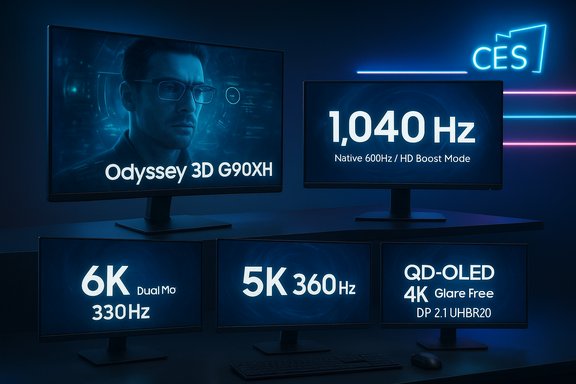
- Odyssey 3D (G90XH): 32‑inch 6K (6,144 × 3,456) IPS panel with glasses‑free 3D, real‑time eye tracking, native 165Hz that can run 330Hz in Dual Mode (3K), and 1ms GtG response. Samsung says the 3D experience is dynamically adjusted to viewer position and will ship with optimized titles and studio collaborations.
- Odyssey G6 (G60H): 27‑inch QHD monitor with native 600Hz support and a Dual Mode HD boost to 1,040Hz (note: Samsung states the 1,040Hz boost works only at HD resolution). The model is pitched squarely at competitive gamers chasing ultra‑fine motion clarity.
- Odyssey G8 family (G80HS / G80HF / G80SH): three variants that split the tradeoffs between resolution and speed: a 32‑inch 6K model at native 165Hz (Dual Mode up to 330Hz), a 27‑inch 5K model at native 180Hz (Dual Mode up to 360Hz), and a 32‑inch QD‑OLED 4K model with 240Hz and VESA DisplayHDR True Black 500 certification; the OLED G8 adds Glare Free coating and DP2.1 (UHBR20) 80Gbps support.
- Ports, VRR and ecosystem: Across the lineup Samsung advertises HDMI 2.1 and DisplayPort 2.1 on selected models, with AMD FreeSync Premium/FreeSync Premium Pro and NVIDIA G‑Sync Compatible support listed for stable VRR. The company cites IDC market share data to position Odyssey as the market leader for high‑refresh gaming monitors.
Deep dive: Odyssey 3D — glasses‑free 6K, but what does that actually mean?
How the tech works (short version)
Samsung’s Odyssey 3D uses a lenticular or light‑field front layer plus integrated eye‑tracking and view‑mapping logic to deliver separate images to the left and right eyes without glasses. The panel effectively renders two viewpoints (or a parallax map) and the front optics direct those views to the viewer’s eyes; eye tracking updates the mapping in real time to maintain the illusion as the viewer moves. That approach is consistent with what Samsung demonstrated at Gamescom and what reporters observed in earlier hands‑on coverage.Resolution and refresh: native 6K at 165Hz versus boosted 3K at 330Hz
Samsung’s spec sheet lists a 6,144 × 3,456 (6K) native resolution on a 32‑inch IPS panel. Native 6K at 165Hz is uncommon in desktop monitors and will require substantial GPU bandwidth for uncompressed playback; Samsung also lists a Dual Mode that runs at 3K and can be pushed to 330Hz. Practically, two realities should be emphasised:- Rendering real, high‑frame‑rate stereoscopic content at full 6K per eye would be massively demanding; Dual Mode and content optimizations are Samsung’s practical concessions to bandwidth and rendering realities.
- The 3D effect imposes constraints: glasses‑free stereoscopy usually produces a sweet spot for optimal depth perception and is typically single‑viewer or limited‑viewer by design, even with eye tracking. This technology trades viewer flexibility for a glasses‑free experience. Past glasses‑free demos required careful head positioning and sometimes had reduced brightness and contrast because of the lenticular layer. Early coverage noted these tradeoffs when Samsung first showed 3D prototypes.
Gaming support and studio partnerships
Samsung points to partnerships and title optimizations for an “expanded lineup” of games with dedicated 3D effects (examples cited by Samsung include The First Berserker: Khazan, Lies of P: Overture, and Stellar Blade). That signals two crucial facts:- The raw hardware is only part of the experience; the quality of glasses‑free 3D rests on content adaptation — per‑title depth maps, occlusion handling and UI considerations.
- At launch, expect a limited but curated set of optimized titles rather than universal 2D→3D magic across the library. Samsung’s press materials make this explicit.
Caveats and verification
Hands‑on reviews and measurement campaigns will determine whether Samsung’s 6K/3D combo is comfortable over long sessions and whether the performance scaling (visual fidelity versus refresh) meets users’ expectations. Early independent coverage supported the concept but flagged ergonomics and single‑viewer constraints as the usual tradeoffs for glasses‑free 3D. Readers should treat glasses‑free 3D as an experimental mainstreaming rather than a solved, universal experience at this stage.Deep dive: Odyssey G6 and the 1,040Hz claim — speed vs. usefulness
What Samsung says
The 27‑inch Odyssey G6 (G60H) advertises native QHD up to 600Hz and a Dual Mode HD boost to 1,040Hz (the release explicitly states the 1,040Hz figure is only available at HD). Samsung positions this model for competitive esports players who prize motion clarity and the tiniest perceptual advantages.Technical context and skepticism
Historically, refresh rates beyond 360–480Hz have been niche engineering showcases; the perceptual benefit of moving from 360Hz to 1,040Hz is marginal for nearly all players, constrained by human visual processing, input latency in the rest of the system (mouse, USB polling, GPU frame pacing) and the ability of game engines to deliver such frame rates. Samsung’s own footnote states the 1,040Hz mode runs only at lower resolution — a practical concession that reduces pixel count and bandwidth to enable higher scan rates. That’s consistent with earlier “overclocked” monitor modes where bandwidth and panel driving trade resolution for speed.No independent reviews or lab measurements have validated the practical benefits or the fidelity of the 1,040Hz mode at the time of announcement; journalists and testing labs will need to verify:
- Whether the panel genuinely updates at 1,040 discrete Hz (or whether interpolation/technical layering is used),
- The end‑to‑end input latency in 1,040Hz mode, and
- The real perceptual advantage under tournament conditions.
Odyssey G8 family: resolution, OLED, and real‑world use
Three distinct approaches
- G80HS (32", 6K): targets creators and sim‑owners who want a large workspace with a 6K canvas at native 165Hz with a Dual Mode to 330Hz.
- G80HF (27", 5K): prioritizes pixel density with 5K native at 180Hz and a QHD Dual Mode to 360Hz — a middle ground for creators who also game.
- G80SH (32", QD‑OLED 4K): a 4K QD‑OLED 240Hz monitor with Glare Free treatment and VESA DisplayHDR™ True Black 500, and DisplayPort 2.1 (UHBR20) supporting up to 80Gbps bandwidth for high‑bit‑depth, high‑refresh HDR playback. The OLED model also carries Samsung’s burn‑in mitigation and thermal measures.
DisplayPort 2.1 (UHBR20) and cable realities
Samsung lists DP2.1 (UHBR20) and an 80Gbps figure for select models. That bandwidth tier is part of the DisplayPort 2.1 specification: UHBR20 corresponds to an aggregate link capacity around 77–80Gbps before encoding overhead, and VESA has been active on DP80 cable specifications to make that bandwidth usable over practical cable lengths. However, the market reality is that DP2.1 UHBR20 capable devices and certified DP80 cables are still rolling out, and cable length, quality and device firmware all affect true performance in the field. Independent reporting on DP2.1 has highlighted that early DP2.1 systems often depend on carefully specified cables and that some monitors still rely on DSC (Display Stream Compression) for the highest modes. Readers should map their GPU output and cable choices before assuming full uncompressed 6K/240+Hz workflows will work out‑of‑the‑box.Practical implications for gamers and creators
For competitive gamers
- The G6’s headline boost to 1,040Hz positions Samsung as trying to win the “fastest refresh” narrative, but real performance gains depend on system latency, game engine frame generation and input devices. Professional players may find niche utility; most players will benefit more from stable, high frame rates combined with low input latency than from headline refresh numbers alone. Treat the claim cautiously until independent latency and frame‑pacing tests appear.
- VRR support across the lineup (FreeSync Premium Pro, G‑Sync Compatible) is essential in practice; the importance of robust VRR implementation is at least as great as peak Hz. Samsung lists certifications in its materials but notes some certifications will be completed at product launch.
For creators and hybrid users
- The G8 5K and 6K panels offer workspace advantages: greater pixel real estate at desktop screen sizes improves detail work, multi‑window editing and high‑res asset review without downscaling. The OLED 4K QD‑OLED option is compelling for color‑critical work with deep black levels, but buyers should consider brightness and HDR workflow needs against reported peak nit figures.
- DisplayPort 2.1 UHBR20 promises uncompressed high‑bit‑depth HDR at high refresh, but the ecosystem (GPU outputs, cables, drivers) must be matched carefully. VESA’s DP80 active cable work aims to make UHBR20 practical across longer cables — an important detail for desktop setups where the GPU may not be cheek‑by‑jowl with the monitor.
Ecosystem, availability and pricing
Samsung’s announcement presents the lineup and model numbers and confirms Samsung will showcase the full 2026 Odyssey range at CES 2026 (Jan 6–9, Las Vegas). The company did not publish global retail pricing in the headline release; historically, Samsung has used CES as a demonstration plus a staged pricing/availability rollout window, so expect regionally staggered SKUs and prices. Press materials show images, spec sheets and footnotes; independent outlets will likely publish hands‑on impressions and price information following CES demos and pre‑order windows.Strengths: where Samsung’s strategy makes sense
- Bold technical ambition: Samsung is pushing new display modalities — glasses‑free 3D at very high native resolution and extremely high refresh rate modes — which forces the industry to re‑examine user expectations for monitors. That innovation posture often catalyzes supply chain improvements (panel fabs, cable standards) and spurs software support from studios.
- Clear segmentation: the lineup maps directly to known user needs — immersion (3D/6K), pure speed (G6), and creative resolution (G8 5K/6K/OLED). That clarity helps buyers choose instead of being overwhelmed by one model trying to be everything.
- Standards alignment where it matters: inclusion of DisplayPort 2.1 (UHBR20) on higher‑end models, VESA HDR True Black certification on OLED, and stated VRR certifications demonstrate Samsung is aiming for technical interoperability rather than closed‑garden gimmicks. At the same time, real interoperability will depend on third‑party certification follow‑through and ecosystem maturity.
Risks, unknowns and realistic caveats
- Verification gap on headline claims: the most attention‑grabbing numbers (6K glasses‑free 3D and 1,040Hz) currently originate from Samsung’s release. Prior press coverage and demos show that Samsung has prototypes and early units, but independent lab validation of stability, latency, brightness and real‑world comfort is still required. Until rigorous reviews appear, treat the claims as manufacturer announcements, not established performance facts.
- Practical throughput and cabling: DisplayPort 2.1 UHBR20 (DP80) is part of the official standard, but certified DP80 cables and long‑run support are still catching up; early DP2.1 devices have shown cable and compatibility quirks. Users assembling full‑bandwidth workflows should carefully verify GPU, cable and monitor capabilities before purchase.
- Content ecosystem for 3D: glasses‑free stereoscopic systems need either native stereoscopic content or per‑title engineering to avoid artifacts and UI legibility issues. Samsung’s collaboration with studios on optimized titles is a sensible start, but broad, consistently high‑quality 2D→3D conversions at scale are difficult without robust tools and industry buy‑in. Expect a curated set of best‑in‑class experiences at launch rather than universal compatibility.
- Price and accessibility: historically, novel display tech arrives at premium price points; even if Samsung attempts competitive pricing, high bandwidth components, proprietary optics and calibration add cost. Early adopters should be prepared to pay a premium or wait for second‑wave pricing.
Quick buyer checklist
- Match your GPU and cables to the monitor: if you want DP2.1 UHBR20 modes, you need a DP2.1 UHBR20‑capable GPU output and a certified DP80/DP80LL cable.
- Decide whether you prioritize refresh or resolution: 6K native panels deliver workspace but will reduce max refresh in many GPUs; G6’s extreme Hz modes are available at lower resolution only.
- For 3D buyers: test for comfort — glasses‑free 3D remains sensitive to head position and is often best for single‑viewer, short‑session use. Look for studio‑optimized titles if gaming is the use case.
- Wait for independent lab results if you need verified latency, brightness and burn‑in behavior (especially for OLED models).
Conclusion
Samsung’s 2026 Odyssey lineup is a deliberate effort to reshape expectations: it pairs experimental spectacle — a 6K glasses‑free 3D monitor — with extreme competitive engineering — a 1,040Hz boost mode — and fills the rest of the portfolio with higher‑resolution options that cater to creators. The product announcements are technically credible on paper: the implementations described use known methods (lenticular optics + eye tracking for glasses‑free 3D; resolution‑reducing “Dual Modes” for ultra‑high refresh) and align with evolving standards like DisplayPort 2.1 (UHBR20). However, the industry now needs independent laboratory testing and broader ecosystem confirmation before callers can treat these specifications as settled realities — especially for the most headline‑grabbing items. Early reporting and past Samsung demos show promise for the tech, but measurable verification (latency, sustained brightness, ergonomic comfort, cable/driver compatibility) will define whether these monitors are category‑defining or simply a compelling showcase of what’s technically possible.Samsung will have the full lineup on display at CES 2026; that will be the earliest point for extended hands‑on coverage and lab measurements from independent outlets. For buyers and IT pros assessing these monitors for competitive playrooms, creative desks, or demo rigs, the sensible options are clear: plan for the right GPU/cable match, prioritize tested VRR and latency figures over headline Hz, and treat early 3D experiences as specialized — exciting, but not yet ubiquitous.
Source: samsung.com Samsung Unveils New Odyssey Gaming Monitor Lineup, Featuring World-First 6K 3D and Ultra-High-Resolution Displays
