

SAP’s new EU AI Cloud is a bold attempt to package sovereignty, scale and partner-driven model choice into a single enterprise offering for Europe’s regulated customers, combining SAP’s sovereign cloud stack and local operations with integrated models from Cohere, Mistral AI, OpenAI and others while promising flexible SaaS/PaaS/IaaS consumption and deployment across SAP data centers, trusted European infrastructure and managed on‑site installations.
Europe’s policy and commercial debate over data sovereignty and AI control has moved from rhetoric to investment. SAP’s EU AI Cloud is the company’s latest public statement of strategy: a full‑stack, “sovereign” AI and cloud offering intended to let enterprises and public bodies run generative AI and related workloads under local control and legal frameworks. The offering consolidates previous sovereign initiatives—SAP Cloud Infrastructure, SAP Sovereign Cloud On‑Site and Delos Cloud—into a unified product framing that emphasizes EU data residency, legal/operational sovereignty and partner model access.
SAP positions the program as flexible: customers can consume partner models and applications (for example, through SAP Business Technology Platform) as Software‑as‑a‑Service (SaaS), Platform‑as‑a‑Service (PaaS) or Infrastructure‑as‑a‑Service (IaaS). That combination seeks to address both organizations that want a managed cloud experience and those that require the tightest possible physical and legal control.
Caveat: published counts (for example, regional location totals and the GPU figure) often come from company statements or aggregated press coverage. Some figures are forward‑looking targets rather than immediate operational capacity. Buyers and analysts should treat them as plans and commitments rather than guarantees of immediate availability.
Delos Cloud plus on‑site offerings lower the barrier for public agencies to trial advanced models while keeping governance controls intact. The combination of SAP’s enterprise application integration and partner models (including OpenAI in a German‑specific arrangement) is positioned to speed adoption where hyperscaler solutions have been resisted on sovereignty grounds.
The proposition’s greatest strengths are enterprise integration, a credible capital commitment and an ecosystem approach that blends European and global model access. Its greatest risks are operational complexity, the practical limits of hardware scaling (GPUs), and the legal fuzziness that still surrounds sovereignty claims.
For organizations operating under strict regulatory obligations, SAP EU AI Cloud offers a viable path to deploy generative AI within European legal boundaries — provided buyers insist on concrete SLAs, audited proof of separation, and contractual protections. For the broader market, the offering marks a notable evolution in how major enterprise vendors are translating geopolitical concerns about data and AI into commercial products.
The next 12–24 months will be decisive: customers will test the durability of SAP’s sovereignty claims in real projects, vendors will be judged on delivered GPU capacity and latency, and European policymakers will refine the regulatory frames that make — or break — sovereign cloud economics.
Source: Data Center Dynamics SAP launches EU AI Cloud offering
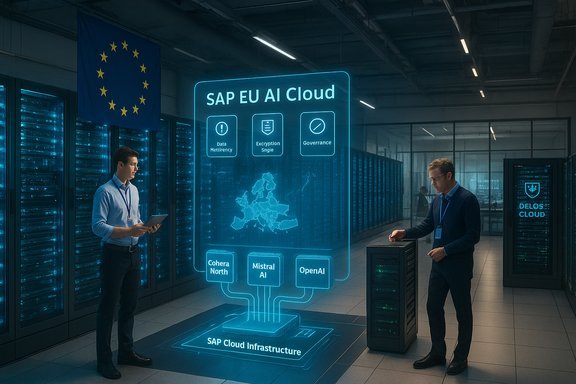 Background / Overview
Europe’s policy and commercial debate over data sovereignty and AI control has moved from rhetoric to investment. SAP’s EU AI Cloud is the company’s latest public statement of strategy: a full‑stack, “sovereign” AI and cloud offering intended to let enterprises and public bodies run generative AI and related workloads under local control and legal frameworks. The offering consolidates previous sovereign initiatives—SAP Cloud Infrastructure, SAP Sovereign Cloud On‑Site and Delos Cloud—into a unified product framing that emphasizes EU data residency, legal/operational sovereignty and partner model access.SAP positions the program as flexible: customers can consume partner models and applications (for example, through SAP Business Technology Platform) as Software‑as‑a‑Service (SaaS), Platform‑as‑a‑Service (PaaS) or Infrastructure‑as‑a‑Service (IaaS). That combination seeks to address both organizations that want a managed cloud experience and those that require the tightest possible physical and legal control.
What SAP EU AI Cloud actually offers
Core promise: sovereignty plus choice
At its core, the EU AI Cloud is framed around three intertwined promises:- Data residency and legal sovereignty — keep data inside EU borders and operate under European legal and compliance constraints.
- Operational sovereignty — deliver managed services from SAP or trusted European partners with local personnel and processes.
- Model and platform choice — integrate third‑party foundation models and agent frameworks while providing SAP’s own platform and abstraction layers.
Deployment models explained
SAP describes four primary deployment choices inside the EU AI Cloud framework:- SAP Sovereign Cloud on SAP Cloud Infrastructure (IaaS): an SAP‑operated stack using open‑source building blocks, hosted in SAP’s European data centers so that data and inference happen in the EU.
- SAP Sovereign Cloud On‑Site: SAP operates infrastructure inside a customer‑selected or customer‑owned data center for maximum operational and legal control.
- Selected hyperscalers per market: for customers that accept hyperscaler infrastructure but require sovereignty features, SAP will enable market‑specific hyperscaler options.
- Delos Cloud (Germany): a market‑specific sovereign cloud run by SAP on top of Microsoft Azure technology but operated by SAP to meet German sovereignty requirements.
Partners and technical ecosystem
Cohere North: agentic capabilities inside the stack
SAP announced a strategic tie‑in with Cohere to deliver agentic and multimodal AI capabilities via Cohere North, integrated into SAP Business Technology Platform (BTP). The aim is to allow enterprises with strict data residency or compliance needs to use agent frameworks and multimodal models without letting data leave sovereign boundaries. In practical terms, that means Cohere’s models and agent tooling will be callable from SAP BTP under the protections and residency guarantees SAP provides.Mistral AI, OpenAI and other models
SAP explicitly lists Mistral AI and OpenAI among partners whose models and applications can be integrated directly into SAP BTP and consumed inside EU AI Cloud. That hybrid approach — combining European and global model providers — is intended to solve a difficult problem: give customers access to the most advanced models while preserving regional control and legal assurances.Delos Cloud and the Microsoft layer
Delos Cloud, SAP’s German sovereign offering, is notable because it runs on Microsoft Azure technology while being managed by SAP independently of Microsoft. For customers who need German‑specific safeguards — physically isolated data center facilities and SAP‑operated services — Delos is the targeted channel. OpenAI has already announced a German‑facing partnership that will use Delos Cloud as the delivery mechanism for public sector services, and SAP has signalled expansion of Delos capacity for AI workloads.Infrastructure scale and investment: the numbers that matter
SAP’s announcements include several headline numbers that require careful reading.- SAP publicly stated a multi‑year investment plan of more than €20 billion to expand sovereign cloud and AI capabilities across Europe. That figure has been repeated across SAP communications and industry reporting as the strategic budget to build and adapt infrastructure, software and services aimed at digital sovereignty.
- For Germany’s Delos Cloud specifically, SAP and partners have discussed scaling to 4,000 GPUs dedicated to AI workloads as an initial hardware footprint to support sovereign deployments, with the option to scale further depending on demand.
- SAP has also described a broad global footprint of SAP‑operated or partner locations: dozens of data center presences spanning North America, South America, Europe, Africa, Asia and Australasia. Exact counts in published summaries vary according to whether partner colocation and hyperscaler regions are included.
Caveat: published counts (for example, regional location totals and the GPU figure) often come from company statements or aggregated press coverage. Some figures are forward‑looking targets rather than immediate operational capacity. Buyers and analysts should treat them as plans and commitments rather than guarantees of immediate availability.
How the EU AI Cloud works technically (high level)
A software abstraction and deployment fabric
SAP’s approach centers on a software abstraction layer built on SAP Cloud Infrastructure + SAP BTP, which acts as the platform to orchestrate workloads, models and data access. That layer handles model lifecycle, access controls, logging, and integration with SAP enterprise applications. It serves two major purposes:- Provide a consistent API and development experience across different physical deployments (SAP IaaS, Delos, on‑site, hyperscaler).
- Enforce sovereign controls — ensuring data residency, encryption key management and operational separation where required.
Data flows and control points
SAP’s messaging emphasizes three control points for sovereignty:- Data location — ensuring all storage and processing occur within the EU/target country region.
- Operational access — restricting who can access systems and logs, with the option for local staffing and audited processes.
- Legal governance — contracts, SLAs and on‑site operation models that reduce legal exposure to extraterritorial access claims.
Strategic implications for Europe’s cloud and AI market
For European public sector and regulated industries
The EU AI Cloud is squarely targeted at customers who live under stringent data protection or national security rules — governments, defense contractors, healthcare, utilities and critical infrastructure. For those buyers, verifiable data residency and operational controls are often prerequisites to deploying generative AI at scale.Delos Cloud plus on‑site offerings lower the barrier for public agencies to trial advanced models while keeping governance controls intact. The combination of SAP’s enterprise application integration and partner models (including OpenAI in a German‑specific arrangement) is positioned to speed adoption where hyperscaler solutions have been resisted on sovereignty grounds.
For hyperscalers and non‑European model providers
SAP’s move is not a direct infrastructure rivalry to hyperscalers at hyperscale, but it is a strategic pivot: instead of trying to match hyperscalers on raw data center scale, SAP is aggregating sovereignty features, managed operation and enterprise workflow integration. Hyperscalers still dominate raw capacity and developer ecosystems, but SAP’s strategy could win pockets of regulated demand that value legal controls over marginally lower costs or broader ecosystem breadth.For model economics and European AI ecosystem
By integrating European models (like Mistral) alongside global leaders and regionalized deployments of major model vendors, SAP is building a “model of models” ecosystem. That could accelerate commercial activity around European model builders and create commercial paths for them inside enterprise customers that previously relied on hyperscaler and US‑centric stacks.Strengths of SAP’s EU AI Cloud proposition
- Enterprise integration: SAP’s long experience with ERP, finance and operations systems gives it a major edge in embedding AI into business workflows rather than offering stand‑alone models.
- Choice and flexibility: Multiple deployment models (IaaS, on‑site, hyperscaler, Delos) let customers select trade‑offs between control, cost and speed.
- Partner‑first model access: Integrating models from Cohere, Mistral, OpenAI and others removes the “single‑model” constraint and lets customers choose industry‑fit models under sovereign constraints.
- Regulatory fit: A sovereign stack designed for EU data residency and legal controls is aligned with the priorities of public sector and regulated industries.
- Capital commitment: A multi‑billion euro investment plan signals seriousness and the ability to put money behind infrastructure and personnel investments.
Potential risks and limitations
1) Sovereignty is as much legal and procedural as it is technical
Keeping data inside EU boundaries is necessary but not sufficient. Sovereignty claims hinge on legal constructs, access controls, staff nationality, contractual terms and the ability to resist foreign legal orders. Customers must validate operational processes, auditability and contractual rights — not just the physical geography of servers.2) Scale, GPU availability and timing
The reported intent to deploy 4,000 GPUs in Delos is an early capacity indicator, but enterprise AI demand can be spiky and the hardware ecosystem (NVIDIA accelerators and data center GPUs) remains constrained. Customers should treat announced GPU counts as targets and verify scheduling, instance types and SLAs for model training vs. inference.3) Complexity and cost
A sovereign on‑site deployment managed by SAP may carry materially higher operational costs than multi‑tenant hyperscaler alternatives. For many customers, the sovereignty premium will require explicit budget approvals and ongoing operational funding.4) Vendor and operational lock‑in
While the offering promises choice of models, the practical integration depth of SAP BTP and SAP applications could create operational lock‑in — making it costly to re‑platform later. Technical and contractual exit strategies must be part of procurement evaluations.5) Ecosystem dependencies
Delos Cloud runs on Azure technology under SAP’s management for German customers. While that hybrid approach delivers technical and commercial benefits, it re‑introduces dependency on a major hyperscaler’s software stack. Customers with maximal sovereignty needs will want to inspect SAP’s separation controls and audit processes.6) Regulatory uncertainty
European regulation of AI (for example the EU AI Act and national interpretations) remains an evolving field. Any sovereign AI offering must absorb regulatory changes quickly; customers must plan for compliance drift, audits and potential re‑engineering costs.What enterprises and public sector buyers should look for
When evaluating SAP EU AI Cloud or comparable sovereign offers, procurement and technical teams should consider the following checklist:- Contracts and legal guarantees:
- Clear data residency clauses
- Audit rights and third‑party attestation controls
- Clauses protecting against extraterritorial access (to the extent feasible)
- Operational independence:
- Local staffing models and escalation procedures
- Proof of physical separation for Delos or equivalent deployments
- On‑site inspection rights and routine compliance reporting
- Technical details and SLAs:
- Exact GPU instance types, quotas and latency guarantees
- Backup, disaster recovery and cross‑region failover within the EU
- Encryption key custody (customer‑held vs. provider‑held)
- Model governance:
- Model lineage and provenance tracking
- Fine‑tuning and retraining policies with private data
- Explainability, red teaming and safety certification procedures
- Exit and portability:
- Data export paths and format guarantees
- Application portability guidance and migration costs
- Third‑party validation for model drift and data deletion
Competitive and geopolitical consequences
SAP’s EU AI Cloud is both a commercial product and a geopolitical statement. Europe’s push for digital sovereignty is partially a response to concerns about dependence on non‑European hyperscalers and non‑EU model providers. Market‑level effects could include:- Acceleration of European model builders and hosting providers as they find clearer enterprise commercialization channels.
- More sovereign partnerships (national or regional) between European vendors and global model providers who can offer localized, compliant instances.
- Hyperscalers doubling down on regional sovereignty variants to retain large enterprise business, potentially leading to more sovereign clouds run by major US cloud providers but operated under local controls.
Technical and procurement recommendations
- For critical systems, prefer the SAP Sovereign Cloud On‑Site model when the legal risk of data access or cross‑border subpoenas is intolerable.
- For rapid pilots or analytics workloads, the SAP IaaS in EU data centers or Delos Cloud options may provide the quickest path to production while meeting residency rules.
- Negotiate GPU capacity and instance commitments in procurement, not just “availability targets,” and include penalty clauses for missed capacity promises.
- Demand transparency about third‑party software stacks (e.g., Azure components used by Delos) and independent evidence of physical separation measures.
- Include regulatory change clauses that require provider participation in future compliance remediation if the legal landscape shifts.
Final assessment
SAP EU AI Cloud is a carefully constructed product narrative that stitches together SAP’s sovereign cloud ambitions, its enterprise application strengths and a pragmatic approach to partner models. It recognizes a real market need: many European organizations want advanced AI but cannot accept the legal and operational exposure that comes with typical multi‑region hyperscaler deployments.The proposition’s greatest strengths are enterprise integration, a credible capital commitment and an ecosystem approach that blends European and global model access. Its greatest risks are operational complexity, the practical limits of hardware scaling (GPUs), and the legal fuzziness that still surrounds sovereignty claims.
For organizations operating under strict regulatory obligations, SAP EU AI Cloud offers a viable path to deploy generative AI within European legal boundaries — provided buyers insist on concrete SLAs, audited proof of separation, and contractual protections. For the broader market, the offering marks a notable evolution in how major enterprise vendors are translating geopolitical concerns about data and AI into commercial products.
The next 12–24 months will be decisive: customers will test the durability of SAP’s sovereignty claims in real projects, vendors will be judged on delivered GPU capacity and latency, and European policymakers will refine the regulatory frames that make — or break — sovereign cloud economics.
Source: Data Center Dynamics SAP launches EU AI Cloud offering
