

Sarat Piridi’s recent recognition and practical playbook for enterprise modernization underscore a consistent message: built-in governance, cloud-first architectures, and contextual AI are the difference between brittle pilots and reliable, production-grade platforms. In 2025 he was named a recipient of a Global Recognition Award for his work as a Microsoft‑certified Power Platform and Azure developer and solution architect, a milestone that highlights a portfolio of projects spanning finance, energy, retail IT and public-sector modernization.
Sarat Piridi has built a career on solving operational problems with pragmatic software design — not flashy point solutions but unified digital workspaces, lifecycle discipline, and governance‑first engineering. Public profiles and his author bio for a 2025 Apress book describe more than a decade of work delivering low‑code modernization, CI/CD for Power Platform, and AI‑enabled user experiences that surface analytics where people work. Those public summaries and his speaker profile position him as a practitioner who combines Power Platform, Azure services, and Microsoft Copilot‑era tooling into repeatable enterprise patterns. At a glance: what the public record shows
Key governance elements he advocates
Note on verification: where the public record references specific large‑scale figures (for example book publisher bios that attribute “one million support cases per day” to a named project), those claims originate in author and publisher materials and should be subject to direct verification (project scope, reporting windows, dashboards) before being used as comparative benchmarks in procurement or vendor selection.
Source: Digital Journal How Sarat Piridi builds reliable, AI-driven platforms that strengthen enterprise operations
 Background
Sarat Piridi has built a career on solving operational problems with pragmatic software design — not flashy point solutions but unified digital workspaces, lifecycle discipline, and governance‑first engineering. Public profiles and his author bio for a 2025 Apress book describe more than a decade of work delivering low‑code modernization, CI/CD for Power Platform, and AI‑enabled user experiences that surface analytics where people work. Those public summaries and his speaker profile position him as a practitioner who combines Power Platform, Azure services, and Microsoft Copilot‑era tooling into repeatable enterprise patterns. At a glance: what the public record shows- Recognition: 2025 Global Recognition Award for enterprise Power Platform and Azure work.
- Book: GovOps with Microsoft Power Platform and Copilot (Apress, 2025) — a practical handbook aimed at public‑sector modernization with low‑code, Copilot, and governance playbooks.
- Public materials and speaker profiles describe large internal programs (e.g., enterprise Command Center apps at Silicon Valley Bank, CI/CD pipelines at Hanwha‑Qcells), and a background of Microsoft certifications and practitioner experience.
How Piridi frames the problem: one platform, not many islands
Sarat Piridi repeatedly frames his work as unifying fragmented processes into a single operational interface — a digital workspace where users can see context, act, and trust the outputs. This pattern is explicit in accounts of the “Command Center” Canvas app and in the governance playbooks he teaches in his book: centralize the workflow, ground recommendations in enterprise data, and keep human judgement as the safety valve for high‑impact decisions. Why this matters for enterprise AI and low‑code adoption- Context: AI is most useful when recommendations appear inside the tools people already use (Power Apps, Teams, Dynamics UIs), not as separate dashboards.
- Continuity: Preserving business logic during modernization reduces risk; the objective is evolution, not a big‑bang rewrite.
- Trust: Operational adoption depends on observable provenance — who/what made a recommendation, what data supported it, and whether control gates exist for sensitive outcomes.
The technical building blocks Piridi uses
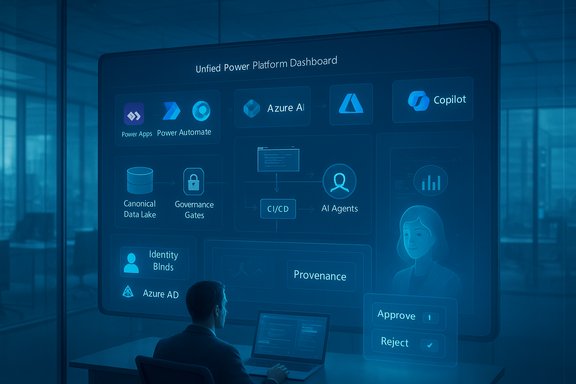
Sarat’s public narrative and his book make clear which parts of the Microsoft stack and adjacent practices he relies on to make AI‑driven platforms reliable and maintainable.Core platform components
- Microsoft Power Platform (Power Apps, Power Automate, Power BI, Dataverse) as the low‑code glue that ties UI, automation, and data together. This is the primary surface for end users and citizen makers.
- Microsoft Copilot and Copilot Studio to author, embed, and govern agents and conversational assistants inside business apps. Copilot provides the conversational UX and model runtime hooks for retrieval‑grounded outcomes.
- Azure AI services (Azure AI Vision, Azure AI Language, Azure OpenAI / Foundry primitives) for multimodal processing, extraction, and model hosting. These enable image processing, structured data extraction, and model inference close to the data.
- CI/CD and environment pipelines for Power Platform and Azure — automations and governance checks promote reproducible deployments across Dev → UAT → Prod. These are central to maintaining long‑term reliability.
Patterns and integrations
- Retrieval‑augmented generation (RAG) and canonical data lakes to ground model outputs in enterprise records. RAG is a critical guard against hallucination and a requirement for auditable recommendations.
- Role‑based access and identity binding (Azure AD groups, Dataverse security roles) to limit what agents and copilots can access and to ensure traceability of actions.
- Automated deployment checks and lifecycle governance — preflight checks, automated policy enforcement, and environment‑based controls so releases are predictable even without a large DevOps org.
AI features that are integrated—not bolted on
Piridi’s platforms emphasize pragmatic AI features that appear directly in users’ daily workstreams.- Predictive analytics surfaced as recommendations: predictive scoring or “Top 3” recommendations are embedded into the workspace so a user’s next action is explicit and supported by model output. This pattern improves decision velocity while ensuring that final judgement remains human.
- Conversational interfaces and voice prompts: Copilot‑style conversational layers reduce friction and let domain experts interact with data without switching contexts. When combined with connector fabrics, this produces a usable, multi‑channel experience.
- AI‑assisted image processing and automated language interpretation: vision services and language models are used to extract structured data from documents and images, reducing repetitive manual extraction and improving operational accuracy.
Governance and operational guardrails: the non‑sexy but essential work
A recurring theme in Piridi’s public materials and his book is that governance, ALM and lifecycle controls are not optional extras — they are the foundation for reliable platforms.Key governance elements he advocates
- Environment‑based separation: enforce Dev → Test → Prod pipelines with automated controls and policy gates. This prevents risky changes from reaching production and enables rollback patterns.
- Identity and access binding: register agents and services with Azure AD, map them to cost centers and owners, and tie permissions to concrete business roles. This reduces “shadow AI” risk and orphaned identities.
- Automated deployment checks and observability: telemetry, OpenTelemetry‑style tracing for agent actions, and consumption controls (Copilot credits, tenant limits) to prevent runaway costs and to allow forensic review.
- Human‑in‑the‑loop for high‑impact decisions: mandatory reviews for regulated or high‑risk actions, with audit trails and provenance for every recommendation.
Community, authorship and influence: turning craft into reproducible playbooks
Piridi contributes to community knowledge through articles, speaking engagements, and a technical book that packages governance playbooks and agentic‑AI patterns for public‑sector use. His 2025 book GovOps aims to give public‑sector architects a replicable modernization roadmap, including CI/CD, ALM, Copilot Studio integration, and operational governance. The book’s availability across major retailers and the associated author bios provide evidence of the intentional effort to codify these practices. He is also co‑author on academic and practitioner papers that explore agentic AI for public services, including an SSRN report on autonomous agents in government workflows that describes event‑driven architectures and governance patterns. Those materials place his practical work within a broader, research‑aware context.Measurable outcomes — claims and confirmations
Public descriptions of Piridi’s projects include concrete metrics: system adoption counts, reductions in operational latency, and the number of deployments handled. The Global Recognition Awards profile and publisher bios attribute outcomes such as a 50% reduction in CRM query latency and more than 150 Dev→UAT→Prod deployments without a dedicated DevOps team. These figures appear in multiple public profiles and publisher materials, suggesting they originate from project reporting and the author’s own summaries. A careful reader should note:- Where multiple independent outlets (award page, book publisher listings, session profiles) repeat the same project metrics, the claims gain corroborative weight.
- Some highly specific numbers (for example a publisher bio statement that a “Unified Premier” project handled up to one million support cases per day) are drawn from author/ publisher descriptions and are difficult to independently validate from public third‑party sources. Such claims should be treated as publisher‑reported and subject to direct verification if used for procurement or benchmarking.
Strengths in Piridi’s approach
- User‑first integration of AI: embedding analytics and recommendations where workers act reduces cognitive overhead and improves adoption. This is a well‑proven pattern for delivering measurable productivity gains.
- Governance as engineering: treating lifecycle management, identity binding, and environment separation as first‑class engineering problems prevents brittle systems and shadow deployments.
- Pragmatic use of low‑code and cloud tooling: the coupling of Power Platform for UI/automation with Azure AI for model inference and Copilot Studio for agents creates a practical, enterprise‑ready stack. This reduces hand‑coding and speeds pilots into production without sacrificing controls.
- Community and codification: publishing a book and technical papers helps other architects replicate the patterns and governance playbooks rather than re‑discovering them in each organization.
Risks and limitations to watch
- Publisher and profile claims need verification: author bios and award summaries sometimes cite large numbers (deployments, case volumes) that are likely accurate but originate with the practitioner or publisher. Organizations should request project dashboards, scope definitions, and audit logs when evaluating such claims for procurement decisions.
- Data quality remains the gating factor: no amount of model tuning replaces the need for canonical master data, clean indexes, and reliable retrieval. Agentic systems built on poor data will not be reliable. Many industry threads emphasize the primacy of master‑data management before agentic deployment.
- Operational cost and consumption unpredictability: agentic workloads invoke model inference, storage and retrieval costs. Without accurate consumption modeling and billing controls (Copilot credits, tenant caps), costs can escalate unpredictably. Practitioners must plan capacity and cost KPIs.
- Model validation and explainability: generative outputs can hallucinate. The industry consensus — echoed in governance playbooks — is to require provenance, confidence scores, and mandatory human approval for critical actions. Systems must log the evidence and models used for every recommendation.
Practical checklist distilled from Piridi’s playbook
- Start with a narrow, high‑value pilot that touches low‑risk processes (e.g., invoice OCR → matching, meeting summarization).
- Build a canonical data layer (Dataverse/OneLake) and RAG index before connecting agents to production data.
- Register agents and services as identity objects in Azure AD and map owners, cost centers and SLOs.
- Automate preflight checks and policy gates in CI/CD pipelines for Power Platform and Azure.
- Implement observability: traces, telemetry, provenance for recommendations, and human‑in‑the‑loop controls for decisions with legal or financial impact.
- Track cost and consumption KPIs (tokens, inference calls, storage) and enforce quotas to avoid surprise bills.
Conclusion
Sarat Piridi’s work exemplifies a useful, discipline‑driven approach to building AI‑driven enterprise platforms: make AI a contextual helper, not an isolated experiment; bake governance and lifecycle controls into engineering practices; and package what you learn as playbooks so others can reuse the approach. His 2025 recognition and published GovOps playbook are evidence of both practitioner impact and an explicit attempt to codify lessons for the public sector and enterprise IT teams. Practical teams evaluating a similar path to production‑grade, AI‑enabled automation should embrace the same core tradeoffs Piridi recommends: place governance at the center, ground model outputs in canonical data, instrument everything for observability, and prioritize incremental, measurable outcomes over broad, speculative automation. For enterprise leaders aiming to modernize operations with Power Platform, Copilot, and Azure AI, those are the guardrails that turn innovation into durable operational advantage.Note on verification: where the public record references specific large‑scale figures (for example book publisher bios that attribute “one million support cases per day” to a named project), those claims originate in author and publisher materials and should be subject to direct verification (project scope, reporting windows, dashboards) before being used as comparative benchmarks in procurement or vendor selection.
Source: Digital Journal How Sarat Piridi builds reliable, AI-driven platforms that strengthen enterprise operations
