

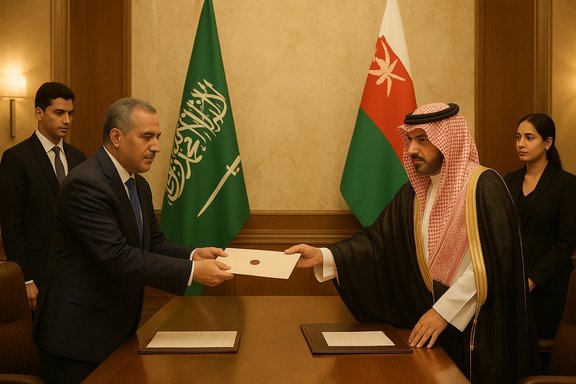
Prince Mohammed bin Salman received a written message from Sultan Haitham bin Tariq of Oman, delivered in Riyadh by Oman’s ambassador and received on behalf of the Crown Prince by Saudi Deputy Foreign Minister Waleed bin Abdulkarim Al‑Khereiji, in a diplomatic exchange that Riyadh framed as a routine but constructive review of bilateral ties and areas for cooperation.
Saudi Arabia and Oman share a long history of pragmatic, low‑drama diplomacy in the Gulf, shaped by geography, trade, and an often‑complementary approach to regional crises. The recent written message follows earlier exchanges between the two monarchies and is consistent with a pattern of formal missives, ambassadorial contacts, and working‑level talks that aim to maintain steady relations and explore practical cooperation in trade, security and infrastructure. Over the past decade, the two countries have pursued closer economic and security ties while carefully managing differences over regional policy. Oman has cultivated a distinctive diplomatic role—often acting as a mediator or a discreet interlocutor between larger regional powers—while Saudi Arabia has focused on deepening economic diversification and infrastructure initiatives under its national reform agenda. The written message should be read against this background of sustained, if low‑profile, engagement.
For policy watchers, companies, and regional stakeholders, this exchange should be logged as a positive indicator of continuity in Saudi‑Omani relations that merits attention for downstream, verifiable actions—ministerial visits, technical MOUs, or co‑financed projects—rather than as a moment of immediate breakthrough. Any assertion of major new agreements should be treated as unverified until formal documentation or cross‑ministerial announcements appear.
The recent reporting makes clear that the exchange occurred on January 15–16, 2026, and that it was carried by Oman’s ambassador and received by Saudi Deputy Foreign Minister Waleed Al‑Khereiji on behalf of the Crown Prince; these specific operational details are confirmed by multiple regional outlets. Readers and stakeholders should therefore treat the message as a durable, routine element of Gulf statecraft—one that sets the stage for potential cooperation but does not, by itself, constitute an actionable bilateral deal.
Source: MSN https://www.msn.com/en-ae/news/othe...tten-message-from-sultan-of-oman/ar-AA1Uke1j]
 Background
Saudi Arabia and Oman share a long history of pragmatic, low‑drama diplomacy in the Gulf, shaped by geography, trade, and an often‑complementary approach to regional crises. The recent written message follows earlier exchanges between the two monarchies and is consistent with a pattern of formal missives, ambassadorial contacts, and working‑level talks that aim to maintain steady relations and explore practical cooperation in trade, security and infrastructure. Over the past decade, the two countries have pursued closer economic and security ties while carefully managing differences over regional policy. Oman has cultivated a distinctive diplomatic role—often acting as a mediator or a discreet interlocutor between larger regional powers—while Saudi Arabia has focused on deepening economic diversification and infrastructure initiatives under its national reform agenda. The written message should be read against this background of sustained, if low‑profile, engagement. What happened — the facts, verified
- The exchange took place in Riyadh and centers on a written message that Sultan Haitham bin Tariq sent to Crown Prince Mohammed bin Salman. Multiple Saudi and Omani outlets reported the event on January 15–16, 2026.
- The message was handed to Saudi Deputy Foreign Minister Waleed bin Abdulkarim Al‑Khereiji during a meeting with Oman’s ambassador to Riyadh, Sayyid Najib bin Hilal Al‑Busaidi (also reported as Najib Al‑Busaidi). The meeting included a review of bilateral relations and discussion of ways to bolster cooperation across several fields.
- Saudi state media and regional outlets characterized the content as relating to “relations between the two countries” and “topics of mutual interest,” language typically used in formal diplomatic communiqués that prioritize continuity and constructive engagement rather than headline‑grabbing announcements.
Why such exchanges matter: a practical view
A short written message might look ceremonial at first glance, but in Gulf diplomacy these exchanges serve several concrete functions.- They maintain open channels of communication at the highest levels and can set the tone for future negotiations or visits.
- They provide a formal, recordable step in a sequence of engagement that may later yield memoranda of understanding, trade agreements, or joint projects.
- They enable leaders to test positions or express goodwill without committing to public policy shifts.
Oman‑Saudi ties: continuity, not a reset
Historical patterns
Oman and Saudi Arabia have traditionally favored a pragmatic, interest‑based partnership rather than ideational alignment. Oman’s foreign policy is often described as quiet diplomacy: it engages broadly, sometimes acting as a backchannel in regional disputes, while preserving national autonomy. Saudi Arabia, meanwhile, pursues strategic modernization and economic diversification, exporting an agenda that benefits from stable neighborhood relations. The recent written message conforms to established practice rather than signaling a sudden shift.Recent precedents
This exchange is one of several diplomatic notes and visits between the two governments in the last year. For example, Riyadh and Muscat have previously exchanged written communications about major events and invitations, including cultural and economic initiatives. That reciprocity—messages moving both ways—illustrates the normal diplomatic traffic that keeps relations functional and forward looking.Diplomatic mechanics: who did what, and why it matters
The actors
- Sultan Haitham bin Tariq: Oman’s head of state and foreign policy lead, who uses formal messages to articulate priorities or goodwill.
- Prince Mohammed bin Salman: Saudi Arabia’s Crown Prince and Prime Minister, who centrally directs Riyadh’s foreign policy engagements.
- Sayyid Najib bin Hilal Al‑Busaidi / Najib Al‑Busaidi: Oman’s ambassador to Saudi Arabia, who physically delivered the message.
- Waleed bin Abdulkarim Al‑Khereiji: Saudi Deputy Foreign Minister, who received the message on the Crown Prince’s behalf.
Why an ambassador delivers written messages
Ambassadors are the formal instrumentalities of state‑to‑state communication. A written message delivered by an ambassador and received by a deputy minister carries multiple advantages:- It is traceable and becomes part of the formal diplomatic record.
- It allows the receiving side to respond through equivalent channels without escalating the rhetoric.
- It preserves the sovereign dignity of both parties while enabling precise wording that may not be suitable for public press statements.
Strategic and economic context: issues likely on the agenda
While the official reports were brief and non‑specific, there are a set of recurring areas where Saudi‑Omani cooperation is both natural and strategically useful. These are the domains most likely to feature in follow‑up talks or coordination:- Energy and infrastructure: Given both countries’ stakes in Gulf hydrocarbon markets and infrastructure projects, cooperation on energy shipments, pipelines, or joint investment vehicles is plausible.
- Trade and ports: Oman’s ports and logistics networks complement Saudi Arabia’s broader economic corridors; commercial linkages are a practical area for expansion.
- Security and maritime coordination: The Arabian Sea and the Strait of Hormuz are strategic waterways. Practical coordination on maritime security and counter‑smuggling or counterterrorism efforts benefits both capitals.
- Transport and connectivity: Air routes, overland transit, and customs facilitation are concrete, revenue‑generating areas that can be advanced without major political risk.
- Labour and consular affairs: Large expatriate communities and business flows require routine bureaucratic coordination—an often overlooked but important source of bilateral friction and opportunity.
Implications for Gulf diplomacy and regional stability
Reinforcing steady diplomacy
In the current regional environment—marked by interstate tensions, shifting alignments, and external great‑power involvement—steady, routine communication among Gulf states reduces the risk of miscalculation. Regular diplomatic contact, even by way of short messages, contributes to crisis avoidance and faster coordination when trouble arises.Buffering against volatility
Oman’s role as a pragmatic middle actor and Saudi Arabia’s growing regional influence mean that closer operational coordination can help stabilize responses to regional shocks, whether in Yemen, the Red Sea, or the Levant. Cooperation on humanitarian corridors, de‑escalation mechanisms, or information sharing around maritime threats would all be facilitated by stronger institutional ties.Economic signaling
For markets and investors watching the Gulf, routine diplomatic exchanges signal a baseline of stability that underpins cross‑border projects and foreign direct investment decisions. While a written message alone is not a trade pact, it helps maintain the confidence necessary for longer‑term economic cooperation.Strengths of the move — immediate positives
- Low‑risk engagement: The exchange reaffirms relations without forcing public commitments, allowing both countries to preserve flexibility.
- Institutional continuity: The act of delivering and receiving a formal message strengthens bureaucratic channels and procedural norms.
- Platform for near‑term cooperation: It creates an opening for ministerial follow‑ups on trade, energy or transport projects already under discussion.
- Positive optics: For international observers and markets, this signals that the Gulf’s major states are maintaining predictable diplomatic routines.
Risks, limits, and things to watch
What this is not
- It is not a treaty, joint communiqué, or headline announcement of a major policy pivot. Official communiqués carefully avoid overstating such exchanges; readers should not interpret a written note as an automatic precursor to sweeping bilateral integration.
Potential pitfalls
- Expectation inflation: Domestic constituents or commercial actors may overinterpret routine diplomatic communication as a guarantee of imminent projects or preferential arrangements.
- Private differences: Agencies that report to different ministries—energy, defense, trade—may hold differing priorities, meaning a formal message does not resolve interagency divergences.
- External flashpoints: Broader regional shocks (escalation in neighboring conflicts, sudden shifts in external patronage from major powers) can disrupt incremental diplomatic progress.
How analysts should interpret the exchange — a checklist
- Confirm whether follow‑up ministerial visits are scheduled, which would indicate momentum beyond a courtesy message.
- Watch for technical MOUs or memoranda concerning ports, transport, or energy; these would turn goodwill into specific projects.
- Track defense and security statements from both capitals for language indicating practical coordination on maritime or border security.
- Monitor business forums and chambers of commerce for concrete initiatives or task forces established after the diplomatic exchange.
What to expect next
- Expect routine follow‑up at the ministry level: working groups, technical delegations, and possibly scheduled phone calls between ministers or senior officials.
- Look for incremental announcements: aviation codeshares, port logistics arrangements, or joint committees on energy and infrastructure.
- If either side seeks to elevate the relationship, the natural next step would be a high‑level visit or a formal bilateral meeting accompanied by specific deliverables.
Final assessment: modest signal, meaningful mechanics
The written message from Sultan Haitham to Crown Prince Mohammed is a modest but meaningful piece of Gulf diplomacy. It confirms that formal channels between Muscat and Riyadh are active and being used to review the relationship and explore practical cooperation. While the communiqué’s language is intentionally general, that ambiguity is also its utility: it preserves the capacity for both capitals to adjust tactical positions privately while keeping the public record positive.For policy watchers, companies, and regional stakeholders, this exchange should be logged as a positive indicator of continuity in Saudi‑Omani relations that merits attention for downstream, verifiable actions—ministerial visits, technical MOUs, or co‑financed projects—rather than as a moment of immediate breakthrough. Any assertion of major new agreements should be treated as unverified until formal documentation or cross‑ministerial announcements appear.
The recent reporting makes clear that the exchange occurred on January 15–16, 2026, and that it was carried by Oman’s ambassador and received by Saudi Deputy Foreign Minister Waleed Al‑Khereiji on behalf of the Crown Prince; these specific operational details are confirmed by multiple regional outlets. Readers and stakeholders should therefore treat the message as a durable, routine element of Gulf statecraft—one that sets the stage for potential cooperation but does not, by itself, constitute an actionable bilateral deal.
Source: MSN https://www.msn.com/en-ae/news/othe...tten-message-from-sultan-of-oman/ar-AA1Uke1j]
