

Schleswig-Holstein has quietly pulled off one of the most significant public-sector IT pivots in Europe in recent years: a planned, state-wide shift away from a proprietary, Microsoft-centric desktop toward an open-source ecosystem that now powers the majority of administrative workstations. What began as a strategic declaration in late 2024 has, within the span of a year, become a functioning operational reality — with LibreOffice designated as the standard office suite, the migration of tens of thousands of mailboxes to an open-source groupware platform, a trial of Linux-based desktops, and a reported reduction in annual license spend measured in the millions of euros. The result is a striking case study in digital sovereignty, showing how a modern administration can redesign its software stack to reduce vendor dependence, contain recurring costs, and reshape its procurement and support strategy — while exposing the practical frictions and technical compromises that follow such a transition.
Public administrations across Europe have been wrestling with the same strategic dilemma for years: how to balance operational continuity, security, and agility against the financial and geopolitical implications of deep dependence on a small set of global technology vendors. For the government in Schleswig-Holstein, the answer took the form of a formal “Open Innovation and Open Source” strategy announced in late 2024. The policy framed open-source software (OSS) not merely as a cost-saving measure but as a tool for preserving data sovereignty, improving transparency, and enabling faster local innovation.
Key, stated motivations for the strategy were:
This approach reduces single-supplier dependence but introduces a new dimension of operational complexity: the state will become dependent on in-house or regional support capabilities and on the quality of open-source upstream projects and professional support partners.
That balance matters. The clearest wins are not purely technical; they are procedural and fiscal. The project reoriented procurement priorities, forced a disciplined approach to standards and formats, and created a politically salient proof point that a modern public administration can reduce vendor lock-in without abandoning service responsibilities.
At the same time, the transition exposes the ordinary frictions of enterprise IT modernization: hidden integration costs, specialized legacy workflows that refuse to conform, and the need to grow internal capability to manage a more heterogeneous stack. Those challenges are manageable, but they are real and ongoing.
For other administrations watching this case, the takeaways are straightforward: plan exhaustively, invest in people and governance, choose standards to minimize long-term friction, and measure the full cost of ownership — not just license savings. When done with prudence and institutional commitment, the move to open-source-based government IT can be both an economic and strategic win. Schleswig-Holstein’s experience provides a practical — if imperfect — blueprint for getting there.
Source: royalsblue.com What it took was a farewell to Windows - Royals Blue
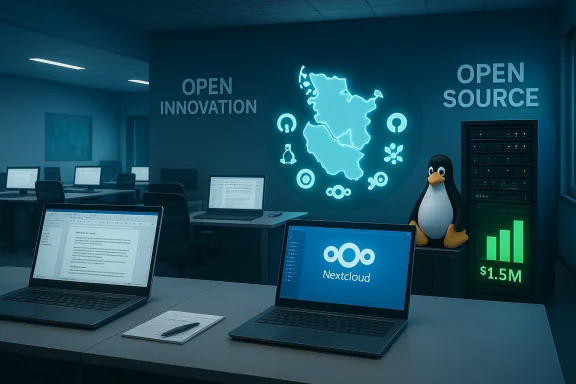 Background: why Schleswig-Holstein decided to say goodbye to Windows
Public administrations across Europe have been wrestling with the same strategic dilemma for years: how to balance operational continuity, security, and agility against the financial and geopolitical implications of deep dependence on a small set of global technology vendors. For the government in Schleswig-Holstein, the answer took the form of a formal “Open Innovation and Open Source” strategy announced in late 2024. The policy framed open-source software (OSS) not merely as a cost-saving measure but as a tool for preserving data sovereignty, improving transparency, and enabling faster local innovation.Key, stated motivations for the strategy were:
- Reducing vendor lock-in and the economic exposure created by recurring license fees.
- Increasing control over data and workflows by using modifiable, observable software componentss.
- Promoting open standards (notably the Open Document Format) to ensure long-term accessibility of documents.
- Fostering a local open-source ecosystem and leveraging state IT services for deployment and support.
Overview of the migration: what changed and how quickly
The tactical elements of the migration were straightforward and pragmatic: replace the most visible and expense-heavy proprietary components with mature open-source alternatives, where feasible.- Office suite: LibreOffice was adopted as the binding standard for office documents, with the Open Document Format (ODF) promoted as the preferred, long-term archival format.
- Email and groupware: Tens of thousands of mailboxes were migrated to an open-source groupware stack, replacing a proprietary Exchange-based backend for the state’s administrative accounts.
- Client mail: Desktop email clients were moved to open solutions such as Thunderbird in many contexts.
- Collaboration and file services: Nextcloud and related tools have been positioned as the successor to previous SharePoint/SharePoint-like workflows, with gradual replacements and integrations planned.
- Desktop operating system: Trials and selective rollouts of a professionally supported Linux distribution (a vendor-supported “+1.Linux” distribution in the state’s communications) have begun; Windows is being de-emphasized in favour of Linux on suitable endpoints.
- Real-time communications: Open-source conferencing and messaging stacks (including OpenTalk) are being evaluated and deployed where they meet security and accessibility criteria.
The economics: headline savings, one‑off costs, and payback
The arithmetic behind the decision is blunt: perpetual and subscription license fees are recurring and predictable; an upfront migration spend is finite and can be amortized. The state’s public statements outline the following financial contours:- Recurring savings: More than €15 million per year in license costs through the elimination or downgrading of Windows, Microsoft Office licenses, and certain cloud/enterprise subscriptions.
- One-off transition costs: An estimated €9 million in 2026 for migration activities and further development of the open-source toolchain — intended to cover customization, interoperability work, integration of specialized workflows, staff training, and any required consulting and support engagements.
- Payback horizon: Given the scale of annual savings, the one-off migration investment is projected to be recovered in less than a year on a straight license-cost basis.
Technology choices and standards: compatibility and lock-in tradeoffs
The core technical decisions were conservative in terms of application maturity but bold in scope.Office and document standards
LibreOffice plus the ODF standard form the backbone of the desktop productivity layer. This choice emphasizes:- Long-term readability and vendor neutrality for official documents.
- Reduced licensing costs, since LibreOffice is free to install and distribute.
- Potential friction with external partners who use DOCX/XLSX as a de facto interchange format, and with internal specialist workflows that rely on macros and advanced Excel features.
Mail and collaboration
Migrating tens of thousands of mailboxes to an open groupware solution addressed both cost and sovereignty. The project also required:- Reconciliation of calendar and address-book data across platforms.
- Handling large historical archives and ensuring searchability and continuity.
- Ensuring that mobile and remote access worked seamlessly for staff used to integrated Exchange features.
Desktop OS and endpoint strategy
The state’s strategy contemplates a multipronged approach: maintain Windows where necessary, migrate standard office endpoints to a Linux distribution where feasible, and ensure that critical legacy applications can be accessed through virtualization, web interfaces, or compatibility layers.This approach reduces single-supplier dependence but introduces a new dimension of operational complexity: the state will become dependent on in-house or regional support capabilities and on the quality of open-source upstream projects and professional support partners.
What went well: strengths and early wins
- Cost reduction at scale: The move demonstrably cut recurring license costs and rewired budgetary dynamics in favor of predictable maintenance and development spending.
- Improved data sovereignty: By moving to standards-based formats and open-source infrastructure, the administration reduced the risk that proprietary protocols or platform policies could constrain access to state data.
- Policy coherence: The strategy ties together procurement, security, and innovation goals: open-source components are used not just to save money, but to create a foundation for local customization and sovereignty.
- Phased rollout minimized operational shock: Rather than a single “big-bang” migration, the state followed a staged approach with pilot programs and perimeter defenses, allowing teams to adapt progressively.
- Visible, measurable milestones: Completion of the large-scale mailbox migration and the near-80-percent rollout of LibreOffice provided concrete proof points that helped sustain political support.
What proved difficult: practical frictions and technical risks
A transition of this breadth inevitably surfaces real-world complications:- Specialized applications and legacy integrations: Certain administrative domains — notably tax administration and other specialty “Fachverfahren” systems — still rely on Microsoft-specific integrations and macros. These systems require bespoke migration plans or continued interoperability layers, which can slow full adoption.
- Compatibility with complex spreadsheets: Advanced Excel spreadsheets, VBA macros, and bespoke calculations frequently break or behave differently in alternative suites. Rewriting, testing, or encapsulating those workflows requires time and domain expertise.
- User training and productivity dips: Shifting to unfamiliar interfaces and workflows can reduce short-term productivity. Trade unions, opposition politicians, and some staff reported ongoing user complaints and occasional workarounds that increased support load.
- Support model shift: Replacing a major vendor with a mosaic of open-source projects and local support partners changes the risk profile. The state must now maintain stronger internal capability for patching, security updates, and SLA management with multiple suppliers.
- Interoperability with external partners: Government agencies interact with suppliers, citizens, and other public authorities that may continue to use proprietary formats. Converters and policy decisions about accepted document formats are necessary to avoid friction and legal disputes.
- Perception and political opposition: The rollout attracted criticism from political opponents and sceptics who argued that the public narrative glossed over persistent problems in day-to-day administration.
Security and compliance considerations
Moving to open source does not automatically equal “more secure,” but it does alter the security calculus.- Visibility vs. responsibility: Open-source code can be audited and fixed by anyone, increasing transparency. That benefit depends on adequate in-house security capacity or contracted third-party services to audit, patch, and monitor systems.
- Supply-chain and maintenance: The state must ensure timely updates for all components, and must have processes to handle vulnerabilities across a diversified stack.
- Certification and governance: Some open-source projects are moving through formal evaluation processes; selective certification of components (e.g., videoconferencing tools) is an important part of meeting public-sector security and accessibility requirements.
- Data protection and jurisdictional concerns: Hosting services on state-controlled infrastructure and using open-source software reduces some jurisdictional risks associated with external cloud offerings, but also requires disciplined data governance and logging practices.
The political and strategic implications: more than just software
The Schleswig-Holstein program is as much a political statement as it is a technical project. It signals a new posture for public IT:- A model for regional digital sovereignty: The initiative argues that public administrations can make substantial sovereignty gains without sacrificing functionality — and it provides a template other regions will study.
- Industrial policy effects: By committing to open-source solutions, the state creates opportunities for local MSPs, system integrators, and public-sector service partners, potentially seeding a local market for customization and long-term support.
- A nudge to procurement law and standards: The program reinforces the importance of procurement processes that consider total cost of ownership, data sovereignty clauses, and open-standards compliance as default tender criteria.
Lessons learned and practical advice for other governments
Schleswig-Holstein’s experience offers a set of pragmatic lessons for any public body considering a similar path:- Treat the migration as a program, not a project. Large IT transitions are ongoing efforts that require governance, KPIs, and sustained funding beyond a single fiscal year.
- Prioritize interoperability and standards. Define preferred exchange formats and build conversion utilities early to minimize friction with external partners.
- Map dependency chains for specialized applications. Identify systems that are tightly coupled to vendor-specific features (macros, APIs, proprietary connectors) and create bespoke transition paths.
- Invest in training and local support. Budget for extended helpdesk services and role-specific training to reduce productivity losses during the transition period.
- Run pilot projects and controlled rollouts. Use pilots to uncover corner cases: complex spreadsheets, legal-document flows, and external data exchange scenarios.
- Preserve rollback and continuity plans. For mission-critical functions, ensure there are fallbacks and dual-operational windows to avoid single points of failure.
- Measure beyond license savings. Track productivity, incident rates, user satisfaction, and the cost of ongoing maintenance to form a full TCO picture.
Risks to watch as the program matures
The early wins are real, but several medium-term risks need active management:- Hidden operational costs: Patching, integration, and bespoke development efforts can erode the headline savings if not tightly controlled.
- Vendor substitution risk: While moving off a major vendor reduces dependence in some dimensions, it can create new dependencies on specific integrators or consulting firms if the state lacks internal skills.
- Security burden: Vulnerability management and secure configuration are responsibilities that shift more heavily to the state; failing to resource these functions could create exposure.
- Legal and compliance traps: Public-sector document retention, e‑discovery, and evidence standards may require specific metadata handling that must be preserved in any new toolchain.
- Staff morale and recruitment: If daily workflows become harder for specific user groups (e.g., auditors, tax specialists), recruitment and retention in those roles could be affected.
What success looks like a year in: balanced judgment
Success in a program like this must be judged on multiple axes: cost, continuity, security, sovereignty, and user experience. Schleswig-Holstein’s early report card shows strong progress on the first two, credible declarations on sovereignty, and mixed but improving results for user experience and continuity. The administration’s transparency about one-off costs and ongoing migration paths for the remaining 20 percent of dependent workstations — plus the explicit acknowledgement of stubborn dependencies in tax administration and other specialist areas — reflects a pragmatic, staged implementation rather than an ideological purge.That balance matters. The clearest wins are not purely technical; they are procedural and fiscal. The project reoriented procurement priorities, forced a disciplined approach to standards and formats, and created a politically salient proof point that a modern public administration can reduce vendor lock-in without abandoning service responsibilities.
Final analysis: a cautious blueprint for digital sovereignty
Schleswig-Holstein’s migration away from a Microsoft-dominant stack toward open-source alternatives is not an experiment in austerity — it is a deliberate strategic gamble on control, transparency, and long-term fiscal sustainability. The state’s early results show that a carefully planned, incremental migration can deliver significant recurring savings and demonstrable improvements in digital sovereignty within a public-sector context.At the same time, the transition exposes the ordinary frictions of enterprise IT modernization: hidden integration costs, specialized legacy workflows that refuse to conform, and the need to grow internal capability to manage a more heterogeneous stack. Those challenges are manageable, but they are real and ongoing.
For other administrations watching this case, the takeaways are straightforward: plan exhaustively, invest in people and governance, choose standards to minimize long-term friction, and measure the full cost of ownership — not just license savings. When done with prudence and institutional commitment, the move to open-source-based government IT can be both an economic and strategic win. Schleswig-Holstein’s experience provides a practical — if imperfect — blueprint for getting there.
Source: royalsblue.com What it took was a farewell to Windows - Royals Blue
