

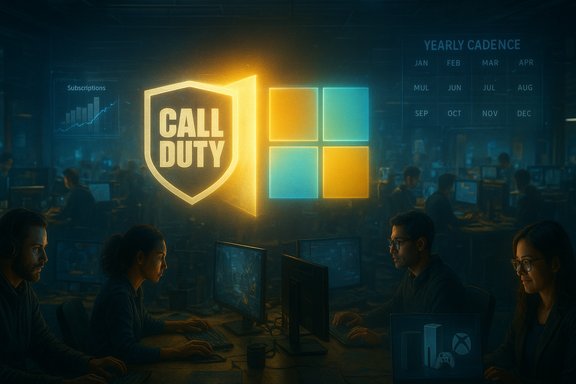
Glen Schofield’s off‑hand worry at Gamescom Asia — that Call of Duty could lose its identity and creative momentum now that it sits inside Microsoft’s gaming empire — has become more than an industry conversation starter; it forces a closer look at how megacorporate ownership, subscription-first strategies, and relentless monetization shape the future of the world’s most lucrative shooter franchise. Schofield’s comments were recorded in an interview with Video Games Chronicle and were picked up and analyzed by Windows Central, which framed his concern around studio culture, release cadence, and incentive systems. This feature unpacks what Schofield actually said, verifies the central factual claims around the Call of Duty business and the broader market, and offers a critical analysis of whether his fears are likely — or whether they are a cautionary note from a game director remembering how creative stewardship matters. The piece examines three intersecting forces that make this moment consequential: Microsoft’s ownership and strategic priorities, the economics of AAA live‑service shooters, and the talent and development pressures that shape creative output.
Call of Duty arrived at Microsoft as part of the largest gaming acquisition in history: Microsoft announced its intent to buy Activision Blizzard for roughly $68.7 billion in January 2022 and completed the deal following protracted regulatory review in 2023. The acquisition placed Call of Duty alongside Xbox Game Studios and tied the franchise to Microsoft’s distribution and subscription ambitions. Since the acquisition, Microsoft has pushed Call of Duty into its larger platform ecosystem. Black Ops 6 notably launched day‑and‑date on Xbox Game Pass — a watershed moment for the franchise — and Microsoft publicly celebrated record engagement metrics for that release. The Game Pass strategy changes how players access new entries, how launches are monetized, and how success is measured (subscriptions and engagement as much as unit sales). The competition has responded in kind. Electronic Arts’ Battlefield 6 (released October 10, 2025) recorded a massive opening, selling over 7 million copies in its first three days and setting new franchise records — proof that the premium market still moves in big waves and that Call of Duty faces renewed competition for players’ attention. Amid this turbulence, Schofield’s comments strike a cultural and structural chord: he worries that systems, incentives, and corporate priorities can reshape a franchise’s creative DNA in ways that don’t always align with what made it successful in the first place.
Evidence and trendlines:
Microsoft’s Game Pass pivot alters that perception calculus because access is decoupled from retail purchase. For some players, that’s a win: more people sample the game, and engagement metrics reward the franchise. For traditional retail economics, heavy Game Pass penetration can cannibalize unit sales or shift pricing power. Both outcomes are legitimate corporate strategies — but they are not neutral cultural shifts. How a studio balances free access, premium cosmetics, and core gameplay integrity will influence ongoing consumer trust.
The takeaway for Microsoft and Activision:
At the same time, the hard business facts are clear and double‑edged. Microsoft has the capital to underwrite longer development cycles, the distribution muscle to increase reach, and the engineering platform to modernize live operations. Black Ops 6’s Game Pass launch and Battlefield 6’s record sales show both routes — subscription reach and premium volume — still work, but they reward different kinds of corporate and creative choices. The practical test will be whether Microsoft uses ownership to enable creative stewardship — protecting bonuses and studio autonomy where it matters — or whether scale is permitted to flatten incentives into a subscription‑first playbook that deprioritizes long-form craft. Schofield’s critique is a call to action: preserving the health of AAA franchises requires deliberate choices, not default integration. As players, journalists, and industry observers, the near future will tell whether Call of Duty’s next phase is defined by revitalized creative breadth — or by the business imperatives Schofield fears. In either case, the debate itself is a healthy one: stewardship of culture at scale is difficult, and transparency about the trade‑offs matters to everyone who cares about AAA games.
Source: Windows Central Former CoD director isn’t sold on Xbox’s Call of Duty vision
 Background / Overview
Call of Duty arrived at Microsoft as part of the largest gaming acquisition in history: Microsoft announced its intent to buy Activision Blizzard for roughly $68.7 billion in January 2022 and completed the deal following protracted regulatory review in 2023. The acquisition placed Call of Duty alongside Xbox Game Studios and tied the franchise to Microsoft’s distribution and subscription ambitions. Since the acquisition, Microsoft has pushed Call of Duty into its larger platform ecosystem. Black Ops 6 notably launched day‑and‑date on Xbox Game Pass — a watershed moment for the franchise — and Microsoft publicly celebrated record engagement metrics for that release. The Game Pass strategy changes how players access new entries, how launches are monetized, and how success is measured (subscriptions and engagement as much as unit sales). The competition has responded in kind. Electronic Arts’ Battlefield 6 (released October 10, 2025) recorded a massive opening, selling over 7 million copies in its first three days and setting new franchise records — proof that the premium market still moves in big waves and that Call of Duty faces renewed competition for players’ attention. Amid this turbulence, Schofield’s comments strike a cultural and structural chord: he worries that systems, incentives, and corporate priorities can reshape a franchise’s creative DNA in ways that don’t always align with what made it successful in the first place. What Schofield actually said — and what he didn’t
The quote in context
At Gamescom Asia — during a keynote and a follow‑up interview — Glen Schofield said he was “immensely worried” about Call of Duty’s future under Microsoft, citing three related concerns: loss of release cadence and revenue implications, studio assimilation into large corporate structures, and changes to internal bonus/incentive systems that could affect creative output. He named Gears and Halo as examples of franchises that, in his view, have struggled post‑acquisition or through studio transitions. Key excerpts include:- “If they go to not every year, they lose a billion dollars every year, so that’s why Call of Duty never did that.” (Schofield framed the franchise’s annual cadence as a cash machine.
- “Unfortunately, once you’re assimilated by one of these companies, I think you take on some of their traits.” (A concern about cultural dilution inside large corporate parents.
- “I would imagine that the Call of Duty bonus system is out, and now you have theirs, and people are going to go ‘that isn’t that’.” (A claim about shifting compensation/incentives, framed as likely but not demonstrably factual at the time he spoke.
Verifiable facts embedded in the exchange
A few concrete things can be confirmed quickly:- Microsoft did acquire Activision Blizzard in 2023 for approximately $68.7–$69 billion. That deal is public record and reshaped platform-scale ownership in games.
- Black Ops 6 launched simultaneously on Game Pass and retail, and Microsoft and Activision reported record engagement metrics for the title’s launch period. That shift altered distribution for the franchise.
- Battlefield 6 delivered a blockbuster opening in October 2025 (7 million copies in three days), showing there is appetite for premium, high‑production shooters outside of Call of Duty.
The commercial reality: how much does Call of Duty actually matter?
Call of Duty is not just a popular series — it is a major financial engine. Industry tallies and company filings show the franchise has generated tens of billions in lifetime revenue and represents a material portion of Activision’s (now Microsoft’s) gaming revenue stream. Exact annual figures fluctuate, but Call of Duty’s contribution to Activision’s revenue has historically been measured in the billions. Why that matters to Schofield’s argument:- Annual cadence was historically driven by calendarized product releases and predictable revenue flows. Moving away from an annual model changes the revenue recognition profile and may reduce upfront retail units while increasing dependence on recurring revenue mechanics (Game Pass subscriptions, battle passes, microtransactions). That trade‑off has both upside and downside.
- If the franchise’s revenue model shifts — for example, prioritizing subscription lifetime value and recurring spend over premium units — internal incentives and R&D prioritization will likely follow. That is exactly the kind of thing Schofield worries could influence creative decisions.
Culture and creative stewardship: why leadership and incentives matter
Schofield’s nervousness is partly professional memory: he ties quality dips he experienced after leaving Sledgehammer to key personnel changes and waning institutional coherence. He points to departures among veteran staff and frames a loss of voice for creators as a causal path to diminished game quality. That pattern is familiar in game studio histories: leadership churn, talent departures, and mismatched incentives often precede uneven releases. Two concrete cultural risks when a franchise moves into a megacorp:- Homogenization of incentives. Large companies centralize performance metrics (subscriptions, retention, ARPU). That can prioritize live‑service hooks and short‑term engagement metrics over high‑risk creative experiments. Schofield fears the loss of the smaller, studio‑level bonus and recognition systems that directly rewarded creative ownership. That worry is plausible: corporate compensation structures do change after acquisitions, and studio autonomy can ebb. But the precise mechanics — which bonuses are removed, how replaced — require documented confirmation from inside teams or company filings to be considered factual.
- Talent attrition and brand stewardship. High‑value franchises depend on institutional knowledge. When senior creatives leave, it often shows up in tone, systems, and design choices. Schofield points to that pattern with blunt proximity: his involvement in earlier CoD entries and the subsequent departures of peers were followed by titles he viewed as weaker. That correlation is not proof of causation, but it is a credible warning signal.
Release cadence and product quality: does breathing room help?
Schofield’s most concrete design critique is simple: Call of Duty needs breathing room. Annual releases put enormous strain on teams and limit the runway for meaningful systemic improvement. The game‑by‑game sprint model can leave major features half‑baked and push recurrent monetization into core loop design rather than optional add‑ons. These structural incentives drive feature roadmaps and, by extension, player experience.Evidence and trendlines:
- Many AAA studios are moving to multi‑year cycles and live‑service models to sustain both quality and ongoing engagement. That requires different investment profiles and patience from owners. Microsoft’s deep pockets could provide the capital for longer cycles — but only if corporate strategy values long‑term IP health over short‑term subscriber metrics.
- Black Ops 6 showed the upside of large distribution: it reached record engagement and likely drove Game Pass interest, but it also raised questions about unit sales on retail platforms. Heavy Game Pass penetration can mean fewer full‑price purchases while increasing retention and recurring revenue — a trade some publishers accept and others resist. Schofield sees the economic math and worries about the artistic fallout.
Monetization, player perception, and studio identity
Call of Duty’s monetization model is layered: full‑price premium releases, battle passes, cosmetics, and live‑service events. The player perception problem Schofield highlights is real: players now expect a cleaner value equation on release day, and they notice when a premium game pushes additional paid gates aggressively. That tension is central to community trust.Microsoft’s Game Pass pivot alters that perception calculus because access is decoupled from retail purchase. For some players, that’s a win: more people sample the game, and engagement metrics reward the franchise. For traditional retail economics, heavy Game Pass penetration can cannibalize unit sales or shift pricing power. Both outcomes are legitimate corporate strategies — but they are not neutral cultural shifts. How a studio balances free access, premium cosmetics, and core gameplay integrity will influence ongoing consumer trust.
Technical friction: cross‑gen performance and experience parity
Another practical issue highlighted by recent coverage is the technical cost of supporting older hardware. Cross‑generation shipping — preserving functionality on Xbox One while building for Series X/S and PC — can lead to compromised experiences on legacy hardware, particularly with modern engines and streaming demands. Windows Central and hands‑on beta coverage of Black Ops 7’s cross‑gen builds showed that the Xbox One X struggled to sustain high‑tempo multiplayer frame‑pacing, producing a degraded experience compared to newer consoles. That underlines the cost of backwards compatibility when engines push the envelope.The takeaway for Microsoft and Activision:
- If cross‑gen builds are required out of goodwill or market necessity, they must be engineered as pared‑down or different SKU experiences, not as one‑size‑fits‑all ports. Otherwise, the company risks reputational damage when a paying customer gets an inferior product.
What Microsoft could do (practical playbook)
If the concern is preserving creative quality while leveraging Microsoft’s scale, there are three pragmatic paths that reduce risk and preserve upside:- Preserve and publish studio‑level incentive systems that reward creative ownership and long‑term IP stewardship rather than purely top‑line subscription metrics.
- Use Microsoft’s balance sheet to underwrite longer dev cycles for flagship entries, pairing those longer cycles with robust live‑ops roadmaps rather than forcing annual full launches.
- Treat last‑gen support as a clearly labeled, quality‑guaranteed product class: legacy editions with explicit compromises and cloud‑first paths that provide a viable alternative for hardware‑limited players.
Risks, winners, and the middle‑ground
Risks if Schofield is right
- Creative stagnation or homogenization: A culture that prizes metrics over craft can prioritize short‑term engagement hooks over memorable design.
- Talent drain: Senior creatives may leave if compensation, autonomy, or creative influence decline.
- Reputational friction: Fans will notice if quality or identity drifts; that can erode franchise goodwill over years.
What Microsoft can win
- Scale and reach: Game Pass and cloud can bring Call of Duty to more players across more markets, increasing lifetime engagement and monetization potential.
- Investment and tooling: Microsoft’s engineering resources (cloud, AI tooling, productivity) can lower technical barriers for content creation and live ops.
- Market resilience: Ownership gives Microsoft the strategic freedom to coordinate cross‑franchise initiatives and invest counter‑cyclically where rivals hesitate.
A realistic middle ground
The most likely near‑term outcome is a hybrid: Microsoft keeps Call of Duty highly commercial and platform‑integrated while trying to preserve studio autonomy where it matters (creative directors, lead design pillars). That compromise will require visible, credible governance to satisfy both shareholders and creators. If Microsoft fails to demonstrate both financial discipline and creative deference, Schofield’s skeptical forecast gains weight; if it succeeds, the company may produce its most commercially vibrant and creatively stable Call of Duty era yet.Short‑term indicators to watch
- Public statements or filings about compensation and bonus restructuring at Activision/Microsoft (concrete confirmation would validate or refute Schofield’s incentive claim).
- Studio leadership appointments and autonomy terms for Treyarch, Sledgehammer, and Infinity Ward (are they operating inside a Microsoft‑style matrix or as independent creative studios?.
- Development cadence announcements: explicit plans to move to multi‑year cycles or to retain annual premium releases tied to Game Pass metrics.
- Consumer messaging and SKU clarity for cross‑gen editions (are legacy editions marketed as “legacy” with honest feature lists?.
Conclusion — a cautious reading
Glen Schofield’s warning is valuable because it frames the issue in human and institutional terms: franchises are not just IP assets; they are networks of people, processes, and cultural memory. Schofield’s fear that corporate assimilation, altered incentives, and relentless monetization could hollow out what made Call of Duty resonate is a reasonable professional concern — and one that should be taken seriously by Microsoft, Activision’s studio leads, and the community.At the same time, the hard business facts are clear and double‑edged. Microsoft has the capital to underwrite longer development cycles, the distribution muscle to increase reach, and the engineering platform to modernize live operations. Black Ops 6’s Game Pass launch and Battlefield 6’s record sales show both routes — subscription reach and premium volume — still work, but they reward different kinds of corporate and creative choices. The practical test will be whether Microsoft uses ownership to enable creative stewardship — protecting bonuses and studio autonomy where it matters — or whether scale is permitted to flatten incentives into a subscription‑first playbook that deprioritizes long-form craft. Schofield’s critique is a call to action: preserving the health of AAA franchises requires deliberate choices, not default integration. As players, journalists, and industry observers, the near future will tell whether Call of Duty’s next phase is defined by revitalized creative breadth — or by the business imperatives Schofield fears. In either case, the debate itself is a healthy one: stewardship of culture at scale is difficult, and transparency about the trade‑offs matters to everyone who cares about AAA games.
Source: Windows Central Former CoD director isn’t sold on Xbox’s Call of Duty vision
