

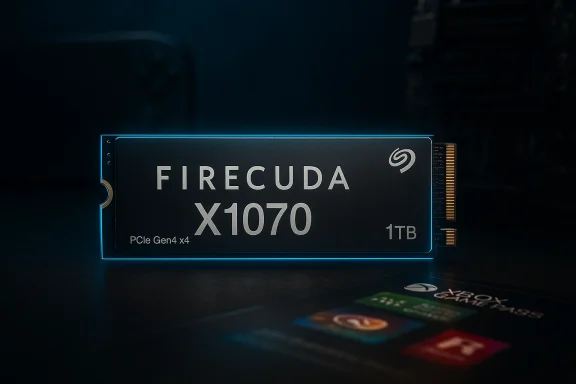
Seagate’s next consumer NVMe — the FireCuda X1070 — has leaked in retail listings and spec sheets ahead of any official announcement, revealing a PCIe Gen4 M.2 drive family with 1TB, 2TB, and 4TB SKUs, headline sequential reads of 7,200 MB/s, write ratings between 6,000–6,500 MB/s, and a mix of endurance and pricing that positions the X1070 as a value‑oriented FireCuda aimed at gamers and handheld console users rather than a straight performance heir to the FireCuda 530 line. (tomshardware.com)
Seagate’s FireCuda family has been the company’s consumer‑focused performance line for several generations, with the FireCuda 530 (and 530R variant) earning a reputation for very high sequential bandwidth and high endurance thanks to TLC NAND and premium controller pairings. The FireCuda 530 remains a benchmark reference for Seagate in the PCIe 4.0 era. The appearance of a new FireCuda X series is therefore notable: it suggests Seagate is refining product segmentation and pursuing different tradeoffs (capacity, price, power/thermal balance) within the gaming and handheld markets.
Retailer listings — notably a Best Buy product page that included a full spec sheet — and mirrored Amazon entries exposed the FireCuda X1070 model name, packaging callouts (Xbox Game Pass trial, Adobe Creative Cloud trial, Rescue Data Recovery service), and full SKU options before Seagate posted any marketing materials. The Best Buy page that briefly hosted the X1070 listing shows a 1TB SKU with an MSRP of $239.99 and selectable 2TB and 4TB options; other outlets spotted a $829.99 price that appears to relate to a higher‑capacity SKU. Given the listings have since been removed or marked sold out, these figures should be treated as provisional until Seagate confirms them. (bestbuy.com)
Why would Seagate do this? There are three plausible commercial reasons reflected in the leaked details:
An Amazon listing capture referenced by outlets described the drive as using 3D QLC NAND, though the performance numbers look closer to TLC behavior in peak throughput. If QLC is indeed used, expect:
Seagate’s inclusion of three years of Rescue Data Recovery Services and bundled content (Xbox Game Pass trial, Adobe trial) is a clear signal of the target audience: mainstream gamers, creators who occasionally need larger working stores, and users who prioritize a safety net for data recovery. That service bundle can be a differentiator in retail buying decisions if Seagate keeps Rescue and warranty policies consistent globally. (bestbuy.com)
That mix could make the X1070 a compelling choice for buyers who want fast game load times and lots of storage at a competitive sticker price, provided they accept the endurance tradeoffs and confirm the controller/NAND details. Conversely, users who push multi‑terabyte daily writes or who prioritize long TBW figures should approach the X1070 cautiously until Seagate publishes full specifications and independent testers validate sustained workloads.
In short: the FireCuda X1070 — as leaked — looks like a market‑aware SSD that chooses affordability and capacity over elite endurance. If Seagate confirms the leaked spec sheet and prices, the X1070 could be the company’s answer to gamers and handheld markets that want close‑to‑flagship sequential speeds without flagship pricing. Until Seagate publishes formal specs and reviewers complete independent validation, buyers should treat leaked listings as a strong signal but not the final word. (bestbuy.com)
Conclusive note: watch Seagate’s official channels for a confirmed datasheet and sample availability before making procurement or upgrade decisions; leaked retailer pages are useful early indicators, but platform‑level details — controller, NAND type, firmware maturity — are the ultimate determinants of whether a drive is the right fit for a specific workload. (tomshardware.com)
Source: TechPowerUp Seagate's FireCuda X Series of NVMe SSDs Leak Ahead of Official Launch | TechPowerUp}
 Background / Overview
Seagate’s FireCuda family has been the company’s consumer‑focused performance line for several generations, with the FireCuda 530 (and 530R variant) earning a reputation for very high sequential bandwidth and high endurance thanks to TLC NAND and premium controller pairings. The FireCuda 530 remains a benchmark reference for Seagate in the PCIe 4.0 era. The appearance of a new FireCuda X series is therefore notable: it suggests Seagate is refining product segmentation and pursuing different tradeoffs (capacity, price, power/thermal balance) within the gaming and handheld markets.Retailer listings — notably a Best Buy product page that included a full spec sheet — and mirrored Amazon entries exposed the FireCuda X1070 model name, packaging callouts (Xbox Game Pass trial, Adobe Creative Cloud trial, Rescue Data Recovery service), and full SKU options before Seagate posted any marketing materials. The Best Buy page that briefly hosted the X1070 listing shows a 1TB SKU with an MSRP of $239.99 and selectable 2TB and 4TB options; other outlets spotted a $829.99 price that appears to relate to a higher‑capacity SKU. Given the listings have since been removed or marked sold out, these figures should be treated as provisional until Seagate confirms them. (bestbuy.com)
What leaked: Straight facts from the listings
The most load‑bearing details published in retailer pages and reported by multiple outlets are:- Form factor and interface: M.2 2280, PCIe Gen4 x4 (NVMe). (bestbuy.com)
- Capacity options: 1TB, 2TB, 4TB (single‑sided and multi‑SKU retail options shown). (bestbuy.com)
- Sequential performance (manufacturer/retailer sheet): 7,200 MB/s read for all capacities; 6,000 MB/s write on 1TB, 6,500 MB/s write on 2TB and 4TB. (tomshardware.com)
- Random IOPS targets: up to 900k–1,000k IOPS (4K random) depending on capacity. (tomshardware.com)
- Endurance (TBW) figures published in the leak table: 600 TBW (1TB), 1,200 TBW (2TB), 2,400 TBW (4TB). These endurance levels are significantly lower than the FireCuda 530R’s top TBW rating. (tomshardware.com)
- Warranty and services: 5‑year limited warranty and 3 years of Rescue Data Recovery Services included per the retailer listing. (bestbuy.com)
- Packaging extras / marketing: 1‑month Xbox Game Pass Ultimate and 2‑month Adobe Creative Cloud Pro trials are mentioned on the Best Buy listing and in the leaked spec sheet. The drive is also shown as certified for some handheld devices (ROG Ally and related handhelds). (bestbuy.com)
Technical analysis: What those numbers mean
Performance positioning and tradeoffs
At 7,200 MB/s read and maximum writes capped at 6,500 MB/s, the X1070 sits close to other high‑end PCIe 4.0 drives on pure sequential numbers, but it is not positioned to beat the very fastest Gen4 parts in every metric. For example, Samsung’s leading Gen4 consumer drive family publishes sequential read/write numbers up to about 7,450 / 6,900 MB/s and higher published random IOPS in some capacities, while Seagate’s own FireCuda 530R series had higher endurance and, in some SKUs, higher sequential ceilings. Comparing those published figures shows the X1070 is competitive on sequential bandwidth but likely conservative on endurance and sustained workload resilience.Why would Seagate do this? There are three plausible commercial reasons reflected in the leaked details:
- Capacity and price leverage: Lower TBW and the presence — per Amazon captures cited by outlets — of QLC NAND in some listings suggest Seagate may be optimizing for higher capacity at lower cost, rather than maximum sustained throughput or lifetime endurance. QLC allows higher die capacities and lower $/GB, but historically trades endurance and sustained performance after SLC cache exhaustion. (tomshardware.com)
- Target platform focus: The packaging calls out handheld gaming devices such as ROG Ally compatibility and includes Xbox Game Pass packaging, indicating Seagate may target gamers and users who value capacity and real‑world loading times more than enterprise‑grade TBW. Handhelds also benefit from balanced power and thermal behavior, which Gen4 drives with moderate peak numbers can deliver better than hotter Gen5 options. (bestbuy.com)
- Thermal and platform compatibility considerations: PCIe Gen4 remains the sweet spot for broad compatibility across desktops, laptops, and consoles. Choosing Gen4 instead of Gen5 avoids some cooling and platform caveats that complicate system integration and raises the addressable market. (tomshardware.com)
Endurance (TBW) and NAND implications
The leaked TBW figures (600 / 1,200 / 2,400 for 1/2/4TB) are materially lower than Seagate’s higher‑end FireCuda 530R 4TB TBW (5,100 TBW) and many leading TLC‑based proposals. Lower TBW alone doesn’t make a drive “bad” — everything is workload dependent — but it does imply the X1070 is not intended for professional multi‑terabyte daily write workloads such as aggressive video editing, high‑frequency swapfile activity, or enterprise cache roles. For most gamers and mainstream users, even 600 TBW on a 1TB drive equates to many years of typical consumer writes. However, durability expectations should be matched to usage patterns. (tomshardware.com)An Amazon listing capture referenced by outlets described the drive as using 3D QLC NAND, though the performance numbers look closer to TLC behavior in peak throughput. If QLC is indeed used, expect:
- Good peak sequential figures (SLC cache) but potential drop in sustained writes once SLC cache is exhausted.
- Lower TBW relative to TLC parts (consistent with the leaked TBW values).
- Better $/GB for large capacities, allowing competitive street pricing. (tomshardware.com)
How the X1070 compares to the FireCuda 530 and market rivals
FireCuda X1070 vs FireCuda 530 / 530R (Seagate’s recent history)
- Sequential read: X1070 at 7,200 MB/s vs 530R at ~7,300–7,400 MB/s. The 530R remains slightly faster on peak reads. (tomshardware.com)
- Sequential write: X1070 6,000–6,500 MB/s vs 530R up to ~6,900–7,000 MB/s depending on SKU. 530R retains an advantage on write throughput. (tomshardware.com)
- Endurance: X1070 TBW (up to 2,400 TBW on 4TB) vs 530R 4TB TBW up to 5,100 TBW. 530R is clearly aimed at endurance‑sensitive workloads; X1070 is not. (tomshardware.com)
X1070 vs Samsung 990 PRO and other Gen4 competitors
Samsung’s 990 PRO — one of the fastest mainstream Gen4 consumer SSDs — publishes sequential numbers around 7,450 / 6,900 MB/s and very high IOPS in some SKUs. Compared to Samsung, the X1070’s read and write numbers are in the same ballpark for reads and a little lower for writes. Where Samsung and some other premium Gen4 drives differentiate is consistent sustained performance, firmware maturity, and higher TBW parameters on larger SKUs. If Seagate prices the X1070 attractively, it can compete strongly on $/GB and real‑world game loading times despite these differences.Market positioning and pricing: what Seagate seems to be aiming for
The Best Buy leaked price for the 1TB SKU was $239.99 (the Best Buy product page still captured in retailer snapshots shows this), while other reports referenced an $829.99 figure that appears to correspond to the 4TB SKU in some retailer captures. These price points — if accurate at launch — would place the X1070 as a competitively priced Gen4 option for gamers and capacity‑hungry users, not a premium flagship challenger. Pricing consistency across retailers and timing of official MSRPs will ultimately determine its competitiveness. Readers should treat early retail prices as provisional until Seagate confirms them. (bestbuy.com)Seagate’s inclusion of three years of Rescue Data Recovery Services and bundled content (Xbox Game Pass trial, Adobe trial) is a clear signal of the target audience: mainstream gamers, creators who occasionally need larger working stores, and users who prioritize a safety net for data recovery. That service bundle can be a differentiator in retail buying decisions if Seagate keeps Rescue and warranty policies consistent globally. (bestbuy.com)
Risks, unknowns, and caveats — what to watch for
- Controller and NAND remain unverified. Retail listings did not name the controller; Amazon capture suggested QLC NAND in one instance but that claim is not confirmed by Seagate. Controller choice (Phison, Silicon Motion, or in‑house) has major implications for firmware maturity and long‑term reliability. Treat controller/NAND callouts in press captures as unconfirmed. (tomshardware.com)
- QLC tradeoffs. If the X1070 uses QLC, expect very different behaviors for sustained sequential writes after SLC cache exhaustion. This affects large file transfers and workload patterns like prolonged video recording or multi‑TB scratch disk usage. Buyers who run sustained write workloads should prefer drives with TLC and higher TBW. The leaked TBW numbers make this caveat particularly relevant. (tomshardware.com)
- Firmware maturity and early rev risks. Retail listings leaking ahead of launch increase the chance that first‑ship firmware will be updated quickly after reviews and lab tests reveal issues. Historically, SSD firmware iterations can change both performance characteristics and long‑term reliability; early adopters sometimes experience teething problems. Seagate’s FireCuda history includes multiple firmware updates across product generations. If launch firmware fixes are needed, expect a cadence of updates across the first weeks or months.
- Pricing volatility at launch. Pre‑launch prices captured on retailer pages are often placeholders or MAP‑driven figures that change rapidly. The $239.99 (1TB) and $829.99 (possible 4TB SKU) references should be treated as early signals rather than guaranteed street prices. Purchasers seeking the best value should monitor price drops and launch promotions. (bestbuy.com)
- Marketing vs. real‑world performance. Marketing sequential numbers and IOPS can be useful for top‑line comparisons, but real application performance depends on firmware, system configuration, thermal throttling, and workload mix. Look for independent, repeatable reviews from credible labs that test both short‑burst and sustained workloads before judging long‑term performance. (tomshardware.com)
Recommendations for buyers and system builders
- If you need the maximum sustained write endurance and professional reliability (heavy editing, scratch disks, VM hosts), wait for Seagate to confirm controller and NAND and for independent endurance testing. The leaked TBW numbers suggest the X1070 is not tailored for extreme write‑heavy use. (tomshardware.com)
- If you’re a gamer or owner of a handheld/console‑style device who values capacity and peak loading speeds, the X1070 appears promising as a good $/GB offering with healthy peak sequential reads — but consider starting with the 2TB/4TB SKUs if you expect heavier write use. Watch for firmware and real‑world sustained write tests. (bestbuy.com)
- For system integrators and OEMs: evaluate the X1070 for cost‑sensitive gaming SKUs and handheld compatibility, but require Seagate’s full datasheet (controller, NAND vendor, power envelopes) and a firmware‑mature sample before large fleet commitments. Early retail listings are not a replacement for engineering validation. (tomshardware.com)
- Always keep backups and use Rescue/Data Recovery service as intended. The inclusion of Seagate’s Rescue service is useful — but that service is an insurance policy, not a substitute for a proactive backup strategy. (bestbuy.com)
What we still need Seagate to confirm
- Official launch date and MSRP per capacity (Best Buy captures exist, but Seagate has not announced). (bestbuy.com)
- Controller model and NAND type/vendor (TLC vs QLC; die and layer counts). These are decisive for sustained performance and TBW. (tomshardware.com)
- Power consumption and thermal behavior under sustained loads (important for laptops and handhelds). Retail sheets often omit detailed power figures until official product pages go live. (bestbuy.com)
- Full firmware feature set (DRAMless or DRAM cache, host memory buffer behavior, encryption support, SMART/Thermal management capabilities). (bestbuy.com)
How to evaluate the X1070 at launch (checklist)
- Confirm the official datasheet from Seagate and compare controller/NAND details to retailer captures.
- Look for independent benchmarking that includes both short‑burst and sustained large sequential writes.
- Verify TBW and warranty registration process; check Rescue service coverage limits and regional availability.
- Test thermal throttling behavior in constrained environments (laptops, handhelds).
- Read community feedback for early firmware bugs and patch cadence.
Final assessment
The FireCuda X1070 leak is notable because it represents Seagate’s move to broaden the FireCuda family with a Gen4 product that appears optimized for capacity, price, and mainstream gaming/handheld compatibility rather than absolute benchmark supremacy. The leaked numbers show strong peak sequential performance, lower endurance than Seagate’s recent 530R flagship, and service/bundle choices aimed at gamers and content creators who value capacity and a retail support package.That mix could make the X1070 a compelling choice for buyers who want fast game load times and lots of storage at a competitive sticker price, provided they accept the endurance tradeoffs and confirm the controller/NAND details. Conversely, users who push multi‑terabyte daily writes or who prioritize long TBW figures should approach the X1070 cautiously until Seagate publishes full specifications and independent testers validate sustained workloads.
In short: the FireCuda X1070 — as leaked — looks like a market‑aware SSD that chooses affordability and capacity over elite endurance. If Seagate confirms the leaked spec sheet and prices, the X1070 could be the company’s answer to gamers and handheld markets that want close‑to‑flagship sequential speeds without flagship pricing. Until Seagate publishes formal specs and reviewers complete independent validation, buyers should treat leaked listings as a strong signal but not the final word. (bestbuy.com)
Conclusive note: watch Seagate’s official channels for a confirmed datasheet and sample availability before making procurement or upgrade decisions; leaked retailer pages are useful early indicators, but platform‑level details — controller, NAND type, firmware maturity — are the ultimate determinants of whether a drive is the right fit for a specific workload. (tomshardware.com)
Source: TechPowerUp Seagate's FireCuda X Series of NVMe SSDs Leak Ahead of Official Launch | TechPowerUp}
