

Microsoft’s long-running bet that AI can be the backbone of enterprise security just took a substantial commercial turn: Security Copilot—the company’s generative‑AI security assistant and its expanding suite of specialized security agents—has been folded into Microsoft 365 E5 as a built‑in entitlement with a fixed monthly capacity. The move recasts Security Copilot from an optional add‑on into a baseline capability for E5 customers, introduces a new metering unit (Security Compute Units, or SCUs), and pairs that inclusion with operational governance tooling that treats AI agents like first‑class, auditable entities in the enterprise. For Windows administrators, security teams, and CIOs, this is both a practical acceleration of agentic automation and a strategic inflection that changes procurement, governance, and incident‑response planning overnight.
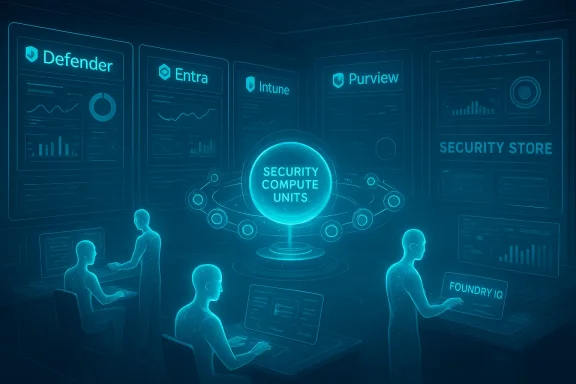
Microsoft announced the inclusion during its major product wave in late 2025, positioning Security Copilot agents as embedded helpers across Defender, Entra (identity), Intune (device management), and Purview (data governance). The company also framed the announcement within a broader “agentic” architecture—Agent 365 as a tenant control plane, Copilot Studio and Foundry for development and grounding, and a Security Store to distribute Microsoft and partner agents.
Two operational pillars stand out:
But this is not a plug‑and‑play magic bullet. The new model swaps one class of complexity (mismatched integrations) for another: identity‑driven agent governance, metered compute economics, and the need for robust AgentOps to prevent automation disasters. The sensible path forward is cautious and data‑driven: pilot in low‑impact modes, instrument for SCU spend and detection quality, codify governance (agent identity lifecycle, least privilege), and maintain strong off‑ramps and independent detection controls while you build confidence.
For IT leaders and security architects, the single most important near‑term actions are straightforward: model SCU usage, put agent approval and revocation playbooks in place, and run adversarial tests on agent lifecycles. Do that, and the inclusion of Security Copilot in E5 becomes a powerful, manageable accelerant rather than an uncontrolled wildcard.
Conclusion
Microsoft’s decision to include Security Copilot in Microsoft 365 E5 changes the calculus for enterprise security teams by making agentic defenses a baseline capability rather than a premium add‑on. The inclusion simplifies adoption, brings governance primitives to agent lifecycles, and introduces measurable capacity units (SCUs) that teams must actively manage. Success will not be automatic; it will follow disciplined pilots, strong AgentOps, careful cost forecasting, and an insistence on human‑in‑the‑loop checks until automated remediations prove safe at scale. For organizations that do the work now—policy, modeling, testing—the promise is real: less toil, faster investigations, and a platform that turns integrated telemetry into operational advantage.
Source: FourWeekMBA Security Copilot Now Included in Microsoft 365 E5 - FourWeekMBA
 Background / Overview
Microsoft announced the inclusion during its major product wave in late 2025, positioning Security Copilot agents as embedded helpers across Defender, Entra (identity), Intune (device management), and Purview (data governance). The company also framed the announcement within a broader “agentic” architecture—Agent 365 as a tenant control plane, Copilot Studio and Foundry for development and grounding, and a Security Store to distribute Microsoft and partner agents.Two operational pillars stand out:
- A licensing and capacity model that grants Microsoft 365 E5 tenants a monthly SCU allocation (the baseline accounting unit for Security Copilot compute).
- A governance and lifecycle model that treats agents as directory principals (Entra Agent IDs), making them discoverable, auditable, and quarantine‑able via Agent 365.
What Microsoft actually included (the hard facts)
Microsoft’s public materials and product pages set out a few specific, verifiable items that IT teams must plan for immediately.Key inclusions and numbers
- Security Copilot inclusion for Microsoft 365 E5: Security Copilot agents will be made available to all Microsoft 365 E5 customers as part of the subscription package. Rollout began for eligible tenants and will expand in phases, with advance notifications prior to activation.
- Security Compute Units (SCUs): Microsoft provides 400 SCUs per month for every 1,000 paid user licenses, scaled pro‑rata (with included capacity capped at 10,000 SCUs per month). Allocations reset monthly and do not roll over.
- Pay‑as‑you‑go scaling: Microsoft signaled a future option to purchase additional SCUs on demand (public communications included a referenced $6 per SCU pay‑as‑you‑go price point to be enabled later), though customers should expect more precise commercial terms to be finalized in Microsoft’s billing documentation.
- Agent expansions: Microsoft previewed a set of new Microsoft‑built security agents (dozens in aggregate when counting partner contributions and previously available agents)—examples include Phishing Triage, Conditional Access Optimization, Identity Risk Management, DLP/Remediation agents, and automated threat‑hunting agents.
- Agent governance: Agent 365 is the tenant control plane for agent inventory, quarantine, lifecycle, and policy enforcement. Agents receive Entra Agent IDs and are subject to conditional access, RBAC‑style controls, and unified telemetry surfaces.
- Grounding and developer tooling: Copilot Studio and Foundry (with a set of “IQ” layers for grounding) are the development and publishing paths for building, testing, and publishing agents into Agent 365 and Microsoft 365 contexts.
Why this matters: practical, immediate impacts for IT and security teams
This is a practical, not merely theoretical, shift. The inclusion converts an optional security AI capability into a default entitlement for many enterprise customers and thereby:- Lowers the procurement barrier for agentic security automation, accelerating trial and adoption cycles inside E5 enterprises.
- Forces operational planning around meterable compute (SCUs) rather than purely capacity provisioning—teams must model likely consumption patterns to avoid surprises.
- Brings governance to the forefront: agents are now directory entities whose identity lifecycle, permissioning, and audit trail must be managed like service accounts.
- Tightens integration between identity, endpoint, data, and security incidents—agents will operate across Entra, Defender, Intune, and Purview, enabling multi‑domain automation but also creating cross‑product blast radii.
The commercial model: SCUs, included capacity, and cost control
Security Copilot’s compute usage is measured in Security Compute Units (SCUs)—a metered currency that represents the compute used to run Copilot workloads (prompt execution, incident summarization, hunting jobs, etc.). The inclusion model replaces an hourly provisioned capacity model with a monthly allocation:- 400 SCUs per 1,000 paid E5 user licenses, up to a 10,000 SCU monthly cap included with the subscription.
- Allocations are tenant‑wide and consumable across workspaces; unused SCUs do not roll over.
- Microsoft’s examples show how ephemeral prompt workloads consume fractional SCUs, and how inclusion can be materially cheaper than always‑on provisioned capacity for intermittent usage patterns.
- A pay‑as‑you‑go overage option is intended for heavy or bursty consumers, but customers should treat that option as a forthcoming commercial mechanism that requires separate verification when enabled.
- Build a simple SCU‑consumption model during pilot phases to estimate monthly allocations required.
- Use the included allocation for low to medium usage scenarios (typical triage and investigation loads) and budget for pay‑as‑you‑go for large hunts or automated remediation bursts.
- Put consumption alerts and caps in place to avoid surprise charges when overage billing becomes enabled.
The technical architecture: agents, Agent 365, Foundry, Copilot Studio
Microsoft’s narrative is intentionally holistic: agents are small automation units that need identity, lifecycle, grounding, and observability.Agent 365 — the control plane
Agent 365 is a tenant registry and governance surface that:- Inventories tenant agents (Microsoft‑built, partner, or custom).
- Issues and binds Entra Agent IDs to agents so that conditional access, MFA, and lifecycle controls apply.
- Provides quarantine and audit tools to remove or isolate rogue agents.
- Surfaces telemetry and behavior analytics around agent-to-resource interactions.
Copilot Studio and Foundry
Copilot Studio is the low‑code/no‑code authoring environment for building and tuning agents. Foundry and its IQ layers provide grounding and retrieval pipelines (called Foundry IQ, Fabric IQ, Work IQ) to give agents tenant context and reduce hallucination risks.- Work IQ: maps roles and collaboration patterns for contextual responses.
- Fabric IQ: brings analytics and time‑series context into reasoning.
- Foundry IQ: managed knowledge endpoints for curated, tenant‑specific content.
Strengths and strategic upsides
- Faster time to value for E5 customers. Inclusion removes the licensing friction that slowed many pilot projects, enabling SOCs to test real automation scenarios without immediate extra cost.
- Unified telemetry and richer model inputs. A single vendor controlling identity, endpoint, cloud and data telemetry permits cross‑domain reasoning that often outperforms stitched‑together detections.
- Governance baked into the product. Treating agents as Entra identities and providing quarantine controls reduces operational surprise compared with unchecked script proliferation.
- Built‑in agent catalogue and partner ecosystem. The Security Store and partner agents simplify discovering prebuilt automations for common tasks, accelerating deployment for understaffed teams.
- Reduced analyst toil. Early trials cited by Microsoft show substantial triage and throughput improvements for repetitive, high‑volume tasks such as phishing report processing.
Risks, caveats, and what Microsoft’s marketing tends to underplay
No platform transition is risk‑free. The move toward agentic security introduces new, real operational tradeoffs.1. Vendor concentration and lock‑in
Consolidating identity, telemetry, policy, and AI models inside one vendor reduces integration friction, but it increases dependency: detection quality, attack telemetry, and remediations become tightly coupled to Microsoft’s data and roadmap. For multi‑vendor estates this is a strategic decision—not merely a technical one.2. Automation blast radius
Agents that can perform actions (isolate endpoints, revoke access, modify policies) increase the potential impact of malicious or buggy automation. Misconfigurations, compromised agent credentials, or logic errors can magnify harm. Organizations must require staged operation modes: suggest‑only, semi‑automated with approval, then fully automated after confidence is built.3. Supply‑chain and agent authenticity
Publishing and installing partner agents creates a new supply chain. Tenants must vet agents (manifests, publisher identity), restrict third‑party consent, and monitor agent behavior for anomalies. Treat agent manifests like any other third‑party software package discovery.4. Opaque economics at scale
Metering is useful, but SCU consumption at scale—large hunts, bulk DLP scans, or enterprise‑wide remediation—can be costly. The fixed monthly allocation helps, but forecasting heavy agent workloads and setting operational caps is essential to avoid bill shock when pay‑as‑you‑go options are enabled.5. Data residency, compliance, and privacy
Agents that access tenant content and prompts require careful handling of logging, prompt retention, and cross‑region compute decisions. Default provisioning choices (data geography, GPU location, and data sharing defaults) must be verified against regulatory and contractual obligations.6. Overreliance on vendor‑reported efficacy
Microsoft cites trials and metrics showing analyst productivity gains. These are promising but environment‑dependent. Organizations should treat vendor trial results as directional: pilot, measure, and validate with their telemetry before assuming equivalent outcomes.Practical deployment guidance: a recommended phased playbook
If your organization is an E5 customer (or considering migration), here’s a practical, staged approach to adopt Security Copilot safely and effectively.1. Governance and policy foundations (done first)
- Create an AgentOps governance working group (security, identity, compliance, and application owners).
- Define agent approval flows, required manifest checks, and vendor review criteria.
- Establish a baseline of what agents may do (suggest vs. act) and which actions require human approval.
2. Capacity planning and SCU modeling
- Map expected scenarios (phishing triage volume, weekly hunts, incident summarization).
- Estimate SCU consumption per scenario during test runs and extrapolate monthly usage.
- Compare estimates to included SCUs; model potential overage scenarios and budget accordingly.
3. Start in read‑only / recommend mode
- Deploy high‑value agents initially in suggest or read‑only mode.
- Measure false positives, analyst time saved, and SCU consumption before enabling any action‑taking capabilities.
4. Integrate into SIEM/SOAR and playbooks
- Pipe agent logs and activity trails into your SIEM and SOAR for unified auditing.
- Update IR playbooks to include agent interventions and rollback procedures.
5. Run tabletop and red‑team simulations
- Simulate compromised agent scenarios and test quarantine and revocation via Agent 365.
- Validate cross‑product incident choreography (endpoint isolation + user disable + cloud remediation).
6. Progressive automation with reversibility guarantees
- Move from suggest → semi‑automated (automated proposals, human approval) → fully automated, but require rollback hooks and explicit approvals for high‑impact actions.
Checklist: what to verify in your tenant before wider rollout
- Confirm whether your tenant has already received a 30‑day activation notice and whether zero‑click provisioning will occur.
- Validate default auto‑provision settings: data geography, GPU processing location, and data sharing toggles.
- Review Entra conditional access and RBAC rules that will apply to Entra Agent IDs.
- Confirm retention policies and prompt content handling for audit/compliance requirements.
- Create SCU usage alerts and spend thresholds.
- Vet partner agents in the Security Store and require manifest and publisher attestations.
How to measure success (KPIs and metrics)
Operational KPIs should be concrete and telemetry‑driven:- Analyst time per investigated alert (target % reduction).
- Mean time to triage (MTT) and mean time to containment (MTTC) for sample incident classes.
- False positive / false negative rates for agent triage actions.
- Monthly SCU consumption vs included allocation and cost per incident itemized.
- Number and impact of automated remediations (and any rollbacks performed).
Final assessment: pragmatic optimism with strict guardrails
Microsoft’s inclusion of Security Copilot in Microsoft 365 E5 is a pragmatic step that materially reduces the friction of adopting agentic security automation. For organizations already committed to the Microsoft ecosystem, the operational conveniences—unified telemetry, agent governance, and included SCU capacity—can accelerate SOC modernization, reduce repetitive analyst tasks, and enable faster, cross‑domain investigations.But this is not a plug‑and‑play magic bullet. The new model swaps one class of complexity (mismatched integrations) for another: identity‑driven agent governance, metered compute economics, and the need for robust AgentOps to prevent automation disasters. The sensible path forward is cautious and data‑driven: pilot in low‑impact modes, instrument for SCU spend and detection quality, codify governance (agent identity lifecycle, least privilege), and maintain strong off‑ramps and independent detection controls while you build confidence.
For IT leaders and security architects, the single most important near‑term actions are straightforward: model SCU usage, put agent approval and revocation playbooks in place, and run adversarial tests on agent lifecycles. Do that, and the inclusion of Security Copilot in E5 becomes a powerful, manageable accelerant rather than an uncontrolled wildcard.
Conclusion
Microsoft’s decision to include Security Copilot in Microsoft 365 E5 changes the calculus for enterprise security teams by making agentic defenses a baseline capability rather than a premium add‑on. The inclusion simplifies adoption, brings governance primitives to agent lifecycles, and introduces measurable capacity units (SCUs) that teams must actively manage. Success will not be automatic; it will follow disciplined pilots, strong AgentOps, careful cost forecasting, and an insistence on human‑in‑the‑loop checks until automated remediations prove safe at scale. For organizations that do the work now—policy, modeling, testing—the promise is real: less toil, faster investigations, and a platform that turns integrated telemetry into operational advantage.
Source: FourWeekMBA Security Copilot Now Included in Microsoft 365 E5 - FourWeekMBA
