

Russia’s sudden mobile “cooling-off” for returning travellers, Microsoft’s push to make passkeys a first-class OS feature, and a flurry of vendor patches and threat intelligence reports together make this an unusually consequential week for enterprise defenders and everyday Windows users alike — each story exposes a different trade-off between security, convenience, and national or corporate resilience.
Russia implements 24‑hour SIM lockdown for returning travellers
In early November 2025 Russian authorities ordered telecom operators to apply a temporary 24‑hour block on mobile internet and SMS for SIM cards that have been used abroad or that have been inactive for 72 hours, with an online captcha or identity check offered as an immediate bypass. The government framed the measure as a counter‑drone step: SIM‑equipped modules can be embedded in unmanned aerial vehicles and used as inexpensive navigation or signalling aids, the Ministry said. Independent reports and local outlets show the policy entered a test phase and has already caused confusion and service gaps in border regions. Windows 11 moves passkeys to the OS level with third‑party plugins
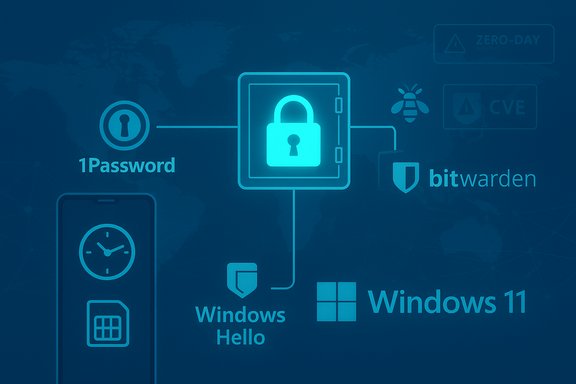
Microsoft’s November 2025 Windows 11 servicing wave converted passkeys from a mostly browser‑bound convenience into a system‑level capability. The update introduces a passkey provider plugin API that lets packaged credential managers register as system passkey providers (initial partners include 1Password and Bitwarden). Windows Hello remains the local gatekeeper for biometric/PIN verification while providers handle discovery, storage, and optional cloud sync. Microsoft also surfaced its Password Manager (from Edge) as a native Windows plugin with Azure‑backed protections. Community and vendor reporting provides implementation and packaging details (MSIX for 1Password, beta builds for Bitwarden) and practical steps for administrators and end users. Synology patches a critical BeeStation RCE disclosed at Pwn2Own
Synology issued an emergency update to address a critical remote code execution vulnerability (CVE‑2025‑12686) affecting BeeStation OS, a consumer “personal cloud” product line; the bug — a buffer copy without input size checks — was demonstrated at Pwn2Own Ireland 2025 and carries a high CVSS rating. Synology’s advisory requires immediate upgrades to BeeStation OS 1.3.2‑65648 or later, and independent reporting confirms exploitability and the lack of practical mitigations beyond patching. Amazon’s threat intelligence links Cisco and Citrix zero‑day abuse to an APT‑style campaign
Amazon Integrated Security’s MadPot honeypot telemetry and subsequent analysis report that a highly resourced actor exploited two zero‑day flaws — Citrix NetScaler (the “CitrixBleed 2” family, CVE‑2025‑5777) and Cisco ISE (CVE‑2025‑20337) — before public disclosure, and tailored a custom in‑memory web shell for Cisco ISE to sustain stealthy access. Multiple outlets corroborate Amazon’s findings and emphasize the operational profile of a persistent espionage actor rather than a commodity criminal gang. DanaBot returns with a new Windows variant after Operation Endgame disruptions
Researchers at Zscaler ThreatLabz observed a new DanaBot Windows variant (v669), marking a comeback roughly six months after international law‑enforcement interventions (Operation Endgame) disrupted several initial‑access and loader families. The malware remains modular and offered as malware‑as‑a‑service, with fresh C2 infrastructure and wallet addresses linked in vendor reports. Operators are once again targeting multiple regions, including Australia, North America and Europe. UK advances its Cyber Security and Resilience Bill; insurers report surge in cyber payouts
The UK government’s Cyber Security and Resilience Bill (policy statement published April 1, 2025) is progressing as a major update to the NIS 2018 framework; it widens scope, strengthens regulator powers, and adds more robust incident‑reporting obligations. In parallel, the Association of British Insurers (ABI) reported a sharp rise in cyber insurance payouts — £197m in the latest year, a 230% increase — a data point that underscores escalating systemic costs and the importance of resilience investments. Google and the Lighthouse smishing allegations (unverified)
Several social media summaries and aggregated posts allege that Google has filed litigation related to the Lighthouse smishing kit that impersonates services like E‑ZPass and USPS; however, at the time of writing an authoritative, verifiable public court filing or Google press release matching those specific claims could not be located in primary legal or company records. This item is marked as requiring further confirmation from court dockets or an official Google statement. (See “Verification note” below.
Source: LinkedIn Mobile blackout for Russian travelers, Windows 11 supports 3rd party passkeys, Synology patches BeeStation flaw
 Background / Overview
Russia implements 24‑hour SIM lockdown for returning travellersIn early November 2025 Russian authorities ordered telecom operators to apply a temporary 24‑hour block on mobile internet and SMS for SIM cards that have been used abroad or that have been inactive for 72 hours, with an online captcha or identity check offered as an immediate bypass. The government framed the measure as a counter‑drone step: SIM‑equipped modules can be embedded in unmanned aerial vehicles and used as inexpensive navigation or signalling aids, the Ministry said. Independent reports and local outlets show the policy entered a test phase and has already caused confusion and service gaps in border regions. Windows 11 moves passkeys to the OS level with third‑party plugins
Microsoft’s November 2025 Windows 11 servicing wave converted passkeys from a mostly browser‑bound convenience into a system‑level capability. The update introduces a passkey provider plugin API that lets packaged credential managers register as system passkey providers (initial partners include 1Password and Bitwarden). Windows Hello remains the local gatekeeper for biometric/PIN verification while providers handle discovery, storage, and optional cloud sync. Microsoft also surfaced its Password Manager (from Edge) as a native Windows plugin with Azure‑backed protections. Community and vendor reporting provides implementation and packaging details (MSIX for 1Password, beta builds for Bitwarden) and practical steps for administrators and end users. Synology patches a critical BeeStation RCE disclosed at Pwn2Own
Synology issued an emergency update to address a critical remote code execution vulnerability (CVE‑2025‑12686) affecting BeeStation OS, a consumer “personal cloud” product line; the bug — a buffer copy without input size checks — was demonstrated at Pwn2Own Ireland 2025 and carries a high CVSS rating. Synology’s advisory requires immediate upgrades to BeeStation OS 1.3.2‑65648 or later, and independent reporting confirms exploitability and the lack of practical mitigations beyond patching. Amazon’s threat intelligence links Cisco and Citrix zero‑day abuse to an APT‑style campaign
Amazon Integrated Security’s MadPot honeypot telemetry and subsequent analysis report that a highly resourced actor exploited two zero‑day flaws — Citrix NetScaler (the “CitrixBleed 2” family, CVE‑2025‑5777) and Cisco ISE (CVE‑2025‑20337) — before public disclosure, and tailored a custom in‑memory web shell for Cisco ISE to sustain stealthy access. Multiple outlets corroborate Amazon’s findings and emphasize the operational profile of a persistent espionage actor rather than a commodity criminal gang. DanaBot returns with a new Windows variant after Operation Endgame disruptions
Researchers at Zscaler ThreatLabz observed a new DanaBot Windows variant (v669), marking a comeback roughly six months after international law‑enforcement interventions (Operation Endgame) disrupted several initial‑access and loader families. The malware remains modular and offered as malware‑as‑a‑service, with fresh C2 infrastructure and wallet addresses linked in vendor reports. Operators are once again targeting multiple regions, including Australia, North America and Europe. UK advances its Cyber Security and Resilience Bill; insurers report surge in cyber payouts
The UK government’s Cyber Security and Resilience Bill (policy statement published April 1, 2025) is progressing as a major update to the NIS 2018 framework; it widens scope, strengthens regulator powers, and adds more robust incident‑reporting obligations. In parallel, the Association of British Insurers (ABI) reported a sharp rise in cyber insurance payouts — £197m in the latest year, a 230% increase — a data point that underscores escalating systemic costs and the importance of resilience investments. Google and the Lighthouse smishing allegations (unverified)
Several social media summaries and aggregated posts allege that Google has filed litigation related to the Lighthouse smishing kit that impersonates services like E‑ZPass and USPS; however, at the time of writing an authoritative, verifiable public court filing or Google press release matching those specific claims could not be located in primary legal or company records. This item is marked as requiring further confirmation from court dockets or an official Google statement. (See “Verification note” below.
Russia’s SIM “cooling off” — practical effects and security trade-offs
What changed and why it matters
The policy imposes a 24‑hour automatic limit on mobile internet and SMS for SIMs that return from roaming or have been inactive for 72 hours, with operators offering an online captcha or phone‑based ID check to restore service early. Authorities say the measure reduces the risk of small, unattended SIMs being used to equip loitering UAVs; however, the practical result is an enforced connectivity blackout that can imperil travellers who rely on mobile data for navigation, contact, and transit boarding confirmations.Strengths of the measure
- Hardening against low‑tech adversary techniques: SIM‑based tracking or control can be attractive for low‑cost drone guidance; a temporary lockdown raises the bar for opportunistic use.
- Rapid operator control: Telcos already have the network hooks to implement these geographic and roaming checks on detection, enabling fast deployment if the threat landscape shifts.
Risks and unintended consequences
- Collateral damage to civilians and critical services: Border regions, transportation hubs and remote workers can lose connectivity when they most need it — a clear operational risk for safety and commerce.
- Usability and recovery friction: Captchas and phone‑based verification are friction points that may be inaccessible for some travellers (e.g., non‑smartphone users or those with disabled roaming SIMs).
- Potential misuse for surveillance or censorship: Any permanent expansion of such controls raises civil‑liberties questions if lockouts are triggered by automated heuristics that misclassify legitimate use.
Practical guidance for travellers and network teams
- Before travel into or out of Russia, ensure recovery channels are configured: register alternate emails, enable operator‑provided identity verification, and test the ability to receive operator SMS while roaming.
- Keep paper copies or offline screenshots of critical travel documents and boarding passes to reduce reliance on mobile connectivity immediately on arrival.
- For enterprise administrators with mobile workforces, plan for fallback communications (local SIM swap with trusted provider, preconfigured secure VPN via tethering, or satellite comms for critical operations).
Windows 11 passkeys: what changed, why it matters, and deployment realities
The technical shift: passkeys at OS level
Microsoft’s November 2025 update exposes a passkey provider plugin API in Windows 11 and a redesigned Settings → Accounts → Passkeys UI where users may pick a system passkey provider. Windows Hello remains the local verification step; registered providers (Microsoft Password Manager, 1Password, Bitwarden) handle storage and optional cross‑device sync and recovery. This design intentionally separates local authentication (Windows Hello + TPM) from vault storage and recovery, giving users and organizations real choice about key custody.Immediate benefits
- Reduced phishing and credential theft risk: Passkeys are FIDO/WebAuthn public‑key credentials; the private key never leaves the authenticator, making phishing and server‑side credential dumps ineffective by design.
- Better cross‑device UX: Third‑party managers can reuse their existing sync and recovery systems so a passkey created on mobile can be used on a PC without ad‑hoc QR pairing.
- Enterprise control: IT can manage packaging and deployment (MSIX) and utilize Windows Hello for Business primitives to scale passwordless adoption in corporate fleets.
Operational caveats and risks
- Packaging and deployment friction: Microsoft’s plugin registration is tied to app packaging semantics; vendors registering as system providers typically need MSIX packaging. Enterprises that restrict packaging types (AppLocker, restricted installers) will need deployment exceptions or new processes.
- Recovery & continuity: Each provider has different recovery models. If an employee’s third‑party vault account is lost or suspended, passkey recovery is governed by that vendor’s account recovery processes. Organizations must document and test helpdesk and fallback authentication flows.
- Early‑adopter edge cases: Community reports from preview/beta channels highlight browser interoperability and extension edge cases that warrant a cautious pilot before broad rollouts.
Practical checklist for IT and security teams
- Ensure Windows 11 devices are patched to the November 2025 servicing wave; look for the Passkeys UI in Settings → Accounts → Passkeys (Advanced options).
- Pilot with a controlled group using the MSIX‑packaged vendor clients (1Password MSIX, Bitwarden preview if required).
- Update recovery and helpdesk playbooks to include vendor‑specific recovery flows; require multi‑factor custody for master recovery credentials.
- Require hardware‑backed attestation where possible (TPM, Secure Boot) and enforce device health posture checks before passkey enrollment.
- Monitor vendor advisories and vendor cryptographic handling (end‑to‑end encryption, HSM usage, recovery primitives) as part of procurement security reviews.
Synology BeeStation RCE: immediate actions and implications
The flaw and immediate fix
CVE‑2025‑12686 in Synology BeeStation OS is a buffer copy without input size checks that allows unauthenticated remote code execution. Synology’s advisory mandates upgrading to BeeStation OS 1.3.2‑65648 or later — there are no practical mitigations beyond patching for exposed devices. Pwn2Own proof‑of‑concept and multiple vendor reports confirm exploitability.Why this matters
BeeStation targets consumers and small offices with “personal cloud” functionality, meaning compromised devices can leak user documents, multimedia and backups. Unpatched devices on the public internet or with exposed management interfaces are at immediate risk of takeover, data theft and lateral propagation into local networks.Recommended mitigation steps
- Patch BeeStation devices to the vendor‑released OS version (1.3.2‑65648) immediately.
- If patching is delayed, block management and storage ports at network edge and disable remote access features.
- Enforce strong device provisioning: unique admin credentials, 2FA on accounts, and network segmentation to limit lateral movement.
- Search enterprise and home networks for exposed devices (shodan/zoomeye monitoring, but do this under policy and with permission) and prioritize emergency patching for internet‑facing hosts.
Amazon’s threat intel on Cisco and Citrix: tactical lessons
What Amazon observed
Amazon’s MadPot honeypots detected pre‑disclosure exploitation of Citrix NetScaler (CVE‑2025‑5777, aka “CitrixBleed 2”) and Cisco ISE (CVE‑2025‑20337), and traced custom in‑memory web shells designed to blend into Cisco ISE internals. The profile (custom tooling, memory‑only implants, selective targeting) is consistent with a highly resourced espionage actor seeking prolonged stealthy access. Amazon disclosed findings to vendors during the investigation window.Implications for defenders
- Patch‑gap exploitation is real: Actors will weaponize vulnerabilities pre‑ or near‑simultaneous with public advisories; this places a premium on rapid detection and compensating controls for high‑value perimeter appliances.
- Telemetry and deception matter: Honeypot and deception telemetry can reveal attacker TTPs and recover IoCs before broad customer impact; consider running controlled canaries for edge services.
- Assume compromise of old appliances: NetScaler and similar edge devices often have legacy configurations and exposed management interfaces — treat them as high‑value assets and harden accordingly.
Recommended steps (prioritized)
- Immediately validate all Citrix NetScaler and Cisco ISE instances are patched to vendor‑recommended versions; if immediate patching is not possible, implement network ACLs to restrict administrative interfaces.
- Deploy or tune IDS/IPS signatures to detect anomalous Tomcat/Tomcat‑related HTTP listener registrations and suspicious DES‑like obfuscation patterns referenced in the Amazon analysis.
- Harden logging and collection on identity and access infrastructure (IaaS) to capture memory‑scanning activities and anomalous account creation or HTTP endpoints.
Malware watch: DanaBot’s comeback and what it signals
DanaBot’s resurfacing with a Windows variant confirms a classic pattern: law‑enforcement takedowns slow but don’t permanently stop modular MaaS families, which can re‑emerge with incremental changes. The modular design allows operators to add plug‑ins and pivot to steal banking credentials, deliver loaders, or stage secondary payloads. Zscaler provided IoCs and C2 infrastructure for detection and takedown collaboration. Defensive posture recommendations:- Treat modular banking trojans like persistent threats: patch endpoints, enforce application allow‑listing, implement EDR detection for process hollowing and DLL injection, and block known C2 infrastructure at network edge.
- Maintain active threat‑feed ingestion and prioritize IOC matching from vendor advisories to reduce dwell time.
Policy and market signals: UK bill and insurance market reaction
The UK’s Cyber Security and Resilience Bill (policy statement) aims to bring roughly 1,000 firms into a strengthened regulatory regime, expand incident reporting, and give regulators faster powers to respond to “emerging threats.” The policy statement and related guidance are available from the UK government; businesses in scope should plan for increased reporting burdens and higher baseline controls. At the market level, the ABI’s data (reported by Infosecurity) shows cyber insurance payouts in the UK jumped to £197m — a 230% increase year‑on‑year — indicating both increased incident severity and greater reliance on insurance transfer. Insurers are responding by demanding stronger baseline controls and offering more pre‑incident risk prevention services bundled with policies. Practical read‑through for boards and CISOs:- Expect regulators to require demonstrable technical controls and incident readiness. Align compliance roadmaps with the new bill’s policy statement now.
- Treat cyber‑insurance as part of a resilience program, not a substitute for fundamental security posture; insurers will tighten underwriting requirements and may restrict payout options (e.g., bans on ransom payments for some sectors).
Verification note and flagged claims
- The Google litigation against Lighthouse smishing kit is reported in some social summaries, but a primary court filing or an official Google press release detailing the specific claims (RICO, Lanham Act, CFAA) and named defendants could not be located in official public dockets at the time of this article. Readers and legal teams should seek the actual filing in U.S. federal court PACER records or an official corporate statement before treating the story as legally settled. This claim is flagged as unverified pending primary source confirmation.
What to watch next (risk horizon)
- Watch the roll‑out and third‑party adoption curve for Windows passkey providers: early adoption will expose the most interesting integration and recovery edge cases, and browser interoperability will be the next battleground.
- Monitor post‑patch telemetry on Synology BeeStation devices for evidence of exploit attempts; unpatched IoT and consumer cloud devices remain high‑risk.
- For organizations using Citrix or Cisco edge appliances, prioritize patching and assume the attacker may have long‑term footholds; beef up detection and isolate any suspected hosts.
- Track regulatory moves in the UK and elsewhere; compliance deadlines and insurer underwriting changes will affect budgets and security program priorities.
Final analysis: balancing defence, convenience, and oversight
This week’s headlines illustrate a persistent security paradox: practical protective measures (Russia’s SIM lockdowns, Microsoft’s OS‑level passkey orchestration, Synology’s emergency patch) each trade convenience or control for a security gain. Successful security programmes will be those that manage these trade‑offs deliberately:- Emphasize choice and recovery: Windows passkeys are a major step forward for phishing resistance — but only if recovery models and packaging/deployment realities are explicitly addressed in policy and helpdesk playbooks.
- Prioritize patch and containment for edge devices: Citrix, Cisco, Synology — perimeter and consumer cloud devices are favorite targets; rapid patching plus compensating network controls matter.
- Maintain resilient communications plans: the Russia example is a reminder that policy and security controls can disrupt essential services; planners must build robust fallback communication paths for employees and customers.
- Incorporate threat intelligence and deception: Amazon’s MadPot findings demonstrate the operational value of deception and telemetry for early detection of zero‑day exploitation.
Source: LinkedIn Mobile blackout for Russian travelers, Windows 11 supports 3rd party passkeys, Synology patches BeeStation flaw
