

Using a self-hosted VPN is still one of the few practical ways to regain control over your traffic in 2026, but the right setup depends on what you value most: speed, stealth, jurisdictional flexibility, or simplicity. The Habr guide argues that a personal VPS plus Amnezia-based obfuscation is the most resilient option for users facing throttling, censorship, or aggressive DPI, while also avoiding the trust problems that come with commercial VPN brands. It also frames the deployment as achievable in about 30 minutes, provided you choose the right host and follow the firewall and protocol steps carefully .
The core idea behind the article is straightforward: rent a VPS, install a privacy-focused VPN stack, and keep control of the keys, logs, and routing yourself. That premise has become more appealing as internet controls have tightened, commercial VPN IP ranges have become easier to fingerprint, and users have grown more skeptical of “no logs” marketing claims. The piece treats the self-hosted model not as a hobby project, but as a defensive response to a more fragmented and monitored internet .
That framing matters because self-hosting changes the trust model. Instead of relying on a third-party VPN provider’s promises, policy enforcement, and internal security practices, you own the server configuration and decide how access is granted. In practice, that means fewer unknowns, fewer shared customers, and fewer reasons for a provider-side incident to expose your session metadata or operational details .
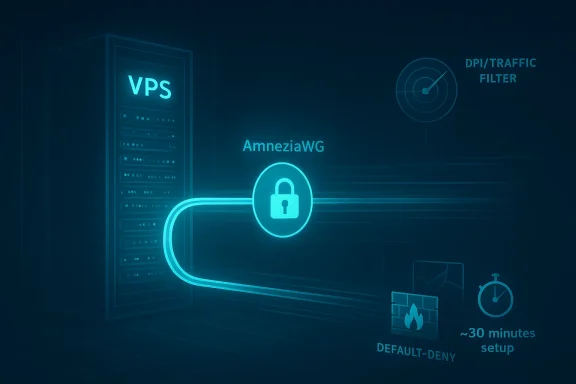
The guide also places a strong emphasis on stealth rather than raw encryption. Standard WireGuard is fast, but its packet shape is recognizable to DPI systems, so the article recommends AmneziaWG for obfuscation and XRay/V2Ray for stricter environments. That is an important distinction: the article is not just saying “use a VPN,” it is saying “use a VPN that is harder to classify, throttle, or block” .
It is also notable that the article blends consumer, privacy, and quasi-technical procurement advice. It spends a large amount of space on host selection, jurisdiction, and payment options, which tells you that the operational environment is part of the product. In other words, the server is not just infrastructure; it is part of the privacy posture .
A self-hosted setup changes the economics of control. You are no longer buying into a mass-market network whose IPs are being used by thousands of strangers. Instead, you are purchasing a single VPS instance and turning it into a private transit point, which makes your traffic less likely to look like a generic VPN customer flow and more like a unique, self-managed endpoint .
There is also an operational advantage that privacy enthusiasts tend to underestimate: predictability. If a commercial VPN’s exit IP is blocked, the provider has to solve the problem for everyone. If your VPS endpoint is blocked or flagged, you can move faster, change ports, change protocol behavior, or migrate jurisdictions on your own schedule .
The guide’s answer is to use obfuscated transports that resemble ordinary traffic. AmneziaWG is positioned as a WireGuard fork that hides the protocol’s recognizable signature and can masquerade as common UDP-like flows. XRay/V2Ray is presented as a heavier-duty option for more hostile environments, trading simplicity for resilience against inspection and classification .
The practical implication is that one-size-fits-all VPN advice no longer works well. A setup that is perfect for casual streaming or café Wi‑Fi might fail in an environment where filtering systems are tuned to find and throttle common VPN signatures. The article’s layered approach is therefore more realistic than generic “install a VPN app” advice .
That said, the article takes a pragmatic, almost marketplace-style approach to vendor selection. It lists several providers with different trade-offs: privacy-oriented hosts, budget options, geographically diverse infrastructure, and platforms with pre-installed Amnezia. That is useful for readers who want a quick launch path, but it also means the decision is partly about risk tolerance, not just benchmarks .
The article also recognizes that jurisdiction is not a decorative detail. Hosting in a country with clear infrastructure rules and solid network quality can make a practical difference in reliability, while also shaping what legal exposure or abuse response behavior you may encounter. In a privacy-sensitive setup, geography is part of the architecture .
The piece also acknowledges that some providers carry controversy or risk factors. That is important because a VPN endpoint is not just another disposable app instance. If the host is slow to respond, inconsistent about suspensions, or exposed to sanctions or legal pressure, your “private” VPN can become a weak link rather quickly .
The article’s recommendation is essentially to balance convenience against survivability. That is a mature way to think about infrastructure, because a VPN is only as useful as its ability to stay up, stay reachable, and remain in your control. For many users, that will outweigh small differences in monthly cost .
The firewall guidance is also solid in principle. The article recommends a default-deny posture for inbound traffic, then explicitly allowing SSH and the chosen UDP port for the VPN tunnel. That is the right mental model for a dedicated VPN box: keep the exposed surface area narrow, and do not assume the VPS provider’s own network settings will do the job for you .
The recommendation to avoid the default WireGuard port is another practical touch. While port choice is not a security feature by itself, it can reduce gratuitous fingerprinting and avoid simplistic blocking rules that target well-known VPN ports. That does not defeat sophisticated DPI, but it can still reduce unnecessary attention .
The guide also references FakeTLS behavior through the client, where the session appears to be ordinary TLS externally. That is a valuable concept because many filtering systems prioritize visible protocol patterns and handshake characteristics. By making the connection resemble common encrypted web traffic, the VPN has a better chance of surviving in suspicious networks .
The value here is that the setup moves beyond “just encrypt it” and into “make it look ordinary.” That is the difference between a privacy tool and a censorship-resilience tool. The article understands that distinction and builds the deployment path around it .
The guide’s treatment of XRay is concise but clear: use it when stealth matters more than convenience. That is a fair editorial call, because the more complex a tool becomes, the more room there is for misconfiguration. In return, you get a transport that can be shaped to resemble web traffic more convincingly than a conventional VPN stack .
The article gets this balance mostly right by framing XRay as a specialized option rather than a universal default. That restraint is important, because the best privacy tool is often the one you can actually keep running and recover quickly when something breaks. Usability remains part of security here .
For enterprise users, the implications are more nuanced. A self-hosted VPN can be attractive for small teams that want a controlled remote-access point without paying for a larger managed platform, but it also shifts responsibility for patching, monitoring, authentication, and uptime onto the operator. In other words, the enterprise upside is control; the enterprise downside is ownership of every failure mode .
The article’s real enterprise lesson is that a private tunnel can be a useful building block, not a complete program. You still need device hygiene, identity controls, endpoint monitoring, and a backup plan if the VPS becomes unreachable. That is the difference between a privacy tool and a business-critical access layer .
It also correctly recognizes that the VPN problem in 2026 is not just encryption quality. It is detectability, provider trust, host jurisdiction, and network adaptability. By acknowledging those layers, the guide gives readers a more realistic model of what they are actually defending against .
There is also a risk that users will overestimate what a self-hosted VPN can do. It improves control, but it does not make a user invisible, nor does it eliminate endpoint compromise, browser fingerprinting, account correlation, or legal exposure tied to activity. A private VPN is a routing decision, not a full anonymity system .
The more interesting question is whether self-hosted VPNs become easier for mainstream users to deploy without sacrificing control. If platforms like Amnezia continue to simplify onboarding, the gap between privacy enthusiasts and ordinary users may narrow. But the underlying tension will remain: the more widely a stealth tool is adopted, the more attention it attracts from filtering systems and network operators .
Source: Хабр How to Setup Your Own Private Self-Hosted VPN Server in 30 Minutes (2026)
 Overview
The core idea behind the article is straightforward: rent a VPS, install a privacy-focused VPN stack, and keep control of the keys, logs, and routing yourself. That premise has become more appealing as internet controls have tightened, commercial VPN IP ranges have become easier to fingerprint, and users have grown more skeptical of “no logs” marketing claims. The piece treats the self-hosted model not as a hobby project, but as a defensive response to a more fragmented and monitored internet .That framing matters because self-hosting changes the trust model. Instead of relying on a third-party VPN provider’s promises, policy enforcement, and internal security practices, you own the server configuration and decide how access is granted. In practice, that means fewer unknowns, fewer shared customers, and fewer reasons for a provider-side incident to expose your session metadata or operational details .
The guide also places a strong emphasis on stealth rather than raw encryption. Standard WireGuard is fast, but its packet shape is recognizable to DPI systems, so the article recommends AmneziaWG for obfuscation and XRay/V2Ray for stricter environments. That is an important distinction: the article is not just saying “use a VPN,” it is saying “use a VPN that is harder to classify, throttle, or block” .
It is also notable that the article blends consumer, privacy, and quasi-technical procurement advice. It spends a large amount of space on host selection, jurisdiction, and payment options, which tells you that the operational environment is part of the product. In other words, the server is not just infrastructure; it is part of the privacy posture .
Why Self-Hosting Is Back in Focus
Commercial VPN fatigue is one of the article’s central themes. The author argues that public VPN networks are increasingly easy to identify, block, or degrade, and that many providers make claims about anonymity that users cannot independently verify. That argument resonates because reputation alone does not solve problems like shared IP blacklists, provider logging policies, or the operational opacity of large consumer VPN fleets .A self-hosted setup changes the economics of control. You are no longer buying into a mass-market network whose IPs are being used by thousands of strangers. Instead, you are purchasing a single VPS instance and turning it into a private transit point, which makes your traffic less likely to look like a generic VPN customer flow and more like a unique, self-managed endpoint .
The trust model shift
This is where the strongest argument for self-hosting lives. The article explicitly suggests that your own server eliminates many of the risks associated with commercial providers because you control the keys and the logs. That is not absolute anonymity, but it is a measurable reduction in third-party dependency and a cleaner security boundary .There is also an operational advantage that privacy enthusiasts tend to underestimate: predictability. If a commercial VPN’s exit IP is blocked, the provider has to solve the problem for everyone. If your VPS endpoint is blocked or flagged, you can move faster, change ports, change protocol behavior, or migrate jurisdictions on your own schedule .
- You control the server-side configuration.
- You avoid dependence on a provider’s logging promises.
- You can rotate ports and protocols more freely.
- You can move hosts without waiting for vendor support.
- You reduce exposure to mass-market IP reputation problems.
The Censorship and DPI Problem
The article’s strongest editorial claim is that standard VPNs are becoming less reliable in places where filtering has matured. It highlights DPI-based blocking, traffic fingerprinting, and the tendency for public VPN endpoints to get recognized over time. That is a real tactical problem: once a protocol or port becomes associated with VPN use, its utility drops sharply in restrictive networks .The guide’s answer is to use obfuscated transports that resemble ordinary traffic. AmneziaWG is positioned as a WireGuard fork that hides the protocol’s recognizable signature and can masquerade as common UDP-like flows. XRay/V2Ray is presented as a heavier-duty option for more hostile environments, trading simplicity for resilience against inspection and classification .
Why obfuscation matters
Obfuscation does not make traffic magical; it just raises the cost of reliable blocking. That distinction matters because many users confuse “encrypted” with “unclassifiable.” A classic VPN can be encrypted and still easy to spot. The article’s protocol choices are all about reducing that metadata visibility, not replacing cryptography .The practical implication is that one-size-fits-all VPN advice no longer works well. A setup that is perfect for casual streaming or café Wi‑Fi might fail in an environment where filtering systems are tuned to find and throttle common VPN signatures. The article’s layered approach is therefore more realistic than generic “install a VPN app” advice .
- WireGuard: fastest, simplest, easiest to manage.
- AmneziaWG: better for stealth with modest overhead.
- XRay/V2Ray: stronger for restrictive networks, but more complex.
- Shadowsocks: lightweight proxying, but not full-device tunneling.
Picking the Right VPS
The hosting section of the article is less about brand rankings and more about infrastructure fit. It recommends a small KVM VPS with one vCPU and 1–2 GB of RAM for a handful of users, which is sensible for a private VPN. It also stresses that jurisdiction, network quality, and public IPv4 availability matter more than raw discount pricing .That said, the article takes a pragmatic, almost marketplace-style approach to vendor selection. It lists several providers with different trade-offs: privacy-oriented hosts, budget options, geographically diverse infrastructure, and platforms with pre-installed Amnezia. That is useful for readers who want a quick launch path, but it also means the decision is partly about risk tolerance, not just benchmarks .
IPv4 still matters in 2026
One of the smartest warnings in the guide is about the “IPv4 trap.” It notes that some budget plans now ship with IPv6-only or NAT64-style access, which can be fine for modern workloads but problematic for a personal VPN. For a service meant to work on older networks, mobile hotspots, and mixed enterprise environments, a dedicated public IPv4 address remains the safer choice .The article also recognizes that jurisdiction is not a decorative detail. Hosting in a country with clear infrastructure rules and solid network quality can make a practical difference in reliability, while also shaping what legal exposure or abuse response behavior you may encounter. In a privacy-sensitive setup, geography is part of the architecture .
- Prioritize a dedicated public IPv4.
- Prefer KVM virtualization for clean isolation.
- Keep the VPS small but not underprovisioned.
- Choose a jurisdiction that matches your risk profile.
- Treat payment methods and account verification as part of privacy planning.
Provider Risk and Reputation
The article’s provider roundup is one of its more opinionated sections. It includes hosts with privacy-friendly payment options, hosts with strong uptime claims, and hosts that market themselves toward users who value anonymity above all else. That breadth is useful, but it also reminds readers that VPS selection is never purely technical; business policy, abuse handling, and support quality all matter once traffic starts flowing .The piece also acknowledges that some providers carry controversy or risk factors. That is important because a VPN endpoint is not just another disposable app instance. If the host is slow to respond, inconsistent about suspensions, or exposed to sanctions or legal pressure, your “private” VPN can become a weak link rather quickly .
The hidden trade-off
What the guide does well is show that privacy-friendly hosting often comes with operational compromise. A provider may accept crypto, offer offshore positioning, or support quick deployment, but still have weaker support or a more aggressive abuse policy. Conversely, a more mainstream cloud vendor may be reliable but less aligned with user expectations around discretion .The article’s recommendation is essentially to balance convenience against survivability. That is a mature way to think about infrastructure, because a VPN is only as useful as its ability to stay up, stay reachable, and remain in your control. For many users, that will outweigh small differences in monthly cost .
- Better privacy billing does not guarantee better service.
- Fast setup is useful, but uptime is more important.
- Support quality can matter more than raw specs.
- Abuse handling policy can affect innocent customers.
- Legal risk can be more important than advertised bandwidth.
Deployment: What the Guide Gets Right
The technical walkthrough is the most actionable part of the article. It begins with basic provisioning, moves through SSH access, updates, firewall configuration, and then installs the Amnezia client in self-hosted mode. That sequence is broadly sensible, especially for readers who may not be Linux experts but still want a repeatable deployment path .The firewall guidance is also solid in principle. The article recommends a default-deny posture for inbound traffic, then explicitly allowing SSH and the chosen UDP port for the VPN tunnel. That is the right mental model for a dedicated VPN box: keep the exposed surface area narrow, and do not assume the VPS provider’s own network settings will do the job for you .
Hardening before exposure
A useful detail is the inclusion ofunattended-upgrades and fail2ban. Those are not glamorous tools, but they make a real difference on an internet-facing host where bots routinely probe SSH and other standard services. For a small, single-purpose VPN server, basic hardening is often the difference between a stable endpoint and a noisy liability .The recommendation to avoid the default WireGuard port is another practical touch. While port choice is not a security feature by itself, it can reduce gratuitous fingerprinting and avoid simplistic blocking rules that target well-known VPN ports. That does not defeat sophisticated DPI, but it can still reduce unnecessary attention .
- Update the system first.
- Lock the firewall down to essentials.
- Keep SSH exposed only if needed.
- Use a non-default VPN port.
- Verify the provider’s own network firewall, too.
AmneziaWG and FakeTLS
The article’s most important technical distinction is that AmneziaWG is being used not merely as a VPN, but as an obfuscated transport. The author describes it as a WireGuard fork that avoids the protocol’s usual fingerprint and can blend into normal UDP-like traffic. For readers facing DPI, that matters more than headline throughput numbers .The guide also references FakeTLS behavior through the client, where the session appears to be ordinary TLS externally. That is a valuable concept because many filtering systems prioritize visible protocol patterns and handshake characteristics. By making the connection resemble common encrypted web traffic, the VPN has a better chance of surviving in suspicious networks .
Performance versus stealth
The article repeatedly argues that the speed penalty is small. That is plausible in principle, but readers should interpret it carefully: small overhead can still become noticeable on poor VPS hardware, congested routes, or mobile links. Still, the bigger point is right: stealth does not necessarily require a catastrophic sacrifice in usability .The value here is that the setup moves beyond “just encrypt it” and into “make it look ordinary.” That is the difference between a privacy tool and a censorship-resilience tool. The article understands that distinction and builds the deployment path around it .
- AmneziaWG is optimized for concealment.
- FakeTLS helps disguise tunnel behavior.
- Port randomization reduces obvious signature matching.
- Small performance losses are the trade-off for survivability.
- Obfuscation is most valuable in hostile networks.
XRay, V2Ray, and the Strictest Environments
Where AmneziaWG is the article’s preferred compromise, XRay/V2Ray is its escalation path. The author presents it as a better fit for very restrictive environments where ordinary VPN patterns are likely to fail. That makes sense because more advanced proxy frameworks are usually more adaptable, even if they demand more configuration and maintenance .The guide’s treatment of XRay is concise but clear: use it when stealth matters more than convenience. That is a fair editorial call, because the more complex a tool becomes, the more room there is for misconfiguration. In return, you get a transport that can be shaped to resemble web traffic more convincingly than a conventional VPN stack .
When complexity is justified
Not every user needs the most difficult tool in the room. If your goal is secure home access, remote browsing, or routine streaming protection, the additional moving parts may not be worth it. But if your environment is actively hostile to VPNs, extra complexity becomes a justified insurance premium .The article gets this balance mostly right by framing XRay as a specialized option rather than a universal default. That restraint is important, because the best privacy tool is often the one you can actually keep running and recover quickly when something breaks. Usability remains part of security here .
- Use XRay/V2Ray for tougher filtering environments.
- Expect more setup complexity.
- Plan for more troubleshooting overhead.
- Reserve it for cases where stealth is essential.
- Do not overengineer if the lighter stack already works.
Enterprise Versus Consumer Impact
From a consumer standpoint, the article is mostly about freedom of access, travel resilience, and privacy. It offers a path for people who want to avoid public VPN uncertainty, access geo-restricted content, or keep their browsing less exposed on untrusted networks. That is the common self-hosted VPN story, and the guide tells it well .For enterprise users, the implications are more nuanced. A self-hosted VPN can be attractive for small teams that want a controlled remote-access point without paying for a larger managed platform, but it also shifts responsibility for patching, monitoring, authentication, and uptime onto the operator. In other words, the enterprise upside is control; the enterprise downside is ownership of every failure mode .
Different expectations, different risks
Consumers generally care about ease, privacy, and unblockability. Enterprises care about auditability, consistency, and administrative control. The guide leans heavily toward the first group, but its infrastructure advice can still translate to the second if the operator understands that a DIY VPN is not a substitute for a full remote-access strategy .The article’s real enterprise lesson is that a private tunnel can be a useful building block, not a complete program. You still need device hygiene, identity controls, endpoint monitoring, and a backup plan if the VPS becomes unreachable. That is the difference between a privacy tool and a business-critical access layer .
- Consumers gain privacy and bypass capability.
- Small teams gain a controllable remote endpoint.
- Enterprises gain ownership, but also extra duty.
- Admin overhead increases as complexity rises.
- Resilience depends on operational discipline, not just encryption.
Strengths and Opportunities
The article’s biggest strength is that it converts a vague privacy goal into a concrete deployment pattern. It does not stop at philosophy; it gives readers a sequence they can follow, plus enough protocol and firewall detail to avoid obvious mistakes. That makes it unusually practical for a topic that is often oversimplified .It also correctly recognizes that the VPN problem in 2026 is not just encryption quality. It is detectability, provider trust, host jurisdiction, and network adaptability. By acknowledging those layers, the guide gives readers a more realistic model of what they are actually defending against .
- Clear step-by-step deployment logic.
- Useful emphasis on obfuscation, not only encryption.
- Sensible firewall hardening advice.
- Good attention to host jurisdiction and IPv4 availability.
- Practical distinction between consumer and strict-censorship use cases.
- Awareness that port choice can influence detectability.
- A self-hosted model that reduces trust in third parties.
Risks and Concerns
The biggest concern is that the article can feel more certain about vendor claims and censorship outcomes than the evidence usually supports. Hosting providers change, network policies evolve, and obfuscation that works today may stop working after a filtering update. Readers should treat any “works everywhere” implication as temporary, not guaranteed .There is also a risk that users will overestimate what a self-hosted VPN can do. It improves control, but it does not make a user invisible, nor does it eliminate endpoint compromise, browser fingerprinting, account correlation, or legal exposure tied to activity. A private VPN is a routing decision, not a full anonymity system .
- Protocol obfuscation can lose effectiveness over time.
- VPS reputations can change unexpectedly.
- A single server creates a single point of failure.
- Misconfiguration can weaken rather than improve privacy.
- Legal and policy risks still exist at the host level.
- Users may confuse routing privacy with total anonymity.
- Cheap VPS plans may lack the IPv4 or stability needed.
Looking Ahead
The broader trend behind this guide is likely to intensify: more people will seek tools they control, and more networks will try to identify and classify those tools. That means the market will keep rewarding solutions that combine self-hosting, obfuscation, and operational flexibility rather than relying on trust alone. In that sense, the article is less a niche tutorial than a snapshot of where personal privacy infrastructure is heading .The more interesting question is whether self-hosted VPNs become easier for mainstream users to deploy without sacrificing control. If platforms like Amnezia continue to simplify onboarding, the gap between privacy enthusiasts and ordinary users may narrow. But the underlying tension will remain: the more widely a stealth tool is adopted, the more attention it attracts from filtering systems and network operators .
- More obfuscation tools will likely enter the mainstream.
- VPS pricing and IPv4 availability will keep shaping adoption.
- DPI systems will continue to evolve in response.
- Simpler deployment will drive wider self-hosting use.
- Host jurisdiction and abuse policy will remain critical.
Source: Хабр How to Setup Your Own Private Self-Hosted VPN Server in 30 Minutes (2026)

