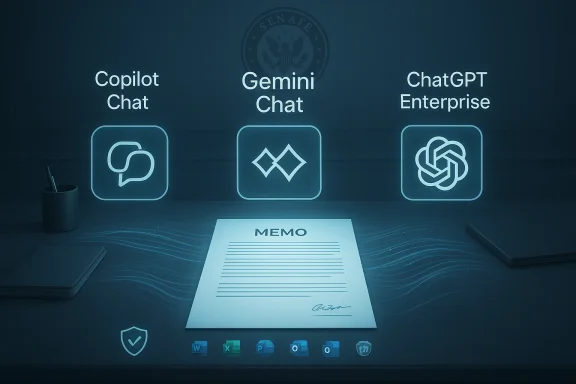
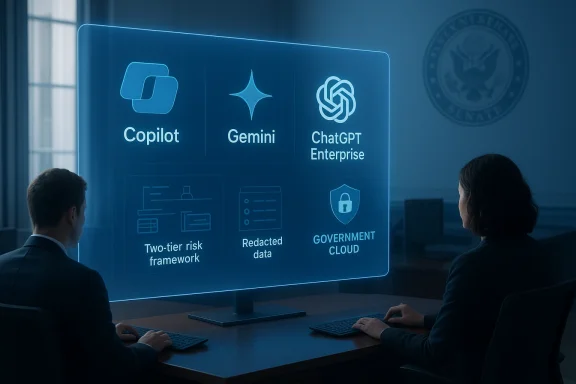
A top Senate technology official has quietly cleared three large, consumer-facing chatbots for official Senate use — Google’s Gemini, OpenAI’s ChatGPT, and Microsoft’s Copilot — a move that formalizes what many Capitol Hill staffers were already doing informally and brings Congress squarely into the mainstream of enterprise AI adoption.
The Senate memo follows a longer hill-wide process of limited experimentation and uneven rulemaking. The House of Representatives began a formal pilot in spring 2023 when House Digital Services issued about 40 ChatGPT Plus licenses to staff for experimentation, and later restricted general staff to specific, preapproved services under guidance created by House administrative offices. Those House-level experiments and restrictions are the precedent that many staff and offices have used as a template for when and how to use generative AI in legislative work.
The judicial incidents involving AI hallucinations are a cautionary tale for legislative institutions: when courts found fabricated citations or incorrect passages introduced by AI-assisted research, rulings had to be withdrawn and judges faced congressional scrutiny. Those episodes illustrate how quickly small lapses in verification can escalate into institutional embarrassment and legal consequences. For a legislature whose primary product is language — bills, reports, and constituent communications — the margin for error is small.
There is also a political dimension. Approving industry-leading models puts the Senate in the tricky position of appearing to endorse specific corporations. That dynamic raises long-term questions about competition, vendor neutrality and whether government IT strategy should favor vertically integrated productivity suites over best-of-breed or open-source models.
Finally, the judiciary’s experience with hallucinations highlights a systemic truth: no model is infallible. Human oversight and rigorous verification are not optional add-ons — they are the operational core of safe AI use in government. If Senate staff treat models as authoritative rather than assistive, the institution will see errors that could have been avoided with modest, process-driven checks.
If the memo is to be more than a headline, the Senate will need to follow it with enterprise agreements, enforceable technical controls, mandatory training, and transparent incident reporting. Otherwise, the chamber runs the risk of accelerating productivity while amplifying the very failures — hallucinations, data leaks, and opaque vendor behavior — that policymakers are already trying to legislate against.
Adopting AI inside government is inevitable; doing it well is deliberate. The difference between the two will be the safeguards the Senate puts in place now — not after the next high-profile error forces a fix.
Source: Tech in Asia https://www.techinasia.com/news/chatgpt-ai-chatbots-reportedly-approved-senate/
 Background
What the memo says (and what it doesn’t)
A one-page memorandum from the Senate sergeant-at-arms’ chief information officer says aides may use Gemini, ChatGPT and Copilot on Senate platforms for routine work such as drafting and editing documents, summarizing information and preparing briefing material. The memo notes that some services — notably Microsoft Copilot — are already integrated into Senate systems and asserts that data entered while using Copilot Chat remains inside a protected Microsoft 365 Government environment. But the public summary of the memo leaves major questions unanswered about scope, controls, and oversight for sensitive or classified workflows.The Senate memo follows a longer hill-wide process of limited experimentation and uneven rulemaking. The House of Representatives began a formal pilot in spring 2023 when House Digital Services issued about 40 ChatGPT Plus licenses to staff for experimentation, and later restricted general staff to specific, preapproved services under guidance created by House administrative offices. Those House-level experiments and restrictions are the precedent that many staff and offices have used as a template for when and how to use generative AI in legislative work.
Why this matters now
Granting official permission to use major AI chatbots on Senate systems is more than a productivity memo: it changes the institutional calculus for procurement, oversight, and risk. When the legislature that writes the rules allows mainstream vendors onto its platforms, other branches, state governments, law firms and regulated industries watch closely — acceptance in a central federal institution accelerates vendor trust, commercial adoption, and political pressure to standardize policy. At the same time, the institutionalization of AI raises the stakes for errors, data leaks, and vendor accountability.Overview of capabilities and the productivity argument
What these tools offer Senate staff
Gemini, ChatGPT and Copilot are generative AI platforms built on large language models (LLMs). In practice, they are being used across organizations for:- Drafting and editing memos, briefings and speeches.
- Summarizing legislative text, reports, and hearings.
- Creating talking points and constituent response templates.
- Rapid background research and information retrieval.
- Assisted spreadsheet, slide, and document generation when integrated into office suites.
The productivity case: measured gains in the real world
Controlled field research and industry experiments find real productivity gains when knowledge workers use advanced LLMs responsibly. One high-profile study that ran GPT-4 experiments with consultants reported improvements in task completion, speed and quality: users completed more tasks, worked faster, and produced measurable quality gains compared with a control group. These kinds of productivity statistics — while not a direct guarantee for public-sector work — explain why legislative offices are eager to standardize AI usage rather than attempt to ban it outright.The risks: security, privacy, hallucination, and legal exposure
Data leakage and classification boundaries
The single clearest operational risk with any consumer or cloud AI service is uncontrolled data flow. Public chatbots by default retain user inputs and may use them to improve models, and even enterprise versions require contract-level assurances about retention, access, and training. Government offices handling sensitive but unclassified information — procurement details, constituent casework, internal drafts, or committee-specific data — must be careful: a single slip of uploading "for internal use only" material into the wrong model can trigger automated security flags and create audit headaches. The Senate memo’s assertion that Copilot data stays within Microsoft 365 Government is meaningful for Copilot users, but it is not a blanket solution for Gemini or ChatGPT unless those services are provisioned under enterprise or government-specific contracts.Hallucinations and the cost of error
Large language models are probabilistic text generators, not deterministic retrieval systems. They can and do produce hallucinations — fabricated facts, invented citations, and misattributed quotes — with real-world consequences. In the legal world, reliance on AI without rigorous human verification has already created liability: courts and attorneys have faced sanctions and retractions after AI-generated filings or orders included false citations or inaccurate quotes. In one cluster of incidents, federal judges acknowledged that staff used generative tools to draft orders that contained factual errors, leading to withdrawals and congressional inquiries. When legislative staff use AI to prepare talking points, legal language, or committee materials, the cost of hallucination can be reputational and operational as well as legal.Vendor lock-in and opaque model behavior
Approving specific vendors for official duty can accelerate procurement dependence. The Senate position effectively endorses major cloud vendors’ models, which may make it more politically and technically difficult to adopt rival or open-source solutions. This concentration of reliance raises questions about third-party risk (vendor faults, policy changes, or outages) and model transparency: how is the model trained, what data influences output, and what is the vendor’s liability when outputs are wrong? Those are questions that require contract negotiation and oversight, not just a memo.Insider abuse and shadow AI
When leadership normalizes particular external tools while others remain restricted, shadow AI behaviors — selected exceptions, undisclosed usage, or differing rules across offices — can proliferate. Internal controls must prevent staffers from copying sensitive documents into consumer chat sessions even if “official use” is permitted in some contexts. Past incidents in other agencies showed that special-case exceptions can be misused, producing security alerts and governance headaches. Institutional guidance must be consistent and enforceable.What the Senate approval does — and does not — change institutionally
Normalization without full governance
The memo normalizes the use of mainstream LLMs for day-to-day legislative workflows. That is significant: it reduces administrative friction for staffers who need to trial tools and creates a baseline presumption that AI assistance is a legitimate productivity aid. But normalization without public, granular governance guidance does not solve the fundamental problems of classification control, procurement security, auditability, and incident reporting.Procurement, contracting, and audit controls
For true risk management, three things must happen after a memo like this:- Enterprise contracts that specify retention, model-training exclusions, access logging, and government-grade compliance controls must be put in place for each vendor used on Senate systems.
- Technical enforcement must follow: DLP (data loss prevention), network blocks that prevent unauthorized consumer endpoints, and integrated authentication that ties queries to office accounts for audit trails.
- Training and certification should be mandatory for staff — including what constitutes sensitive data, how to verify AI outputs, and how to escalate errors.
Practical guardrails the Senate (and other institutions) should require
Minimum technical controls
- Enterprise provisioning only: Require paid, enterprise or government-specific contracts for ChatGPT, Gemini, or Copilot access tied to the office domain and SSO (single sign-on).
- DLP and input filtering: Enforce data loss prevention policies preventing PII/PHI, procurement metadata, or classified fragments from being input to models.
- Audit logs and retention: Keep immutable logs of queries, outputs, and related artifacts for at least the legally required retention period.
- Role-based access: Limit which roles can use conversational agents for drafting versus research, and require manager approval for sensitive uses.
Human-in-the-loop process controls
- Mandatory verification: Any fact, quote, legal citation, or statutory reference produced by an LLM must be verified against primary sources by a human reviewer before publication or official use.
- Attribution and disclosure: If an AI-generated passage was used substantively in any briefing, the staffer should mark it and include a short chain-of-custody note indicating which model and what prompt was used.
- Escalation pathways: Errors that could affect constituent privacy, legal outcomes, or classified workflows must be immediately escalated to a designated security officer.
Policy and procurement steps
- Negotiate explicit contractual clauses restricting retention and training on government-supplied data.
- Deploy model-specific risk assessments and publish summary guidance for staff offices.
- Run regular red-team tests and external audits of AI use and DLP effectiveness.
- Create an incident reporting and public transparency process for AI-caused errors that materially affect public operations.
How other institutions have handled similar choices — lessons from the House and courts
The House’s 2023 experiment — distributing ChatGPT Plus licenses and later gating model use through administrative guidance — offers a useful precedent. The House experience shows that limited, paid licenses plus centralized oversight can enable experimentation while constraining the most egregious privacy risks. But experience in the courts and executive agencies also proves that rules alone are not enough: enforcement, technical controls, and cultural training are all required.The judicial incidents involving AI hallucinations are a cautionary tale for legislative institutions: when courts found fabricated citations or incorrect passages introduced by AI-assisted research, rulings had to be withdrawn and judges faced congressional scrutiny. Those episodes illustrate how quickly small lapses in verification can escalate into institutional embarrassment and legal consequences. For a legislature whose primary product is language — bills, reports, and constituent communications — the margin for error is small.
The broader policy implications
Incentivizing vendor accountability
By formally approving major vendors, the Senate has leverage to demand contract-level guarantees: no training on Senate data, strong retention controls, and auditability. Vendors must be pushed to sign government-grade agreements rather than offer only standard commercial terms. Without those protections, the institutional endorsement risks embedding data policies that later prove inadequate.Transparency, public trust, and the legislative record
Legislatures must preserve the integrity of official recordkeeping. When AI helps draft bills or legislative reports, offices must ensure that the provenance of language is traceable. Constituents, the media, and other branches will expect clarity about what was AI-assisted and what was not. Failure to disclose could erode public trust and complicate accountability if mistakes are made.Regulatory ripple effects
When Congress and the Senate adopt mainstream models, it raises pressure on regulators and watchdogs to set minimum standards for AI use in government. Expect oversight committees and auditors to demand records, policies, and incident reports. Vendors will increasingly be asked to demonstrate compliance with federal standards, and Congress itself may be driven to legislate model governance.Five immediate recommendations for any Senate office starting with AI
- Require an enterprise agreement before any staff use an LLM on an official device or account.
- Turn on SSO, conditional access, and DLP blocks that prevent the upload of classified or PII content into chat windows.
- Institute a two-person verification rule for any legal or policy language generated by a model.
- Maintain an audit log of prompts and outputs for transparency and post-incident review.
- Train staffers on the limits of generative AI, including hallucination risk and data handling best practices.
Critical analysis — balancing innovation and institutional risk
The Senate’s decision to permit ChatGPT, Gemini and Copilot reflects a realistic assessment: generative AI can materially improve staff productivity, and attempting to ban it entirely is both impractical and counterproductive. The productivity gains demonstrated in controlled studies and the day-to-day time savings reported by staffers are compelling reasons for adoption. But the policy is, for now, a permission slip without a seatbelt. Permission must be paired with enforceable technical controls, training, procurement safeguards and a clear incident response playbook.There is also a political dimension. Approving industry-leading models puts the Senate in the tricky position of appearing to endorse specific corporations. That dynamic raises long-term questions about competition, vendor neutrality and whether government IT strategy should favor vertically integrated productivity suites over best-of-breed or open-source models.
Finally, the judiciary’s experience with hallucinations highlights a systemic truth: no model is infallible. Human oversight and rigorous verification are not optional add-ons — they are the operational core of safe AI use in government. If Senate staff treat models as authoritative rather than assistive, the institution will see errors that could have been avoided with modest, process-driven checks.
Conclusion
The Senate’s memo opening official workflows to ChatGPT, Gemini and Copilot marks a consequential step in government AI adoption: it acknowledges generative AI as a legitimate, everyday productivity tool for lawmakers’ offices. That normalization has upside — faster research, cleaner drafts, and a more modern legislative staff toolkit — and it also raises the stakes for data governance, vendor contracts, and human verification.If the memo is to be more than a headline, the Senate will need to follow it with enterprise agreements, enforceable technical controls, mandatory training, and transparent incident reporting. Otherwise, the chamber runs the risk of accelerating productivity while amplifying the very failures — hallucinations, data leaks, and opaque vendor behavior — that policymakers are already trying to legislate against.
Adopting AI inside government is inevitable; doing it well is deliberate. The difference between the two will be the safeguards the Senate puts in place now — not after the next high-profile error forces a fix.
Source: Tech in Asia https://www.techinasia.com/news/chatgpt-ai-chatbots-reportedly-approved-senate/