

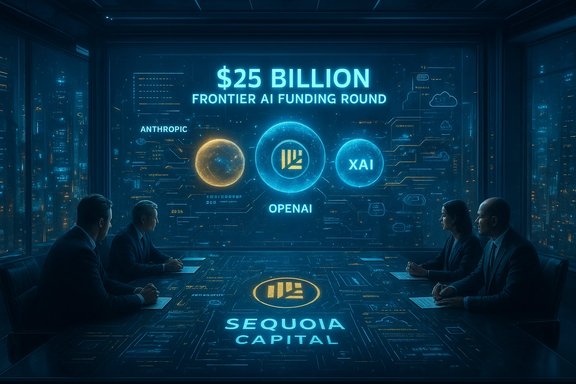
Sequoia Capital is preparing to join a mammoth funding round for Anthropic that would push the Claude-maker toward a headline valuation in the hundreds of billions and mark a striking departure from the old venture playbook of backing a single winner in a category. The move — reported in mid‑January 2026 — follows Sequoia’s earlier investments in OpenAI and Elon Musk’s xAI, and crystallizes a new behavior among top-tier investors: diversify across competitive frontier-model developers rather than choose one exclusive partner. The immediate effect is a reshaping of capital flows, cloud bargaining power, and the competitive geometry of enterprise AI; the longer-term consequences touch valuation stability, vendor concentration, and regulatory scrutiny.
These figures demand careful interpretation: the fundraising target and the valuation are reported negotiation positions and headline anchors, not audited market caps or immediate cash transfers. The shape and timing of tranche releases, whether funds are equity or purchase commitments, and how stock‑oriented or contract‑oriented the deals actually are will determine whether these numbers turn into realized market value or remain headline optics.
This change in posture coincides with leadership transitions inside Sequoia. During late 2025 the firm’s senior leadership structure changed, and the new co‑leaders have been described as more reflexive about backing multiple winners in a rapidly evolving technology category. Whether this reflects a permanent cultural shift at Sequoia, or a transactional response to exceptionally large opportunities in the AI era, will matter for how other VCs position themselves.
When the addressable market and required capital both balloon simultaneously, the old zero‑sum calculus (“pick one winner”) becomes less attractive. Backing multiple labs is a way to preserve optionality across wildly divergent technical architectures and commercialization models.
This approach also recognizes that different labs may win on different vectors — scale and ubiquity; enterprise safety and explainability; latency and cost efficiency; or vertical specialization. Holding stakes across those vectors is a rational hedge.
Sequoia has a long history of event‑driven bets and relationships with repeat founders; stewarding a portfolio that spans multiple labs may also be an institutional strategy to preserve access to top AI talent and deal flow.
But capital alone doesn’t guarantee sustainable margins. The path to profitability still depends on converting enterprise traction into long-term contracts with predictable revenue, securing favorable cloud economics, and optimizing inference cost per token. Anthropic’s premium on safety and explainability can attract higher‑margin enterprise deals, but it also has to prove durable adoption at scale.
Nonetheless, the narrative of unique dominance is shifting toward a multi‑model equilibrium where enterprises choose the best model for the task. OpenAI must therefore both sustain capability leadership and compete more directly on enterprise economics, SLAs and governance features.
Circular arrangements have short‑term productivity benefits — they secure compute capacity, accelerate co‑design, and reduce supply risk — but they also complicate the objective valuation of model builders. If part of the demand supporting a valuation is a pre‑committed spend by the investor, the effective market determination of value becomes blurred.
Investors, employees and partners must distinguish between contractual commitments (multi‑year compute purchases, reseller agreements) and instantaneous, flippable market value.
Sequoia’s decision to invest across rival frontier labs pushes against that convention. In practice, firms manage the risk in various ways: limiting information rights, structuring passive stakes, waiving board seats, and implementing internal “Chinese walls” to prevent sensitive information sharing.
For senior executives, these restrictions can also be personal — a firm may be free to invest, but individuals who sit on a rival company’s board or have access to secret technical plans will face strict separation obligations or may be recused from certain votes.
When cloud providers or chipmakers invest in a lab, they gain both a long‑term customer and a partner to validate next‑generation systems under real workloads. That technical reciprocity has become pivotal to model economics.
Enterprises should therefore demand contractual clarity on data residency, SLAs, auditability and portability.
Regulators will examine whether these alliances distort market dynamics — for example, by locking customers into bundled offers or by creating barriers to entry for independent labs. The presence of cross‑investments and compute purchase commitments makes such reviews more likely.
At the same time, procurement teams should:
That strategy buys optionality and access, but it also raises classic trade‑offs in amplified form: circular financing that complicates true market valuation; potential conflicts of interest; and concentration risks that attract regulator attention. For Anthropic, the fresh capital and distribution muscle could accelerate commercialization of Claude and deepen enterprise traction. For customers, the likely short‑term winners are choice and arguably better pricing; for investors and markets, the watchwords should be structure, execution and verification.
Enterprises and investors alike will be best served by focusing on the hard details behind headline numbers: tranche schedules, contract language, operational SLAs, and recorded revenue rather than projected run rates. In a category where billions move and technology changes fast, the firms that translate commitments into durable, profitable deployments will define who truly “won” the race — not the ones with the biggest announced valuation on paper.
Source: The Economic Times After investing in OpenAI and xAI, Sequoia set to back another rival, Anthropic - The Economic Times
 Background
What was announced, when, and what the numbers look like
In announcements and subsequent reporting around January 18–19, 2026, Anthropic opened talks for a funding round targeting roughly $25 billion or more with a headline valuation around $350 billion. The round was described as being led by large institutional players and accompanied by sizable commitments from strategic technology companies that had already shown interest in Anthropic’s expansion. The terms cited in press coverage included multi‑billion contributions from sovereign and institutional investors, while earlier strategic commitments to Anthropic from major cloud and hardware vendors were already in place.These figures demand careful interpretation: the fundraising target and the valuation are reported negotiation positions and headline anchors, not audited market caps or immediate cash transfers. The shape and timing of tranche releases, whether funds are equity or purchase commitments, and how stock‑oriented or contract‑oriented the deals actually are will determine whether these numbers turn into realized market value or remain headline optics.
Sequoia’s unusual position: investments in rivals
Sequoia’s reported participation in Anthropic’s round is noteworthy because the firm already has meaningful ties to two other high‑profile frontier labs: OpenAI and xAI. Historically, many venture firms avoided direct stakes in competing startups within the same core market, preferring to avoid conflicts and preserve confidential deal flow. Sequoia’s new posture — publicly backing multiple frontier AI companies — signals a shift in that long‑standing convention.This change in posture coincides with leadership transitions inside Sequoia. During late 2025 the firm’s senior leadership structure changed, and the new co‑leaders have been described as more reflexive about backing multiple winners in a rapidly evolving technology category. Whether this reflects a permanent cultural shift at Sequoia, or a transactional response to exceptionally large opportunities in the AI era, will matter for how other VCs position themselves.
Why a VC would back competing frontier AI labs
1. The sheer scale of required capital
Modern frontier model development is capital‑intensive at an unprecedented scale. Large language models and multimodal systems demand repeated multi‑billion‑dollar training runs, enormous inference fleets, and dedicated co‑engineering with hardware vendors. For top labs, long‑term compute and data center commitments can eclipse traditional startup capital requirements.When the addressable market and required capital both balloon simultaneously, the old zero‑sum calculus (“pick one winner”) becomes less attractive. Backing multiple labs is a way to preserve optionality across wildly divergent technical architectures and commercialization models.
2. Portfolio diversification at the frontier
Sequoia and other large VCs are increasingly treating frontier AI as a multi‑product bet rather than a single startup bet. The logic resembles index diversification at the high end: if the market is large enough to support multiple dominant players, then a balanced exposure across several labs could maximize expected returns while reducing single‑name downside.This approach also recognizes that different labs may win on different vectors — scale and ubiquity; enterprise safety and explainability; latency and cost efficiency; or vertical specialization. Holding stakes across those vectors is a rational hedge.
3. Strategic synergies and optionalities
Investors sometimes accept the optics of overlap because individual investments bring different rights and strategic benefits. An investor can retain board access or information rights with one company while holding a passive stake in another, or structure investments as limited partner commitments that avoid day‑to‑day conflict. The investor’s goal is to maintain influence where they have it and optionality where they do not.Sequoia has a long history of event‑driven bets and relationships with repeat founders; stewarding a portfolio that spans multiple labs may also be an institutional strategy to preserve access to top AI talent and deal flow.
What this means for Anthropic, OpenAI, xAI and the broader market
Anthropic: scale, distribution and the margin story
Anthropic’s product strategy — emphasizing safety, interpretability, and enterprise controls — positions it well for regulated buyers in finance, healthcare and government. A large new financing round would supply capital for scaling Claude’s capacity and for broader commercial expansion, including enterprise sales and partnerships.But capital alone doesn’t guarantee sustainable margins. The path to profitability still depends on converting enterprise traction into long-term contracts with predictable revenue, securing favorable cloud economics, and optimizing inference cost per token. Anthropic’s premium on safety and explainability can attract higher‑margin enterprise deals, but it also has to prove durable adoption at scale.
OpenAI: competitive pressure, but not a knockout blow
Sequoia’s stake in Anthropic does not by itself threaten OpenAI’s dominance, but it amplifies a now‑public diversification of investor sentiment away from exclusive pairings. OpenAI still possesses deep distribution advantages, a massive installed user base for ChatGPT, and tight product integrations with large platform partners.Nonetheless, the narrative of unique dominance is shifting toward a multi‑model equilibrium where enterprises choose the best model for the task. OpenAI must therefore both sustain capability leadership and compete more directly on enterprise economics, SLAs and governance features.
xAI and other challengers: crowded but strategic niches
Companies like xAI can still find defensible niches: real‑time data integrations, social‑platform synergies, unique research agendas, or vertical focus. Large fundraising rounds for other labs increase the total pool of resources but also intensify competition for talent, cloud capacity and enterprise mindshare.The circularity problem and valuation risk
What “circular financing” looks like
Recent financing dynamics in AI can create circularity: cloud providers, chipmakers and model labs invest in each other and then enter large procurement or partnership commitments that reinforce headline valuations. For instance, a fabric of investments, compute commitments and co‑engineering deals can make a private valuation appear supported by future demand that is partially self‑fulfilling.Circular arrangements have short‑term productivity benefits — they secure compute capacity, accelerate co‑design, and reduce supply risk — but they also complicate the objective valuation of model builders. If part of the demand supporting a valuation is a pre‑committed spend by the investor, the effective market determination of value becomes blurred.
Valuation volatility and headline effects
A reported headline valuation of several hundred billion dollars creates both market excitement and vulnerability. Private valuations at that scale are sensitive to assumptions about revenue growth, enterprise contract durations, account concentration, and the realized economics of model serving. If expectations about enterprise conversion or inference pricing fail to materialize, those valuations can re‑rate quickly.Investors, employees and partners must distinguish between contractual commitments (multi‑year compute purchases, reseller agreements) and instantaneous, flippable market value.
Governance, conflict of interest and confidentiality
The classic VC norm and how it’s changing
Venture firms historically avoided direct conflicts by declining stakes in competing companies where they had material non‑passive exposure. That norm exists to protect confidential information, preserve board neutrality, and avoid downstream antitrust or fiduciary problems.Sequoia’s decision to invest across rival frontier labs pushes against that convention. In practice, firms manage the risk in various ways: limiting information rights, structuring passive stakes, waiving board seats, and implementing internal “Chinese walls” to prevent sensitive information sharing.
Real legal and contractual constraints
Frontier labs have taken measures to protect competitively sensitive information via investor covenants. In prior financing rounds, some labs placed restrictions on active investors who would gain access to confidential model roadmaps or usage metrics. Any investor taking a non‑passive stake in multiple rivals must therefore navigate contractual constraints and explicit confidentiality protections.For senior executives, these restrictions can also be personal — a firm may be free to invest, but individuals who sit on a rival company’s board or have access to secret technical plans will face strict separation obligations or may be recused from certain votes.
The cloud and hardware calculus: why Microsoft and NVIDIA matter
Reserved capacity and co‑engineering accelerate time-to-market
Large model labs require both compute and hardware roadmaps. Strategic partnerships with cloud providers and accelerator vendors secure that access and allow for close co‑optimization of software and silicon. These collaborations reduce training time, lower inference cost, and can materially improve product performance.When cloud providers or chipmakers invest in a lab, they gain both a long‑term customer and a partner to validate next‑generation systems under real workloads. That technical reciprocity has become pivotal to model economics.
Vendor concentration: benefits and risks for enterprises
From a buyer’s perspective, multi‑model availability inside major clouds is a net positive: it means choice, potential price competition, and simpler procurement. Yet, concentration of compute and model supply inside a handful of hyperscalers raises systemic risks. If a single cloud becomes the primary host for multiple leading models, outages, contractual changes or geopolitical actions could cascade across enterprise deployments.Enterprises should therefore demand contractual clarity on data residency, SLAs, auditability and portability.
Regulatory and national security angles
Antitrust and competition scrutiny
Large, cross‑ownership arrangements that link cloud, silicon and model vendors invite regulatory attention. Authorities are increasingly alert to whether a small set of players can exert outsized control over critical AI infrastructure, creating de‑facto chokepoints for innovation and competition.Regulators will examine whether these alliances distort market dynamics — for example, by locking customers into bundled offers or by creating barriers to entry for independent labs. The presence of cross‑investments and compute purchase commitments makes such reviews more likely.
National security and export controls
Advanced AI models, especially those optimized on specialized hardware and trained on secretive data pipelines, may also raise national security concerns around dual‑use capabilities and sensitive compute deliveries. Long‑dated procurement commitments across borders attract scrutiny about data flow, export compliance, and strategic autonomy.Practical implications for enterprise buyers and IT leaders
Short‑term: greater choice, tighter negotiations
Enterprises will have more model options surfaced through major clouds and platform integrations. That’s immediately useful: it allows IT architects to match model behavior and cost characteristics to specific workloads.At the same time, procurement teams should:
- Treat headline pricing and availability as negotiable, not fixed.
- Model total cost of ownership (TCO) on per‑inference and per‑token bases, including data egress and orchestration costs.
- Force vendors to disclose SLAs, versioning policies, and data‑use guarantees for every model they resell.
Medium‑term: insist on portability and governance
Given the risk of vendor concentration, enterprise IT should:- Require no‑training or non‑derivative clauses where regulatory or IP risk demands it.
- Mandate auditability and observability: every inference should be traceable to model version and runtime environment.
- Adopt multi‑cloud pilot strategies to preserve bargaining power and prevent lock‑in.
Long‑term: architect for a multi‑model reality
Operational AI is becoming a platform choice rather than a one‑size‑fits‑all decision. Enterprises should design governance frameworks, identity pipelines, and cost‑allocation models that support multiple models and routed inference strategies, allowing the organization to benefit from specialized models without sacrificing compliance or reliability.Investment community takeaways and practical investor advice
- Large institutional investors are now comfortable with multi‑winner exposure in frontier AI; smaller funds may follow, creating more capital diversity for labs but also more competition for talent and compute.
- Investors should distinguish between headline commitment figures and realized economics. Ask for tranche schedules, dilution mechanics, and contract forms before pricing a private company’s valuation into a portfolio’s mark.
- Watch for governance mechanisms inside funds to manage conflicts. Passive stakes and restricted information rights are common tools to avoid direct conflicts when backing rivals.
Risks and unknowns that matter most
- Valuation Accuracy: Several high‑profile valuations in late 2025 and early 2026 depended on reported commitments and optimistic growth assumptions. Those numbers are volatile and should be treated as directional unless confirmed by audited financial statements or regulatory filings.
- Deal Structure Opacity: Headlines often compress complicated deal structures into single numbers. Whether investments are equity, convertible instruments, purchase commitments, or credits materially affects economic outcomes.
- Execution Risk: Building sustainable enterprise revenue at scale — not merely headline enterprise logos — is the critical test. Conversion of pilots into long‑term, high‑ARPU contracts will determine whether the capital delivered buys growth or only extends cash runway.
- Regulatory Intervention: The cross‑ownership fabric that helps labs scale could also attract antitrust or national security scrutiny, potentially altering the economics of tightly knit partnerships.
- Talent and IP Flows: As investors back multiple labs, human mobility and the transfer of institutional knowledge will be a vector of competitive tension. Firms will need rigorous operational controls to avoid leakage of IP or roadmap signals.
Conclusion: a new normal or a risky experiment?
Sequoia’s reported participation in Anthropic’s giant funding round is emblematic of a larger industrial shift: the AI era rewards scale, cooperation with cloud and chip providers, and vast capital commitments that were rare for software startups even a few years ago. VCs are adapting by broadening exposure across competing frontier labs rather than picking a single champion.That strategy buys optionality and access, but it also raises classic trade‑offs in amplified form: circular financing that complicates true market valuation; potential conflicts of interest; and concentration risks that attract regulator attention. For Anthropic, the fresh capital and distribution muscle could accelerate commercialization of Claude and deepen enterprise traction. For customers, the likely short‑term winners are choice and arguably better pricing; for investors and markets, the watchwords should be structure, execution and verification.
Enterprises and investors alike will be best served by focusing on the hard details behind headline numbers: tranche schedules, contract language, operational SLAs, and recorded revenue rather than projected run rates. In a category where billions move and technology changes fast, the firms that translate commitments into durable, profitable deployments will define who truly “won” the race — not the ones with the biggest announced valuation on paper.
Source: The Economic Times After investing in OpenAI and xAI, Sequoia set to back another rival, Anthropic - The Economic Times
