

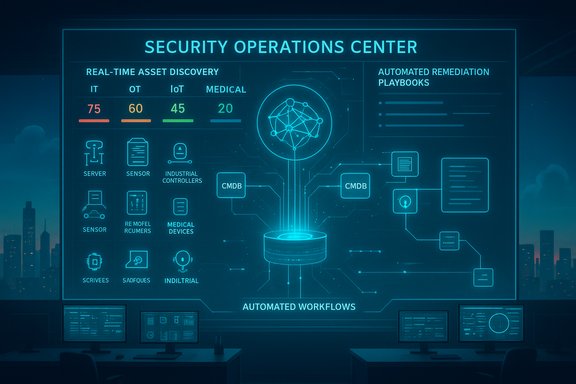
ServiceNow’s move to acquire Armis — a deal announced as an all‑cash agreement worth approximately $7.75 billion — marks a decisive bet that workflow automation and real‑time asset visibility must converge to secure the new, AI‑driven enterprise attack surface.
Overview
ServiceNow announced it has agreed to acquire Armis for roughly $7.75 billion in cash, a transaction ServiceNow says will expand its security and risk offerings by combining ServiceNow’s workflow and governance fabric with Armis’s cyber exposure management capabilities. Armis is a cybersecurity company focused on asset discovery, real‑time exposure management, and security for IT, OT, IoT and medical devices through its flagship platform, Armis Centrix™ — an AI‑driven, cloud‑native suite that emphasizes continuous visibility, vulnerability prioritization and automated remediation workflows. For ServiceNow, the purchase is the largest in the company’s history and follows an active 2025 in M&A, including the earlier Moveworks deal — underscoring an aggressive strategy to assemble an AI-native enterprise platform that combines governance, agent orchestration, and security workflows.Background: who’s buying whom — at a glance
ServiceNow: workflow, CMDB, and the AI control plane
ServiceNow’s core value is its workflow engine and Configuration Management Database (CMDB), which maps business services to the assets and teams that support them. In recent years ServiceNow has layered AI capabilities — from assistant features to the AI Control Tower — to govern agentic AI and automate cross‑enterprise processes. Those governance and orchestration capabilities are the primary integration surface ServiceNow brings to this acquisition.Armis: asset intelligence and cyber exposure
Armis was founded to solve the pervasive blind spot created by unmanaged and non‑traditional assets — everything from IoT sensors and industrial control systems to medical devices and cloud‑connected appliances. Its Centrix platform provides continuous discovery, contextualized risk scoring, and vulnerability prioritization that can feed automated remediation workflows. Armis completed a large pre‑IPO funding round in November 2025 and has been public about rapid ARR growth, which underpins its valuation and attractiveness as an acquisition target.What the deal actually buys ServiceNow — technical and product synergies
The strategic logic is straightforward: ServiceNow provides the workflows, governance and record‑of‑truth (CMDB), while Armis provides the real‑time telemetry and exposure intelligence that tell those workflows what to act on.- Continuous asset discovery and inventory: Armis’ agentless discovery can feed ServiceNow’s CMDB with more comprehensive and timely device inventories, closing a major source of configuration drift and unknown exposure.
- Real‑time cyber exposure management: Armis Centrix offers prioritized exposure scoring and mitigation recommendations; combined with ServiceNow’s automation, these can translate into automated ticketing, patch orchestration, and cross‑team playbooks.
- IT/OT/IoT/medical device coverage: Armis’ strength in operational technology and medical devices addresses protection gaps that traditional IT security tooling often misses.
- AI‑enhanced prioritization: Armis’ AI models for risk scoring and behavior detection can help ServiceNow reduce noise and focus remediation on actions that materially reduce enterprise risk.
Verification of the facts (what’s confirmed, what’s still uncertain)
- The purchase price and structure. ServiceNow’s announcement and multiple finance outlets report a cash deal valued at about $7.75 billion and state ServiceNow expects to fund the transaction with cash and debt, with a close expected in H2 2026 subject to regulatory approvals. These figures are confirmed in the official transaction release and by market reporting.
- Armis product naming and capabilities. Armis publicly markets Armis Centrix™ as its AI‑powered cyber exposure management platform, with modular capabilities across asset inventory, OT/IoT security, medical device protection and vulnerability prioritization. Those product claims are documented on Armis’ own site and press materials.
- Armis financial momentum. Armis completed a large pre‑IPO financing in November 2025 — publicly disclosed as $435 million led by Growth Equity at Goldman Sachs — and has reported ARR north of $300M with rapid year‑over‑year growth. This funding and ARR reporting are company announcements corroborated by investor press. Projections to $1B ARR are company guidance and should be treated as aspirational targets rather than realized facts.
- ServiceNow’s M&A context. Prior 2025 deals such as Moveworks ($2.85B) and smaller acquisitions position ServiceNow as an active buyer in AI and security — offering historical context for how aggressive this move is relative to the company’s M&A track record.
The strategic case — why this makes sense for ServiceNow
1) Closing an operational security loop
ServiceNow’s strength is in closing loops: incident discovery → ticketing → remediation → audit. Armis supplies the discovery and risk intelligence for assets that historically fell outside traditional security tooling, allowing ServiceNow to extend automated remediation and governance to those previously blind spots.2) Building an AI‑native security control plane
Organizations are rapidly adopting agentic AI and connected systems. ServiceNow positions the acquisition as a way to deliver trusted governance in the “agentic AI era” by combining exposure awareness with policy enforcement and auditable remediation — effectively delivering an AI‑enhanced security control plane that both detects exposures and drives automated corrective actions.3) Expanding ServiceNow’s addressable market and differentiation
By adding asset‑level exposure management, ServiceNow enlarges its TAM (total addressable market) in security and risk — particularly in OT/IoT/medical verticals where Armis already has traction. This is a potential differentiator versus pure‑play XDR vendors that lack built‑in workflow orchestration.Risks, integration challenges and unanswered questions
Large strategic logic does not remove operational and financial risk. Below are the primary points of caution enterprises and investors should weigh.- Integration complexity: Armis operates across heterogeneous estates with embedded agents, network telemetry, cloud connectors and partner integrations. Mapping Armis’ telemetry to ServiceNow’s CMDB at scale — without generating noise or duplication — is non‑trivial and will require careful engineering and phased rollouts.
- Product overlap and GTM friction: ServiceNow already sells security workflow capabilities and has built integrations with other security vendors. Integrating Armis without alienating existing partners, or coercing customers into a tightly coupled ServiceNow+Armis stack, will require a careful go‑to‑market strategy and partner management.
- Price vs. performance expectations: The $7.75B price tag implies high expectations for ARR growth and cross‑sell. Armis’ reported ARR (~$300–$340M) is fast‑growing, but investors and customers may scrutinize the implied multiple and the pace at which cross‑sell to ServiceNow’s installed base materializes. If growth slows or cross‑sell lags, the financial justification will be questioned.
- Regulatory and antitrust review: While not an obvious antitrust target, large acquisitions in critical security infrastructure invite regulatory scrutiny, especially when the combined entity claims coverage across national critical infrastructure, healthcare and government domains. The transaction’s H2 2026 close timeline leaves room for regulatory conditions.
- Cultural and retention risks: Armis has a deep engineering and research culture focused on asset visibility and IoT/OT security. Retaining key technical talent and aligning roadmaps is essential to preserve Armis’ product momentum and customer trust.
- Customer lock‑in and multi‑vendor realities: Many customers prefer best‑of‑breed stacks and rely on ecosystems (e.g., CrowdStrike, Palo Alto, Microsoft Defender). ServiceNow must avoid forcing product choices that disrupt customers’ existing vendor relationships, or risk slower adoption.
What this means for customers — practical implications
Short term, customers should expect:- A sustained Armis product offering, now with ServiceNow backing and investments aimed at product integration and scale. ServiceNow’s announcement suggests Armis will continue to operate and be integrated into ServiceNow’s security and risk portfolio.
- Migration planning for organizations that want tighter CMDB‑to‑exposure automation; depending on the customer’s size and asset diversity, a staged pilot is the prudent path.
- For customers using third‑party security stacks, anticipate expanded integrations over time but no immediate forced consolidation — ServiceNow will likely prioritize interoperability to avoid alienating major security vendors.
- Inventory current coverage: identify where asset visibility is weak (OT, medical devices, IoT, guest networks).
- Map remediation workflows: which teams and playbooks will accept automated tickets and what SLAs must be met?
- Pilot integration: run a small POC that maps Armis discovery into your CMDB and triggers one end‑to‑end remediation playbook.
- Validate alerts and prioritization: measure false positive rates and time‑to‑remediate before broad rollout.
- Maintain vendor neutrality: require contractual SLAs and clear exit/migration paths if you make deeper investments.
Competitive landscape and market dynamics
The acquisition tightens ServiceNow’s position as a workflow‑driven defender and raises pressure on adjacent vendors:- Security vendors (XDR, EDR, IT asset management) will need to sharpen their integration stories with workflow and governance platforms.
- Cloud providers and identity vendors may accelerate partnerships with governance platforms to offer converged detection → response → remediation stories.
- Specialist OT/IoT vendors may find consolidation pressures intensifying as large platform players bundle discovery and remediation capabilities.
Financial and shareholder considerations
ServiceNow plans to fund the purchase with a mix of cash and debt, a common choice for a deal of this size. Share price reactions to acquisition news can be mixed:- Investors often reward strategic tuck‑ins that accelerate high‑margin ARR growth, but they penalize deals that stretch balance sheets or fail to demonstrate near‑term synergies.
- ServiceNow’s earlier years of M&A activity in 2025 (including Moveworks) already shifted investor expectations about capital allocation and growth tradeoffs; the Armis acquisition will be judged on measured cross‑sell and margin accretion over subsequent quarters.
Integration playbook — how ServiceNow should approach combining Armis
A pragmatic, low‑risk phased integration reduces disruption and protects both customer trust and product momentum. Recommended sequencing:- Short term (0–3 months): Preserve Armis product independence; establish joint GTM teams; prioritize high‑value integrations (CMDB sync, ticket automation).
- Mid term (3–12 months): Deliver deep technical integrations — automatic asset ingestion into CMDB, vulnerability scoring → VIPR playbooks, pre‑built remediation workflows for common OT/IoT scenarios.
- Longer term (12–24 months): Rationalize overlapping product features, merge licensing options where it benefits customers, and surface a combined “Security Exposure & Operations” UX within the ServiceNow console.
Strengths and opportunities
- Immediate capability lift: ServiceNow gains an established product that solves a real and growing blind‑spot: unmanaged connected assets.
- Workflow differentiation: Few vendors can claim an integrated governance + exposure + automation story at enterprise scale.
- Vertical reach: Armis’ traction in healthcare, manufacturing and government provides ServiceNow a faster route into regulated verticals that demand strong OT and medical device protections.
- AI‑first positioning: Combining Armis’ AI discovery/prioritization with ServiceNow’s AI Control Tower creates a credible narrative for secure, governable agentic AI adoption.
Weaknesses and material risks
- Execution risk: Integration failures, degraded user experience or slower‑than‑expected cross‑sell would undermine the strategic rationale.
- Valuation pressure: Paying a premium for growth expectations creates pressure for ServiceNow to convert the acquisition into visible ARR and margin expansion quickly.
- Partner dynamics: Armis integrations across ecosystems (CrowdStrike marketplace, other SIEM/XDR vendors) must remain robust to avoid being marginalized in multi‑vendor environments.
Final assessment
ServiceNow’s acquisition of Armis is a bold, logical extension of the company’s playbook: translate detection into action by embedding automated, auditable workflows at the point where security decisions are made. If executed well, it solves a widely recognized problem — the blind spot of connected devices — and gives ServiceNow a differentiator many workflow vendors lack: real‑time, asset‑level exposure intelligence that triggers automated remediation at scale. That said, the deal’s success depends on disciplined integration, thoughtful partner management, and measured financial execution. The promise of an AI‑native security control plane is compelling, but it will be judged on delivered risk reduction, not marketing language. Organizations should view the news as an inflection point: the era when discovery and automated remediation for the full attack surface become table stakes for enterprise security and operations teams.ServiceNow and Armis customers will want to watch the integration roadmap closely, run conservative pilots, and insist on interoperability guarantees as the two platforms come together. The Cloud‑to‑edge attack surface is growing — this acquisition aims to make it visible and actionable, but visibility alone is not protection; how quickly organizations can turn that visibility into measured, auditable remediation will determine whether this deal is transformative or merely strategic theater.
Source: Cloud Wars AI-Enhanced Security: ServiceNow’s Bold Move with Armis
