

ServiceNow and Microsoft announced a tightly coordinated set of integrations this week that stitch ServiceNow’s AI governance and workflow orchestration into Microsoft’s emerging agent control plane — a move that promises to make enterprise AI agent deployment both more powerful and more governable, while raising new questions about operational risk, vendor lock‑in, and cost control.
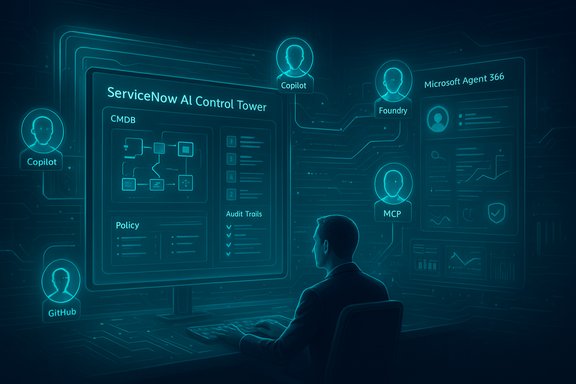
ServiceNow has been positioning the ServiceNow AI Platform — anchored by AI Control Tower and the newly introduced AI Agent Fabric — as a single-pane command center for managing agents, models, and agent-driven workflows across heterogeneous environments. AI Control Tower consolidates discovery, policy, and operational telemetry, leveraging ServiceNow’s configuration management database (CMDB) to provide context-rich governance across internal and external systems. The Control Tower and Agent Fabric were first announced earlier in 2025 as tools for centralized oversight and agent-to-agent interoperability. Microsoft, for its part, has been building an agent ecosystem centered on Agent 365, Copilot Studio, and Azure AI Foundry. Agent 365 acts as a tenant-level control plane and registry for agents, enforcing identity and access controls, surfacing telemetry, and enabling quarantine and lifecycle operations. Copilot Studio is Microsoft’s low-code visual agent builder and orchestration surface; Azure AI Foundry provides managed model hosting, multi-model routing and runtime primitives. Together these pieces represent Microsoft’s strategy to treat agents as first-class, identity-bound entities that integrate with Microsoft 365 apps, Entra (Azure AD), Purview, Defender and tenant observability. This week’s announcements formalize integrations between the two stacks: the ServiceNow AI Platform will integrate with Microsoft Agent 365; ServiceNow Build Agent will connect to GitHub (via Model Context Protocol, MCP) to bring developer workflows into the loop; and ServiceNow AI Control Tower will connect to Microsoft Foundry and Copilot Studio so ServiceNow can discover and govern Microsoft‑hosted agents. ServiceNow says these integrations are expected to be generally available by the end of the year.
Strategically, organizations that standardize on Microsoft + ServiceNow stand to benefit from deep end‑to‑end integrations (Copilot inside Teams, ServiceNow workflows triggered from Office documents), but they must trade off increased platform dependence for reduced integration friction and stronger governance. Procurement teams should plan for that tradeoff and insist on contractual portability and audit access.
To make this safe and productive:
The integration is a powerful example of how the industry is moving from isolated AI assistants to agentic systems that require full‑life governance. Organizations that invest early in observability, model residency controls and human‑in‑the‑loop processes will be best positioned to capture the productivity upside while keeping risk within acceptable bounds.
Source: No Jitter ServiceNow-Microsoft integrate for AI agent control
 Background
ServiceNow has been positioning the ServiceNow AI Platform — anchored by AI Control Tower and the newly introduced AI Agent Fabric — as a single-pane command center for managing agents, models, and agent-driven workflows across heterogeneous environments. AI Control Tower consolidates discovery, policy, and operational telemetry, leveraging ServiceNow’s configuration management database (CMDB) to provide context-rich governance across internal and external systems. The Control Tower and Agent Fabric were first announced earlier in 2025 as tools for centralized oversight and agent-to-agent interoperability. Microsoft, for its part, has been building an agent ecosystem centered on Agent 365, Copilot Studio, and Azure AI Foundry. Agent 365 acts as a tenant-level control plane and registry for agents, enforcing identity and access controls, surfacing telemetry, and enabling quarantine and lifecycle operations. Copilot Studio is Microsoft’s low-code visual agent builder and orchestration surface; Azure AI Foundry provides managed model hosting, multi-model routing and runtime primitives. Together these pieces represent Microsoft’s strategy to treat agents as first-class, identity-bound entities that integrate with Microsoft 365 apps, Entra (Azure AD), Purview, Defender and tenant observability. This week’s announcements formalize integrations between the two stacks: the ServiceNow AI Platform will integrate with Microsoft Agent 365; ServiceNow Build Agent will connect to GitHub (via Model Context Protocol, MCP) to bring developer workflows into the loop; and ServiceNow AI Control Tower will connect to Microsoft Foundry and Copilot Studio so ServiceNow can discover and govern Microsoft‑hosted agents. ServiceNow says these integrations are expected to be generally available by the end of the year. What was announced — the three integrations, explained
1) ServiceNow AI Platform ↔ Microsoft Agent 365
- What it is: A connectivity layer that lets joint customers register, monitor and control agents that live in Microsoft’s Agent 365 catalog from within the ServiceNow AI Platform. The integration maps ServiceNow’s governance constructs (policies, CMDB context, audit trails) onto Microsoft’s agent registry and control plane.
- Why it matters: Enterprises that standardize on ServiceNow for ITSM, governance, and CMDB gain a single source of truth for agent inventory and policy enforcement across Microsoft 365 and ServiceNow agent deployments, enabling coordinated policy application and ROI tracking.
2) ServiceNow Build Agent ↔ GitHub (MCP)
- What it is: A connector allowing ServiceNow Build Agent to consume developer context (issues, PRs, discussions) securely from GitHub via a Model Context Protocol (MCP) server, enabling agents to automate routine development tasks while preserving access controls and audit logs.
- Why it matters: Development teams can safely expose code workflows to agentic automation — for example, triaging issues, creating PRs, or filling release notes — without sacrificing identity, least‑privilege access, or traceability. This brings agentic assistance directly into the CI/CD lifecycle while keeping enterprise governance policies in play.
3) ServiceNow AI Control Tower ↔ Microsoft Foundry + Copilot Studio
- What it is: Bi-directional integrations that let ServiceNow discover agents authored in Copilot Studio or deployed via Azure AI Foundry, then import metadata, ownership, telemetry and controls into AI Control Tower for unified governance.
- Why it matters: Organizations using Microsoft’s agent authoring and runtime tools can retain ServiceNow’s governance and risk workflows (approvals, human manager assignments, ROI dashboards, CMDB enrichment) without forgoing the scale and integration points of Copilot & Foundry. This is aimed at large enterprises that need consistent policy enforcement across multiple toolchains and clouds.
Technical mechanics and architecture
Identity and lifecycle: Entra Agent IDs and CMDB linkage
Both vendors emphasize identity-first lifecycle management. Microsoft assigns agents directory-bound identities via Microsoft Entra Agent ID, which enables access reviews, conditional access and least-privilege assignment. ServiceNow’s AI Control Tower ties agent identities and operational metadata back into the CMDB, giving governance and risk teams contextual maps of what each agent can access and which business processes they may affect. This alignment makes it technically feasible to include agents in access reviews, incident playbooks, and compliance evidence.Model Context Protocol (MCP) and tool calls
The Model Context Protocol (MCP) is the emerging interoperability standard for agent tooling; it enables agents to call tools (MCP servers) — for mail, calendar, ticketing, code repositories — with well-defined payloads and audit traces. In this set of integrations, GitHub’s MCP server will be a primary example for developer workflows, while Microsoft’s Foundry and Copilot Studio expose MCP endpoints for agents to access business data and services. MCP-based tool calls are designed to be logged with agent identity, caller context, parameters and outcomes to support auditable traces.Grounding and observability: Foundry, Purview, and ServiceNow dashboards
Grounding (ensuring agent outputs are tied to authoritative data) is handled via Foundry/Dataverse integrations and ServiceNow CMDB enrichment. Observability relies on telemetry pipelines: Microsoft points to Purview, Defender and a Security Dashboard for AI; ServiceNow feeds agent telemetry into AI Control Tower’s value and risk dashboards. The goal is reconstructability: every agent action should be traceable end‑to‑end for audit and remediation.What enterprises gain: strengths and practical benefits
- Centralized governance for agent fleets: The combined stack lets security and governance teams inventory agents, enforce least‑privilege, and quarantine misbehaving agents from either the Microsoft or ServiceNow console, addressing a core enterprise blocker to agent adoption.
- Reduced context switching and faster automation: Agents published in Copilot Studio can surface inside Microsoft 365 apps (Word, Teams, Outlook) and trigger ServiceNow workflows, turning insights into automated service actions without manual handoffs.
- Developer productivity with guardrails: ServiceNow Build Agent + GitHub integration enables secure, audited automation of developer workflows (issue triage, PR creation, changelog generation) while preserving enterprise controls and audit trails.
- Observability and ROI measurement: AI Control Tower’s Value Dashboard is designed to quantify adoption, performance and business impact — a crucial feature for procurement and finance teams tracking AI investments.
Risks, unknowns and cautionary notes
The technical promise is substantial, but so are the operational and security risks. Cross‑referencing vendor claims with independent reporting and prior platform behavior surfaces several areas that require scrutiny.- Data exfiltration and over‑privileged agents. Any agent that can access email, files and ticketing systems is a potential exfiltration vector. Even with DLP and scoped permissions, configuration errors or overly broad policies can leak sensitive fields. Enterprises must validate sensitivity filters and enforce payload inspection and redaction at runtime.
- Hallucinations that act on systems. Agents with write privileges (creating tickets, changing records, sending emails) can do harm if their outputs are incorrect or hallucinated. Strong human‑in‑the‑loop gates and post‑action validation are necessary when agents perform high‑impact tasks.
- Agent sprawl and shadow agents. Registries mitigate sprawl, but organizations that allow broad agent creation risk untracked agents performing actions beyond intended scope. Enforce publication gates, owner metadata, and lifecycle decommissioning policies.
- Model routing and data residency. Microsoft’s Foundry and Copilot Studio can route workloads to third‑party model hosts. For regulated workloads, model hosting choices matter — control and documentation are required to keep data residency and compliance intact. Organizations must map model routing to regulatory requirements.
- Licensing complexity and unpredictable costs. Agent metering, per‑agent licenses and model inference costs create complex billing surfaces. Procurement teams should budget for per‑agent and per‑call consumption and insist on clear pricing models and telemetry to track usage.
- Vendor dependency and lock‑in. Deep integrations reduce integration friction but increase dependency on a combined Microsoft‑ServiceNow stack. Architects should design export and fallback strategies for data and automation logic to avoid costly migration paths later.
Practical rollout playbook — step by step
- Establish governance and a sponsor team.
- Form an AI governance board with representation from IT, Security, Legal, HR and the lines of business that will own agents.
- Inventory and classify candidate workflows.
- Map current automations and candidate agent use cases; designate low‑risk pilots (read-only knowledge agents, meeting summarizers) first.
- Register agents in Agent 365 and AI Control Tower.
- Require Entra Agent IDs and ServiceNow owner metadata for every agent; set publication gates.
- Start in monitor-only mode.
- Onboard Microsoft and ServiceNow agents in visibility-only mode to validate telemetry and alerts before enabling write actions.
- Define DLP and grounding rules.
- Apply Purview policies, exclude sensitive fields from prompts, and ensure Dataverse/Foundry grounding is used for authoritative lookups.
- Enforce human-in-the-loop thresholds.
- Define which actions can be auto-executed and which require approvals; automate escalation procedures in ServiceNow.
- Integrate telemetry into SIEM/SOAR.
- Forward agent logs to Defender, Sentinel, or your SIEM; create playbooks for quarantine and identity revocation.
- Run a controlled pilot with KPIs.
- Measure accuracy, escalation rates, false positives, mean time to resolution, and cost; use a control group to validate claims.
- Scale with guardrails.
- After successful pilots, scale by business unit with enforced lifecycle management, cost centers, and regular reviews.
- Contractual safeguards.
- Negotiate telemetry access, audit rights, data residency guarantees and breach/incident responsibilities with vendors.
Security and compliance: concrete mitigations
- Require Entra Agent IDs and include agents in monthly access reviews.
- Apply least‑privilege MCP scopes to every MCP server and instrument rate limits and payload size constraints.
- Configure Purview/ServiceNow retention and eDiscovery rules for all agent artifacts and Work IQ memory caches.
- Route regulated workloads to approved model hosts and disable model routing to unapproved endpoints.
- Implement post‑action QA sampling and automated rollback capabilities for write operations.
Market implications and competitive landscape
The ServiceNow–Microsoft integrations accelerate a market shift toward a dual-visibility model: platform owners want to provide first-class agent runtime (Microsoft’s approach) while governance/orchestration vendors (ServiceNow) insist the control plane must include business context, lifecycle and CMDB integration. Other enterprise vendors — Zendesk, Oracle, Salesforce — are rapidly building their own agent integrations with Microsoft’s control plane, reflecting a broader industry move toward interoperable agent governance. For buyers, the ecosystem choice now includes not only agent capabilities but also governance maturity and cross‑vendor interoperability.Strategically, organizations that standardize on Microsoft + ServiceNow stand to benefit from deep end‑to‑end integrations (Copilot inside Teams, ServiceNow workflows triggered from Office documents), but they must trade off increased platform dependence for reduced integration friction and stronger governance. Procurement teams should plan for that tradeoff and insist on contractual portability and audit access.
Developer experience and the promise of Build Agent + GitHub
The Build Agent connector to GitHub via MCP is a practical win for engineering velocity: it enables secure sharing of contextual code artifacts with ServiceNow agents while preserving the developer’s identity and audit trail. Use cases include automated issue triage, PR creation, release note generation, and change-ticket synchronization.To make this safe and productive:
- Limit write privileges to well-understood, small-scope tasks initially (labels, comments, draft PRs).
- Use shadow-mode testing to compare agent decisions to human triage before allowing live writes.
- Keep an explicit ownership and rollback plan for agent-made changes.
Short‑term view: what to test in a pilot
- Accuracy and hallucination rates: sample agent output vs. human baseline for critical tasks.
- Escalation fidelity: confirm metadata, attachments and audit trails persist through escalations and cross‑platform handoffs.
- Data leakage tests: assert that restricted fields are not transmitted to models or third-party hosts.
- Performance and cost: measure latencies and inference costs at realistic concurrency.
- Governance effectiveness: simulate agent compromise and validate quarantine and revocation procedures.
Conclusion
The ServiceNow–Microsoft integrations announced this week represent a pragmatic step toward enterprise AI orchestration: one vendor providing rich authoring and runtime primitives (Microsoft) while the other enforces business context, CMDB-backed governance and lifecycle controls (ServiceNow). For enterprises, the joint capabilities promise meaningful productivity gains — safer automation inside Microsoft 365 apps, tighter developer workflows with GitHub, and centralized governance across agent fleets. At the same time, the combined stack raises the operational bar. Security teams, procurement and engineering must coordinate on identity, telemetry, DLP, model routing and cost governance to avoid common failure modes: data leaks, hallucination-driven actions, agent sprawl and runaway costs. Treat vendor ROI claims as starting points; validate them with a measured pilot program, strong governance rules, and an insistence on audit, exportability and clear billing models.The integration is a powerful example of how the industry is moving from isolated AI assistants to agentic systems that require full‑life governance. Organizations that invest early in observability, model residency controls and human‑in‑the‑loop processes will be best positioned to capture the productivity upside while keeping risk within acceptable bounds.
Source: No Jitter ServiceNow-Microsoft integrate for AI agent control
