

Two respected futurists on the Ignite stage laid out a practical, human-centered roadmap for enterprise AI adoption while demonstrating a striking new reality: AI will not only answer questions — it will watch, act, orchestrate, and increasingly talk to data directly, dissolving apps into pipelines of governed information and reusable skills.
Microsoft Ignite this year made clear that mainstream enterprise AI is no longer a collection of prototypes and pilots — it’s a systems problem that touches identity, permissions, workflows, and the very user interfaces knowledge workers use every day. Two speakers framed the conversation in sharp, operational terms: a Citrix futurist describing a staged evolution for human–AI collaboration, and a Microsoft product leader showing how modern agent frameworks and multimodal Copilots are already doing work inside enterprise environments.
The session’s core messages are simple but consequential. First, AI adoption is a multi-stage journey from simple prompts to fully orchestrated, multi-agent workflows. Second, the path to productive AI is not model-first; it’s workspace-first — AI must operate where humans work (on the screen, inside apps, and against enterprise data stores). Third, governance and access control are no longer optional: identity, permissions, and fine-grained guardrails are the linchpin that separates useful, safe AI from systemic risk.
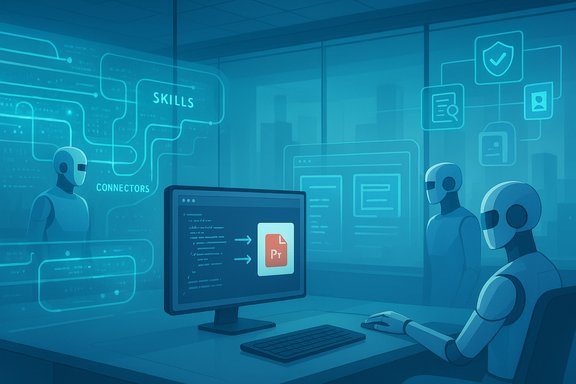
These are not just theoretical takeaways. Demonstrations shown on stage — including an agent using Anthropic’s Claude on Azure to assemble a PowerPoint deck by composing HTML and converting it into a .pptx without ever launching the PowerPoint application — illustrate how practical agent capabilities are becoming. At the same time, vendors and platforms are racing to provide the plumbing that makes that possible: agent runtimes, skills libraries, data connectors, telemetry, and enterprise governance controls.
This sequence is useful because it ties technical capability to organizational readiness. Each stage grows the attack surface and the governance burden, so enterprises should not accelerate technical capability faster than their control frameworks can keep up.
This pattern reflects two trends:
Key guardrail patterns:
Enterprises that follow a staged, observability-driven, identity-first approach — piloting conservative agents, encoding policies as code, and enforcing least-privilege delegation — will capture the benefits while minimizing systemic risk. Those that prioritize speed without guardrails will likely face painful setbacks: regulatory exposure, operational failure, and the erosion of employee trust.
The choice is not between stopping AI and letting AI run unchecked. It’s between disciplined, staged adoption with clear guardrails and chaotic deployment that amplifies hazards. The future of work is being rewritten by agents and Copilots; the winners will be the organizations that build the operational and governance muscles to wield them responsibly.
Source: Cloud Wars Microsoft Ignite: Renowned Futurists Map Out the Next Era of Enterprise AI Success
 Background
Microsoft Ignite this year made clear that mainstream enterprise AI is no longer a collection of prototypes and pilots — it’s a systems problem that touches identity, permissions, workflows, and the very user interfaces knowledge workers use every day. Two speakers framed the conversation in sharp, operational terms: a Citrix futurist describing a staged evolution for human–AI collaboration, and a Microsoft product leader showing how modern agent frameworks and multimodal Copilots are already doing work inside enterprise environments.The session’s core messages are simple but consequential. First, AI adoption is a multi-stage journey from simple prompts to fully orchestrated, multi-agent workflows. Second, the path to productive AI is not model-first; it’s workspace-first — AI must operate where humans work (on the screen, inside apps, and against enterprise data stores). Third, governance and access control are no longer optional: identity, permissions, and fine-grained guardrails are the linchpin that separates useful, safe AI from systemic risk.
These are not just theoretical takeaways. Demonstrations shown on stage — including an agent using Anthropic’s Claude on Azure to assemble a PowerPoint deck by composing HTML and converting it into a .pptx without ever launching the PowerPoint application — illustrate how practical agent capabilities are becoming. At the same time, vendors and platforms are racing to provide the plumbing that makes that possible: agent runtimes, skills libraries, data connectors, telemetry, and enterprise governance controls.
The seven-stage roadmap for human–AI collaboration
The roadmap presented at Ignite frames AI adoption as a discrete progression of capabilities and trust. Treating it as a roadmap helps enterprises plan for organizational change and for incremental investments that build trust and measurable ROI.1. Prompt and paste (introductory)
The first stage is the low-friction adoption most organizations have already experienced: employees paste text into an LLM and get summaries, drafts, or idea prompts back. This delivers immediate productivity gains but provides little control or auditability.2. AI as an analyst
Here, AI augments specific roles: analysts receive automated summaries, insight extraction, or statistical analysis anchored to uploaded documents or datasets. This stage introduces controlled data inputs and a basic provenance model.3. AI watching your screen (screen-aware Copilots)
Screen-aware Copilots observe user context — open documents, browser state, and application windows — to provide contextually relevant suggestions. This dramatically increases relevance but introduces new surface-area for privacy, leakage, and consent concerns.4. AI using your computer for you (guided action)
At this stage, AI takes action on the user’s behalf with explicit permissions: filling forms, composing emails, or preparing slides. Actions occur with the user in the loop and explicit confirmations.5. AI using your computer without you watching (autonomous agents)
Agents operate with delegated authority to complete tasks end-to-end. This stage requires stronger controls: delegated credentials, scoped permissions, robust error handling, and audit trails.6. Multi-agent communication
Multiple agents collaborate to complete complex workflows — for example, one agent gathers data, another validates it against a policy engine, and a third submits results to a downstream system. Inter-agent protocols, message formats, and orchestration engines become key.7. AI-orchestrated work (agentic enterprise)
The final stage is where agents manage entire processes across teams and systems, dynamically composing skills, scheduling actions, and enforcing policies. Humans transition from executors to reviewers, controllers, and exception handlers.This sequence is useful because it ties technical capability to organizational readiness. Each stage grows the attack surface and the governance burden, so enterprises should not accelerate technical capability faster than their control frameworks can keep up.
Screen-aware Copilots and multimodal interfaces: productivity gains and privacy trade-offs
Screen-aware Copilots and multimodal UIs — where vision, text, audio, and even live video feed into agent decision-making — are where much of the near-term productivity upside lives. These interfaces allow AI to recommend next steps, extract facts from open documents, and synthesize multi-source context without manual data shuffling.- Benefits:
- Dramatically reduced context-switching for knowledge workers.
- Faster synthesis of meeting artifacts, slide decks, and reports.
- More relevant, timely recommendations that reflect actual user intent.
- Challenges:
- Data leakage: Copilots that "see" everything risk exposing confidential information across unintended contexts.
- Consent and visibility: Workers and organizations must have transparent, enforceable consent models for any screen or device telemetry captured by agents.
- Input integrity: Screen-scraping or OCR-driven context extraction can mis-interpret or corrupt the original content.
Agents, skills, and the dissolution of apps into data
One of the most consequential technical ideas surfaced at Ignite is the notion that apps may dissolve into data plus skills. Instead of instructing PowerPoint to create slides, an agent composes an HTML slide bundle and converts that into a .pptx — effectively bypassing the traditional app UI and speaking directly to the data format and workflow.This pattern reflects two trends:
- The rise of skills or modular capabilities (generate-report, extract-tables, create-slides) that can be composed into workflows.
- The emergence of agent runtimes that can execute code, call APIs, manipulate files, and orchestrate multiple steps under policy constraints.
Platform-level advances: what the vendors are building
Major cloud and AI vendors are now shipping components that make agentic workflows feasible at scale. Key platform capabilities to watch include:- Agent runtimes that support modular “skills” and safe execution sandboxes.
- Governance layers with policy enforcement, versioned skills, and audit logs.
- Identity and credential management integrated with enterprise SSO and managed identities.
- Data connectors and memory stores that allow agents to retrieve, index, and persist knowledge with lineage and TTL (time-to-live) controls.
- Multimodal ingestion and file-creation capabilities enabling agents to produce production-ready artifacts like Word documents, Excel sheets, and PowerPoint decks.
Why identity, permissions, and access guardrails now matter more than ever
When AI moves from suggestion to action, identity and permissions become the de facto safety mechanism. The moment an agent can submit a change, order a resource, or send a contractor an invoice, the enterprise needs to control scope, auditing, and rollback.Key guardrail patterns:
- Least privilege and scoped delegation: Agents receive tightly scoped tokens with limited lifetime and constrained permissions. Avoid handing agents broad, long-lived credentials.
- Just-in-time elevation: For high-sensitivity actions, require human approval or ephemeral elevated tokens with strong authentication (MFA, device attestation).
- Policy-as-code: Encode business rules and compliance constraints as executable policies that are enforced at the agent runtime.
- Observable audit trails: Every agent action should produce an auditable event that links intent, inputs, outputs, and the identity that authorized the action.
- Data minimization and masking: Agents should be given the minimal data required for a task, with automated redaction/masking when possible.
Security and compliance risks: a practical taxonomy
Enterprises must treat agent deployments as systemic risk events. Here’s a concise taxonomy of the most immediate concerns and pragmatic mitigations.- Credential and privilege misuse
- Risk: Agents with broad credentials perform unauthorized operations.
- Mitigation: Use managed identities, shortest possible token lifetimes, scoped permissions, and anomaly detection on agent behaviors.
- Data exfiltration
- Risk: Screen-aware Copilots or agents accidentally leak PII or intellectual property into external prompts or third-party APIs.
- Mitigation: Implement sensitive-data classifiers, prompt sanitization, and network egress controls for model access.
- Hallucinations and flawed automation
- Risk: Agents generate plausible but incorrect outputs and act on them (e.g., sending erroneous invoices).
- Mitigation: Require verifiable checks, human-in-the-loop approvals for critical steps, and provenance tracing for inputs.
- Supply chain/model provenance
- Risk: Using third-party model APIs without understanding training data or safety controls.
- Mitigation: Adopt vendor due diligence, contractual SLAs about data handling, and test suites for model behaviors.
- Regulatory noncompliance
- Risk: Automated workflows modify records in regulated domains (healthcare, finance) without proper controls.
- Mitigation: Map workflows to compliance frameworks (GDPR, HIPAA, SOX), use policy-as-code to block disallowed actions.
- Prompt injection and adversarial manipulation
- Risk: Malicious inputs cause an agent to override safeguards or leak secrets.
- Mitigation: Use input sanitation, tokenized secrets that are never passed to LLMs, and model-level guardrails.
- Observability gaps
- Risk: Lack of logs and traces means incidents are undetectable until significant damage occurs.
- Mitigation: Centralized telemetry for agent decisions, file generation, outbound calls, and policy violations.
Technical architecture and operational practices
A robust, production-ready agent architecture should include the following layers:- Identity & Access Layer
- Integration with enterprise identity provider (SSO, SCIM).
- Managed identities and ephemeral tokens for agents.
- Role-based access control (RBAC) and attribute-based access control (ABAC).
- Agent Runtime & Orchestration
- Sandboxed execution environments, per-skill resource limits, and network egress controls.
- Orchestration engine for multi-agent workflows with retry and compensation logic.
- Data & Memory Layer
- Versioned knowledge stores, indexed retrieval with TTL, and documented data contracts.
- Encryption at rest & in transit, with selective decryption at runtime.
- Policy & Governance
- Policy-as-code that can be validated in CI/CD and enforced at runtime.
- Audit logs stored in immutable ledger or tamper-evident store.
- Model & Tooling Layer
- Choice of models based on use case, latency, and trust needs; local vs. cloud models trade-offs.
- Tooling for prompt engineering, test harnesses, and red teaming.
- Observability & Incident Response
- Tracing of agent decisions from input to output.
- Alerting on anomalous agent behavior and automatic rollback paths.
Enterprise playbook: a pragmatic sequence to deploy agents safely (numbered steps)
- Inventory and map high-value workflows that could benefit from automation.
- Classify data sensitivity for each workflow and identify host systems and connectors.
- Choose a controlled pilot: single team, bounded scope, low blast radius.
- Implement identity-first controls: scoped managed identities and just-in-time elevation.
- Build policy-as-code for compliance-critical checks and include them in pre-deployment tests.
- Use a sandboxed agent runtime for the pilot; require human approvals for external actions.
- Run adversarial and red-team tests, including prompt-injection, data leakage, and error cascades.
- Validate outputs with active monitoring and quality gates, measuring accuracy and correctness.
- Expand incrementally with pre-defined guardrails; automate deprovisioning of unused agents.
- Institutionalize lifecycle management: periodic re-testing as model weights, skills, or connectors change.
Cost, performance, and vendor strategy
Agent deployments introduce new cost vectors: model inference costs, orchestration charges, connector API usage, and storage for memory and logs. Enterprises should:- Benchmark models for latency and cost at expected load.
- Use smaller, local models for high-frequency, low-risk tasks and reserve larger models for complex reasoning.
- Negotiate vendor SLAs for data handling, retention, and legal protections.
- Maintain multi-vendor flexibility where necessary to avoid lock-in; prefer abstractions (skills, connectors) that can be re-pointed.
Critical analysis: strengths, blind spots, and strategic implications
Strengths:- Agentic AI promises real productivity gains by eliminating repetitive orchestration work and by working in context with people.
- Modular "skills" enable reuse and governance at a manageable scope, accelerating composability across the stack.
- Platform evolution (agent runtimes, skills, governance primitives) is rapidly moving from research to production-grade capabilities.
- Many enterprises underestimate the policy and identity engineering effort required. The technical work is only one side; integrating governance into daily operations is arguably harder.
- Screen-aware capabilities can increase value per user but also expand the risk surface quickly. There are few industry standards today for consent models or for blocking sensitive UI content from being ingested by Copilots.
- Vendor ecosystems are immature: connectors, skill definitions, and runtime semantics vary between platforms, creating operational complexity and potential lock-in.
- Organizational change management is under-discussed. Shifting users from direct action to oversight requires new processes, training, and clear accountability.
- Organizations that get identity and policy right will outcompete peers by safely scaling agents to do actual work.
- Those that rush technical rollout without governance are likely to encounter compliance failures, data breaches, and loss of trust that will slow future adoption.
- The most competitive advantage will come from creating proprietary skills and knowledge graphs that agents can use to perform domain-specific tasks faster and more reliably than general-purpose models alone.
Practical mitigations and engineering recommendations
- Treat agents like microservices: implement CI/CD pipelines that include security tests, policy validation, and model-behavior regression checks.
- Keep secrets out of prompts: use tokenized secrets and APIs for any operation involving private keys, credentials, or PII.
- Implement role separation: developers build and test skills; security and legal teams certify them; operations enforce runtime constraints.
- Use canary deployments and progressive exposure: start with read-only or audit-only modes before granting write privileges.
- Record "explainability metadata" for every automated decision to help with investigations and regulatory requests.
- Adopt continuous red-team cycles to probe prompt-injection, poisoning, and adversarial workflows.
Organizational and cultural considerations
Technology alone won’t solve the human and cultural challenges. Successful adopters do three things well:- Build cross-functional governance councils that include legal, security, engineering, and business stakeholders to set and iterate policy.
- Create transparent worker controls — visible toggles and clear consent dialogs — so employees understand when an agent is watching or acting on their behalf.
- Invest in training: workers need new skills to supervise agents, validate outputs, and interpret provenance metadata.
Where enterprises should focus next quarter
- Identify three high-value, low-complexity workflows to pilot with scoped agents.
- Establish identity and policy baselines: RBAC/ABAC rules, ephemeral token patterns, and mandatory audit logging.
- Select an orchestration runtime that supports policy enforcement and tamper-evident logging.
- Run a red-team exercise focused on prompt injection and data exfiltration scenarios.
- Model cost at expected scale and set budget controls for model use and connector charges.
Conclusion
The conversations and demos at recent vendor events crystallize a simple strategic reality: the next era of enterprise AI is agentic and workspace-centric. Productivity gains come from agents that act where humans work, but those gains are only sustainable when the organization treats identity, permissions, and governance as first-class engineering problems.Enterprises that follow a staged, observability-driven, identity-first approach — piloting conservative agents, encoding policies as code, and enforcing least-privilege delegation — will capture the benefits while minimizing systemic risk. Those that prioritize speed without guardrails will likely face painful setbacks: regulatory exposure, operational failure, and the erosion of employee trust.
The choice is not between stopping AI and letting AI run unchecked. It’s between disciplined, staged adoption with clear guardrails and chaotic deployment that amplifies hazards. The future of work is being rewritten by agents and Copilots; the winners will be the organizations that build the operational and governance muscles to wield them responsibly.
Source: Cloud Wars Microsoft Ignite: Renowned Futurists Map Out the Next Era of Enterprise AI Success
