

Shadow AI has moved from a niche IT concern to a board-level problem because employees are already using public GenAI tools faster than enterprises can govern them. The core warning in Meer’s English edition is straightforward: the productivity gains are real, but so are the risks, and the old playbook of banning innovation or ignoring it no longer works. The article argues that companies need to replace ad hoc use with controlled, sanctioned GenAI systems before sensitive data, compliance obligations, and intellectual property leak into tools they do not control. That framing is consistent with the broader enterprise AI shift now visible across Microsoft’s own governance messaging, where identity, observability, and policy enforcement are being treated as first-class security issues rather than afterthoughts.
The article begins from an important premise: generative AI adoption is already widespread, and employees are making their own decisions about when to use it. A rising share of workers now rely on public assistants for drafting, summarization, coding, and research, which means the enterprise is no longer deciding whether AI exists in the workflow. It is deciding whether that AI usage happens inside a governed perimeter or outside it. The article’s strongest contribution is that it treats Shadow AI not as a theoretical policy issue, but as an operational reality that companies have to manage now.
That matters because the temptation in many organizations is to frame AI as a productivity booster first and a risk vector second. Meer flips that sequence by arguing that unmanaged use creates a three-part threat: data leakage, regulatory exposure, and competitive loss. This is not the same as older Shadow IT. Traditional unsanctioned software often stayed local or isolated; GenAI can ingest prompts, retain content, and reuse patterns at scale, which means a single careless interaction can have persistent consequences.
The article also connects Shadow AI to the changing economics of workplace productivity. It cites evidence that heavy users gain more than light users, while non-users may fall behind, creating a widening performance gap inside teams. That is a useful insight because it explains why employees are not merely being reckless; they are responding rationally to pressure, deadlines, and the convenience of consumer-grade tools. When the best option is a browser tab away, policy alone will not stop usage.
A final strength of the piece is that it does not stop at risk diagnosis. It proposes a governance framework built around technology, policy, and culture. That structure is especially relevant in 2026 because many enterprises have moved beyond “Should we use AI?” and into “How do we govern AI at scale without choking off the value?” The article’s answer is essentially that safety has to be easier than shadow use, or the shadow will win.
The article places this in the context of broad workplace adoption. Surveys and industry reports point to a steady rise in use of public AI assistants, and the organization-level response has not kept pace. In that environment, employees have learned that AI can shave minutes off routine work, and managers often tolerate that behavior because they can see the productivity bump right away. The problem is that the downside is delayed, hidden, and often contractual or regulatory rather than visibly technical.
This is where the article’s treatment of enterprise versus consumer behavior is especially sharp. Consumer AI can be casual and forgiving; enterprise AI cannot. A consumer user asking for a travel itinerary is operating in a low-stakes environment. A salesperson pasting client revenue details or a lawyer uploading a draft settlement is crossing into a world where retention, jurisdiction, and privilege matter. The article is right to emphasize that employees often do not appreciate how different those contexts are.
The enterprise stakes are also changing because the market is shifting toward embedded and governed AI rather than standalone chat tools. Microsoft’s recent enterprise announcements show a strong emphasis on identity controls, observability, and agent governance, which reflects the broader industry recognition that AI is becoming a managed workload rather than a novelty. That aligns with the article’s premise: companies need a control plane, not just a chatbot.
Another key background issue is the regulatory environment. The article points to GDPR, HIPAA, PCI-DSS, and the EU AI Act as examples of why governance is no longer optional. Whether or not every company is directly subject to each framework, the strategic point is valid: once AI is part of a regulated workflow, the burden of proof shifts to the enterprise. If you cannot show where data went, who accessed it, and what model touched it, you are already exposed.
The article argues that delay only deepens the problem. If internal alternatives are poor, staff will keep using public tools. If policies are vague, behavior will fragment by department. If security controls are legacy-bound, they will miss the new data paths AI creates. In other words, inaction is not a neutral choice; it is a decision to let shadow practices harden.
The article uses developer productivity research to make this point. Heavier AI users do better, lighter users gain only modestly, and non-users can fall behind. That suggests the value is not just in access, but in learning curve, workflow fit, and trust. A tool that is technically available to everyone may still create internal stratification if only some workers know how to use it effectively.
That is why enterprises need to measure AI on business outcomes, not novelty. If a chatbot saves fifteen minutes but adds an hour of review, the net gain may be negative. If an internal model reduces errors, improves consistency, and keeps data within the perimeter, the value is real. The distinction matters because speed alone is not a strategy.
The same logic applies to team dynamics. If one group adopts AI heavily and another avoids it, the organization can end up with a two-speed workforce. The article is right to suggest that the productivity gap becomes a talent issue as much as a technology issue. High performers will gravitate toward environments that let them use modern tools safely and effectively.
A useful operational takeaway is that companies should map AI benefits by task class:
The article also stresses that Shadow AI is not only about direct breaches. It is about irreversible loss of control. Once a user pastes proprietary material into a public model, the enterprise may no longer know where that information lives, how it is processed, or whether it is used to improve the service. That uncertainty is the real problem. Opacity itself becomes a risk surface.
That is especially dangerous for regulated data. Personally identifiable information, health records, payment data, and confidential client information can all be exposed in a single moment of convenience. The article’s argument is that traditional confidentiality training is not enough if workers do not understand the data flow behind the model.
This is why policy matters as much as technology. A company can buy a secure tool and still fail if workers bypass it. Conversely, a rule without tooling tends to become a suggestion. The article argues for a managed environment where the safe path is also the easiest path, and that is the right framing.
This is the part of Shadow AI that executives often underestimate. Data breaches are visible and embarrassing. IP erosion is slower, harder to trace, and potentially more damaging over time. A company can recover from a bad draft; it may not recover from the loss of a trade secret or the contamination of a software supply chain.
Employees also tend to trust their own judgment more than organizational warnings, especially when they already use consumer AI in their personal lives. The article is persuasive on this point: people confuse familiarity with safety. If a tool feels conversational and private, it can seem less like a data platform and more like a quick brainstorming partner, even when the opposite is true.
That illusion matters because it lowers the psychological barrier to sharing. Workers would never forward a sensitive spreadsheet to a stranger, yet they may paste equivalent content into a chatbot because the interface feels harmless. That is a classic example of interface-driven risk.
There is also an organizational signaling issue. If managers quietly reward speed and do not enforce AI rules, employees infer that the real policy is “use whatever works.” Once that norm takes hold, formal guidance loses credibility. The gap between stated policy and lived practice is where shadow behavior grows.
That means the answer cannot be mere prohibition. Organizations have to build internal alternatives that are safe but also good. Usability is a security control, because poor tools drive users to unsafe ones. The article’s governance model depends on making the approved path the most attractive path.
What makes this framework useful is that it treats governance as an enabling function rather than a brake. The aim is not to eliminate AI use. It is to centralize decision-making, protect data, and preserve the flexibility to adopt better models later. That is a much more sustainable strategy than blanket bans.
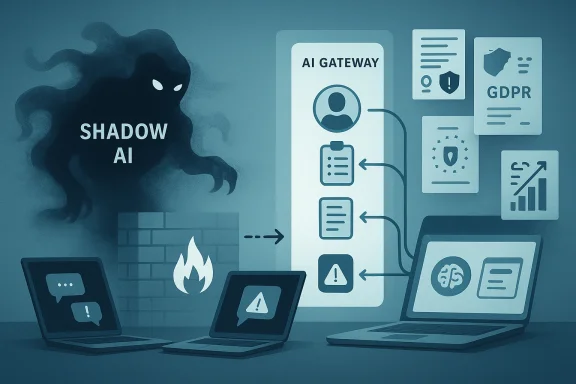
This is where enterprise architecture becomes strategic. A centralized AI gateway can enforce redaction, model selection, logging, and role-based routing. It can also give security teams the visibility they need to understand how AI is actually being used. In a shadow-heavy environment, that visibility is priceless.
Well-designed policy should be tiered. Not every workflow needs the same restrictions, and not every data class carries the same risk. HR, legal, finance, engineering, and marketing should not be governed by the same blanket rule if their use cases differ. Granularity is what makes policy usable.
That means support models matter too. AI champions, help desks, escalation paths, and approved use cases can all reduce the temptation to improvise. If workers can get quick help for edge cases, they are less likely to turn to a personal account or unauthorized tool out of frustration.
Consumers can tolerate a lot of ambiguity because the stakes are usually low. Enterprises cannot. When the consequence of an error is customer harm, legal exposure, or operational failure, the tolerance for sloppy use drops sharply. That is why public GenAI may be acceptable as a consumer tool while still being inappropriate for sensitive business workflows.
The article’s emphasis on audit trails is important here. If security teams cannot reconstruct what happened, they cannot defend the system later. That is why enterprise AI must be designed for traceability from the start. If you cannot audit it, you cannot govern it.
That expectation is not going away. Which is why companies need to stop trying to suppress AI instinctively and start providing approved tools that compete on user experience. If the sanctioned option feels second-rate, shadow usage will remain attractive no matter how stern the policy language becomes.
A mature organization has to close that gap through process, not hope. Training should be scenario-based, short, repeated, and tied to actual workflows. The message should be clear: AI is allowed where the company has made it safe, not where the employee happens to be curious.
This is especially true in sectors where the rules are strict and the penalties are concrete. Healthcare, finance, public services, and cross-border operations all need a higher standard. The article makes a compelling case that Shadow AI can create compliance failures long before a breach is visible.
For multinational companies, residency and transfer rules make this even more complicated. Data may be processed in jurisdictions that the enterprise never intended to use. That can create a compliance problem even when the employee thinks they are simply getting help with a draft. Intent does not erase liability.
Even where the exact penalties vary by circumstance, the strategic message is clear: enforcement is maturing. Organizations that wait for the first incident to define policy will be late. The article’s call for immediate governance is therefore not alarmism; it is risk management.
Auditability also supports internal discipline. When workers know usage is visible, they behave differently. That is not about surveillance for its own sake; it is about making risk measurable. In a world of shadow use, visibility is the first step toward control.
This is where the piece becomes especially relevant for leadership teams. AI governance is often framed as a defensive function, but it is also a strategic differentiator. A company that gives employees safe, fast, well-integrated tools will outperform one that merely issues warnings.
The BlueOptima-style productivity gap also suggests that AI fluency will become a workplace dividing line. Employees who know how to use AI responsibly will move faster. Organizations that fail to support that skill development will end up with uneven performance across teams and, eventually, uneven career progression. That is both an HR issue and an operating model issue.
That is why many enterprises are moving toward internal models, private deployments, or zero-retention options. The goal is not to be anti-AI. It is to ensure that the benefits of AI do not come at the expense of the company’s core advantage. Owned intelligence beats rented intelligence when the workflow is strategic.
Organizations should therefore compare total cost of ownership, not sticker price. A sanctioned tool that reduces risk and integrates cleanly may be cheaper in the long run than a consumer service that employees use informally. The budget line may look larger, but the risk-adjusted cost may be lower.
It also identifies a real opportunity: companies that build safe AI pathways can capture productivity without surrendering control. That is the sweet spot enterprise leaders should be aiming for. The article’s framework supports that goal by making responsible use more convenient than unsafe use.
A second risk is policy without usability. If internal tools are clunky or overly constrained, employees will ignore them. A third risk is that governance teams may focus so much on model restrictions that they miss the broader workflow issues, such as where data lives, how prompts are logged, and who can approve exceptions. The challenge is to build controls that are effective without becoming bureaucratic drag.
The article is persuasive because it understands the real-world behavior of employees. People will use whatever makes them faster, and if the approved path is weaker than the shadow path, the shadow path will persist. The answer, then, is not merely to stop Shadow AI. It is to make sanctioned AI so good that shadow use becomes unnecessary.
Source: Meer | English edition Why companies must stop Shadow AI now
 Overview
The article begins from an important premise: generative AI adoption is already widespread, and employees are making their own decisions about when to use it. A rising share of workers now rely on public assistants for drafting, summarization, coding, and research, which means the enterprise is no longer deciding whether AI exists in the workflow. It is deciding whether that AI usage happens inside a governed perimeter or outside it. The article’s strongest contribution is that it treats Shadow AI not as a theoretical policy issue, but as an operational reality that companies have to manage now.That matters because the temptation in many organizations is to frame AI as a productivity booster first and a risk vector second. Meer flips that sequence by arguing that unmanaged use creates a three-part threat: data leakage, regulatory exposure, and competitive loss. This is not the same as older Shadow IT. Traditional unsanctioned software often stayed local or isolated; GenAI can ingest prompts, retain content, and reuse patterns at scale, which means a single careless interaction can have persistent consequences.
The article also connects Shadow AI to the changing economics of workplace productivity. It cites evidence that heavy users gain more than light users, while non-users may fall behind, creating a widening performance gap inside teams. That is a useful insight because it explains why employees are not merely being reckless; they are responding rationally to pressure, deadlines, and the convenience of consumer-grade tools. When the best option is a browser tab away, policy alone will not stop usage.
A final strength of the piece is that it does not stop at risk diagnosis. It proposes a governance framework built around technology, policy, and culture. That structure is especially relevant in 2026 because many enterprises have moved beyond “Should we use AI?” and into “How do we govern AI at scale without choking off the value?” The article’s answer is essentially that safety has to be easier than shadow use, or the shadow will win.
Background
Shadow AI is the latest version of a familiar enterprise pattern. For years, companies struggled with Shadow IT: employees using unsanctioned apps, cloud drives, and collaboration tools to move faster than official systems allowed. GenAI makes that problem more acute because the value proposition is immediate, the setup is trivial, and the data sensitivity can be far higher than a file-sharing app ever was.The article places this in the context of broad workplace adoption. Surveys and industry reports point to a steady rise in use of public AI assistants, and the organization-level response has not kept pace. In that environment, employees have learned that AI can shave minutes off routine work, and managers often tolerate that behavior because they can see the productivity bump right away. The problem is that the downside is delayed, hidden, and often contractual or regulatory rather than visibly technical.
This is where the article’s treatment of enterprise versus consumer behavior is especially sharp. Consumer AI can be casual and forgiving; enterprise AI cannot. A consumer user asking for a travel itinerary is operating in a low-stakes environment. A salesperson pasting client revenue details or a lawyer uploading a draft settlement is crossing into a world where retention, jurisdiction, and privilege matter. The article is right to emphasize that employees often do not appreciate how different those contexts are.
The enterprise stakes are also changing because the market is shifting toward embedded and governed AI rather than standalone chat tools. Microsoft’s recent enterprise announcements show a strong emphasis on identity controls, observability, and agent governance, which reflects the broader industry recognition that AI is becoming a managed workload rather than a novelty. That aligns with the article’s premise: companies need a control plane, not just a chatbot.
Another key background issue is the regulatory environment. The article points to GDPR, HIPAA, PCI-DSS, and the EU AI Act as examples of why governance is no longer optional. Whether or not every company is directly subject to each framework, the strategic point is valid: once AI is part of a regulated workflow, the burden of proof shifts to the enterprise. If you cannot show where data went, who accessed it, and what model touched it, you are already exposed.
Why the timing matters
The timing of this debate is significant because companies are being squeezed from both sides. On one side, employees expect AI tools to be available in daily work. On the other, regulators and customers are becoming less tolerant of opaque data handling. That creates a narrow path: organizations must enable AI quickly, but they must do it with controls that are visible, enforceable, and auditable.The article argues that delay only deepens the problem. If internal alternatives are poor, staff will keep using public tools. If policies are vague, behavior will fragment by department. If security controls are legacy-bound, they will miss the new data paths AI creates. In other words, inaction is not a neutral choice; it is a decision to let shadow practices harden.
The Productivity Paradox
One of the most useful tensions in the article is the productivity paradox. GenAI clearly helps people move faster, but its benefits are uneven and context-dependent. That means companies should not assume a universal uplift just because a tool exists. They need to ask which roles benefit, which tasks are suitable, and what downstream work the AI actually saves.The article uses developer productivity research to make this point. Heavier AI users do better, lighter users gain only modestly, and non-users can fall behind. That suggests the value is not just in access, but in learning curve, workflow fit, and trust. A tool that is technically available to everyone may still create internal stratification if only some workers know how to use it effectively.
Productivity is not the same as value
A faster draft is not necessarily a better outcome. In customer service, legal review, finance, or compliance, a hasty AI-generated answer can create rework, escalation, or reputational damage. The article gets this right by warning that productivity gains can be illusory if they create hidden verification costs later.That is why enterprises need to measure AI on business outcomes, not novelty. If a chatbot saves fifteen minutes but adds an hour of review, the net gain may be negative. If an internal model reduces errors, improves consistency, and keeps data within the perimeter, the value is real. The distinction matters because speed alone is not a strategy.
The same logic applies to team dynamics. If one group adopts AI heavily and another avoids it, the organization can end up with a two-speed workforce. The article is right to suggest that the productivity gap becomes a talent issue as much as a technology issue. High performers will gravitate toward environments that let them use modern tools safely and effectively.
A useful operational takeaway is that companies should map AI benefits by task class:
- drafting and summarization,
- research assistance,
- code generation and debugging,
- internal knowledge retrieval,
- customer-facing personalization,
- high-risk decision support.
What Shadow AI Really Means
The article’s definition of Shadow AI is straightforward but powerful: using unapproved external GenAI tools without governance or oversight. That sounds similar to old Shadow IT, but it is not the same in practice. Shadow AI can expose prompts, context, source material, and user intent, and it can do so in a conversational format that encourages casual disclosure.The article also stresses that Shadow AI is not only about direct breaches. It is about irreversible loss of control. Once a user pastes proprietary material into a public model, the enterprise may no longer know where that information lives, how it is processed, or whether it is used to improve the service. That uncertainty is the real problem. Opacity itself becomes a risk surface.
Data leakage at scale
The biggest threat is the quiet migration of sensitive information into external systems. Employees tend to think of prompts as temporary interactions, but many public tools log, store, or reuse content in ways the user may not expect. The article’s warning is that this turns every prompt into a potential breach point.That is especially dangerous for regulated data. Personally identifiable information, health records, payment data, and confidential client information can all be exposed in a single moment of convenience. The article’s argument is that traditional confidentiality training is not enough if workers do not understand the data flow behind the model.
Compliance exposure
Shadow AI also creates a documentation problem. If a compliance team cannot show what model handled the data, where it was processed, and what terms governed retention, the organization may struggle to defend its practices. The article is right that auditability is not just paperwork; it is the proof mechanism for modern governance.This is why policy matters as much as technology. A company can buy a secure tool and still fail if workers bypass it. Conversely, a rule without tooling tends to become a suggestion. The article argues for a managed environment where the safe path is also the easiest path, and that is the right framing.
Intellectual property risk
The IP concern is even broader than most workers realize. Source code, algorithms, merger plans, product roadmaps, and legal drafts can all be turned into training fuel or retained context outside the company’s control. The article correctly highlights the competitive downside: you are not just leaking data, you may be arming rivals with your own strategic material.This is the part of Shadow AI that executives often underestimate. Data breaches are visible and embarrassing. IP erosion is slower, harder to trace, and potentially more damaging over time. A company can recover from a bad draft; it may not recover from the loss of a trade secret or the contamination of a software supply chain.
Why Employees Use It Anyway
The article does a good job of resisting the lazy explanation that employees are simply careless. In reality, Shadow AI thrives because the incentives are aligned in its favor. The tools are easy, the value is immediate, and the risk often feels abstract. That combination is hard to beat with policy memos alone.Employees also tend to trust their own judgment more than organizational warnings, especially when they already use consumer AI in their personal lives. The article is persuasive on this point: people confuse familiarity with safety. If a tool feels conversational and private, it can seem less like a data platform and more like a quick brainstorming partner, even when the opposite is true.
The illusion of privacy
One of the most important cultural drivers is the feeling that a chatbot is private. Users type into a text box and receive an answer, so the interaction feels ephemeral. But the article points out that the provider may log, store, and analyze the exchange.That illusion matters because it lowers the psychological barrier to sharing. Workers would never forward a sensitive spreadsheet to a stranger, yet they may paste equivalent content into a chatbot because the interface feels harmless. That is a classic example of interface-driven risk.
Productivity pressure and autonomy
Modern work environments also encourage speed and self-direction. Remote work, BYOD culture, decentralized teams, and deadline pressure all make employees more likely to choose their own tools. The article is right that the shadow use often reflects autonomy, not malice.There is also an organizational signaling issue. If managers quietly reward speed and do not enforce AI rules, employees infer that the real policy is “use whatever works.” Once that norm takes hold, formal guidance loses credibility. The gap between stated policy and lived practice is where shadow behavior grows.
Weak internal alternatives
Another reason Shadow AI persists is that sanctioned tools are often less useful than public ones. Employees compare the polished experience of consumer assistants to slow, heavily restricted enterprise systems and make a rational choice. If the company tool is cumbersome, they will bypass it.That means the answer cannot be mere prohibition. Organizations have to build internal alternatives that are safe but also good. Usability is a security control, because poor tools drive users to unsafe ones. The article’s governance model depends on making the approved path the most attractive path.
The Governance Stack
The article’s proposed solution is not a single control, but a stack. That is the correct approach. Shadow AI is a layered problem, so the response must be layered too. The three pillars—technology, policy, and people—map well to how enterprises actually operate.What makes this framework useful is that it treats governance as an enabling function rather than a brake. The aim is not to eliminate AI use. It is to centralize decision-making, protect data, and preserve the flexibility to adopt better models later. That is a much more sustainable strategy than blanket bans.
Technology and control
The article argues for a modular AI architecture with a gateway that inspects traffic, filters prompts, and enforces policy before data reaches a model. That is an important idea because technical controls only work when they sit in the data path. If the enterprise cannot see prompts, it cannot protect them.This is where enterprise architecture becomes strategic. A centralized AI gateway can enforce redaction, model selection, logging, and role-based routing. It can also give security teams the visibility they need to understand how AI is actually being used. In a shadow-heavy environment, that visibility is priceless.
Policy and process
The policy layer is where the rules of engagement live. The article correctly insists that companies need to answer who can use AI, for what purpose, with what data, and through which tools. That is simple enough to state, but many organizations have not formalized it.Well-designed policy should be tiered. Not every workflow needs the same restrictions, and not every data class carries the same risk. HR, legal, finance, engineering, and marketing should not be governed by the same blanket rule if their use cases differ. Granularity is what makes policy usable.
People and culture
The article’s cultural pillar is especially strong because governance fails when people do not believe in it. Training needs to be role-specific, practical, and continuous. Employees must understand not just what the rules are, but why they exist and how they protect both the company and their own work.That means support models matter too. AI champions, help desks, escalation paths, and approved use cases can all reduce the temptation to improvise. If workers can get quick help for edge cases, they are less likely to turn to a personal account or unauthorized tool out of frustration.
Enterprise vs Consumer Impact
The article’s argument is enterprise-focused, but it helps to separate enterprise and consumer effects more explicitly. Consumer AI is about convenience, creativity, and low-friction use. Enterprise AI is about control, traceability, and business outcomes. Those are related but not interchangeable goals.Consumers can tolerate a lot of ambiguity because the stakes are usually low. Enterprises cannot. When the consequence of an error is customer harm, legal exposure, or operational failure, the tolerance for sloppy use drops sharply. That is why public GenAI may be acceptable as a consumer tool while still being inappropriate for sensitive business workflows.
Why enterprises need more restraint
Enterprise environments also face the burden of proof. If a company uses AI to support a regulated process, it has to show how the system behaves, what data it sees, and where outputs go. That creates a documentation and monitoring obligation that consumer users do not have.The article’s emphasis on audit trails is important here. If security teams cannot reconstruct what happened, they cannot defend the system later. That is why enterprise AI must be designed for traceability from the start. If you cannot audit it, you cannot govern it.
Why consumers keep pushing adoption
Consumers, by contrast, will often choose the easiest available tool. If a chatbot helps draft a resume, translate a message, or generate content, the decision is simple. This creates a market signal that eventually bleeds into the workplace: employees expect the same convenience at work that they enjoy at home.That expectation is not going away. Which is why companies need to stop trying to suppress AI instinctively and start providing approved tools that compete on user experience. If the sanctioned option feels second-rate, shadow usage will remain attractive no matter how stern the policy language becomes.
The organizational learning gap
The enterprise challenge is not just technical; it is educational. Many workers know enough about AI to use it, but not enough to use it safely. They understand prompts and outputs, but not retention, training data, model terms, or regulatory scope. That mismatch is a governance problem in itself.A mature organization has to close that gap through process, not hope. Training should be scenario-based, short, repeated, and tied to actual workflows. The message should be clear: AI is allowed where the company has made it safe, not where the employee happens to be curious.
Regulatory Pressure and Legal Exposure
The article’s legal section is one of its strongest because it reflects how enterprise risk has changed. AI governance is now inseparable from data governance. Once public models enter the workflow, the company inherits a mix of privacy, security, and jurisdictional concerns that old IT policies were not designed to handle.This is especially true in sectors where the rules are strict and the penalties are concrete. Healthcare, finance, public services, and cross-border operations all need a higher standard. The article makes a compelling case that Shadow AI can create compliance failures long before a breach is visible.
GDPR, HIPAA, and sector rules
The article is correct that regulated industries face the steepest risk. A healthcare worker exposing patient data, or a financial employee pasting payment information into an unauthorized tool, can trigger serious consequences. Even if the initial intent is productivity, the legal exposure can be immediate.For multinational companies, residency and transfer rules make this even more complicated. Data may be processed in jurisdictions that the enterprise never intended to use. That can create a compliance problem even when the employee thinks they are simply getting help with a draft. Intent does not erase liability.
The EU AI Act and emerging enforcement
The article also frames the EU AI Act as a new layer of responsibility. That is useful because it shows AI governance is no longer just about privacy. It is about model risk, use-case classification, accountability, and provider obligations. Companies that treat AI as just another software feature are likely to misread their exposure.Even where the exact penalties vary by circumstance, the strategic message is clear: enforcement is maturing. Organizations that wait for the first incident to define policy will be late. The article’s call for immediate governance is therefore not alarmism; it is risk management.
Why auditability is central
The most practical legal point is auditability. If the company cannot show who used what, when, and for which data, it will struggle to defend itself. That is why logging, telemetry, review, and access control need to be built in, not bolted on.Auditability also supports internal discipline. When workers know usage is visible, they behave differently. That is not about surveillance for its own sake; it is about making risk measurable. In a world of shadow use, visibility is the first step toward control.
Competitive and Strategic Implications
The article’s market argument is that Shadow AI is not just a compliance issue; it is a competitiveness issue. Organizations that manage AI well can move faster, attract better talent, and preserve proprietary advantage. Those that do not will either stagnate or leak value into external systems.This is where the piece becomes especially relevant for leadership teams. AI governance is often framed as a defensive function, but it is also a strategic differentiator. A company that gives employees safe, fast, well-integrated tools will outperform one that merely issues warnings.
Productivity and talent retention
Workers increasingly expect AI support. If a company blocks it entirely, top performers may see that as a sign that the organization is behind the curve. Conversely, if the company offers strong internal tools, it can become a more attractive place to work. That is a subtle but important talent effect.The BlueOptima-style productivity gap also suggests that AI fluency will become a workplace dividing line. Employees who know how to use AI responsibly will move faster. Organizations that fail to support that skill development will end up with uneven performance across teams and, eventually, uneven career progression. That is both an HR issue and an operating model issue.
Protecting proprietary advantage
The article’s IP warning should resonate with any company whose competitive edge depends on code, product design, pricing, or market intelligence. If those assets are fed into public systems, the company risks flattening its own differentiation. A competitor does not need direct access to your files if your staff are training the outside world with your own material.That is why many enterprises are moving toward internal models, private deployments, or zero-retention options. The goal is not to be anti-AI. It is to ensure that the benefits of AI do not come at the expense of the company’s core advantage. Owned intelligence beats rented intelligence when the workflow is strategic.
The hidden cost of “free”
The article also makes a smart point about economics: free tools are not actually free when they create hidden governance, training, and incident-response costs. This is often overlooked because license pricing is visible while compliance overhead is not.Organizations should therefore compare total cost of ownership, not sticker price. A sanctioned tool that reduces risk and integrates cleanly may be cheaper in the long run than a consumer service that employees use informally. The budget line may look larger, but the risk-adjusted cost may be lower.
Strengths and Opportunities
The article’s greatest strength is that it treats Shadow AI as a systems problem rather than a moral panic. It explains why employees use public tools, why policy alone fails, and why governance has to combine architecture, process, and culture. That makes the argument more realistic than a simple ban-and-enforce posture.It also identifies a real opportunity: companies that build safe AI pathways can capture productivity without surrendering control. That is the sweet spot enterprise leaders should be aiming for. The article’s framework supports that goal by making responsible use more convenient than unsafe use.
- Clear recognition of business risk
- Strong link between productivity and governance
- Practical emphasis on sanctioned alternatives
- Useful separation of consumer and enterprise needs
- Strong focus on data protection and auditability
- Realistic explanation of employee behavior
- Balanced view of technology, policy, and culture
Risks and Concerns
The article’s warnings are credible, but there are still risks in how organizations respond. The biggest one is overcorrection. Some companies will use Shadow AI as justification for sweeping bans that slow innovation and drive usage even further underground.A second risk is policy without usability. If internal tools are clunky or overly constrained, employees will ignore them. A third risk is that governance teams may focus so much on model restrictions that they miss the broader workflow issues, such as where data lives, how prompts are logged, and who can approve exceptions. The challenge is to build controls that are effective without becoming bureaucratic drag.
- Overly restrictive bans that push usage underground
- Weak internal tools that fail to replace public assistants
- Policies that are unclear or impossible to enforce
- Audit systems that miss browser-based or personal-account use
- Insufficient training on what data may be shared
- Vendor lock-in if one platform becomes the only safe option
- False confidence from “approved” tools without real controls
Looking Ahead
The next phase of enterprise AI will not be decided by whether companies say yes or no to GenAI. It will be decided by whether they can govern it well enough that employees do not feel forced to go outside the fence. That means the winners will be organizations that build internal AI capability, define clear use cases, and integrate governance into everyday work.The article is persuasive because it understands the real-world behavior of employees. People will use whatever makes them faster, and if the approved path is weaker than the shadow path, the shadow path will persist. The answer, then, is not merely to stop Shadow AI. It is to make sanctioned AI so good that shadow use becomes unnecessary.
What companies should do next
- Map where employees are already using public GenAI tools.
- Classify data by sensitivity and define prompt rules for each class.
- Deploy approved AI tools with logging, redaction, and access controls.
- Train staff with role-specific, scenario-based examples.
- Establish review and escalation paths for high-risk use cases.
- Measure productivity gains against verification and compliance costs.
- Reassess policy regularly as tools, regulations, and workflows change.
Source: Meer | English edition Why companies must stop Shadow AI now
