

The Shimanami Kaido is a 70‑kilometre ribbon of sea, bridge and blue paint that has quietly redefined what cycle tourism looks like in Japan: part engineering marvel, part island‑hop, and entirely designed for riders who want scenery, culture and well‑built infrastructure in a single, rideable package.
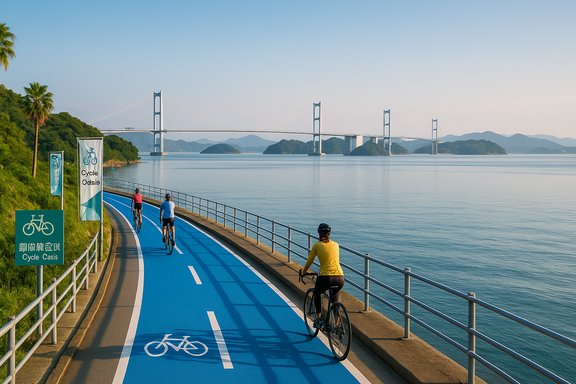
The Shimanami Kaido links Honshu and Shikoku across the Seto Inland Sea, running between Onomichi in Hiroshima Prefecture and Imabari in Ehime Prefecture. The route threads over six main islands — Mukaishima, Innoshima, Ikuchijima, Ōmishima, Hakatajima and Ōshima — using a series of signature bridges that are as much the attraction as the islands themselves. The cycling route most commonly followed by visitors measures roughly 70–80 km depending on your start and finish points and the optional detours you choose. The Shimanami Kaido is not an ad hoc bike lane; it was planned as a multi‑modal corridor that intentionally accommodates bicycles with dedicated markings (a distinctive blue line), mapped rest points known as Cycle Oasis, rental terminals and coordinated one‑way rental returns. That level of tourism‑grade infrastructure is rare worldwide and is a key reason the route is often recommended to novice and experienced cyclists alike.
Day 2: Ikuchijima → Ōmishima (WAKKA), visit Ōyamazumi Shrine and Toyo Ito Museum, finish at Imabari; relax at an onsen and sample local seafood.
This pace allows museum time and reduces exposure to end‑of‑day winds on the major bridge approaches.
For travel‑technology planners, tourism operators and cycling communities, the Kaido offers a blueprint: invest in physical infrastructure first, design the route around human‑scale support, then layer digital coordination and service partnerships (e‑bike fleets, luggage logistics, GPS‑enabled pickups) to reduce friction. Where the model can be improved is in managing seasonal capacity and ensuring consistent standards across the Cycle Oasis network.
For individual riders, the Kaido delivers an accessible, scenic and culturally rich way to experience the Seto Inland Sea — provided they respect seasonal realities, book smartly, and plan around service variances on smaller islands.
In short: the Shimanami Kaido is more than a route; it is an engineered travel experience that balances bold bridge engineering, island culture and modern cycling services. For anyone planning an accessible long‑distance coastal ride with art, temples and sea air, it remains one of the world’s most thoughtfully executed options.
Source: Luxurious Magazine Shimanami Kaido: Japan’s Inspiring Island-Hopping Cycle Route
 Background / Overview
The Shimanami Kaido links Honshu and Shikoku across the Seto Inland Sea, running between Onomichi in Hiroshima Prefecture and Imabari in Ehime Prefecture. The route threads over six main islands — Mukaishima, Innoshima, Ikuchijima, Ōmishima, Hakatajima and Ōshima — using a series of signature bridges that are as much the attraction as the islands themselves. The cycling route most commonly followed by visitors measures roughly 70–80 km depending on your start and finish points and the optional detours you choose. The Shimanami Kaido is not an ad hoc bike lane; it was planned as a multi‑modal corridor that intentionally accommodates bicycles with dedicated markings (a distinctive blue line), mapped rest points known as Cycle Oasis, rental terminals and coordinated one‑way rental returns. That level of tourism‑grade infrastructure is rare worldwide and is a key reason the route is often recommended to novice and experienced cyclists alike. Why the Shimanami Kaido matters: engineering, access and visitor experience
A corridor built for people on two wheels
Unlike casual riverside cycle paths, the Shimanami Kaido combines elevated bridge lanes and quiet island roads. Bridges such as Tatara and the famous Kurushima Kaikyō (Kurushima) are engineered to high standards and include dedicated bicycle/pedestrian ramps or lanes that separate cyclists from high‑speed motorway traffic. This infrastructure makes long‑distance island cycling safe and predictable, and gives riders an uninterrupted vista of the Seto Inland Sea. The Kurushima Kaikyō Bridge, which connects Ōshima to Shikoku, is a notable technical achievement: it comprises three successive suspension bridge spans and was the world’s first triple‑suspension structure when completed. Its size and design are part of what turns the Kaido’s crossings into dramatic, photo‑worthy experiences rather than mere transport links.Accessibility and the visitor funnel
Practical design choices make the Shimanami Kaido accessible. Key logistics include:- Public rental terminals at convenient transportation nodes (Onomichi Station, Sunrise Itoyama, Imabari Station).
- One‑way rental and bike‑return services that let riders start at one end and finish at the other without ferrying bikes back.
- Cycle Oasis rest points offering water, toilets, bike pumps and local hospitality scattered along the route.
- Private cycling hubs (notably WAKKA on Ōmishima) that provide repair support, e‑bike charging, luggage forwarding and car/boat pickup options for when riders decide to abort the ride or need transportation.
The islands and what to look for: a riding‑by‑island guide
Each stop is compact and different. Below are the islands most riders will encounter on a standard traversal from Onomichi to Imabari.Mukaishima — gentle sea breeze and cafés
Mukaishima is an easy warm‑up: low hills, cafés and the ferry transfer from Onomichi that many riders use to avoid a narrow expressway crossing. It’s ideal for a first cup of coffee and a snack before the bridges start to open up the views. Practical note: the short Onomichi ferry to Mukaishima is frequent and inexpensive, and it’s the designed linkage for cyclists to remain safe when the expressway lane isn’t suitable for large volumes of riders.Innoshima — history on the hillside
Innoshima brings a surprising slice of maritime history. The hilltop Innoshima Suigun Castle (a museum) and related Murakami Suigun (naval clan) exhibitions provide a tangible sense of the Seto Inland Sea’s feudal past, with recovered weapons, models and displays that contextualise the archipelago’s once‑strategic importance. The museum is a compact, rider‑friendly attraction located a short diversion from the bike route.Ikuchijima — art, lemon groves and Kosanji Temple
Ikuchijima’s Setoda district is where citrus groves scent the air and small contemporary arts venues sit beside the ornate Kōsanji Temple. The Hirayama Ikuo Museum of Art is near Setoda and frames the island as both agricultural and cultural, making Ikuchijima a natural overnight stop in two‑day itineraries.Ōmishima — shrines, modern architecture and WAKKA
Ōmishima is the cultural heart of the Shimanami experience. The ancient Ōyamazumi Shrine — guardian of mountains and oceans and custodian of a rich treasure house of arms and artifacts — sits amid camphor groves and pilgrimage paths. Nearby, the Toyo Ito Museum of Architecture and Tokoro Museum create a rare pairing: ancient Shinto spirituality and contemporary architectural thought within cycling distance of each other. WAKKA, a modern cycling hub and accommodation complex on Ōmishima, is the practical fulcrum for many tours, offering bike returns, charging, and bicycle taxis by car or boat.Hakatajima and Ōshima — coastal calm and the Kurushima crossing
Hakatajima’s coastal villages and Ōshima’s forest roads lead to the Kurushima Kaikyō Bridge and Imabari. The Kurushima crossing is not only physiographically dramatic but also where many riders sense the endpoint: the final descent into Imabari and the compensatory reward of local onsen and seafood.Planning the ride: practical steps, timing and packing
Whether you’re a leisure rider who wants to treat the Kaido as a wellness retreat or a road cyclist chasing kilometres, planning makes the difference.- Choose a direction. Starting in Imabari is commonly recommended for a slightly easier gradient profile, but riders start from both ends depending on transport connections.
- Decide how many days. A fast day‑ride is possible for fit cyclists (8–10 hours with minimal stops); two to three days lets you explore side attractions, museums and beaches at the island level.
- Reserve rentals and accommodation early — Golden Week and autumn foliage weekends are busy. If you want an e‑bike, book in advance from rental partners or GIANT stores; sport‑class e‑bikes are limited and sometimes must be returned the same day.
- Pack sensibly: sun protection, a compact repair kit, small cash for ferry fares and village cafés, and clothing layers for marine winds. Cycle Oases are plentiful, but services vary by season and time of day.
- Lightweight waterproof jacket and layered clothing.
- Portable pump and puncture kit (Cycle Oases have pumps but not always tools).
- Phone with charger or power‑bank; e‑bike riders should note battery swap/charge points.
- Small amount of cash for island kiosks and local ferries.
Technology and services that make the route modern: e‑bikes, luggage forwarding and digital support
The Shimanami Kaido’s appeal has grown with technology, not just in materials but in the services that power modern travel.- E‑bikes and electric‑assist rentals: Public and private rental programs offer a range of electric‑assist bicycles and performance e‑bikes. City‑style electric‑assist bikes are available for multi‑day rentals at many terminals; sport e‑bikes are available at major terminals but have more restrictive one‑day return rules. These choices broaden access and reduce fatigue for mixed‑ability groups.
- Luggage forwarding and bike returns: Dedicated services allow luggage and even bikes to be forwarded between islands or returned at partner hubs (WAKKA runs a bike return service, for example). This removes a frequent barrier to multi‑day riding when travellers don’t want to cycle with heavy bags.
- On‑route digital support and local coordination: Facilities like WAKKA use social apps (LINE, Facebook) and GPS to coordinate pickups, taxi support and breakdown assistance. This on‑demand, app‑enabled support is a small but meaningful layer of safety for foreign riders who may be unfamiliar with local geography.
Strengths — what the Shimanami Kaido does exceptionally well
- Polished cycle infrastructure: The combination of a continuous blue route, signposting in English and Japanese, Cycle Oasis, and rental terminals is a rare, tourism‑grade network that reduces friction and uncertainty for international visitors.
- Blend of culture and nature: Few riding routes combine temple complexes, contemporary architecture, maritime history museums and island‑scale agricultural landscapes within easy reach of the saddle. This cultural layering turns a cycling day into a cultural itinerary.
- Operational support for non‑cyclists: Bike taxis, luggage forwarding, same‑day battery swaps and WAKKA’s concierge‑style services allow those with limited time or fitness to still enjoy major highlights without technical hurdles.
- Scalable for different rider profiles: The route works for families on rental city bikes, e‑bike newcomers and ambitious road cyclists using the same corridor with different objectives. The flexibility is one of its strongest competitive advantages.
Risks and caveats — what to watch for
- Weather and wind: The Seto Inland Sea is famous for its light, but that light is accompanied by strong tidal winds and occasional storms. Bridges can be exposed and windy, which can be intimidating for light road bikes or inexperienced riders. Wind forecasts should be checked and flexible schedules considered. (Unpredictable conditions are not always obvious from pleasant weather earlier in the day.
- Seasonal crowds and resource strain: Peak seasons (cherry blossom spring and autumn foliage) increase demand for rentals, hotels and Cycle Oasis resources. While the infrastructure is robust, localized crowding at popular viewpoints, terminals and cafés can reduce the quiet‑island feel that many visitors expect. Advance bookings mitigate this.
- Service variability at Cycle Oasis sites: Cycle Oasis locations are community‑run and hospitality varies; not every stop will offer tools, water or extended hours. Cyclists should not rely on oasis points as guaranteed service centers, particularly in off‑season months. Carry the essentials.
- E‑bike rules and limitations: Not all electric vehicles are equal under Japanese law. Full‑power electric vehicles require permits; the common rental category is electric‑assist bicycles that are legal and simple to use. Sport‑class e‑bikes often have stricter rental/return rules. Riders should confirm rental conditions and battery policies before departure.
- Language and etiquette: While signposting is extensive, many local businesses may have limited English service. Respectful local behaviour at shrines and small island shops is essential; use of basic Japanese greetings and modest cash holdings helps. Tourist facilities are improving, but visitors should prepare for variable English support.
Responsible tourism and sustainability considerations
The Shimanami Kaido sits inside a delicate island ecosystem with active local communities. Infrastructure for cycling brings economic benefits — but it also risks over‑commercialisation.- Encouraging staggered itineraries (stay overnight on lesser‑visited islands) spreads tourism income and reduces peak pressure at popular viewpoints.
- Use of local services (cafés, rental shops, guesthouses) supports island economies more directly than passing through on a single long day ride.
- Respect for cycle oasis volunteerists and small retailers is essential: don’t assume facilities are free to use as if public utilities — treat them as small businesses or community resources.
Real‑world itineraries: two examples
One‑day push (for experienced riders)
- Start early at Sunrise Itoyama or Onomichi Station.
- Ride main route with minimal inland detours, schedule short stops at Tatara Park and Ōmishima viewpoint.
- Expect 8–10 hours cycling time depending on stops and fitness.
- Return bike arranged through the rental terminal or use WAKKA bike return services if available.
Two‑day relaxed cultural ride (recommended)
Day 1: Onomichi → Setoda (Ikuchijima). Visit Kōsanji Temple and Hirayama Ikuo Museum; overnight in Setoda or Ikuchijima.Day 2: Ikuchijima → Ōmishima (WAKKA), visit Ōyamazumi Shrine and Toyo Ito Museum, finish at Imabari; relax at an onsen and sample local seafood.
This pace allows museum time and reduces exposure to end‑of‑day winds on the major bridge approaches.
Technical verifications and cross‑checks
Key facts verified across independent sources:- Route distance (approx. 70–80 km) — confirmed by official Shimanami information and Japan National Tourism guidance.
- Islands crossed and the order (Mukaishima, Innoshima, Ikuchijima, Ōmishima, Hakatajima, Ōshima) — repeated consistently in official and tourism reference material.
- Kurushima Kaikyō as the world’s first triple suspension bridge — corroborated by engineering authorities and local government sites.
- Cycle Oasis network and approximate scale — official Shimanami and prefectural guides confirm a large, volunteer‑linked network of rest points (number estimates vary by source). Exact counts change over time and may reflect different definitions; local pages report between 140 and 300 sites depending on the region and counting methodology. This variance is noted here as a caution: specific counts should be checked with the latest local data if the number is critical to planning.
Final assessment: why the Shimanami Kaido remains a model for cycle tourism
The Shimanami Kaido is a rare convergence of engineering, local stewardship and visitor services. It’s a route that makes meaningful trade‑offs: it invests in durable infrastructure (bridges, lanes, rest hubs) while relying on community volunteerism and small businesses to provide the human layer that makes cycling feel hospitable rather than commodified. The result is a ride that is simultaneously comfortable for newcomers and rewarding for cyclists who seek cultural and scenic variety.For travel‑technology planners, tourism operators and cycling communities, the Kaido offers a blueprint: invest in physical infrastructure first, design the route around human‑scale support, then layer digital coordination and service partnerships (e‑bike fleets, luggage logistics, GPS‑enabled pickups) to reduce friction. Where the model can be improved is in managing seasonal capacity and ensuring consistent standards across the Cycle Oasis network.
For individual riders, the Kaido delivers an accessible, scenic and culturally rich way to experience the Seto Inland Sea — provided they respect seasonal realities, book smartly, and plan around service variances on smaller islands.
In short: the Shimanami Kaido is more than a route; it is an engineered travel experience that balances bold bridge engineering, island culture and modern cycling services. For anyone planning an accessible long‑distance coastal ride with art, temples and sea air, it remains one of the world’s most thoughtfully executed options.
Source: Luxurious Magazine Shimanami Kaido: Japan’s Inspiring Island-Hopping Cycle Route
