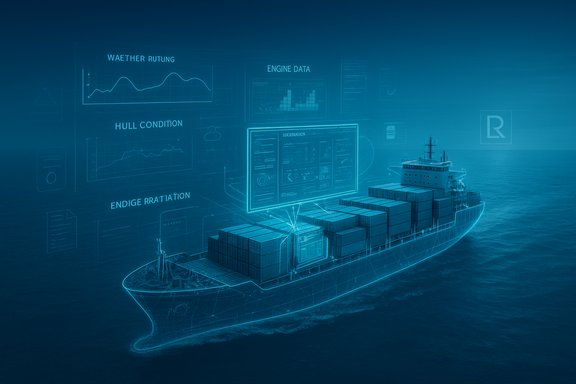
Cost control in shipping tech has quietly flipped from a defensive reflex into a deliberate strategic lever, and Lloyd’s Register’s recent public statements make that shift plain: capital is now being deployed to technologies that can be tied to measurable outcomes such as emissions, safety, compliance and speed to market rather than to novelty for novelty’s sake.
The maritime sector has long treated digital innovation as a mix of high-potential pilots and cautious conservatism. That balance is changing fast. Large owners, operators and class societies are moving beyond one-off trials to invest in platforms that combine data, models and decision workflows. This is not mere hype: the last 18–24 months have seen classification societies, software vendors and cloud hyperscalers sign partnerships and pilot projects that explicitly target scaling and regulatory use-cases — notably using generative AI, edge computing and digital twins as the connective tissue between physical assets and business outcomes.
Lloyd’s Register (LR) has been among the most vocal organisations describing this transition. Its technology leadership frames the evolution as one from “trying new tools” to “backing the right capabilities,” and positions LR as an organisation that is embedding AI and platform thinking into routine operations rather than keeping it in a separate R&D silo. That framing matters because classification societies and technical advisors are no longer just observers of shipboard digitalisation; they are becoming orchestrators and integrators of the stack that converts sensor data into legally defensible decisions and commercial advantage.
This is a meaningful pivot. Embedding AI into mundane, repetitive, and high-volume tasks is a classic adoption pattern that unlocks time for domain experts to focus on judgment tasks that require human oversight. LR’s description of Copilot and AI tools supporting content creation, documentation and knowledge-sharing aligns with broader enterprise trends where copilots increase throughput for technical teams while leaving final decision authority with specialists.
If realised and properly governed, this is a textbook example of a platform that converts institutional knowledge and public regulatory texts into operational advantage: it reduces the time required to research past decisions, helps engineers draft regulatory submissions faster, and supports more predictable regulatory interaction. The broader implication is that when advisory and assurance functions digitise regulatory memory into actionable models, they accelerate technology adoption cycles (for example, small nuclear designs for floating power or propulsion) across the industry.
There is demonstrable value in using generative AI to accelerate regulatory research and in deploying Copilot-like assistants to free up technical staff for higher-value work. There is also a long list of hard engineering, legal and organisational tasks that must be completed to translate those pilot gains into sustainable, fleet-level advantage.
The pragmatic strategy for shipping organisations: invest to win only where the investment can be directly mapped to measurable outcomes, treat data maturity and governance as non-negotiable foundations, and design human-centred processes that ensure AI serves decision-making rather than replacing it. When those conditions are met, technology—deployed as an orchestrated system rather than a collection of toys—becomes a genuine strategic weapon rather than just another line-item to be trimmed in the next downturn.
In short: the industry has moved from curiosity to commitment; the next phase will separate those who can scale reliable systems from those who merely pilot attractive proofs-of-concept. The pragmatic winners will be the organisations that tie technology investments directly to defensible outcomes, manage the accompanying risks with rigor, and rewire their teams and contracts to deliver at pace.
Source: Splash247 From defensive cuts to strategic bets - Splash247
 Background
The maritime sector has long treated digital innovation as a mix of high-potential pilots and cautious conservatism. That balance is changing fast. Large owners, operators and class societies are moving beyond one-off trials to invest in platforms that combine data, models and decision workflows. This is not mere hype: the last 18–24 months have seen classification societies, software vendors and cloud hyperscalers sign partnerships and pilot projects that explicitly target scaling and regulatory use-cases — notably using generative AI, edge computing and digital twins as the connective tissue between physical assets and business outcomes.Lloyd’s Register (LR) has been among the most vocal organisations describing this transition. Its technology leadership frames the evolution as one from “trying new tools” to “backing the right capabilities,” and positions LR as an organisation that is embedding AI and platform thinking into routine operations rather than keeping it in a separate R&D silo. That framing matters because classification societies and technical advisors are no longer just observers of shipboard digitalisation; they are becoming orchestrators and integrators of the stack that converts sensor data into legally defensible decisions and commercial advantage.
Where the strategy has shifted: defensive cuts → strategic bets
- Defensive cost control: Historically, when markets tightened, the first reaction was to cut IT budgets and defer large digital projects. Those cuts often slowed digital maturity and increased long-term costs.
- Strategic cost control: Today, cost control is targeted: investment is directed toward solutions that demonstrably reduce fuel use, lower emissions, speed regulatory approvals, reduce inspection time, or reduce incident risk. The criterion is measurable outcome, not vendor buzz.
Lloyd’s Register: from pilots to platform execution
AI embedded in everyday workflows
Lloyd’s Register’s public commentary highlights several practical implementations in use today. Where AI was once confined to proof-of-concept projects, LR describes tools that are active in day-to-day work: automated triage of email for technical queries, AI-assisted content and documentation work via Microsoft Copilot, and generative AI applied to regulatory/permitting datasets for nuclear licensing scenarios.This is a meaningful pivot. Embedding AI into mundane, repetitive, and high-volume tasks is a classic adoption pattern that unlocks time for domain experts to focus on judgment tasks that require human oversight. LR’s description of Copilot and AI tools supporting content creation, documentation and knowledge-sharing aligns with broader enterprise trends where copilots increase throughput for technical teams while leaving final decision authority with specialists.
The Nuclear Accelerator: a practical example of regulatory AI
One specific LR effort is the Nuclear Accelerator — a generative AI capability aimed at easing regulatory pathways for nuclear applications in maritime contexts. According to LR’s own announcements, the capability analyses historic licensing and regulatory data to speed preparation of permitting documentation, identify common regulatory pitfalls, and surface precedent-driven routes through complex frameworks.If realised and properly governed, this is a textbook example of a platform that converts institutional knowledge and public regulatory texts into operational advantage: it reduces the time required to research past decisions, helps engineers draft regulatory submissions faster, and supports more predictable regulatory interaction. The broader implication is that when advisory and assurance functions digitise regulatory memory into actionable models, they accelerate technology adoption cycles (for example, small nuclear designs for floating power or propulsion) across the industry.
From experiments to orchestration
LR’s leadership frames the next advance as orchestration — connecting the physical sensors on ships, the digital models (digital twins), and the decision layer (AI and workflow engines) to create systems that produce measurable outcomes at speed. The competitive edge, in this view, goes to organisations that can reliably stitch these layers together and operate them across fleets or portfolios — not to those who can run isolated pilots.Product and people: building a blended model
Blended teams, new capabilities
LR describes a staffing model shift: domain experts working alongside data scientists, product managers and engineers. That combination is becoming necessary for shipping tech because domain knowledge alone cannot deliver a production-grade AI platform, and data science without domain context risks producing irrelevant or unsafe recommendations.- Deep domain experts ensure outputs are technically valid and legally defensible.
- Data experts build and sustain models, putting guardrails and observability around them.
- Product thinkers turn prototypes into user-centred workflows that can be adopted by crews, regulators and port teams.
Product focus: clarity over complexity
LR’s approach emphasises converting complexity into clarity for clients. Two product directions stand out:- Client portals and data services that bring operational transparency and track progress on compliance and certification tasks.
- AI-enabled workflow platforms that convert assessment (what’s wrong) into action (what to do, when to do it).
The Safetytech Accelerator and startup collaboration
LR’s Safetytech Accelerator has been active in the safetytech ecosystem for years and positions the organisation as an industry convener that selects and pilots startups focused on safety, emissions and compliance. The accelerator model serves three important functions:- It sources domain-specific innovation from startups that might otherwise be overlooked.
- It de-risks field trials by pairing startups with established industry partners and proof-of-concept funding.
- It channels winning solutions into scaled trials and product lines when appropriate.
Industry context: why orchestration matters now
Three technical trends make LR’s strategy both timely and credible:- Digital twins at scale: Digital twins are no longer just concept slides; fleets and some ports run twins for performance monitoring and operational planning. These twins are feeding real-world decisions such as hull-cleaning windows, propulsion trim guidance, and berth planning.
- Edge intelligence: Advances in ruggedised edge computing and AI acceleration enable real-time inference onboard vessels, reducing latency and bandwidth costs while improving resilience when satellite links are intermittent.
- Generative AI and foundation models: Generative approaches — when carefully constrained — can mine decades of regulatory text and historical outcomes to make engineers and advisors faster and more consistent in repetitive, documentation-heavy tasks.
Risks and caveats: where the promise meets reality
While the strategic pivot is promising, it contains measurable risks that owners, class societies and technology teams must manage.1. Data quality is the limit case
Models and twins are only as good as the data that feeds them. Missing sensors, inconsistent reporting practices and poor calibration can produce misleading predictions. Organisations must treat data maturity as a first-class programme with investment in sensor robustness, data pipelines, and ongoing validation.2. Regulatory and assurance risk
Using AI in regulatory workflows (for example, nuclear licensing) raises liability and traceability questions. Outputs of generative systems must be auditable and explainable; regulators will ask for provenance and human sign-offs. Firms must architect systems with clear human-in-the-loop approvals and record-level traceability.3. Model safety and hallucination
Generative AI can hallucinate or confidently produce incorrect outputs. In safety-critical and regulatory contexts the consequences can be severe. This necessitates rigorous validation, domain-specific fine-tuning, and conservative operational rules that never replace expert regulatory judgement.4. Vendor lock-in and concentration risk
LR’s use of hyperscaler services (for example, Azure and the Azure OpenAI platform) can accelerate capability delivery, but dependence on a single cloud or model family can create strategic and procurement risk. Organisations should adopt multi-cloud strategies or contracting terms that preserve continuity and portability where possible.5. Cybersecurity and supply-chain exposure
More devices and more networked models expand the attack surface. Edge devices on ships, data ingestion endpoints and AI model endpoints become attractive targets. Security must be built into device provisioning, model serving, and fleet update mechanisms.6. Skills and change management
Moving from pilots to platforms requires new skills among crews, engineers and managers. Without a strong change management programme, high-quality capabilities will remain underused. Investment is required in training, human-AI interaction design and incentives that reward safe adoption.Practical guidance: how owners and operators should think about the shift
The move from pilots to platforms requires a disciplined, outcome-first approach. A practical roadmap:- Define measurable outcomes
- Decide on 2–3 outcome metrics (e.g., % fuel saved per voyage, hours of inspection reduced, time-to-certification) and tie technology pilots to those metrics.
- Prioritise data foundations
- Inventory sensors and data sources; fix the highest-impact gaps first. Data quality work often delivers faster ROI than more models.
- Adopt a hybrid AI governance model
- Embed human-in-the-loop processes for safety-critical outputs, require provenance metadata and maintain versioned model registries.
- Pilot with operational integration in mind
- Design pilots as scaled pilots: establish APIs, workflow hooks and performance SLAs from the start to avoid rework.
- Secure the edge
- Harden device provisioning, enforce signed firmware updates, and segregate management planes from operational networks.
- Build blended teams
- Pair domain experts with data engineers and product managers and create retention incentives for cross-functional talent.
- Negotiate platform and cloud terms
- Secure data portability clauses, exit rights and assurances on model provenance when contracting with hyperscalers.
- Measure and publish outcomes
- Use pilot learnings to create repeatable deployment templates and commercial case studies that support broader roll-out.
What scaled delivery looks like: operational examples
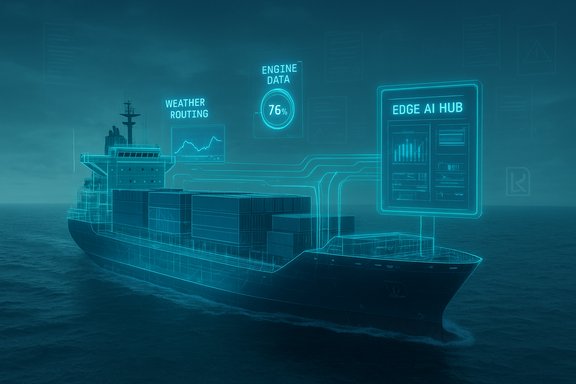
- Fuel and emissions optimisation: A fleet-wide performance twin that blends hull condition, weather routing and engine parameters to produce prescriptive trim and speed guidance. Deployed at scale it becomes a commercial advantage measurable in MWh or tonnes of fuel saved.
- Regulatory and certification acceleration: A platform that ingests historical approvals, regulatory texts and precedent decisions; surfaces best-practice clauses and documents that shorten time-to-approval for novel fuels or propulsion technologies. This reduces time-to-market for new vessel classes and energy systems.
- Safety and incident prevention: Edge AI models detecting anomalies in engine vibration, exhaust composition or cargo hold atmosphere that trigger pre-emptive maintenance or operational changes — lowering incident risk and insurance costs.
- Operational throughput at ports: Digital twin-driven berth allocation and pre-arrival planning that reduces port dwell time, improves berth utilisation and lowers emissions tied to waiting vessels.
The commercial calculus: how to evaluate ROI
When debating whether to fund scale, owners should require business cases that include:- Direct savings (fuel, inspections, man-hours)
- Avoided costs (penalties, detentions, rework)
- Revenue enablement (faster approvals, quicker vessel entry to service)
- Risk-adjusted benefits (probability-weighted reductions in incident costs)
- Implementation and sustainment costs (data ops, security, training, licensing)
The human dimension: jobs, upskilling, and governance
Scaling technology must be accompanied by a humane workforce strategy. Automation of repetitive tasks through Copilot-style tools should be paired with pathways for people to move into higher-value roles like oversight, exception handling and model governance.- Provide structured retraining and clear career ladders for staff affected by automation.
- Govern AI outputs through clear accountability matrices — who signs off when the model recommends a safety-related action?
- Make explainability a contractual requirement for solutions that affect safety or legal compliance.
Final assessment: pragmatism over promise
The industry is entering a phase where the real question is not whether AI, digital twins or edge computing can work — they can — but whether organisations can operationalise them at scale while managing the attendant governance, data and security challenges. Lloyd’s Register’s public position — moving beyond pilots to platform orchestration and embedding AI into routine workflows — is a clear articulation of where many industry leaders want to go.There is demonstrable value in using generative AI to accelerate regulatory research and in deploying Copilot-like assistants to free up technical staff for higher-value work. There is also a long list of hard engineering, legal and organisational tasks that must be completed to translate those pilot gains into sustainable, fleet-level advantage.
The pragmatic strategy for shipping organisations: invest to win only where the investment can be directly mapped to measurable outcomes, treat data maturity and governance as non-negotiable foundations, and design human-centred processes that ensure AI serves decision-making rather than replacing it. When those conditions are met, technology—deployed as an orchestrated system rather than a collection of toys—becomes a genuine strategic weapon rather than just another line-item to be trimmed in the next downturn.
In short: the industry has moved from curiosity to commitment; the next phase will separate those who can scale reliable systems from those who merely pilot attractive proofs-of-concept. The pragmatic winners will be the organisations that tie technology investments directly to defensible outcomes, manage the accompanying risks with rigor, and rewire their teams and contracts to deliver at pace.
Source: Splash247 From defensive cuts to strategic bets - Splash247