

Microsoft’s recent showcase of AI-driven customer stories captures a clear message: the company’s strategy of embedding generative AI across cloud, productivity, developer and industry stacks is moving beyond marketing and into measurable enterprise outcomes. The roundup of customer case studies — from manufacturing and logistics to healthcare and airlines — reads as a blueprint for how Microsoft’s suite of AI tools can accelerate decision velocity, reduce repetitive work, and create new service models for established industries. These customer narratives, combined with Microsoft’s platform-level investments, explain why many CIOs now treat Copilot, Azure OpenAI Service and Azure AI Foundry as core components of their AI roadmaps rather than optional experiments.
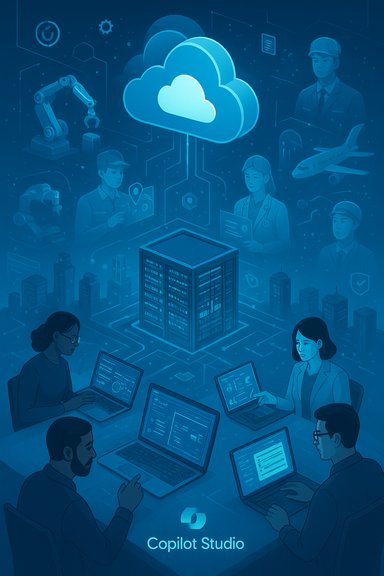
Microsoft’s AI push is not a single product launch; it is an ecosystem play that brings together cloud infrastructure, large language models (LLMs), industry-specific adaptations and end-user copilots. The strategy stitches Azure’s compute and governance capabilities to a family of Copilot experiences — Microsoft 365 Copilot for knowledge workers, GitHub Copilot for developers, vertical and functional Copilots (finance, legal, manufacturing), plus Copilot Studio and Azure AI Foundry for building and managing agents at scale. This integrated posture is why Microsoft positions Copilot as both a productivity layer and an orchestration front end for domain agents.
Microsoft’s platform-level investments are massive and explicit. The company committed to an $80 billion AI-focused infrastructure buildout for fiscal 2025 to support the compute, networking and energy needs of modern LLMs and agentic systems — a stamp of confidence that underpins its long-term enterprise roadmap. At the same time, Microsoft has promoted research and partner programs that fine-tune models for industry use and provide no-code / low-code tooling for business teams to create their own copilots. These pieces — infrastructure, models, tooling and integration — form the practical architecture customers rely on when moving from pilots to production.
However, vulnerabilities remain:
At the same time, enterprises should treat headline metrics with cautious optimism: vendor-commissioned ROI studies and internal usage claims are useful signals but not substitutes for controlled pilots and independent validation in your own context. Managing data privacy, preventing hallucination, designing for portability and preparing for the operational realities of energy and infrastructure are essential steps that determine whether Copilot-driven initiatives become durable advantages or expensive experiments.
For CIOs and IT leaders, Microsoft’s tools offer a clear path to operational AI — but success will be decided by the rigor of adoption, not the hype of marketing. The companies that pair Microsoft’s platform strengths with disciplined governance, measurement and workforce transformation are the ones most likely to turn pilot projects into sustained competitive advantage.
Source: AI Magazine How Microsoft’s AI Tools Leads Global Industries to Success
 Background
Microsoft’s AI push is not a single product launch; it is an ecosystem play that brings together cloud infrastructure, large language models (LLMs), industry-specific adaptations and end-user copilots. The strategy stitches Azure’s compute and governance capabilities to a family of Copilot experiences — Microsoft 365 Copilot for knowledge workers, GitHub Copilot for developers, vertical and functional Copilots (finance, legal, manufacturing), plus Copilot Studio and Azure AI Foundry for building and managing agents at scale. This integrated posture is why Microsoft positions Copilot as both a productivity layer and an orchestration front end for domain agents.Microsoft’s platform-level investments are massive and explicit. The company committed to an $80 billion AI-focused infrastructure buildout for fiscal 2025 to support the compute, networking and energy needs of modern LLMs and agentic systems — a stamp of confidence that underpins its long-term enterprise roadmap. At the same time, Microsoft has promoted research and partner programs that fine-tune models for industry use and provide no-code / low-code tooling for business teams to create their own copilots. These pieces — infrastructure, models, tooling and integration — form the practical architecture customers rely on when moving from pilots to production.
What the AI Magazine coverage summarized
The coverage that inspired this feature aggregates Microsoft’s customer success stories and frames them as cross-industry proof points. The article highlights several recurring themes:- Large-scale productivity wins: Customers report time saved on routine tasks (document drafting, meeting summarization, email triage) and tangible operational improvements when Copilots are embedded into workflows. Examples include insurers, manufacturing plants and education systems adopting Copilot across tens of thousands of users.
- Verticalized solutions: Partners and industry customers have built domain copilots (Genix Copilot for industrial sustainability, NX X Copilot for CAD workflows, in-vehicle copilots for automotive) that blend Microsoft cloud services with domain datasets and control planes. These vertical Copilots show that specificity matters — bespoke grounding and connectors are critical to producing reliable output.
- Scale and adoption metrics: Microsoft and partners report adoption rates that suggest enterprise-scale traction — claims include high Fortune 500 penetration and rapidly growing monthly active user (MAU) counts across Copilot products. These figures are repeatedly used to make the case that Copilot moved from pilot to platform.
Anatomy of Microsoft’s AI stack: the building blocks
Azure AI and Azure OpenAI Service
Azure provides the scalable compute, security controls and enterprise compliance features that organizations require to run inference at scale. Customers host model deployments (OpenAI models and third‑party/foundry models), run retrieval-augmented generation (RAG) flows, and use built-in governance controls for data access and auditability. The Azure OpenAI Service remains a central gateway for many organizations that need high-quality LLM capabilities within Azure’s compliance boundary.Azure AI Foundry
Azure AI Foundry is Microsoft’s multi-model runtime and agent factory: a managed platform for discovering, customizing, orchestrating and operating models and multi-agent systems. It includes a catalog of thousands of foundation, open and industry models, tools for fine-tuning and RAG, and monitoring features for model performance and safety. For enterprises building fleets of agents or production copilots, Foundry is designed to be the lifecycle control plane. This capability dramatically shortens the time from proof of concept to controlled production.Microsoft 365 Copilot, Copilot Studio and Copilot Family
The Copilot family is the visible face for end users: embedded assistants that accelerate writing, analysis, meetings and customer interactions across Office apps, Teams and Windows. Copilot Studio (and related low-code tools) lets organizations create role-specific agents and integrate them into business processes without building a model stack from scratch. This combination — pre-integrated UIs for end users plus developer tooling for custom agents — is why IT leaders treat Copilot as more than a convenience; it’s a platform for orchestration.GitHub Copilot and developer productivity
For engineering teams, GitHub Copilot sustained its role as a productivity multiplier: code suggestions, testing assistance and automation inside IDEs. In enterprise settings, GitHub Copilot plays a different role: it reduces routine engineering toil and accelerates proof-of-concept development for broader AI-enabled workflows. Combined with the rest of the stack, it shortens the feedback loop from “idea” to “production component.”Real-world industry impact: representative case studies
Microsoft’s published customer stories (and reporting on them) reveal real production outcomes across verticals. These are not hypothetical demos — they represent live deployments that yielded measurable benefits.- Manufacturing: Siemens and other heavy industrial customers embed copilots to translate machine error codes, contextualize manuals, and guide frontline technicians through diagnostics — reducing downtime and speeding repairs. One factory scenario noted faster recovery from faults where minutes saved compound into significant output gains.
- Logistics: C.H. Robinson used Azure AI to automate pricing replies and dramatically reduced the response cycle from hours to seconds, improving customer service and throughput in a time-sensitive industry.
- Aviation and travel: Air India built a virtual assistant (AI.g) to manage 30,000 customer queries daily, lowering contact-center load and accelerating passenger support processes.
- Healthcare: Clinical documentation copilots reduce clerical time for clinicians by auto‑generating notes and structured summaries, freeing clinicians to focus on patient care rather than paperwork; customers report substantial nursing-hour saves in pilot deployments.
- Energy and sustainability: ABB and others built operational copilots that surface emissions insights and control recommendations, delivering both cost savings and carbon footprint reductions in industrial settings. These are examples where domain models plus IoT data produce measurable sustainability wins.
The numbers: adoption, scale and claimed ROI — what we can verify
Microsoft and commissioned research provide headline figures that help explain the scale of the AI transition:- Copilot adoption and reach: Microsoft reports that the Copilot family surpassed 100 million monthly active users across consumer and commercial experiences. That figure appears in Microsoft’s investor documents and public commentary and is corroborated by major business media coverage of Microsoft’s earnings and annual filings. These numbers indicate genuine scale in end-user engagement across productivity, search and consumer apps.
- Infrastructure investment: Microsoft publicly announced an $80 billion fiscal-year investment to expand AI-ready data centers in FY2025. This spending commitment — reported by Microsoft and widely covered by business press — is the structural backbone that enables sustained model hosting and inference at scale.
- ROI from generative AI: A widely cited IDC study, commissioned by Microsoft and summarized in Microsoft’s communications, reports an average ROI of $3.7 for every $1 invested in generative AI, with top-performing organizations realizing up to $10.3 per $1. The IDC study also reports rapid adoption increases and short deployment timelines in many use cases. The study is an independent research product but was commissioned by Microsoft, so readers should note that the sample framing and incentives matter when generalizing results. Still, the findings align with multiple third‑party case measurements and analyst commentary.
Why Microsoft’s approach works (and where it has an edge)
There are three practical factors behind Microsoft’s industry traction:- Integrated stack and enterprise controls: Enterprises want models and agents that are secure, auditable and governed. Microsoft bundles identity (Entra/Azure AD), data platforms (Fabric/Cosmos/SharePoint), model runtime (Foundry), and productivity integrations (M365) into a familiar enterprise control plane. This reduces friction for regulated organizations.
- Partner and verticalization strategy: Microsoft’s ecosystem — partners, ISVs and large customers — creates a virtuous loop where vertical solutions (e.g., CAD copilots, industrial copilots) are co-developed and scaled. Industry partners supply domain expertise and datasets; Microsoft supplies the runtime, security and model tooling.
- Tooling for both developers and business users: Copilot Studio, low-code agent builders and GitHub Copilot means organizations can engage both pro-dev and citizen-developer profiles, shortening build cycles and allowing business teams to author and iterate on agents without full engineering lift. This democratization accelerates adoption while preserving controls.
Risks, limits and the cautionary signals enterprises must heed
The positive outcomes are real, but adoption at scale raises systemic and operational risks that require explicit planning.- Data governance and grounding: Generative models produce plausible-seeming outputs. Without rigorous grounding (RAG with verified sources), model hallucinations can propagate incorrect decisions. Enterprises must invest in trusted data plumbing, continuous evaluation and human-in-the-loop checks. Vendor case studies often gloss over these operational costs.
- Privacy, IP and compliance: Embedding proprietary corporate documents into LLMs creates exposure vectors unless policies and technical controls (encryption, tenant isolation, differential privacy techniques) are enforced. Customers in regulated industries must treat compliance as a design constraint, not an afterthought.
- Skills gap and change management: The IDC study itself highlights skill shortages — many organizations lack specialized AI talent — and successful deployments usually pair technology with governance, measurement frameworks and active change programs. Tooling alone doesn’t produce adoption without training and role redesign.
- Energy and infrastructure strain: The scale of AI compute is energy intensive. Large infrastructure investments force trade-offs: local grid capacity, power sourcing and sustainability become central operational issues for hyperscalers and customers alike. Public reporting shows the industry-wide pressure on power systems and the strategic importance of energy provisioning for data centers. Enterprises should consider the environmental and cost implications of high-volume inference.
- Vendor reports vs. independent verification: Many high-impact metrics (Fortune 500 penetration, hours saved, percent gains) are reported by vendors or in vendor-commissioned studies. Independent audits and open measurement frameworks are essential to separate marketing headlines from reproducible operational gains. Where possible, seek third-party benchmarks or run internally controlled A/B experiments prior to large-scale rollouts.
Practical adoption playbook for CIOs and IT leaders
For organizations that want to replicate the successful patterns shown in Microsoft’s case studies, here is an action-oriented roadmap that aligns with the technical and organizational realities described above:- Start with a data readiness assessment
- Catalog the canonical sources (CRM, ERP, SharePoint, telemetry).
- Map ownership, retention and compliance constraints.
- Define clear, measurable pilot objectives
- Choose a narrowly scoped use case (email triage, contract summarization, troubleshooting).
- Establish KPIs (time saved, error rate reduction, SLA improvements).
- Build governance and risk controls up front
- Apply tenant-level controls, encryption, access policies, and monitoring.
- Establish human-in-the-loop review thresholds and incident escalation procedures.
- Use prebuilt connectors and low-code agent tooling
- Leverage Copilot Studio / Agent Builder for rapid proofs of concept.
- Reuse templates for common tasks to speed adoption and maintain consistency.
- Measure, iterate, and scale
- Run controlled A/B tests where possible.
- Track qualitative user feedback (trust, speed, usefulness) and quantitative metrics (cycle time, FCR, revenue impact).
- Transition successful pilots into governed product lines with SRE/observability.
- Invest in people and change management
- Train knowledge workers and frontline staff.
- Redesign roles to capture newly freed capacity for higher-value work.
Critical analysis: strengths, weaknesses and what to watch
Microsoft’s biggest strength is the integrated stack: identity, data fabric, model runtime and productivity UIs all under one enterprise-friendly umbrella. That combination reduces integration friction for regulated organizations and speeds time to value for vertical solutions. The Foundry + Copilot approach also leans into real commercial needs — multi-model routing, model choice, and lifecycle management — that matter when LLMs move from prototypes to operational services.However, vulnerabilities remain:
- Heavy reliance on vendor-supplied success metrics can obscure implementation complexity and total cost of ownership. Independent benchmarks and rigorous internal measurements are essential before generalizing vendor claims about ROI or productivity gains.
- The platform approach can create coupling risks: deep integration with Microsoft identity, storage and agent orchestration provides convenience — but also raises migration and portability concerns if customers later choose to diversify model providers or move workloads. Design for eventual model and runtime portability where possible.
- Sustainability and local infrastructure limits are non-trivial. Building AI data centers at scale shifts the operational burden for energy and cooling; the broader economic and regulatory consequences of this arms race remain unsettled and merit attention from boards and policymakers.
- How Microsoft and regulators clarify data residency, model provenance, and audit trails for high-risk domains.
- The maturity of third-party verification frameworks for AI ROI and fairness testing.
- The pace at which organizations convert pilots into governed, observable services with measurable business impact.
Conclusion
Microsoft’s narrative — that a combined strategy of cloud scale, verticalized models, and integrated Copilot experiences will move industries from manual labor and brittle processes to agent‑augmented workflows — is backed by both company-reported case studies and independent analyst research. The result is a concrete, replicable pattern: modernize the data layer, select appropriate models, deploy agents into the flow of work, and govern outcomes. That pattern is delivering measurable benefits where organizations invest seriously in governance, skilling and observability.At the same time, enterprises should treat headline metrics with cautious optimism: vendor-commissioned ROI studies and internal usage claims are useful signals but not substitutes for controlled pilots and independent validation in your own context. Managing data privacy, preventing hallucination, designing for portability and preparing for the operational realities of energy and infrastructure are essential steps that determine whether Copilot-driven initiatives become durable advantages or expensive experiments.
For CIOs and IT leaders, Microsoft’s tools offer a clear path to operational AI — but success will be decided by the rigor of adoption, not the hype of marketing. The companies that pair Microsoft’s platform strengths with disciplined governance, measurement and workforce transformation are the ones most likely to turn pilot projects into sustained competitive advantage.
Source: AI Magazine How Microsoft’s AI Tools Leads Global Industries to Success
