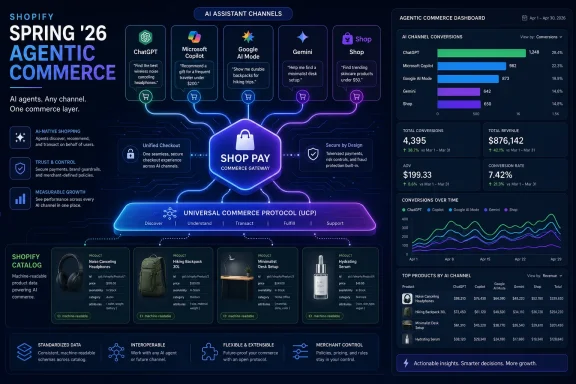
Shopify’s Spring ’26 Edition, announced in June 2026, opens Shop Pay beyond Shopify-built stores while expanding agentic commerce tools that place merchant products inside AI shopping surfaces such as ChatGPT, Microsoft Copilot, Google AI Mode, Gemini, and Shop. The headline is not simply that Shopify added another checkout button. It is that Shopify is trying to make itself the transaction layer for a web where shoppers increasingly begin with an answer engine rather than a storefront.
That is a more ambitious play than another seasonal product bundle. Shopify is betting that the next ecommerce land grab will be fought over product data, checkout identity, and the protocols that let AI agents move from recommendation to purchase. For merchants, the promise is obvious: fewer abandoned carts, more surfaces, and less dependence on search ads. For the rest of the commerce stack, the warning is just as obvious: Shopify wants to be useful even when the merchant is not actually running on Shopify.
For most of its life, Shopify’s strategic center was the merchant storefront. It gave smaller brands a way to look professional, process payments, manage inventory, and scale without hiring a full enterprise software team. That model still matters, but Spring ’26 makes clear that Shopify no longer sees the online store as the only meaningful front door.
The company’s new posture is that commerce is becoming ambient. A shopper might ask ChatGPT for a skincare device, query Copilot while comparing office furniture, use Google AI Mode for a gift recommendation, or wander through the Shop app without visiting a brand’s domain first. In that world, the merchant’s own website is still important, but it is no longer the only place where the sale is won or lost.
That is why the most important parts of the release are infrastructural. Shopify Catalog structures product information so AI systems can read it cleanly. The Universal Commerce Protocol gives agents a common way to understand carts, checkout rules, discounts, and fulfillment. Shop Pay then gives the buyer a familiar fast lane at the moment of purchase.
This is not merely “AI shopping” in the shallow sense of putting a chatbot on a product page. Shopify is trying to make the messy middle of ecommerce machine-readable. The company wants to be the layer that tells an AI agent what a product is, whether it is eligible for a discount, how it can ship, and how the shopper can pay without throwing the user back into the old multi-step checkout maze.
That explains why opening Shop Pay to brands not built on Shopify matters. If Shopify only helped merchants already inside its platform, the move would be defensive. By inviting non-Shopify brands onto Shop Pay and Shopify Catalog, the company is making a platform argument: even if you do not replatform onto Shopify, Shopify still wants a tollbooth on your transaction.
Opening that network to non-Shopify brands changes the competitive geometry. A merchant on another ecommerce platform can now consider Shop Pay not as part of a full migration, but as a checkout layer that brings access to Shopify’s claimed base of more than 250 million shoppers. That is a much easier sell than asking a mature retailer to rebuild its entire commerce stack.
The move also blurs the boundary between platform and payment product. Shopify no longer has to win every store migration to expand its influence. If a brand keeps its existing site architecture but adds Shop Pay, syncs its product data to Shopify Catalog, and appears in AI shopping channels through Shopify’s infrastructure, Shopify has still inserted itself into discovery and conversion.
That is strategically elegant and slightly unnerving. The button is the part users see, but the deeper asset is the account relationship. A checkout network with hundreds of millions of recognized shoppers gives Shopify leverage that is not limited to its core merchant base.
For competitors, the threat is not that every merchant will suddenly abandon WooCommerce, BigCommerce, Salesforce Commerce Cloud, Adobe Commerce, or custom stacks. The threat is that Shopify can become a default commerce identity and agentic shopping layer across those stacks. That is a subtler kind of platform expansion, and potentially a more durable one.
AI systems do not browse like humans. They need structured, trusted, consistently formatted product information. If they rely on scraped pages, they can misunderstand variants, miss inventory changes, flatten important product differences, or surface outdated details. Shopify’s claim that AI searches powered by Catalog convert at twice the rate of searches relying on scraped data is therefore less surprising than it first sounds.
The real implication is that AI visibility may become its own optimization discipline. Merchants will not merely ask whether their product page ranks in Google. They will ask whether their products appear when a user asks an assistant for “the best red light therapy mask for sensitive skin” or “a luxury cooling sheet set that does not feel synthetic.” Those queries are longer, more conversational, and often closer to purchase intent.
Shopify’s search intelligence tools point directly at that future. Showing merchants which AI queries they rank for, which they miss, and where product data fails to convert moves AI commerce from mystery box to dashboard. Sidekick’s suggested fixes, such as improving titles or filling missing specifications, make the message explicit: your products are now being evaluated by machines that prefer complete, structured answers.
This is where the Spring ’26 release becomes more practical than futuristic. Merchants do not need to believe in fully autonomous shopping agents to care about better product data. If AI assistants are already influencing discovery, then missing attributes, vague titles, and incomplete specifications are not cosmetic flaws. They are lost distribution.
Without something like UCP, every AI shopping surface could require a bespoke integration. ChatGPT might need one feed structure, Copilot another, Google AI Mode another, and the next wave of agent apps still more. That would recreate the worst parts of channel management, only with more opaque ranking systems and faster-moving interfaces.
A protocol promises a cleaner model. Product discovery, cart construction, checkout eligibility, discount logic, shipping options, and payment handoff can all be exposed in a more standardized way. For merchants, that could mean fewer custom integrations. For AI developers, it could mean a more reliable route from recommendation to transaction.
But protocols are never neutral merely because they are called open. The organizations that define, implement, and popularize a protocol often shape the economics around it. Shopify’s role in UCP gives it a chance to influence how AI agents understand merchant commerce, while Google’s involvement gives the protocol a path into one of the most important discovery surfaces on the internet.
That is the tension at the heart of this release. Standardization can reduce friction and fragmentation. It can also consolidate power around the companies that operate the most important catalogs, identity systems, and checkout flows. Shopify is not just preparing merchants for agentic commerce; it is trying to make sure agentic commerce is legible through Shopify’s grammar.
For WindowsForum readers, Microsoft Copilot is the most interesting part of the distribution story. Copilot is not just a website or app; it is increasingly woven through Windows, Edge, Microsoft 365, and enterprise productivity surfaces. If shopping recommendations and checkout flows become natural extensions of AI assistants, Microsoft’s consumer and work contexts could become surprisingly important retail real estate.
That does not mean Copilot will turn Windows into a shopping mall overnight. Microsoft has learned, often painfully, that users resist intrusive commerce inside productivity tools. But the possibility of product discovery inside an assistant that already has context about a task is powerful. Buying a replacement monitor, selecting a docking station, comparing office chairs, or ordering supplies are all commerce events that can plausibly begin inside a work assistant.
Google’s role is more direct. AI Mode in Google Search and Gemini sit close to the traditional discovery funnel that merchants already understand. If Google changes how product recommendations appear in AI-generated answers, merchants will follow the traffic, whether they like the new rules or not.
OpenAI’s ChatGPT, meanwhile, brings a different kind of influence: conversational trust. Users increasingly ask ChatGPT for advice framed in natural language rather than keywords. If a product recommendation appears in that context and can move toward purchase without a full browser detour, the line between editorial suggestion, search result, and storefront becomes harder to see.
That matters because ecommerce operators are practical people. They have heard years of vague AI promises, many of them wrapped in demos that never survived contact with inventory systems, returns, fraud controls, tax rules, and customer support. A dashboard that shows real revenue is more persuasive than another keynote about autonomous agents.
Shopify’s examples are designed to make that case. Omnilux reportedly saw AI channels drive 3.2 percent of total revenue in March. Cozy Earth reported AI channel revenue up 20 times year over year. Those numbers should be read with caution because they are brand examples selected by the vendor, not a market-wide benchmark. Still, they are the kind of data points that get merchants to test a channel.
The key question is whether those early gains are incremental or merely reattributed. If a shopper would have bought from the merchant anyway after a Google search, but now the journey runs through AI Mode, the channel looks new without expanding demand. If, however, AI agents are surfacing products to shoppers who would never have found the brand otherwise, then Shopify has created a genuinely new acquisition path.
The answer will vary by category. Products with rich comparison criteria, high consideration, or confusing specifications may benefit more from AI-mediated discovery than impulse buys. A conversational assistant is useful when the shopper needs translation from need to product. It is less obviously transformative when the shopper already knows exactly what SKU to buy.
That is an important shift. In traditional ecommerce, merchants optimized for human perception and search engine crawlers. In agentic commerce, they must optimize for AI systems that parse product attributes, reason across categories, and summarize options for shoppers. Sidekick’s job is to tell merchants where that translation is breaking down.
If a product appears in AI conversations but does not convert, the cause might be price, trust, imagery, shipping, reviews, or simply poor fit. But it might also be missing data. An AI assistant cannot confidently recommend a backpack as carry-on compliant if dimensions are unclear. It cannot compare supplements responsibly if ingredient information is vague. It cannot surface a furniture item for a small apartment if assembled measurements are buried in an image.
Shopify’s suggested fixes therefore point toward a new operating routine for merchants. Catalog hygiene becomes continuous rather than occasional. Product titles, specifications, variants, shipping promises, and discount rules become inputs to an AI distribution system, not just content on a page.
The Apple Watch angle is flashier but less central. Sidekick delivering business insights to a wrist-worn device is a sign of Shopify’s desire to make merchant operations feel ambient too. The more serious story is that Shopify wants its AI assistant to become the daily coach for optimizing not only stores, but machine-readable commerce performance across channels.
The difference now is not that AI magically understands retail. The difference is that large language models are better at handling messy natural language, and Shopify has more structured commerce context to feed them. A storefront chat assistant that knows inventory, policies, product attributes, and customer intent can be more useful than a generic bot trained to deflect support tickets.
Still, this is an area where merchants should be skeptical by default. A bad sales associate can do real damage. It can recommend the wrong size, hallucinate a return policy, misstate compatibility, or push a product that creates a costly support problem. In regulated or sensitive categories, the risk is even higher.
The operational challenge is governance. Merchants will need to decide what the AI assistant is allowed to say, when it should hand off to a human, how it handles uncertain answers, and how its recommendations are audited. The best version of this tool increases confidence. The worst version adds a persuasive interface on top of incomplete data.
That makes Shopify’s broader infrastructure push relevant again. AI sales agents are only as reliable as the systems beneath them. Catalog quality, checkout rules, fulfillment data, and policy constraints are not back-office details; they are the guardrails that determine whether an AI shopping experience feels helpful or reckless.
The company’s pitch is also timed well. Customer acquisition costs have pressured direct-to-consumer brands for years. Social ads became more expensive and less predictable. Search competition intensified. Marketplace dependence came with its own fees and loss of customer relationship. If AI channels can produce incremental discovery, merchants will test them quickly.
But every new distribution channel creates a new dependency. Merchants that once worried about Google ranking changes may soon worry about AI answer visibility. They may ask why a competitor’s product appears in a recommendation, why their own product is omitted, or why a model summarized their value proposition poorly. The interface may be conversational, but the platform dynamics are familiar.
Shopify’s dashboard helps, but it does not eliminate the asymmetry. Merchants can see some performance data and improve catalog inputs. They cannot fully see how models rank products, how user context shapes recommendations, or how platform incentives influence presentation. Agentic commerce may feel more personal to shoppers, but it can be less transparent to sellers.
That is why the opening of Shop Pay to non-Shopify brands cuts both ways. It expands access, but it also expands Shopify’s reach into merchants that might otherwise remain outside its ecosystem. The more value Shopify delivers through checkout identity and AI distribution, the harder it becomes for merchants to treat Shopify as just another vendor.
Product data is not always simple. Availability can differ by region, customer segment, warehouse, or contract. Discounts can depend on loyalty status, bundle rules, negotiated terms, or timing. Checkout flows can trigger tax calculations, fraud checks, age restrictions, export controls, and payment-specific requirements. The more an AI agent participates in the journey, the more these rules must be exposed accurately.
That is what makes UCP interesting to technologists. It recognizes that commerce is not just “find product, click buy.” Real checkout logic is conditional, localized, and full of edge cases. If agents are going to transact safely, they need structured access to those rules rather than a scraped approximation of a product page.
But the same complexity creates implementation caution. Enterprises will want audit logs, permission models, fail-safe behavior, test environments, and clear liability boundaries. If an AI agent presents a discount incorrectly or confirms an unavailable shipping option, who owns the failure? The merchant, the platform, the agent provider, or the protocol implementer?
That question is not theoretical. As AI-mediated transactions become more common, disputes will follow. A conventional checkout flow is already a legally and operationally significant sequence. Adding an AI layer that interprets user intent and merchant rules makes attribution harder, not easier.
For consumers, that could be convenient. Asking an assistant to compare products, narrow options, check shipping constraints, and route to a fast checkout is a reasonable use of AI. The web already made shopping too fragmented. An assistant that reduces tab overload has genuine value.
For admins and security-minded readers, the picture is more complicated. If AI assistants become purchase intermediaries, organizations will need policies around account use, procurement boundaries, data leakage, and employee behavior. A worker asking Copilot for equipment suggestions may not think they are initiating a commerce workflow, but the platform may increasingly be capable of moving in that direction.
There is also a browser and identity angle. Checkout networks thrive when users stay signed in. AI assistants thrive when they have context. Enterprises have spent years managing the risks of consumer accounts, saved payment methods, browser profiles, and shadow IT purchases. Agentic commerce adds another layer to that governance problem.
The likely near-term reality is not fully autonomous purchasing. It is assisted purchasing with more context and fewer clicks. That is still enough to matter. Many security and compliance failures begin not with science-fiction autonomy, but with convenience features that outrun policy.
But the storefront’s monopoly on conversion is weakening. If a shopper can discover, compare, and buy inside an AI channel, the merchant site becomes one node in a broader transaction network. That is a meaningful change even if only a small percentage of revenue moves through these channels at first.
The closest historical analogy is not the death of websites but the rise of marketplaces and social commerce. Amazon did not eliminate brand sites. Instagram did not eliminate online stores. Google Shopping did not eliminate direct traffic. Each changed where discovery happened and forced merchants to adapt their operations to a new channel’s rules.
Agentic commerce may do the same with more abstraction. Instead of optimizing only for page rank or ad placement, merchants will optimize for assistant interpretation. Instead of designing every journey around a human clicking through category pages, they will feed structured data into systems that produce recommendations on demand.
That changes the nature of competition. A beautiful storefront still helps after the shopper arrives. But if the assistant narrows the consideration set before the shopper sees a website, then the fight has already started upstream. Shopify’s Spring ’26 Edition is built for that upstream fight.
That is a more ambitious play than another seasonal product bundle. Shopify is betting that the next ecommerce land grab will be fought over product data, checkout identity, and the protocols that let AI agents move from recommendation to purchase. For merchants, the promise is obvious: fewer abandoned carts, more surfaces, and less dependence on search ads. For the rest of the commerce stack, the warning is just as obvious: Shopify wants to be useful even when the merchant is not actually running on Shopify.
 Shopify Is Selling the Rails, Not Just the Storefront
For most of its life, Shopify’s strategic center was the merchant storefront. It gave smaller brands a way to look professional, process payments, manage inventory, and scale without hiring a full enterprise software team. That model still matters, but Spring ’26 makes clear that Shopify no longer sees the online store as the only meaningful front door.The company’s new posture is that commerce is becoming ambient. A shopper might ask ChatGPT for a skincare device, query Copilot while comparing office furniture, use Google AI Mode for a gift recommendation, or wander through the Shop app without visiting a brand’s domain first. In that world, the merchant’s own website is still important, but it is no longer the only place where the sale is won or lost.
That is why the most important parts of the release are infrastructural. Shopify Catalog structures product information so AI systems can read it cleanly. The Universal Commerce Protocol gives agents a common way to understand carts, checkout rules, discounts, and fulfillment. Shop Pay then gives the buyer a familiar fast lane at the moment of purchase.
This is not merely “AI shopping” in the shallow sense of putting a chatbot on a product page. Shopify is trying to make the messy middle of ecommerce machine-readable. The company wants to be the layer that tells an AI agent what a product is, whether it is eligible for a discount, how it can ship, and how the shopper can pay without throwing the user back into the old multi-step checkout maze.
That explains why opening Shop Pay to brands not built on Shopify matters. If Shopify only helped merchants already inside its platform, the move would be defensive. By inviting non-Shopify brands onto Shop Pay and Shopify Catalog, the company is making a platform argument: even if you do not replatform onto Shopify, Shopify still wants a tollbooth on your transaction.
The Checkout Button Becomes the Trojan Horse
Shop Pay has always been more than a convenience feature. Accelerated checkout products look small because they appear as buttons, but they are really identity networks. A user who has already saved payment and shipping details is less likely to abandon a cart, and a merchant that can reduce checkout friction often sees a meaningful conversion lift.Opening that network to non-Shopify brands changes the competitive geometry. A merchant on another ecommerce platform can now consider Shop Pay not as part of a full migration, but as a checkout layer that brings access to Shopify’s claimed base of more than 250 million shoppers. That is a much easier sell than asking a mature retailer to rebuild its entire commerce stack.
The move also blurs the boundary between platform and payment product. Shopify no longer has to win every store migration to expand its influence. If a brand keeps its existing site architecture but adds Shop Pay, syncs its product data to Shopify Catalog, and appears in AI shopping channels through Shopify’s infrastructure, Shopify has still inserted itself into discovery and conversion.
That is strategically elegant and slightly unnerving. The button is the part users see, but the deeper asset is the account relationship. A checkout network with hundreds of millions of recognized shoppers gives Shopify leverage that is not limited to its core merchant base.
For competitors, the threat is not that every merchant will suddenly abandon WooCommerce, BigCommerce, Salesforce Commerce Cloud, Adobe Commerce, or custom stacks. The threat is that Shopify can become a default commerce identity and agentic shopping layer across those stacks. That is a subtler kind of platform expansion, and potentially a more durable one.
AI Search Turns Product Data Into a Ranking System
The old ecommerce optimization game was built around search engines, marketplaces, and paid acquisition. Merchants learned to optimize titles, descriptions, product images, structured data, reviews, and ad campaigns for Google, Amazon, Meta, and TikTok. Agentic commerce does not replace that game overnight, but it adds a new referee.AI systems do not browse like humans. They need structured, trusted, consistently formatted product information. If they rely on scraped pages, they can misunderstand variants, miss inventory changes, flatten important product differences, or surface outdated details. Shopify’s claim that AI searches powered by Catalog convert at twice the rate of searches relying on scraped data is therefore less surprising than it first sounds.
The real implication is that AI visibility may become its own optimization discipline. Merchants will not merely ask whether their product page ranks in Google. They will ask whether their products appear when a user asks an assistant for “the best red light therapy mask for sensitive skin” or “a luxury cooling sheet set that does not feel synthetic.” Those queries are longer, more conversational, and often closer to purchase intent.
Shopify’s search intelligence tools point directly at that future. Showing merchants which AI queries they rank for, which they miss, and where product data fails to convert moves AI commerce from mystery box to dashboard. Sidekick’s suggested fixes, such as improving titles or filling missing specifications, make the message explicit: your products are now being evaluated by machines that prefer complete, structured answers.
This is where the Spring ’26 release becomes more practical than futuristic. Merchants do not need to believe in fully autonomous shopping agents to care about better product data. If AI assistants are already influencing discovery, then missing attributes, vague titles, and incomplete specifications are not cosmetic flaws. They are lost distribution.
Universal Commerce Protocol Is Shopify’s Bid to Avoid a Fragmented AI Mall
The Universal Commerce Protocol may be the most consequential and least consumer-friendly phrase in the release. Protocols rarely make good headlines, but they decide who can connect to whom, under what rules, and at what cost. Shopify and Google are presenting UCP as a shared language for agentic commerce, and that framing matters.Without something like UCP, every AI shopping surface could require a bespoke integration. ChatGPT might need one feed structure, Copilot another, Google AI Mode another, and the next wave of agent apps still more. That would recreate the worst parts of channel management, only with more opaque ranking systems and faster-moving interfaces.
A protocol promises a cleaner model. Product discovery, cart construction, checkout eligibility, discount logic, shipping options, and payment handoff can all be exposed in a more standardized way. For merchants, that could mean fewer custom integrations. For AI developers, it could mean a more reliable route from recommendation to transaction.
But protocols are never neutral merely because they are called open. The organizations that define, implement, and popularize a protocol often shape the economics around it. Shopify’s role in UCP gives it a chance to influence how AI agents understand merchant commerce, while Google’s involvement gives the protocol a path into one of the most important discovery surfaces on the internet.
That is the tension at the heart of this release. Standardization can reduce friction and fragmentation. It can also consolidate power around the companies that operate the most important catalogs, identity systems, and checkout flows. Shopify is not just preparing merchants for agentic commerce; it is trying to make sure agentic commerce is legible through Shopify’s grammar.
Microsoft, Google, and OpenAI Are the New Storefront Neighbors
The named AI channels in Shopify’s release are not random. ChatGPT, Microsoft Copilot, Google AI Mode, Gemini, and Shop represent different entrances into the same emerging shopping funnel. Some begin as general-purpose assistants. Some are embedded in productivity workflows. Some are search experiences. Shop is Shopify’s own consumer-facing commerce environment.For WindowsForum readers, Microsoft Copilot is the most interesting part of the distribution story. Copilot is not just a website or app; it is increasingly woven through Windows, Edge, Microsoft 365, and enterprise productivity surfaces. If shopping recommendations and checkout flows become natural extensions of AI assistants, Microsoft’s consumer and work contexts could become surprisingly important retail real estate.
That does not mean Copilot will turn Windows into a shopping mall overnight. Microsoft has learned, often painfully, that users resist intrusive commerce inside productivity tools. But the possibility of product discovery inside an assistant that already has context about a task is powerful. Buying a replacement monitor, selecting a docking station, comparing office chairs, or ordering supplies are all commerce events that can plausibly begin inside a work assistant.
Google’s role is more direct. AI Mode in Google Search and Gemini sit close to the traditional discovery funnel that merchants already understand. If Google changes how product recommendations appear in AI-generated answers, merchants will follow the traffic, whether they like the new rules or not.
OpenAI’s ChatGPT, meanwhile, brings a different kind of influence: conversational trust. Users increasingly ask ChatGPT for advice framed in natural language rather than keywords. If a product recommendation appears in that context and can move toward purchase without a full browser detour, the line between editorial suggestion, search result, and storefront becomes harder to see.
The Merchant Dashboard Is Where the Hype Meets the P&L
The Agentic Storefronts dashboard is Shopify’s attempt to domesticate all of this complexity. AI commerce sounds abstract until a merchant can see orders, sales, and conversions attributed to ChatGPT, Copilot, Google AI Mode, Gemini, and Shop in one place. At that point, agentic commerce becomes a line item.That matters because ecommerce operators are practical people. They have heard years of vague AI promises, many of them wrapped in demos that never survived contact with inventory systems, returns, fraud controls, tax rules, and customer support. A dashboard that shows real revenue is more persuasive than another keynote about autonomous agents.
Shopify’s examples are designed to make that case. Omnilux reportedly saw AI channels drive 3.2 percent of total revenue in March. Cozy Earth reported AI channel revenue up 20 times year over year. Those numbers should be read with caution because they are brand examples selected by the vendor, not a market-wide benchmark. Still, they are the kind of data points that get merchants to test a channel.
The key question is whether those early gains are incremental or merely reattributed. If a shopper would have bought from the merchant anyway after a Google search, but now the journey runs through AI Mode, the channel looks new without expanding demand. If, however, AI agents are surfacing products to shoppers who would never have found the brand otherwise, then Shopify has created a genuinely new acquisition path.
The answer will vary by category. Products with rich comparison criteria, high consideration, or confusing specifications may benefit more from AI-mediated discovery than impulse buys. A conversational assistant is useful when the shopper needs translation from need to product. It is less obviously transformative when the shopper already knows exactly what SKU to buy.
Sidekick Is Becoming the Merchant’s Interpreter for Machine Buyers
Sidekick’s role in this release is easy to understate because every platform now has an AI assistant. But in Shopify’s agentic commerce strategy, Sidekick is not merely a support chatbot. It is positioned as an interpreter between the merchant’s catalog and the machine systems deciding whether products are relevant.That is an important shift. In traditional ecommerce, merchants optimized for human perception and search engine crawlers. In agentic commerce, they must optimize for AI systems that parse product attributes, reason across categories, and summarize options for shoppers. Sidekick’s job is to tell merchants where that translation is breaking down.
If a product appears in AI conversations but does not convert, the cause might be price, trust, imagery, shipping, reviews, or simply poor fit. But it might also be missing data. An AI assistant cannot confidently recommend a backpack as carry-on compliant if dimensions are unclear. It cannot compare supplements responsibly if ingredient information is vague. It cannot surface a furniture item for a small apartment if assembled measurements are buried in an image.
Shopify’s suggested fixes therefore point toward a new operating routine for merchants. Catalog hygiene becomes continuous rather than occasional. Product titles, specifications, variants, shipping promises, and discount rules become inputs to an AI distribution system, not just content on a page.
The Apple Watch angle is flashier but less central. Sidekick delivering business insights to a wrist-worn device is a sign of Shopify’s desire to make merchant operations feel ambient too. The more serious story is that Shopify wants its AI assistant to become the daily coach for optimizing not only stores, but machine-readable commerce performance across channels.
The AI Sales Associate Revives an Old Dream With Better Timing
The embedded AI sales associate is the most familiar feature in the release because ecommerce has been chasing automated sales help for decades. Live chat widgets, recommendation engines, guided selling quizzes, and support bots all promised to bring the in-store associate online. Most delivered mixed results because they either lacked context, annoyed users, or failed when questions became specific.The difference now is not that AI magically understands retail. The difference is that large language models are better at handling messy natural language, and Shopify has more structured commerce context to feed them. A storefront chat assistant that knows inventory, policies, product attributes, and customer intent can be more useful than a generic bot trained to deflect support tickets.
Still, this is an area where merchants should be skeptical by default. A bad sales associate can do real damage. It can recommend the wrong size, hallucinate a return policy, misstate compatibility, or push a product that creates a costly support problem. In regulated or sensitive categories, the risk is even higher.
The operational challenge is governance. Merchants will need to decide what the AI assistant is allowed to say, when it should hand off to a human, how it handles uncertain answers, and how its recommendations are audited. The best version of this tool increases confidence. The worst version adds a persuasive interface on top of incomplete data.
That makes Shopify’s broader infrastructure push relevant again. AI sales agents are only as reliable as the systems beneath them. Catalog quality, checkout rules, fulfillment data, and policy constraints are not back-office details; they are the guardrails that determine whether an AI shopping experience feels helpful or reckless.
The Small Merchant Gets Distribution, but Also a New Dependency
For independent merchants, the upside is hard to ignore. Shopify is offering a path into major AI channels without requiring every brand to negotiate with OpenAI, Microsoft, Google, and future agent platforms separately. That kind of aggregation is exactly what small businesses need when the discovery landscape shifts.The company’s pitch is also timed well. Customer acquisition costs have pressured direct-to-consumer brands for years. Social ads became more expensive and less predictable. Search competition intensified. Marketplace dependence came with its own fees and loss of customer relationship. If AI channels can produce incremental discovery, merchants will test them quickly.
But every new distribution channel creates a new dependency. Merchants that once worried about Google ranking changes may soon worry about AI answer visibility. They may ask why a competitor’s product appears in a recommendation, why their own product is omitted, or why a model summarized their value proposition poorly. The interface may be conversational, but the platform dynamics are familiar.
Shopify’s dashboard helps, but it does not eliminate the asymmetry. Merchants can see some performance data and improve catalog inputs. They cannot fully see how models rank products, how user context shapes recommendations, or how platform incentives influence presentation. Agentic commerce may feel more personal to shoppers, but it can be less transparent to sellers.
That is why the opening of Shop Pay to non-Shopify brands cuts both ways. It expands access, but it also expands Shopify’s reach into merchants that might otherwise remain outside its ecosystem. The more value Shopify delivers through checkout identity and AI distribution, the harder it becomes for merchants to treat Shopify as just another vendor.
Enterprise IT Will Notice the Governance Problem Before the Conversion Lift
Large retailers and enterprise IT teams will approach this differently from smaller merchants. They will care about conversion, but they will also care about data governance, compliance, security, brand control, and integration risk. A protocol-driven AI commerce layer touches too many sensitive systems to be treated as a marketing experiment.Product data is not always simple. Availability can differ by region, customer segment, warehouse, or contract. Discounts can depend on loyalty status, bundle rules, negotiated terms, or timing. Checkout flows can trigger tax calculations, fraud checks, age restrictions, export controls, and payment-specific requirements. The more an AI agent participates in the journey, the more these rules must be exposed accurately.
That is what makes UCP interesting to technologists. It recognizes that commerce is not just “find product, click buy.” Real checkout logic is conditional, localized, and full of edge cases. If agents are going to transact safely, they need structured access to those rules rather than a scraped approximation of a product page.
But the same complexity creates implementation caution. Enterprises will want audit logs, permission models, fail-safe behavior, test environments, and clear liability boundaries. If an AI agent presents a discount incorrectly or confirms an unavailable shipping option, who owns the failure? The merchant, the platform, the agent provider, or the protocol implementer?
That question is not theoretical. As AI-mediated transactions become more common, disputes will follow. A conventional checkout flow is already a legally and operationally significant sequence. Adding an AI layer that interprets user intent and merchant rules makes attribution harder, not easier.
Windows Users May Meet Commerce Through Copilot Before They Notice It
This story belongs on WindowsForum not because Shopify is suddenly a Windows company, but because commerce is moving into the AI surfaces that Windows users are being encouraged to adopt. Copilot is one of those surfaces. Edge, Windows, and Microsoft 365 give Microsoft multiple places where an assistant can influence decisions before a browser tab ever reaches a retailer’s site.For consumers, that could be convenient. Asking an assistant to compare products, narrow options, check shipping constraints, and route to a fast checkout is a reasonable use of AI. The web already made shopping too fragmented. An assistant that reduces tab overload has genuine value.
For admins and security-minded readers, the picture is more complicated. If AI assistants become purchase intermediaries, organizations will need policies around account use, procurement boundaries, data leakage, and employee behavior. A worker asking Copilot for equipment suggestions may not think they are initiating a commerce workflow, but the platform may increasingly be capable of moving in that direction.
There is also a browser and identity angle. Checkout networks thrive when users stay signed in. AI assistants thrive when they have context. Enterprises have spent years managing the risks of consumer accounts, saved payment methods, browser profiles, and shadow IT purchases. Agentic commerce adds another layer to that governance problem.
The likely near-term reality is not fully autonomous purchasing. It is assisted purchasing with more context and fewer clicks. That is still enough to matter. Many security and compliance failures begin not with science-fiction autonomy, but with convenience features that outrun policy.
The Open Web Is Not Dead, but the Storefront Is Losing Its Monopoly
Every platform shift produces overstatement. The arrival of AI shopping does not mean merchant websites disappear. Brands still need owned surfaces for storytelling, support, loyalty, search traffic, customer education, and trust. A conversational product card cannot carry the whole burden of brand experience.But the storefront’s monopoly on conversion is weakening. If a shopper can discover, compare, and buy inside an AI channel, the merchant site becomes one node in a broader transaction network. That is a meaningful change even if only a small percentage of revenue moves through these channels at first.
The closest historical analogy is not the death of websites but the rise of marketplaces and social commerce. Amazon did not eliminate brand sites. Instagram did not eliminate online stores. Google Shopping did not eliminate direct traffic. Each changed where discovery happened and forced merchants to adapt their operations to a new channel’s rules.
Agentic commerce may do the same with more abstraction. Instead of optimizing only for page rank or ad placement, merchants will optimize for assistant interpretation. Instead of designing every journey around a human clicking through category pages, they will feed structured data into systems that produce recommendations on demand.
That changes the nature of competition. A beautiful storefront still helps after the shopper arrives. But if the assistant narrows the consideration set before the shopper sees a website, then the fight has already started upstream. Shopify’s Spring ’26 Edition is built for that upstream fight.
The Spring ’26 Bet Comes Down to Five Practical Shifts
The most useful way to read Shopify’s release is not as a single product announcement, but as a bundle of assumptions about where ecommerce is headed. Some will prove early. Some will be overhyped. But merchants, developers, and IT teams should take the direction seriously because the plumbing is already being laid.- Shopify is turning Shop Pay into a cross-platform checkout network rather than keeping it as a benefit reserved for Shopify storefronts.
- Shopify Catalog makes structured product data a distribution asset for AI channels, not merely an internal merchant database.
- The Universal Commerce Protocol is an attempt to standardize how agents move from product discovery to checkout without rebuilding every integration from scratch.
- Agentic Storefronts gives merchants a way to measure AI-channel orders, sales, and conversions instead of treating AI discovery as invisible referral fog.
- Sidekick’s recommendations suggest that catalog quality, product attributes, and missing specifications will become routine optimization work for AI commerce.
- Microsoft Copilot, Google AI Mode, Gemini, ChatGPT, and Shop are becoming storefront-adjacent surfaces where purchase intent may form before a user visits a merchant site.
References
- Primary source: TechJuice
Published: 2026-06-18T10:50:26.067211
Shopify Just Opened Shop Pay to Everyone
Shopify's Spring '26 Edition ships 150+ updates putting merchant products inside ChatGPT, Copilot, and Google AI Mode via Catalog and UCP.www.techjuice.pk
- Related coverage: shopify.com
Shopify Editions | Spring ’26
Sell face to face, online, in social channels, and AI chats with 150+ updates to Shopify. The only platform you need to sell everywhere.www.shopify.com - Related coverage: help.shopify.com
Shopify Help Center | Shop Pay on any platform
Add Shop Pay to your existing checkout and give customers a fast, familiar way to pay on any platform.help.shopify.com - Related coverage: aiadvantageagency.com
Universal Commerce Protocol for Shopify: Agentic Commerce
Universal Commerce Protocol for Shopify connects your store to ChatGPT, Microsoft Copilot, Google AI Mode, and the Gemini app through a single integration,aiadvantageagency.com - Related coverage: skailama.com
What is Shop Pay? How Does Shop Pay Work? (2026)
Shop Pay is Shopify's accelerated checkout used by 250M+ shoppers across 24 countries. Learn how it works, whether it's safe, and what's new in 2026.www.skailama.com - Related coverage: shopify.engineering
Building the Universal Commerce Protocol (2026) - Shopify
Under the hood of UCP: the open protocol powering agentic commerce, enabling AI agents to discover, negotiate, and transact with any merchant.shopify.engineering
- Related coverage: androidcentral.com
How Google's new protocol transforms AI agents into shopping powerhouses | Android Central
Google has unveiled a new open standard called Universal Commerce Protocol that lets AI agents shop, check out, and handle payments for you.www.androidcentral.com - Related coverage: techradar.com
Google is going all-out on "agentic shopping" with new AI ecommerce tools | TechRadar
It seems that every AI agent is bidding for your shopping customwww.techradar.com - Related coverage: ecommercepartners.com
Shopify Plus B2B Development Agency | Ecommerce Partners
Ecommerce Partners is a Shopify Plus B2B development agency helping brands build, migrate, and scale ecommerce. Experts in Adobe Commerce, Magento, and BigCommerce to Shopify Plus migrations. ecommercepartners.com
- Related coverage: investors.commerce.com
- Related coverage: iccr.org
- Related coverage: eyemaginetech.com