

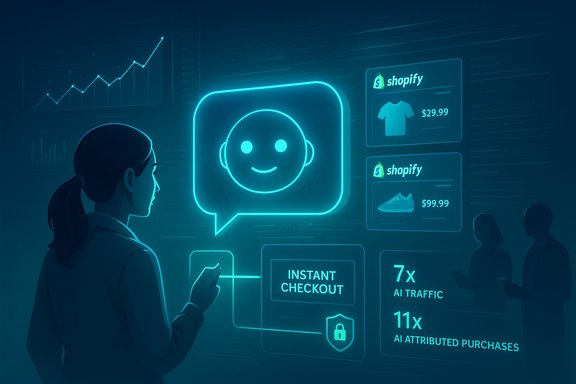
Shopify is betting the future of commerce on AI agents: the company told investors and the press that traffic from AI tools to Shopify storefronts has jumped sevenfold since January, and that purchases attributed to AI-powered search are up 11×, while announcing deeper integrations with ChatGPT and other AI assistants as part of a broader push toward what it calls agentic commerce.
Shopify’s message came during its third-quarter results and earnings commentary, where executives framed AI not as a bolt-on feature but as a core part of the platform’s engine. The company has publicly confirmed partnerships and technical integrations that make Shopify-managed product catalogs and checkout flows available inside AI conversations, and it is positioning its existing merchant data and product infrastructure as a competitive moat in the new AI-driven shopping landscape.
At the same time Shopify reported solid top-line performance: revenue growth in the low‑to‑mid 30s percent year‑over‑year and stronger gross merchandise volume, even as profitability and operating metrics triggered mixed market reactions. The company’s leadership emphasized both external integrations — including ChatGPT and other in‑chat shopping experiences — and internal AI tools such as Scout and Sidekick that are already being used to improve product decisions and operational speed.
This article breaks down what Shopify’s AI claims really mean, how agentic commerce is likely to evolve, what merchants should do to prepare, and where the biggest technical, commercial, and regulatory risks lie.
The result is a fast-moving, winner-take-most environment for the agentic commerce stack: whoever controls the standards for product discovery, secure checkout tokens, and attribution will shape merchant economics.
The numbers Shopify cites about AI traffic and AI-driven orders matter as early evidence that conversational agents can create repeatable shopping funnels. Still, those multipliers require careful independent validation and should be interpreted alongside operational metrics such as return rates, fraud incidence, and repeat customer behavior.
For merchants, the immediate playbook is straightforward: get product data right, enable instant checkout options where feasible, and instrument robust analytics so new traffic sources can be measured and monetized safely. For platform architects and regulators, the urgent work is to harden payment and tokenization rails, define transparent recommendation disclosures, and craft guardrails for privacy and fairness.
Agentic commerce is a structural shift with enormous upside for frictionless conversion and discovery, but the path to a stable, equitable, and trustworthy ecosystem will require technical rigor, clear economics, and steady governance. The companies that get the last mile — secure, transparent checkout and fair discovery — right will have the strongest claim to the next era of commerce.
Source: TechCrunch Shopify says AI traffic is up 7x since January, AI-driven orders are up 11x | TechCrunch
 Background
Shopify’s message came during its third-quarter results and earnings commentary, where executives framed AI not as a bolt-on feature but as a core part of the platform’s engine. The company has publicly confirmed partnerships and technical integrations that make Shopify-managed product catalogs and checkout flows available inside AI conversations, and it is positioning its existing merchant data and product infrastructure as a competitive moat in the new AI-driven shopping landscape.At the same time Shopify reported solid top-line performance: revenue growth in the low‑to‑mid 30s percent year‑over‑year and stronger gross merchandise volume, even as profitability and operating metrics triggered mixed market reactions. The company’s leadership emphasized both external integrations — including ChatGPT and other in‑chat shopping experiences — and internal AI tools such as Scout and Sidekick that are already being used to improve product decisions and operational speed.
This article breaks down what Shopify’s AI claims really mean, how agentic commerce is likely to evolve, what merchants should do to prepare, and where the biggest technical, commercial, and regulatory risks lie.
Why Shopify’s AI numbers matter
Shopify’s announcements combine three forces that matter to any e-commerce business:- Scale: Shopify sits on data from millions of merchants and billions of transactions, giving it a deep real‑time view of product availability, pricing, conversion signals, and fulfillment. That scale is useful for training and tuning AI shopping behavior and for providing economic incentives to platform partners.
- Marketplace reach: By making product catalogs, inventory, and checkout available to AI agents, Shopify can show merchants up in AI conversations the way they currently show up in search engines or social channels.
- Product velocity: Shopify stresses a “founder mode” mentality: ship quickly, iterate, and embed AI across both merchant-facing features and internal decision systems.
- AI agents are already surfacing shopping moments that previously happened on search engines, social posts, or direct store traffic.
- Shopper intent inside AI conversations — when a helpful agent recommends or finds a product — can convert at scale provided the product data and checkout work seamlessly.
Overview of the new commerce stack: what’s changing
AI conversation → product discovery → Instant Checkout
The emerging flow Shopify and its partners envision is straightforward in concept:- A user asks an AI assistant (chat, voice, or multi-agent) for a recommendation, comparison, or gift idea.
- The assistant consults a graph of product metadata and availability (Shopify’s live product feed).
- The assistant recommends products and, when enabled, can complete payment via an Instant Checkout integration or Shop Pay-like experience without redirecting the shopper away from the conversation.
Partnerships and platform plays
Shopify’s public comments name multiple partners and integrations:- Native integration into in‑chat shopping experiences (initially rolling out with leading AI platforms).
- Collaborations with major agent builders and AI intermediaries so Shopify merchants are discoverable across a range of conversational interfaces.
- Internal AI tooling that mines merchant feedback and usage signals to iterate faster.
What Shopify gains from agentic commerce
Shopify’s pitch centers around three competitive advantages:- Data breadth: real‑time inventory, pricing, images, descriptions and historical transaction signals from millions of merchants give Shopify unique training and inference signals for commerce-specific AI.
- Merchant trust and control: Shopify positions itself as keeping merchants “merchant of record,” preserving brand relationships and order flows rather than handing them to intermediaries.
- Distribution: being integrated into the leading AI assistants means Shopify merchants can surface in frictionless shopping flows without having to individually build integrations to each agent.
The economics: monetization and consequences
AI-enabled checkout and discovery create several revenue lines and economic trade-offs:- Transaction fees and platform commissions — if AI agents enable frictionless checkouts, the platform enabling that checkout becomes economically valuable and will seek a piece of the transaction.
- Merchant adoption costs — merchants must opt-in, enable payment and shipping integration, and keep product metadata accurate. There is a nontrivial operational lift for smaller merchants to remain competitive inside agentic channels.
- Customer acquisition shift — channels may shift from paid ads and social to conversation-based discovery, which could disrupt current digital marketing models and redistribute advertising spend.
Verifying the numbers: how to read Shopify’s AI claims
Shopify made bold comparative claims during its latest communications: AI tool traffic up 7× and AI-attributed purchases up 11× since January. Those numbers are important trend signals, but they should be evaluated against three realities:- Attribution is inherently messy: when does a shopping decision count as “AI-driven”? Is it when an agent suggested a product, when a link from a chat session is clicked, or when a checkout token is used? Differences change the multiplier significantly.
- Baseline effects: a 7× increase is dramatic if the baseline is meaningful; it’s less telling if AI traffic started from a near-zero base in January.
- Internal metrics vs public filings: the company-reported multipliers are internal product telemetry; there is no independent, standardized audit of those numbers in public filings.
Technical and product implications for merchants
What merchants must do now (practical checklist)
- Ensure product data quality:
- Accurate titles, descriptions, SKUs, UPCs, and high‑quality images.
- Detailed attributes for size, color, materials, and use cases to help AI agents match intent.
- Confirm checkout and payment readiness:
- Enable supported Instant Checkout options or Shop Pay to minimize friction.
- Verify tax, shipping, and fraud configurations for automated checkouts.
- Inventory & fulfillment hygiene:
- Real‑time inventory syncing is essential to avoid agent‑led purchases that cannot be fulfilled.
- Evaluate fulfillment partners and shipping SLAs compatible with instant buyer expectations.
- Merchant policy clarity:
- Transparent returns, warranties, and customer service contact info so AI agents can accurately convey post‑purchase expectations.
- Monitoring and analytics:
- Instrument attribution and conversion funnels for AI-driven traffic.
- Monitor refunds, chargebacks, and fraud patterns that may spike with novel checkout channels.
Product engineering implications
- API reliability: product and checkout APIs must be robust, low-latency, and scale horizontally.
- Security tokens: checkout flows embedded in conversations must use hardened one-time tokens or delegated checkout sessions to protect payment data.
- Rate-limiting and abuse controls: agents calling product catalogs in bulk require strong rate controls to preserve merchant performance and prevent scraping or competitive gaming.
The role of internal AI tools: Scout, Sidekick, and the feedback loop
Shopify has been explicit about using AI internally to mine support tickets, reviews, and merchant feedback for product decision-making. Tools like Scout (an internal search/analysis engine for merchant signals) and Sidekick (merchant-facing assistance and content tooling) are examples of how the company is both productizing AI and using it to run the business faster.- Benefits: faster feature prioritization, automated triage of merchant signals, and more efficient product roadmaps.
- Risks: over-reliance on internal models can amplify platform biases; if the training signals reflect a subset of merchant behavior they may favor larger or more vocal sellers.
- Governance: companies must maintain human oversight, model retraining cadence, and robust A/B testing of AI-led decisions.
Competition and market dynamics
Agentic commerce creates a new battleground among platform owners, agent builders, and payment processors.- Large AI platforms want to own the conversational surface and are incentivized to keep users inside their ecosystems.
- E-commerce platforms (Shopify, marketplaces) want to preserve merchant relationships and build the plumbing to support embedded commerce.
- Payment and checkout providers (Stripe, Shop Pay equivalents) provide the rails for transaction finalization and will extract fees or strategic control.
The result is a fast-moving, winner-take-most environment for the agentic commerce stack: whoever controls the standards for product discovery, secure checkout tokens, and attribution will shape merchant economics.
Risk matrix: privacy, fraud, bias, and regulation
Privacy and data sharing
Making product and behavioral data available to AI agents requires careful data governance. Merchants and consumers will want clarity on:- What personal data is shared with agents?
- How are payment tokens and customer records stored and used?
- What consent mechanisms are in place for cross‑platform personalizations?
Fraud and abuse
Instant checkouts in conversations could be exploited for:- Social engineering and fraudulent confirmations if authentication is weak.
- Account takeover and unauthorized purchases if checkout tokens are re-used or not tightly scoped.
- Marketplace fraud at scale if bad actors learn to game agent ranking or exploit attribution gaps.
Algorithmic bias and recommendation quality
AI agents will recommend products using a mix of price, availability, seller prominence, and checkout readiness. Without careful design, recommendations can:- Favor merchants with deeper integrations or higher marketing budgets.
- Reduce long-tail discovery by surfacing only the most “instantly purchasable” products.
- Amplify distribution toward brands that optimize purely for AI visibility rather than product quality.
Regulatory scrutiny
As AI becomes a commerce layer, regulators will look at:- Disclosure rules for AI-driven recommendations and paid placements.
- Consumer protections for purchases made via automated agents.
- Data‑sharing and cross‑border transfer implications tied to personal data and payments.
Scenarios for how agentic commerce could evolve
- Narrow agent dominance: A small number of AI platforms (chat assistants integrated into major OSes or apps) become the primary discovery layer. Merchants must integrate deeply to remain visible.
- Federated agent ecosystem: Multiple agents and intermediaries support a standard commerce protocol (open or semi-open), allowing merchants to be discoverable across many agents without bespoke integrations.
- Vertical specialization: Agents that specialize by category (fashion, home, B2B supplies) form and partner with specialist platforms or marketplaces.
- Hybrid human+agent flow: Agents surface recommendations but route higher-value or complex purchases to human-assisted experiences (concierge commerce).
How to measure success: KPIs and signal hygiene
Merchants and platforms should track a balanced set of KPIs that go beyond raw conversion multipliers:- AI visit quality: average time, pages viewed, and depth of product exploration when traffic originates from AI agents.
- True AI-attributed conversion rate: carefully defined attribution windows and event tagging to avoid false positives.
- Return and dispute rates: compare AI-sourced orders to baseline channels to detect higher friction or fraud.
- Customer lifetime value: track whether customers acquired via AI channels return and have similar LTV to other cohorts.
- Operational metrics: inventory accuracy, fulfillment lead time, and support ticket rates for AI-sourced orders.
Strengths and opportunities
- First-mover product depth: Shopify’s merchant base and API ecosystem give it a plausible head start to be a primary supplier of product metadata to agents.
- Integrated checkout capability: Supporting instant purchases reduces friction dramatically, which is the key to converting conversational intent.
- Internal AI tooling: Using AI to reflexively improve product decisions, support, and product roadmap can increase iteration speed and merchant value.
Weaknesses and risks
- Measurement opacity: Company‑reported multipliers are informative but not independently third‑party audited; differences in baselines and attribution windows can mislead.
- Concentration risk: If a small set of AI assistants becomes dominant, merchants may find themselves at the mercy of gatekeepers with different commercial terms.
- Regulatory and consumer trust friction: Instant purchases in conversations raise novel consumer protection, transparency, and privacy questions that will likely attract regulatory attention.
- Operational pressure on small merchants: Smaller sellers may struggle to meet the inventory, speed, and data quality standards demanded by agentic commerce.
Bottom line: pragmatic optimism
Shopify’s declaration that “AI is central to our engine” is consistent with a realistic platform strategy: make product and checkout data available, partner with the leading conversational platforms, and use AI both externally and internally to improve discovery and operations.The numbers Shopify cites about AI traffic and AI-driven orders matter as early evidence that conversational agents can create repeatable shopping funnels. Still, those multipliers require careful independent validation and should be interpreted alongside operational metrics such as return rates, fraud incidence, and repeat customer behavior.
For merchants, the immediate playbook is straightforward: get product data right, enable instant checkout options where feasible, and instrument robust analytics so new traffic sources can be measured and monetized safely. For platform architects and regulators, the urgent work is to harden payment and tokenization rails, define transparent recommendation disclosures, and craft guardrails for privacy and fairness.
Agentic commerce is a structural shift with enormous upside for frictionless conversion and discovery, but the path to a stable, equitable, and trustworthy ecosystem will require technical rigor, clear economics, and steady governance. The companies that get the last mile — secure, transparent checkout and fair discovery — right will have the strongest claim to the next era of commerce.
Source: TechCrunch Shopify says AI traffic is up 7x since January, AI-driven orders are up 11x | TechCrunch
