

Shopify’s third-quarter numbers arrived like a punctuation mark — strong top-line growth, a powerful GMV rebound, and a wave of AI-driven product moves that prompted Morgan Stanley to lift its price target and keep the stock on dealers’ radar.
Shopify has long presented itself as a platform business built on two complementary engines: Subscription Solutions (merchant plans and software tools) and Merchant Solutions (payments, checkout, shipping, and financing). That dual model gives Shopify recurring revenue stability while allowing it to scale monetization as merchant transaction volumes grow. The Q3 results make that dynamic visible — transaction-led growth amplified the top line and reinforced the payments-led monetization thesis.
The quarter also marked an explicit strategy shift in public language: Shopify now talks about agentic commerce — the idea that conversational AI agents will become first-class shopping surfaces and that Shopify’s product catalog, checkout tokens, and payments rails should be the plumbing behind those agents. Executives framed AI as central to the engine, not an ancillary feature. That strategic repositioning matters because it ties product strategy to a potential new distribution layer for merchants.
Key investor signals to watch:
That opportunity is real and substantiated by both internal adoption signals (merchant Sidekick uptake, Shop Pay throughput) and external integrations (OpenAI’s Instant Checkout pilots and Copilot/Perplexity partnerships).
At the same time, caution is warranted: much of the agentic upside remains contingent on attribution clarity, merchant adoption at scale (especially among smaller sellers), negotiation of fee economics with assistant platforms, and emerging regulatory requirements around automated purchasing and consumer protection. Those are significant operational and policy risks that can affect realized monetization and margins.
For merchants, the practical takeaway is immediate: invest in product data hygiene, enable tokenized checkouts where appropriate, and instrument AI attribution now — these steps will determine whether the next wave of conversational discovery is an incremental channel or a disruptive re‑write of how buyers find and buy. For investors, Shopify’s Q3 is evidence that the company can still grow at scale — but the price for future gains is execution of the agentic thesis and the transparent demonstration of economic returns from AI‑sourced commerce.
Shopify’s Q3 showed both momentum and a strategy that aims to move the center of gravity in commerce to AI‑driven surfaces; Morgan Stanley’s upgraded price target is the market’s short‑term recognition of that potential. The longer verdict will depend on whether Shopify can make those agentic promises measurable, profitable, and equitably governed as volumes scale.
Source: Finimize https://finimize.com/content/shopifys-strong-q3-growth-triggers-target-hike-from-morgan-stanley/
 Background / Overview
Shopify has long presented itself as a platform business built on two complementary engines: Subscription Solutions (merchant plans and software tools) and Merchant Solutions (payments, checkout, shipping, and financing). That dual model gives Shopify recurring revenue stability while allowing it to scale monetization as merchant transaction volumes grow. The Q3 results make that dynamic visible — transaction-led growth amplified the top line and reinforced the payments-led monetization thesis.The quarter also marked an explicit strategy shift in public language: Shopify now talks about agentic commerce — the idea that conversational AI agents will become first-class shopping surfaces and that Shopify’s product catalog, checkout tokens, and payments rails should be the plumbing behind those agents. Executives framed AI as central to the engine, not an ancillary feature. That strategic repositioning matters because it ties product strategy to a potential new distribution layer for merchants.
Q3 results: the numbers that moved markets
Headline financials
- Revenue: Shopify reported revenue around $2.84 billion, roughly +32% year‑over‑year — comfortably ahead of several estimates and consistent with a company experiencing strong volume expansion.
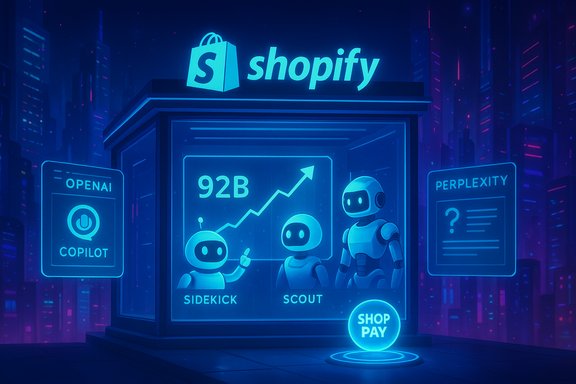
- Gross Merchandise Volume (GMV): GMV was reported at approximately $92.0 billion, up ~32% YoY — the second consecutive quarter with ~30%+ GMV growth, a rare performance among public e‑commerce platforms in the current retail cycle.
- Shop Pay / Payments: Shop Pay throughput accelerated sharply, processing a large share of quarter GMV (Shop Pay processed close to $29 billion for the quarter in some internal tallies), highlighting payments as an accelerating monetization channel.
- Profitability and costs: Operating lines were mixed — operating income and certain profit measures missed the tightest estimates as Shopify continued to invest aggressively in AI capabilities and marketing, causing some near‑term compression in net income versus the year‑ago period. Reuters’ reporting highlighted higher operating expenses tied to AI investment as one reason operating profit landed slightly below expectations.
What’s notable about the GMV rebound
Two consecutive quarters of ~32% GMV growth is noteworthy because it runs counter to a broader retail and e‑commerce slowdown. That recovery is meaningful for several reasons:- It validates that demand still exists across merchant sizes and regions.
- It increases the absolute addressable market for Shopify’s Merchant Solutions products (payments, checkout, capital).
- It provides a larger, richer dataset for Shopify’s AI efforts to train against — making AI features plausibly more effective and defensible over time.
Why Morgan Stanley raised its target — and what that implies
Morgan Stanley raised its price target on Shopify and maintained an Overweight rating, signaling a belief that Shopify’s Q3 momentum is durable and that AI-driven product gains will translate into higher long‑term monetization. The firm’s move to a $192 target reflects a more bullish view of the company’s growth and payments runway. Analysts cited several reasons for the upgrade:- Rapid innovation and execution: The company shipped merchant tools and agent-facing primitives quickly, translating product work into measurable merchant adoption metrics.
- Payments acceleration: The scale of Shop Pay and tokenized checkout options gives Shopify leverage to monetize transactions more effectively.
- AI and distribution: Strong partnerships with leading assistant platforms (OpenAI/ChatGPT, Microsoft Copilot, Perplexity) mean Shopify’s catalog and checkout rails are positioned to capture “agentic” shopping flows.
AI, Sidekick, and the mechanics of “agentic commerce”
Sidekick, Scout and merchant‑facing AI
Shopify described high uptake for merchant tools such as Sidekick (conversational AI helpers for merchants) and internal tooling like Scout, which aggregates merchant feedback for product decisions. Reported adoption numbers — for example, hundreds of thousands of merchants using Sidekick — indicate that Shopify has productized AI for merchant productivity, not just marketing demos. These internal product adoptions provide two benefits: they reduce merchant friction (less churn, higher productivity) and they generate signals that feed external discovery models.From discovery to checkout: the tokenized rails
The technical core of agentic commerce rests on a few primitives:- Machine‑readable product catalogs (structured feeds with accurate SKUs, availability, and metadata).
- Universal cart semantics (so multi‑agent or multi‑device carts reconcile correctly).
- Tokenized checkout (ephemeral tokens that let an assistant trigger a merchant checkout without exposing raw card data).
- Auditable provenance and dispute trails (essential for consumer protection and fraud resolution).
Partnerships: ChatGPT, Copilot, Perplexity and the Instant Checkout story
OpenAI’s Instant Checkout — launched as a limited pilot — demonstrates the model in action: single‑item purchases completed inside ChatGPT, processed using Shop Pay/Stripe primitives. OpenAI and Shopify’s public moves suggest a phased rollout where Shopify merchants will be enabled to accept in‑chat purchases through standardized protocols (Agentic Commerce Protocols) and buy‑now flows. Independent coverage and rollout guides have documented the initial Etsy/US-only pilot, Shopify merchant onboarding plans for Q4, and the reliance on tokenized Shop Pay rails. Microsoft’s Copilot and other assistant ecosystems are also integrating commerce primitives — either through plugins, Copilot Studio connectors, or direct commerce integrations — creating multiple potential agent endpoints. Having Shopify content and checkout available across several helpers reduces single‑point dependency for merchants and increases overall reach — but it raises questions about channel economics and gatekeeper power.Payments and monetization: Shop Pay as the economic driver
Shop Pay is the monetization axis of the agentic thesis. When a checkout is completed through tokenized Shop Pay, Shopify benefits in three ways:- Direct transaction revenue: payment processing and related fees flow into Merchant Solutions.
- Increased stickiness: saved credentials and frictionless checkout improve conversion rates, making conversion via agents more valuable.
- Data and signal capture: tokenized flows that surface inside agents remain traceable and can be used to refine recommendation models and attribution.
What this means for merchants and IT teams
Merchants face a pragmatic checklist to participate in agentic commerce safely and profitably:- Clean and canonicalize product data: accurate SKUs, UPCs, canonical images and structured attributes (size, color, material) are table stakes. Agents rely on machine‑readable metadata.
- Enable tokenized checkout and Shop Pay where possible: these flows reduce friction but require reconciliation, charged‑back funds handling, and updated fraud rules.
- Harden fulfillment and inventory sync: real‑time inventory prevents assistant‑triggered sales that cannot be fulfilled.
- Instrument AI attribution: tag agent‑originated sessions, define attribution windows, and monitor return/dispute rates for AI‑sourced orders.
- Maintain owned channels and direct relationships: email lists, loyalty programs, and first‑party apps remain crucial to avoid over‑dependence on any single assistant.
Risks, regulatory issues and open questions
Shopify’s Q3 and the agentic commerce push surface several important risks:- Attribution and measurement opacity: Growth multiples (e.g., AI traffic up 7x, AI‑attributed purchases up 11x) are powerful trend signals but currently rely on internal telemetry and definitions. Those numbers are directional until independently audited or consistently reported in public filings. Treat these early multipliers with caution.
- Channel concentration and gatekeeper risks: If a few assistants control discovery, merchants could face opaque fee models or preferential ranking that privileges certain vendors or payment rails. Diversification across agents matters.
- Consumer protection and dispute flows: In‑chat checkouts create new liability and fraud surfaces; regulators will demand clarity on merchant vs. platform responsibility, disclosure of assistant‑sourced recommendations, and transparent redress mechanisms.
- Operational strain on smaller merchants: Agentic channels favor merchants with excellent data hygiene, reliable fulfillment and robust inventory systems — capabilities many small sellers lack. Left unchecked, this could create a two‑tier ecosystem.
How investors should read the quarter
The Q3 results and Morgan Stanley’s upgraded target crystallize a simple investor choice: believe the AI‑driven distribution and payments monetization story and pay a premium, or treat the current multiples as contingent on several execution and regulatory outcomes.Key investor signals to watch:
- Traction of AI‑originated GMV as a share of total GMV (conversion, repeat rates, margin profiles).
- Monetization of agentic channels (are commissions or incremental take‑rates emerging as AI volumes scale?.
- Cost‑to‑serve and operating leverage as AI tooling scales merchant support (do AI investments reduce per‑merchant support costs or raise them?.
Practical steps for platform owners and developers
For platform teams and integrators building agentic capabilities, prioritize:- Implementing robust token lifecycles and scoped authorizations for delegated checkouts.
- Designing idempotent order creation APIs to tolerate retries from multi‑agent orchestration.
- Building observability that links an agent call chain to order provenance for dispute resolution.
- Creating clear merchant opt‑in flows and consent surfaces for data sharing with agents.
Final analysis — balance of opportunity and caution
Shopify’s Q3 is a strong operational result backed by real GMV growth, payments acceleration, and rapid AI adoption — a combination that explains Morgan Stanley’s target hike and market optimism. The company’s decision to lay rails for agentic commerce positions it to benefit from a potential re‑ordering of discovery and checkout, where AI assistants act as the new storefronts and Shopify provides the backend plumbing.That opportunity is real and substantiated by both internal adoption signals (merchant Sidekick uptake, Shop Pay throughput) and external integrations (OpenAI’s Instant Checkout pilots and Copilot/Perplexity partnerships).
At the same time, caution is warranted: much of the agentic upside remains contingent on attribution clarity, merchant adoption at scale (especially among smaller sellers), negotiation of fee economics with assistant platforms, and emerging regulatory requirements around automated purchasing and consumer protection. Those are significant operational and policy risks that can affect realized monetization and margins.
For merchants, the practical takeaway is immediate: invest in product data hygiene, enable tokenized checkouts where appropriate, and instrument AI attribution now — these steps will determine whether the next wave of conversational discovery is an incremental channel or a disruptive re‑write of how buyers find and buy. For investors, Shopify’s Q3 is evidence that the company can still grow at scale — but the price for future gains is execution of the agentic thesis and the transparent demonstration of economic returns from AI‑sourced commerce.
Shopify’s Q3 showed both momentum and a strategy that aims to move the center of gravity in commerce to AI‑driven surfaces; Morgan Stanley’s upgraded price target is the market’s short‑term recognition of that potential. The longer verdict will depend on whether Shopify can make those agentic promises measurable, profitable, and equitably governed as volumes scale.
Source: Finimize https://finimize.com/content/shopifys-strong-q3-growth-triggers-target-hike-from-morgan-stanley/
