

Siemens has published a high‑severity security advisory (SSA‑485750) for SIDIS Prime that warns operators: all installations prior to V4.0.800 are affected by a broad cluster of third‑party and product‑level vulnerabilities and should be updated immediately or compensating controls applied. //db.gcve.eu/recent)
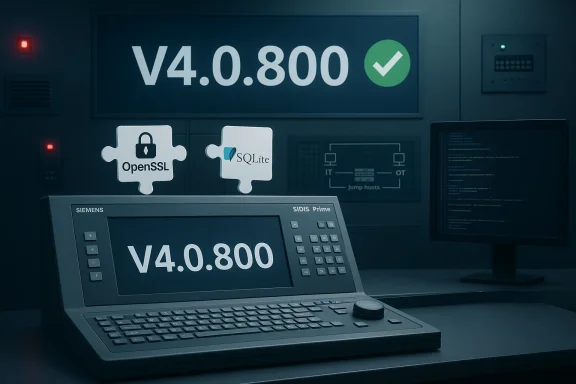
SIDIS Prime is a Siemens product deployed in industrial and critical‑manufacturing environments. On March 10, 2026 Siemens released advisory SSA‑485750 describing multiple, distinct weaknesses rooted in embedded third‑party components (notably OpenSSL, SQLite, and several Node.js packages) as well as product integration issues. National CERTs and cyber‑centres republished or summarized the advisory for their constituencies, confirming the vendor guidance to update to SIDIS Prime V4.0.800 or later.
This advisory follows an earlier wave of SIDIS Prime notices (April 2025) addressing similar third‑party component risks; Siemens has used its ProductCERT/CSAF feed for a sustained disclosure cadence, which is visible in the vendor’s prior SSA releases and the public CISA ICS advisories. Operators who tracked the earlier April 2025 bulletin will recognize SSA‑485750 as the next, expanded patch cycle for the product.
Why this matters: SIDIS Prime systems often sit inside or adjacent to operational‑technology (OT) environments. Vulnerabilities that permit data disclosure, command injection, uncontrolled resource consumption, prototype pollution, or path traversal can translate quickly into loss of availability, integrity failures, or data exfiltration in industrial contexts. Siemens, national cyber agencies and independent trackers all flag these issues as material risks requiring timely mitigation.
Impact for operators:
Impact for operators:
Caveat on CVE detail verification: while Siemens’ CSAF file enumerates many CVEs (spanning 2024–2026), not every CVE description is reproduced in the redistributions; security teams should consult the vendor’s CSAF/SSA entry and authoritative CVE/NVD records for per‑CVE technical details and exploitability assessments before applying prioritization logic. Where public exploit PoCs exist for an underlying library CVE, prioritize those fixes first. ([certhttps://cert-portal.siemens.com/productcert/html/ssa-277137.html)
Siemens SIDIS Prime operators should not treat this as a routine maintenance bulletin. The advisory bundles numerous third‑party issues that, when left unaddressed inside OT networks, increase both cyber risk and operational fragility. The practical answer is simple: verify, test, patch to V4.0.800 (or later) as the vendor recommends, and apply layered defensive controls to buy time where immediate upgrades are impractical. Independent republishing by national CERTs and the vendor’s CSAF release make this a high‑priority item for any organization that depends on SIDIS Prime for industrial operations.
Conclusion: inventory now, test the vendor update, and remove direct Internet exposure immediately — those three steps materially reduce your exposure to the dozens of component flaws named in SSA‑485750.
Source: CISA Siemens SIDIS Prime | CISA
 Background / Overview
SIDIS Prime is a Siemens product deployed in industrial and critical‑manufacturing environments. On March 10, 2026 Siemens released advisory SSA‑485750 describing multiple, distinct weaknesses rooted in embedded third‑party components (notably OpenSSL, SQLite, and several Node.js packages) as well as product integration issues. National CERTs and cyber‑centres republished or summarized the advisory for their constituencies, confirming the vendor guidance to update to SIDIS Prime V4.0.800 or later.This advisory follows an earlier wave of SIDIS Prime notices (April 2025) addressing similar third‑party component risks; Siemens has used its ProductCERT/CSAF feed for a sustained disclosure cadence, which is visible in the vendor’s prior SSA releases and the public CISA ICS advisories. Operators who tracked the earlier April 2025 bulletin will recognize SSA‑485750 as the next, expanded patch cycle for the product.
Why this matters: SIDIS Prime systems often sit inside or adjacent to operational‑technology (OT) environments. Vulnerabilities that permit data disclosure, command injection, uncontrolled resource consumption, prototype pollution, or path traversal can translate quickly into loss of availability, integrity failures, or data exfiltration in industrial contexts. Siemens, national cyber agencies and independent trackers all flag these issues as material risks requiring timely mitigation.
What Siemens reported (summary of the advisory)
- Affected versions: SIDIS Prime versions prior to V4.0.800 are listed as affected in SSA‑485750; Siemens recommends updating to V4.0.800 or later. (db.gcve.eu/recent)
- Root causes: a mix of third‑party library vulnerabilities (OpenSSL, SQLite, multiple Node.js packages) and product integration issues that expose unsafe handling of inputs, improper certificate validation, resource exhaustion, and other common security weaknesses.
- CVEs: Siemens maps a large set of CVE identifiers to the product‑level advisory (the vendor CSAF enumerates many CVEs spanning 2024–2026). The advisory groups these CVEs by component and impact class. Administrators should treat the vendor’s CVE list as authoritative for inventory and patching.
- Severity and scoring: the vendor and republishing agencies assign high CVSS ratings to several of the component flaws; individual CVEs vary in severity and exploitability. Operators should prioritize fixes that enable remote exploitation, arbitrary code execution, credential leaks, or denial of service.
Technical breakdown — components and representative failure modes
OpenSSL: cryptographic API mishandling and MAC/TLS parsing issues
OpenSSL is called out in Siemens’ advisory series as a source of multiple downstream faults. Problems noted in prior SIDIS advisories (and echoed here) include incorrect handling of certain cryptographic API primitives and platform‑specific implementation gaps (for example, issues in POLY1305 MAC code paths on some Windows x64 builds were previously tracked). Cryptographic library bugs can translate to confidentiality and integrity weaknesses or to parser‑level denial‑of‑service conditions when a crafted input triggers unexpected states.Impact for operators:
- Weaknesses in TLS or MAC code may allow man‑in‑the‑middle, silent decryption failures, or denial‑of‑service.
- Even non‑critical cryptographic bugs can lead to unstable connections and operational interruptions in OT settings.
SQLite: parsing and memory‑safety faults (use‑after‑free / heap overflows)
Siemens’ earlier advisories referenced a heap use‑after‑free in SQLite’s JSON parsing routines (jsonParseAddNodeArray or similar), a class of bug that can lead to memory corruption and, in some cases, remote code execution when an attacker can influence database contents or parseable inputs. In SIDIS Prime, SQLite is used for local data stores and configuration databases, which makes parsing bugs especially relevant where external files or API inputs can reach the embedded DB engine.Impact for operators:
- Attackers who can supply or manipulate stored content (for example, via a web interface, uploaded files, or network‑accessible APIs) may trigger memory corruption.
- Outcomes range from crashes and denial of service to potential privilege escalation or arbitrary code paths, depending on exploitability and mitigations such as ASLR and DEP.
Node.js packages: prototype pollution, regex DoS, path traversal and unsafeS Prime’s advisory lists a collection of Node.js dependencies and JavaScript files (lib/form_data.js and others) that are vulnerable to classes of issues commonly found in web‑facing Node stacks: insufficient randomness, prototype pollution, inefficient regular expression complexity (ReDoS), relative path traversal and unsanitized input used in command contexts. Many of those package‑level problems are well‑known across the ecosystem and typically arise when upstream packages remain outdated in product builds.
Impact for operators:- Prototype pollution can allow an attacker to tamper with the application’s object model and bypass intended input validation.
- ReDoS and uncontrolled recursion can produce resource exhaustion (CPU/memory), resulting in service degradation for OT systems.
- Path traversal and insufficient input neutralization may allow unauthorized file read/write or remote command injection scenarios.
Observed vulnerability classes in SSA‑485750 (vendor enumeration)
Siemens categorizes the issue Prime into familiar weakness types: out‑of‑bounds read/write, use of insufficiently random values, improper certificate validation, OS command injection, cross‑site scripting, path traversal, prototype pollution, numeric truncation and integer overflow, and uncontrolled recursion/resource allocation. This pattern makes clear that the advisory is both a supply‑chain patching exercise and a product‑hardening task: many faults trace to third‑party code; others are direct integration defects.Cross‑verification and what independent sources say
Independent summaries and national CERTs republished the vendor advisory and flagged the same core facts: affected versions are pre‑V4.0.800, third‑party libraries are implicated, and the vendor provides updated builds. The Canadian Centre for Cyber Security and INCIBE (Spain) both listed SIDIS Prime among products requiring updates in their March 10, 2026 bulletins, and vulnerability‑tracking aggregators show SSA‑485750 in recent advisory feeds. These independent confirmations make the vendor’s remediation recommendation—update to V4.0.800 or later—the primary actionable item.Caveat on CVE detail verification: while Siemens’ CSAF file enumerates many CVEs (spanning 2024–2026), not every CVE description is reproduced in the redistributions; security teams should consult the vendor’s CSAF/SSA entry and authoritative CVE/NVD records for per‑CVE technical details and exploitability assessments before applying prioritization logic. Where public exploit PoCs exist for an underlying library CVE, prioritize those fixes first. ([certhttps://cert-portal.siemens.com/productcert/html/ssa-277137.html)
Strengths: what Siemens and the community did right
- Prompt disclosure and patch delivery: Siemens published an updated SIDIS Prime release (V4.0.800) addressing the listed issues and used its ProductCERT/CSAF channel to communicate the changes. This gives operators a specific upgrade path.
- Third‑party transparency: The advisory explicitly calls out OpenSSL, SQLite and Node.js packages — naming the supply‑chain components helps organizations map the issues to internal SBOMs and - Multi‑agency republication: National CERTs republished the advisory quickly, increasing visibility to OT teams that may not follow Siemens ProductCERT directly. This reduces the chance of blind spots in critical‑infrastructure environments.
Risks and operational challenges
- Large attack surface and dependency complexity: The advisory demonstrates a common reality in modern OT software: many components are composed of third‑party libraries with distinct update cadences. Rolling a single patch can require coordinating updates across cryptographic libraries, database en ecosystems — each with their own regression risks.
- Testing windows and downtime constraints: Industrial operators often have narrow maintenance windows. Applying V4.0.800 across an environment requires careful staging, system‑level testing and rollback plans to avoid production disruption. Those constraints mean that technical urgency does not always equal operational immediacy, which complicates risk decisions.
- Potential for chained exploitation: Several listed weakness classes (e.g., path traversal -> read sensitive files -> leverage SQLite parsing bug) enable attack chains. Even if an individual CVE appears low‑impact in isolation, the combination can increase practical exploitability inside a compromised network segment.
- Incomplete exploitability data: Public CVE entries and republished advisories may not always include exploitability proofs or PoCs. Some CVEs will remain theoretical until proof is published; security teams need to balance the risk of exploitation versus the risk and cost of immediate updates. Use vendor scoring and independent CVE/NVD detail to prioritize.
Practical, prioritized mitigation checklist (for Windows and OT teams)
If you manage SIDIS Prime instances, treat this as a prioritized mitigation workflow. The steps below are ordered by practicality and defensive value.- Inventory and identify
- Confirm all SIDIS Prime instances and versions in your environment. Use automated asset‑discovery and your SBOM to identify installations older than V4.0.800. If you cannot identify versions automatically, schedule a controlled inventory sweep and tag systems for priority remediation.
- Test the vendor update in a lab
- Deploy SIDIS Prime V4.0.800 in an isolated test network that mirrors production. Validate core workflows, integrations, and backups. Prepare rollback procedures and maintain change windows.
- Patch / upgrade
- Where feasible, schedule upgrades to V4.0.800 or later following successful testing. Prioritize internet‑facing or demilitarized DMZ‑exposed installations first, then move to internal systems during planned maintenance windows.
- Apply compensating network controls if you can’t patch immediately
- Minimize remote exposure (block unneeded ports, restrict management interfaces to jump hosts), enforce strict firewall rules, and isolate SIDIS Prime into segmented VLANs with ACLs. Use network monitoring to detect anomalous file uploads or unusual database access patterns.
- Harden application stack
- Implement application allow‑listing and elevation controls on Windows host systems, restrict local accounts, and use EDR/HIDS to detect suspicious behaviors tied to known CVE families (e.g., unusual sqlite activity, long‑running regex CPU spikes).
- Rotate credentials and protect keys
- If the advisory lists certificate or key handling weaknesses, rotate impacted TLS certs/keys and review certificate validation configurations. Enforce strict private key handling and audit key‑usage logs. ([cert-portal.siemens.tal.siemens.com/productcert/html/ssa-277137.html)
- Monitor and hunt for indicators
- Deploy log collection (centralized) and hunt for signs of exploitation: repeated parsing errors, unexplained process crashes, abnormal memory allocations, unexpected file writes, or suspicious Node.js child_process invocations. Set up alerts for resource exhaustion signatures (potential ReDoS) and for path traversal indicators.
- Follow vendor and CERT feeds
- Subscribe to Siemens ProductCERT (CSAF/RSS) and your national CERT for follow‑ups and errata. Siemens ProductCERT is the primary source for patch details and CVE mappings.
Recommended defensive posture for ICS operators
- Treat third‑party library updates (OpenSSL, SQLite, Node dependencies) as first‑class security items in your maintenance backlog. Keep a current SBOM and map it to vendor advisories.
- Prioritize segmentation: ensure SIDIS Prime is not directly reachable from the public Internet and enforce strict network separation between IT and OT. Use jump hosts or dedicated bastion hosts for administrative access.
- Strengthen supply‑chain hygiene: require vendors to publish SBOMs and to upgrade bundled third‑party libraries in a timely manner. When vendors cite multiple component CVEs, demand explicit mapping between CVE and product artifact so you can prioritize.
Quick‑response playbook for incident responders
- If you detect exploitation attempts or indicators of compromise related to libraries named in SSA‑485750, isolate the affected SIDIS instance immediately and preserve memory and disk images for forensic analysis.
- Notify vendor support and open an incident ticket with Siemens ProductCERT; follow their recommended steps and request CVE‑to‑artifact mapping if it’s not already available.
- Report significant incidents to your national cyber authority (CISA, Canadian Cyber Centre, INCIBE, etc.) as appropriate for cross‑correlation and tracking. National agencies republished SSA‑485750 and can provide additional mitigation materials and watchlisting.
Critical assessment — balancing urgency, risk and operational reality
Siemens’ advisory is a necessary and responsible action: it reduces the information asymmetry between vendor and operators mponents and publishing fixes. The vendor’s use of CSAF facilitates automated ingestion of the advisory into vulnerability‑management tooling. That said, the situation highlights systemic challenges:- Many OT vendors bundle older library versions for compatibility reasons; patching those libraries often means performing functional regression testing to avoid disrupting automation workflows.
- The presence of numerous CVEs across multiple components increases the operational complexity of remediation. Patching every affected element in a live production environment can be disruptive and requires coordination among OT engineers, change control teams, and vendor support.
- The joint public advisories (Siemens + national CERTs) reduce communication lag, but operators must still translate advisories into internal risk tolerances and patch plan and availability constraints.
Final recommendations — what to do this week
- Immediate: inventory SIDIS Prime instances and block external access to any pre‑V4.0.800 systems. If an instance is reachable from the Internet, isolate it now.
- Short term (days–weeks): validate and deploy SIDIS Prime V4.0.800 in a test lab and roll out to production per change control. If you cannot patch immediately, apply network and host‑level compensations (segmentation, firewall rules, access jump hosts, EDR monitoring).
- Medium term (weeks–months): update SBOMs, improve third‑party dependency tracking, and harden secure development and integration pipelines to reduce future exposure to supply‑chain library issues. Make vendor SBOMs and upgrade commitments part of procurement and operational SLAs.
Siemens SIDIS Prime operators should not treat this as a routine maintenance bulletin. The advisory bundles numerous third‑party issues that, when left unaddressed inside OT networks, increase both cyber risk and operational fragility. The practical answer is simple: verify, test, patch to V4.0.800 (or later) as the vendor recommends, and apply layered defensive controls to buy time where immediate upgrades are impractical. Independent republishing by national CERTs and the vendor’s CSAF release make this a high‑priority item for any organization that depends on SIDIS Prime for industrial operations.
Conclusion: inventory now, test the vendor update, and remove direct Internet exposure immediately — those three steps materially reduce your exposure to the dozens of component flaws named in SSA‑485750.
Source: CISA Siemens SIDIS Prime | CISA
