

Siemens’ staged advisory for Altair Grid Engine exposes two locally exploitable weaknesses that can let an attacker escalate privileges and — in one case — execute code as root, and Siemens’ ProductCERT has published a vendor patch and precise workarounds that must be applied immediately to affected clusters.
Altair Grid Engine (the distributed resource manager historically used to schedule compute workloads) shipped in Siemens‑branded appliance images and third‑party distributions is affected by two distinct vulnerabilities assigned CVE‑2025‑40760 and CVE‑2025‑40763. Siemens’ ProductCERT documents both flaws and recommends updating to Altair Grid Engine V2026.0.0 or later as the primary remediation. The vendor also publishes immediate, actionable mitigations for environments that cannot update immediately. In short:
Industrial and engineering compute clusters frequently run with elevated privileges or are tied into build/engineering workflows that provision or control automation workloads. A local compromise on a scheduler host can therefore lead to:
Conclusion
Altair Grid Engine operators must treat CVE‑2025‑40760 and CVE‑2025‑40763 as urgent operational risks. Siemens’ advisory supplies both the required patch (V2026.0.0) and concrete temporary mitigations; applying them in a controlled way, combined with access hardening and monitoring, is the defensible course of action. Vendor advisories are the authoritative source for change; maintain a direct subscription to Siemens ProductCERT and schedule timely patch windows for your compute clusters.
Source: CISA Siemens Altair Grid Engine | CISA
 Overview
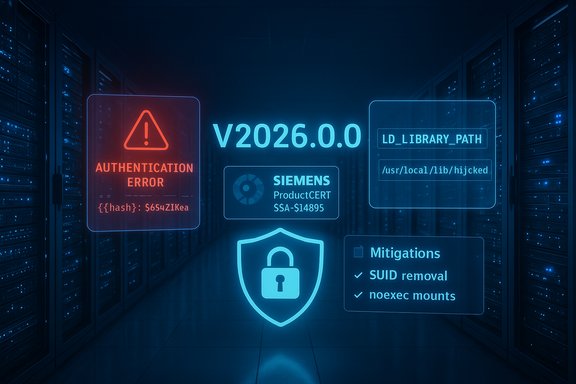
Altair Grid Engine (the distributed resource manager historically used to schedule compute workloads) shipped in Siemens‑branded appliance images and third‑party distributions is affected by two distinct vulnerabilities assigned CVE‑2025‑40760 and CVE‑2025‑40763. Siemens’ ProductCERT documents both flaws and recommends updating to Altair Grid Engine V2026.0.0 or later as the primary remediation. The vendor also publishes immediate, actionable mitigations for environments that cannot update immediately. In short:- CVE‑2025‑40760 is an information disclosure weakness (CWE‑209) where authentication error messages leak sensitive password hash material usable for offline cracking. Siemens assigns a CVSS v3.1 base score of 5.5 (confidentiality impact high; local attack vector).
- CVE‑2025‑40763 is an uncontrolled search path element (CWE‑427) that permits path hijacking during shared‑library loading and can be used for local privilege escalation to superuser — Siemens rates this one higher, with CVSS v3.1 7.8 (and CVSS v4 values up to 8.5 reported by the vendor).
Background: why this matters to IT and OT operators
Altair Grid Engine is widely used to manage compute workloads in research, engineering, and industrial analytics clusters. When Siemens integrates third‑party middleware into automation toolchains and engineering platforms, those components inherit operational privileges and the potential for lateral impact in mixed IT/OT environments.Industrial and engineering compute clusters frequently run with elevated privileges or are tied into build/engineering workflows that provision or control automation workloads. A local compromise on a scheduler host can therefore lead to:
- exposure of privileged account hashes (enabling offline credential cracking and subsequent domain or management account abuse),
- escalation to root via library path hijacking on machines that run SUID binaries,
- persistence mechanisms or supply‑chain style tampering with scheduled jobs and templates.
Technical breakdown
CVE‑2025‑40760 — Error message discloses sensitive password hashes (CWE‑209)
- What the code does wrong: the authentication path returns error messages that include password hash material when certain authentication failures occur. Those messages are observable by a local, authenticated user or by processes that can trigger and capture authentication failures.
- Attack vector and complexity: local (AV:L), low attack complexity (AC:L). An attacker needs low privileges on the host to trigger the response and harvest the leaked data.
- Impact: Confidentiality impact is high — attackers can extract password hashes for privileged accounts and perform offline brute‑force attacks to recover credentials.
- Vendor rating: Siemens reports a CVSS v3.1 base score of 5.5 and CVSS v4 values consistent with a medium severity rating for confidentiality exposure.
CVE‑2025‑40763 — Uncontrolled search path element / library hijack (CWE‑427)
- What the code does wrong: the product does not sufficiently validate or sanitize environment variables (for example LD_LIBRARY_PATH or similar) when loading shared libraries for certain binaries. This allows a user‑controlled directory to be injected into the search path so that a maliciously crafted shared library is loaded instead of the intended, trusted library.
- Attack vector and complexity: local (AV:L), low attack complexity (AC:L). The attacker needs low privileges to manipulate environment variables or to influence the working directory under which a privileged binary executes.
- Impact: confidentiality, integrity, and availability all score high if exploited (the attacker can achieve arbitrary code execution in the context of a privileged process — in this case, SUID binaries used by Altair Grid Engine).
- Vendor rating: Siemens reports CVSS v3.1 7.8 and CVSS v4 up to 8.5 for this flaw; independent trackers echo that high severity rating.
Affected versions and remediation status
- Affected: Altair Grid Engine — all versions prior to V2026.0.0 are listed as affected for these CVEs. Siemens’ ProductCERT states the vendor remediation is to update to V2026.0.0 or later.
- Vendor advisory: Siemens ProductCERT published Security Advisory SSA‑514895 documenting both CVEs and the per‑product mitigations and update guidance. This advisory is the authoritative vendor source for ongoing remediation details.
- Cross‑checks: public CVE registries (NVD, CVEdetails, Tenable/trackers) list the same CVE IDs and map their descriptions to Siemens’ advisory, confirming the product version ranges and scoring.
Immediate mitigations and workarounds (practical steps)
Siemens publishes explicit temporary mitigations that are safe to apply in production and minimize attack surface while customers plan updates. Apply these in the order you can safely test and deploy them.- Primary remediation (recommended): Update Altair Grid Engine to V2026.0.0 or later as supplied via Siemens/Altair channels. This is the only remediation that definitively fixes both flaws at their root.
- Compensating workarounds (for environments that cannot patch immediately):
- For CVE‑2025‑40760 (error‑message disclosure)
- If your cluster is not using the UGE REST API / daemon, remove the setuid‑root bit from the affected binary:
- Identify architectures installed under $SGE_ROOT (the Grid Engine root).
- Run: chmod u‑s $SGE_ROOT/utilbin/<arch>/authuser
- This prevents the binary from running with elevated privileges even if invoked incorrectly, reducing the impact of harvested hashes.
- For CVE‑2025‑40763 (library search path hijack)
- For non‑Windows clusters, remove the setuid‑root bit from the sgepasswd binary for all installed architectures:
- chmod u‑s $SGE_ROOT/bin/<arch>/sgepasswd
- Removing SUID mitigates immediate privilege escalation by ensuring the binary does not run with root privileges even if a malicious library is loaded.
- General immediate controls
- Minimize local shell and file write access on scheduler hosts: enforce strict ACLs, mount partitions with noexec where feasible for directories writable by non‑privileged users, and audit cron/jobs that may allow untrusted users to influence execution directories.
- Protect engineering and scheduler hosts from broad user populations — restrict who can SSH or submit jobs and require jump hosts with MFA for administrative access.
- Removing the SUID bit reduces the immediate risk of local privilege escalation, but it may change operational behavior if workflows legitimately require the binary to run as root. Always test the change in a staging environment before broad rollout.
- If removing SUID breaks required functionality, consider tightly constraining which users or service accounts may execute the SUID binary using Linux capabilities, sudoers controls, or replacing setuid behavior with a controlled, audited helper service that runs as root and validates callers.
Detection, monitoring, and verification
Operators should implement detection and monitoring tuned to these flaws while patching proceeds:- Search logs for unusual authentication error messages that include password hash‑like strings. CVE‑2025‑40760 is an information disclosure issue that will reveal traces in authentication‑related logs when triggered.
- Monitor for unexpected LD_LIBRARY_PATH manipulations, unusual environment variables in process tables, or attempts to execute SUID binaries from untrusted working directories. Attempts to exploit CVE‑2025‑40763 typically leave clues in process exec arguments or audit logs.
- Add file integrity monitoring (FIM) rules around SGE binaries and libraries; alert on unexpected changes to $SGE_ROOT or on new shared library files in writable directories that could be used for hijacking.
- Hunt for local account authentication failures followed by offline cracking activity or later lateral authentication attempts using recovered credentials.
- If you run an OT/engineering SIEM, create a high‑value rule set to flag:
- Calls to authuser and sgepasswd behaviors executed by non‑admin users,
- Changes to $SGE_ROOT permissions,
- Abnormal job submissions that attempt to load local libraries or write to scheduler directories.
Exploitation likelihood and attacker model
- Remote exploitation: Both CVEs are local attack vectors — they require local presence, authenticated shell access, or the ability to execute code or jobs on the same host. They are not authenticated‑remote web exploits that an Internet adversary can trivially weaponize.
- Threat actors: a local threat scenario includes insider misuse, a compromised engineering workstation, or chained attacks where an initial foothold (for example, a vulnerable, internet‑exposed management server) provides local access to scheduler hosts.
- Public exploit code: at the time of Siemens’ advisory publication and subsequent vendor republishing, there were no widely reported, public exploit codes specifically targeting these two CVEs. However, because the attack paths are straightforward (especially the SUID + library hijack pattern), organizations should act assuming exploit code could be developed quickly by motivated attackers. This is consistent with vendor and national advisories advising immediate remediation.
Operational risk assessment and prioritized checklist
Prioritize actions using this short, practical list:- Inventory: locate every Altair Grid Engine installation and confirm version. Identify $SGE_ROOT locations and installed architectures.
- Exposure assessment: confirm which hosts are reachable from engineering, enterprise, or guest networks; block any unnecessary access.
- Patch (if possible): update to V2026.0.0 or later as Siemens publishes. Validate updates in a lab before production rollout.
- Mitigate (if patching delayed):
- Apply chmod u‑s on authuser and sgepasswd as appropriate per Siemens guidance. Test functionality impact.
- Implement stricter file permissions and mount options (noexec for user‑writable spaces where possible).
- Restrict job submission and execution privileges; apply least privilege to job‑submission accounts.
- Monitor: enable FIM, audit SUID and binary execution, and alert on anomalous auth messages or library loads.
- Rotate credentials: if you detect evidence of hash leakage or account misuse, rotate passwords and keys for affected accounts and consider forced reissuance of service credentials.
- Communicate: notify engineering teams and schedule maintenance windows for patching; coordinate fallback plans if SUID removal impacts operational workflows.
Strengths of vendor guidance — and where operators must be cautious
Siemens’ advisory is practical and useful in several ways:- It assigns clear CVE identifiers and CVSS ratings for triage, giving operators a defensible severity baseline.
- It provides specific, testable mitigations (the chmod steps) that are straightforward to audit and reverse if needed.
- It documents the affected version cutoff and points operators toward the vendor update (V2026.0.0), enabling deterministic remediation planning.
- The mitigations that remove SUID mitigate privilege escalation but may break legitimate administrative features; the vendor’s guidance expects operators to validate functional impact in their environment before applying widely.
- Siemens (like many product vendors) is the canonical source for ongoing updates and per‑model status; operators should monitor ProductCERT for hotfixes or revised guidance. National agencies (CISA and others) have emphasized that after January 10, 2023, Siemens’ ProductCERT is the authoritative live feed for Siemens product vulnerabilities, so operational teams must subscribe to vendor feeds.
- Because the flaws are local, many organizations may deprioritize them compared to remote exploitable issues. That is a mistake: privilege escalation primitives on cluster hosts are attractive to attackers and can become pivot points that defeat network segmentation.
Detection‑to‑response playbook (30–90 minutes to implement)
- 0–30 minutes
- Inventory all scheduler/compute nodes and confirm running versions; block any host that is unexpectedly reachable from external or guest networks.
- Temporarily restrict SSH and job submission access to a narrow administrative set (jump hosts with MFA).
- 30–90 minutes
- Implement the SUID bit removal on a non‑production host to test operational impact: chmod u‑s $SGE_ROOT/utilbin/<arch>/authuser and chmod u‑s $SGE_ROOT/bin/<arch>/sgepasswd (where applicable).
- Add immediate audit rules (auditd/Windows Sysmon equivalent) to log executions of authuser/sgepasswd and suspicious LD_LIBRARY_PATH settings.
- Configure FIM on $SGE_ROOT and alert on new or modified shared libraries in writable directories.
Closing assessment and recommendations
The Altair Grid Engine advisories (CVE‑2025‑40760 and CVE‑2025‑40763) are textbook examples of high‑impact local vulnerabilities in widely deployed tooling: one discloses sensitive authentication material, the other provides a low‑complexity route to root via an uncontrolled search path. Siemens’ ProductCERT publishes the canonical advisory (SSA‑514895) and recommends updating to V2026.0.0; until that is applied, operators should apply the vendor’s SUID‑removal mitigations, harden host file permissions, and increase detection and monitoring around scheduler hosts. Action summary — immediate priorities:- Confirm Altair Grid Engine installations and versions.
- Plan and test update to V2026.0.0 or later as vendor fixes are available.
- Where immediate patching is not possible, apply the SUID removal mitigations described by Siemens and validate functionality in test environments before wide deployment.
- Harden access to scheduler hosts, enforce least privilege for job submission users, and enable enhanced logging and FIM to detect attempts to exploit these vector classes.
- Treat the presence of leaked password hashes as high‑impact: rotate credentials and suspect lateral movement if hash disclosure is observed.
Conclusion
Altair Grid Engine operators must treat CVE‑2025‑40760 and CVE‑2025‑40763 as urgent operational risks. Siemens’ advisory supplies both the required patch (V2026.0.0) and concrete temporary mitigations; applying them in a controlled way, combined with access hardening and monitoring, is the defensible course of action. Vendor advisories are the authoritative source for change; maintain a direct subscription to Siemens ProductCERT and schedule timely patch windows for your compute clusters.
Source: CISA Siemens Altair Grid Engine | CISA
