

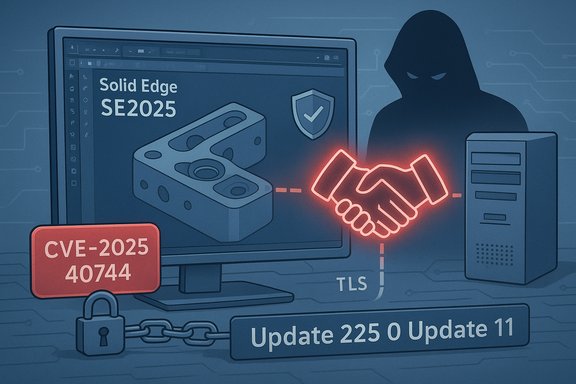
Siemens has confirmed a high‑severity certificate‑validation flaw in Solid Edge SE2025 that can be exploited remotely to perform man‑in‑the‑middle attacks against the software’s License Service connection; Siemens assigned the bug CVE‑2025‑40744 and has released a fixed build (V225.0 Update 11) while public vulnerability databases and vendor advisories report a CVSS v3.1 score of 7.5 and a CVSS v4 score of 8.7.
Solid Edge is Siemens’ mainstream CAD/engineering application used widely on Windows workstations in manufacturing, aerospace, automotive and other design‑centric industries. The recently documented vulnerability affects how the application validates client certificates when connecting to the product’s License Service endpoint, creating a classic improper certificate validation weakness (CWE‑295) that can be abused for man‑in‑the‑middle (MitM) interception of License Service traffic. Siemens’ ProductCERT lists Solid Edge SE2025 versions prior to V225.0 Update 11 as impacted and recommends updating to the fixed release. Multiple vulnerability repositories and security vendors have ingested the advisory and mirror the vendor’s technical scoring and affected‑version mapping, confirming the vendor’s published severity and remediation guidance.
In this case the License Service endpoint is the target: Solid Edge clients connect to a license‑management service to obtain entitlement information and operational licensing. If the client accepts an attacker’s certificate or does not properly check the certificate’s chain/subject/issuer constraints, the attacker can:
CISA’s historical guidance around ICS and engineering platform hardening (isolate control networks, minimize exposure to the internet, use VPNs prudently) remains relevant here; however, the specific mitigation — an updated Solid Edge build — must come from Siemens ProductCERT and the vendor’s supported update channels.
For Windows administrators and desktop engineers, the takeaways are straightforward:
Source: CISA Siemens Solid Edge | CISA
 Background / Overview
Solid Edge is Siemens’ mainstream CAD/engineering application used widely on Windows workstations in manufacturing, aerospace, automotive and other design‑centric industries. The recently documented vulnerability affects how the application validates client certificates when connecting to the product’s License Service endpoint, creating a classic improper certificate validation weakness (CWE‑295) that can be abused for man‑in‑the‑middle (MitM) interception of License Service traffic. Siemens’ ProductCERT lists Solid Edge SE2025 versions prior to V225.0 Update 11 as impacted and recommends updating to the fixed release. Multiple vulnerability repositories and security vendors have ingested the advisory and mirror the vendor’s technical scoring and affected‑version mapping, confirming the vendor’s published severity and remediation guidance. What happened (executive summary)
- Vulnerability ID: CVE‑2025‑40744 (assigned by Siemens / CVE authority).
- Affected product: Siemens Solid Edge SE2025 — all versions older than V225.0 Update 11.
- Root cause: improper validation of client certificates when the application connects to the License Service endpoint (CWE‑295).
- Impact: An unauthenticated remote actor could intercept or manipulate License Service traffic via a MitM, which Siemens and CVE records say can result in confidentiality loss (sensitive license or telemetry data disclosure) without affecting data integrity or availability in the vendor’s scoring model. CVSS v3.1: 7.5; CVSS v4: 8.7.
- Vendor remediation: Update to Solid Edge SE2025 V225.0 Update 11 or later.
Technical analysis
How an improper certificate validation bug leads to MitM
Certificate validation in TLS mutual‑auth flows is meant to ensure the peer (server or client) presenting a certificate is the expected one and that the certificate chain, validity period, and extension constraints are trustworthy. When an application fails to validate client certificates correctly, an attacker who can position themselves on the network path — or convince a client to connect to an attacker‑controlled endpoint — can present a crafted certificate or TLS handshake sequence and break the authentication step.In this case the License Service endpoint is the target: Solid Edge clients connect to a license‑management service to obtain entitlement information and operational licensing. If the client accepts an attacker’s certificate or does not properly check the certificate’s chain/subject/issuer constraints, the attacker can:
- Eavesdrop on license negotiations and telemetry exchanged with the license server.
- Tamper with license responses (if the software does not separately sign or re‑validate payloads), causing license revocation/failure or provoking erroneous behaviour.
- Use the intercepted channel as a foothold for broader reconnaissance on design workstations that communicate with the license service.
Verified technical data and scoring
- Siemens reports CVSS v3.1 base score 7.5 with vector CVSS:3.1/AV:N/AC:L/PR:N/UI:N/S:U/C:H/I:N/A:N. This indicates a network‑accessible (AV:N), low complexity (AC:L), unauthenticated (PR:N/UI:N) flaw with a high confidentiality impact (C:H).
- Siemens also computed a CVSS v4 score at 8.7, reflecting the newer CVSS normalization and emphasis on the confidentiality impact in the v4 model. Independent CVE/NVD entries and commercial vulnerability databases reflect these figures.
Attackability — how easy is exploitation?
The published vectors describe a remote network attack (no authentication required), with low attack complexity, making the flaw operationally attractive to attackers with network‑level access to license traffic. That access can be achieved via:- Local network presence (an attacker on the same subnet/VLAN).
- Compromised VPN or jump host that bridges to engineering networks.
- On‑path interception via misconfigured or compromised gateways or proxies.
- Malicious Wi‑Fi or physically compromised network segments in remote or production sites.
Context and policy implications
Since January 10, 2023, the U.S. Cybersecurity and Infrastructure Security Agency (CISA) has changed how it republishes Siemens advisories: CISA will publish an initial advisory for visibility, but ongoing updates and canonical remediation status come from Siemens ProductCERT. Operators are therefore required to consult Siemens’ ProductCERT pages for the latest fix status and follow‑on advisories. This procedural note matters because it changes where Windows administrators and SOC teams should get their authoritative updates.CISA’s historical guidance around ICS and engineering platform hardening (isolate control networks, minimize exposure to the internet, use VPNs prudently) remains relevant here; however, the specific mitigation — an updated Solid Edge build — must come from Siemens ProductCERT and the vendor’s supported update channels.
Impact and risk evaluation
Who should worry most
- Engineering and CAD workstations that run Solid Edge SE2025 and connect to a networked License Service.
- Organizations that expose licensing servers or dependent services across segmented networks or unauthenticated proxies.
- Firms with remote engineers, contractors, or third parties that route license traffic across diverse network paths (supply‑chain exposure).
- Critical manufacturing environments where CAD systems are a stepping stone into operational technology (OT) or source‑control ecosystems.
Business and security risks
- Intellectual property exposure: Intercepted license/telemetry channels may contain metadata or operational context about projects and design activities that attackers can monetize or exploit for espionage.
- Operational disruption: Although Siemens’ scoring lists no availability impact, manipulated license replies could cause license denials that interrupt engineering work and manufacturing schedules.
- Pivot potential: Successful MitM positions can facilitate lateral movement to other engineering systems that integrate with license workflows, such as PLM or build automation systems.
Known exploitation status
As of the vendor publication and public CVE/NVD entries, there were no public reports of exploitation specifically targeting CVE‑2025‑40744 at time of publishing; however this is a rapidly changing area and the absence of public exploitation reports does not mean the vulnerability is not being probed or used in targeted intrusions. Operators should assume adversaries will attempt to scan and test exposed license endpoints once a public advisory exists. Treat “no public exploitation reported” as time‑bound and not a reason to defer remediation.Mitigation and response
Vendor fix (authoritative, immediate)
- Apply the vendor update: Move affected Solid Edge SE2025 installations to V225.0 Update 11 or later as the primary remediation path. Siemens ProductCERT documents this as the fix and the authoritative upgrade target. Validate your installed build string before and after patching.
- Test before wide rollout: Engineering software distributions often include third‑party add‑ins, custom templates, and certified workflows. Deploy the update first in a test lab or pilot group to verify third‑party tool compatibility and license server interoperability.
Network and operational mitigations (if immediate patching is delayed)
- Minimize network exposure: Ensure license servers and clients are not accessible from the public internet. Place license servers and engineering hosts behind strict ACLs and firewall rules. This reduces the attack surface for a MitM.
- Isolate engineering networks: Put CAD/CAM workstations and license servers on segmented VLANs with tightly controlled egress and ingress rules; forbid lateral network access from general business and guest networks.
- Harden VPNs and remote access: Use modern, patched VPN concentrators and enforce MFA; reduce the number of services reachable over remote links. Remember that VPNs can be an attack vector if misconfigured — treat them as high‑risk conduits for license traffic.
- Use TLS inspection and certificate pinning where feasible: For internal license servers, consider strict certificate pinning or certificate‑based mutual authentication on hardened PKI, so that clients only accept known, vendor‑trusted certificates. If Solid Edge supports additional configuration for stricter certificate checks, enable them per product documentation.
- Monitor for anomalous license server behavior: Track unexpected changes in license grants, unusual client IPs or certificate chains, and sudden increases in failed or reissued license requests.
Short checklist for IT and SecOps teams
- Inventory: Identify all Solid Edge SE2025 hosts and license servers on the estate (hostnames, IPs, build versions).
- Patch: Schedule and apply V225.0 Update 11 in test, then production.
- Block: Restrict license server access to known IP ranges and management hosts.
- Monitor: Add telemetry for TLS handshake metadata and certificate details on license traffic.
- Communicate: Inform engineering teams about expected downtime, validation steps, and to avoid connecting to unknown networks during the update window.
Detection and monitoring guidance
- Enable logging on perimeter devices and license servers to capture TLS negotiation details, including presented client certificates and certificate chains.
- Configure endpoint and EDR tools to alert on unusual outbound TLS destinations from engineering workstations.
- Search SIEM logs for anomalies such as:
- Unusual certificate issuers in license‑service handshakes.
- Unexpected certificate validity or chain errors recorded on clients.
- Abrupt changes in license request volumes or repeated handshake failures.
- If you suspect an incident, preserve packet captures (PCAP) of license traffic and export relevant workstation memory/forensic images to allow analysis of any post‑compromise artifacts.
Broader operational recommendations for Windows environments running CAD
- Treat engineering workstations as high‑value assets requiring more rigid segmentation and hardened baseline images.
- Maintain a dedicated patching cadence for CAD applications and their protectors (license managers, drivers, add‑ins).
- Enforce least privilege for users on CAD machines: engineers should run daily tasks under non‑admin accounts whenever possible.
- Run critical applications in constrained environments (application whitelisting, sandboxing, or virtualization) to limit the risk of lateral escalation from a compromised CAD process.
- Institute strict file‑ingestion controls for design artifacts (document sanitation, content disarm and reconstruction) — while this CVE is network‑facing, many other Solid Edge CVEs to date involved malicious file parsing.
Why this advisory matters to WindowsForum readers
Windows‑based engineering workstations are the primary runtime target for Solid Edge. Unlike some supply‑chain or embedded device fixes that only appliance owners need to track, this issue affects typical Windows CAD clients that often sit in mixed IT/OT contexts — making the risk both widespread and practical to exploit if network access is available.For Windows administrators and desktop engineers, the takeaways are straightforward:
- Prioritize an inventory and patch window for Solid Edge SE2025 installs immediately.
- If patching cannot be completed immediately, harden network controls around license traffic and monitor actively for TLS anomalies.
- Treat the license service as a critical enterprise service: secure it like any other sensitive authentication/entitlement system.
Caveats, verification and trustworthiness of claims
- The technical details and severity metrics cited in this article are verified against Siemens’ ProductCERT entry for SSA‑522291 and corroborated by public CVE/NVD and commercial vendor feeds. The affected version and recommended remediation (V225.0 Update 11) are stated in the vendor advisory.
- The claim that “no public exploitation has been reported” must be treated as time sensitive. The absence of public exploitation reports at publication does not preclude private or targeted exploitation; organizations should assume active scanning attempts may follow public disclosure and act accordingly.
- Where upstream or third‑party observations differ from the vendor’s advisory, always prioritize Siemens ProductCERT for remediation status — CISA’s republication policy ties follow‑on tracking of Siemens issues to Siemens’ own advisories.
Practical patch rollout plan (recommended sequence)
- Inventory hosts and license servers; tag critical projects or machines where downtime is most impactful.
- Download V225.0 Update 11 from Siemens’ official update channels and verify checksums on the installer package.
- Stage the update in a sandbox/test lab with representative add‑ins and sample license configurations.
- Validate license connectivity and all third‑party integrations (PLM connectors, CAM tooling, rendering services).
- Schedule a maintenance window with engineering leads for production rollout; include rollback plans and system restore points.
- Post‑patch, verify TLS handshake behavior and certificate validation logs to ensure the defect is resolved in your environment.
Conclusion
CVE‑2025‑40744 is a high‑severity certificate validation defect in Siemens Solid Edge SE2025 that increases risk for any Windows‑based engineering workstation or license‑service deployment exposed to untrusted networks or insufficiently controlled remote access channels. The fix is straightforward in principle — apply V225.0 Update 11 — yet operational realities (testing, third‑party tool compatibility, and network topology) mean organizations must combine patching with immediate network hardening and telemetry work to reduce exposure in the near term. Verify your Solid Edge build, follow Siemens ProductCERT guidance, and treat license‑service communications as a sensitive part of your engineering infrastructure.Source: CISA Siemens Solid Edge | CISA
