

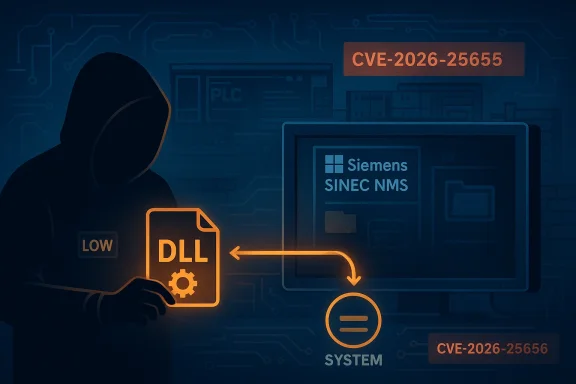
Siemens has released fixes for two high‑severity local privilege‑escalation flaws in its SINEC NMS family that allow a low‑privileged local user to modify configuration data in a way that forces the product to load attacker‑controlled DLLs — a classic uncontrolled search path (DLL hijack) weakness that can lead to arbitrary code execution at elevated or SYSTEM privileges. Siemens’ ProductCERT describes the issues as CVE‑2026‑25655 and CVE‑2026‑25656 and recommends immediate updates; independent trackers and CVE aggregators have mirrored the vendor’s findings and scoring.
SINEC NMS is Siemens’ network management system used to monitor, manage and configure industrial network infrastructures. The User Management Component (UMC) integrates with Microsoft Active Directory for centralized user provisioning in many industrial environments; both the core NMS product and UMC are implicated in the new advisories. Siemens assigned CVSS v3.1 scores of 7.8 for the reported issues and published vendor fixes as the remediation path.
These products are widely deployed in IT/OT converged environments — manufacturing plants, utilities and critical infrastructure — meaning that an escalation on a SINEC host can have downstream consequences for Windo services and SIEM/telemetry collectors that integrate with SINEC workflows. Practical attack chains in these mixed environments are well documented in incident playbooks and recent vulnerability analyses for SINEC components.
Independent vulnerability aggregators have reproduced Siemens’ summary and scoring, confirming the affected version boundaries and the CWE mapping. No public proof‑of‑concept exploit was published at the time of disclosure; trackers note no known active exploitation but still classify the risk as high because the complexity is low when local access exists.
Operators should:
Source: CISA Siemens SINEC NMS | CISA
 Background / Overview
SINEC NMS is Siemens’ network management system used to monitor, manage and configure industrial network infrastructures. The User Management Component (UMC) integrates with Microsoft Active Directory for centralized user provisioning in many industrial environments; both the core NMS product and UMC are implicated in the new advisories. Siemens assigned CVSS v3.1 scores of 7.8 for the reported issues and published vendor fixes as the remediation path.These products are widely deployed in IT/OT converged environments — manufacturing plants, utilities and critical infrastructure — meaning that an escalation on a SINEC host can have downstream consequences for Windo services and SIEM/telemetry collectors that integrate with SINEC workflows. Practical attack chains in these mixed environments are well documented in incident playbooks and recent vulnerability analyses for SINEC components.
What was disclosed: CVE‑2026‑25655 and CVE‑2026‑25656
CVE‑2026‑25655 — SINEC NMS (All versions < V4.0 SP2)
Siemens reports that versions of SINEC NMS prior to V4.0 SP2 permit improper modification of a configuration file by a low‑privileged user. By abusing that control, an attacker can influence the DLL search/load behavior and cause the application to load malicious libraries, potentially resulting in arbitrary code execution with administrative privileges on the host. Siemens maps the underlying fault to CWE‑427: Uncontrolled Search Path Element and strongly recommends upgrading to V4.0 SP2 or later.CVE‑2026‑25656 — SINEC NMS and User Management Component (UMC)
CVE‑2026‑25656 covers similar configuration‑tampering/DLL‑load attack vectors in SINEC NMS in general and specifically the User Management Component (UMC). Siemens states that all versions of SINEC NMS are affected by this CVE, and that UMC versions prior to V2.15.2.1 are vulnerable. The vendor’s advisory indicates this vulnerability can lead to arbitrary code execution with SYSTEM privileges if exploited, and it provides patched UMC builds and guidance to update UMC integrations to the compatible fixed version.Independent vulnerability aggregators have reproduced Siemens’ summary and scoring, confirming the affected version boundaries and the CWE mapping. No public proof‑of‑concept exploit was published at the time of disclosure; trackers note no known active exploitation but still classify the risk as high because the complexity is low when local access exists.
Technical analysis: how the attack works and why it matters
At core, both CVEs are local attacks that exploit how the product determines which DLLs to load at runtime. The vulnerability class (CWE‑427) covers cases where an application uses an unsafe or manipulable search path to locate dependencies — for example, reading a configuration entry that contains a path or filename the application later loads without adequate validation.- A low‑privileged user who can alter that configuration file can point the loader to a directory under the attacker’s control.
- When the service or process restarts, Windows’ dynamic loader follows the path and may load the attacker’s library into the process context.
- If the target process runs with administrative or SYSTEM privileges (as many service processes do), the loaded payload executes with that elevated privilege, giving the attacker control over the host.
- Many SINEC components run as services on Windows hosts and have elevated privileges by design. A local hijack therefore yields privileged code execution rather than a constrained user‑level compromise.
- UMC’s tight integration with Active Directory and credential stores makes a compromised UMC host a valuable pivot point for lateral movement, credential harvesting and subsequent attacks against Windows management planes.
- Both CVEs require local write access to an application configuration file or other local file system location that influences the DLL load path. They are not (in Siemens’ description) remote code‑execution flaws exploitable directly over the network without local access. That said, local access can be achieved in multiple realistic ways (compromised engineering workstation, weak local accounts, exposed remote support tools), so the practical exploitability remains meaningful in OT environments.
Exposure, risk and real‑world scenarios
Operators should perform an immediate invNMS and UMC are installed and determine which hosts run services as SYSTEM or require elevated privileges. Typical high‑risk scenarios include:- An engineering laptop with access to a SINEC host is compromised (phishing, malicious USB), giving an attacker local file write capability and a path to abuse the DLL load process.
- Service accounts or shared local accounts with weak passwords allow low‑privileged login to a SINEC host, enabling changes to configuration files.
- Enemote desktop or poorly segmented remote support solutions expose avenues for local access without physical presence.
- Full takeover of the SINEC management plane — the attacker can alter network device configs, suppress monitoring alerts, or persist code that survives reboots.
- Credential theft and lateral movement — once code runs with SYSTEM privileges on a host connected to AD or Windows management servers, attackers can pivot into domain controllers or SIEM collectors.
- Disruption of industrial operations by tampering with management data, reporting and monitoring.
Recommended immediate actions (0–72 hours)
Siemens has published fixed versions and strongly advises updating affected components; patching is the authoritative remediation.- Prioritize patches
- Update SINEC NMS to V4.0 SP2 or later to address CVE‑2026‑25655.
- Update UMC to V2.15.2.1 or later and ensure any products integrating UMC use the compatible fixed UMC version to remediate CVE‑2026‑25656.
- If you cannot patch immediately, implement compensating controls:
- Restrict local write permissions to configuration directories to system administrators only.
- Harden local accounts: disable unnecessary interactive logins, enforce unique accounts and MFA for operator/engineering access where possible.
- Isolate SINEC servers on a secure management VLAN, reachable only from a small set of hardened jumremote access paths that provide local file write (e.g., shared folders mapped by non‑admin users).
- Short‑term network mitigations:
- Place SINEC hosts behind OT firewalls and deny inbound access from untrusted zones.
- Ensure management services are not exposed to the internet.
- Use host‑based allowlisting and EDR/antivirus to detect unauthorized DLLs or anomalous service restarts. ([cisa.gov](Siemens SINEC NMS | CISA monitoring (immediate):
- Audit file integrity of configuration directories and track unexpected writes by low‑privileged processes.
- Alert on service process loads that reference DLLs located in non‑standard diable paths.
- Correlate local account activity on SINEC hosts with subsequent network authentication events into Windows domains.
Patching and change‑management guidance (practical checklist)
Follow a disciplined, OT‑aware patch process before rolling updates network‑wide:- Inventory
- Enumerate every SINEC NMS and UMC installation, including build strings and any third‑party plugins. Confirm which hosts run services as SYSTEM.
- Lab & test
- Acquire the vendor patches (verify signatures and checksums), deploy them in an isolated staging environment that mirrors production, and validate integrations (AD sync, reporting, device connections).
- Schedule
- Plan maintenance windows in accordance with OT change control, including rollback and backup procedures for configuration and binaries.
- Deploy (staged rollout)
- Pilot → small production pool → full production; monitor logs and telemetry for anomalies during the rollout.
- Post‑patch validation
- Confirm that configuration permissions are correct, that no user‑writable directories are referenced by service DLL loads, and that monitoring and reporting still function as expected.
- Document and communicate
- Record the chand any workarounds applied; notify stakeholders in engineering, IT and security teams.
Detection guidance: what to log and watch for
Effective detection improves containment if an attacker tries to abuse these flaws:- File system auditing: watch for writes to SINEC configuration directories by non‑admin accounts.
- DLL load tracing: instrument hosts (where feasible) to log DLL load paths and alert on libraries loaded from user‑writable locations.
- Process lifecycle: alert on unexpected restarts of SINEC services or child processes running under SYSTEM that spawn network connections to unusual endpoints.
- SIEM correlations: link local non‑privileged login events on SINEC hosts to later privilege escalation or network authentications (possible lateral moves).
Strengths and limits of Siemens’ response
Strengths:- Siemens published an advisory with clear CVE IDs, CWE mapping and explicit affectednabling operators to triage and act quickly. The vendor also produced targeted fixed releases for the affected components.
- Both flaws are local in nature; the advisory therefore relies on operators’ ability to reduce local access and follow strong host‑hygiene practices — something operationally challenging in many OT environments with legacy workflows.
- The advisory does not include a detailed forensic indicator list for malicious DLL names or file hashes, which would aid rapid detection across customer deployments; that omission increases the burden on defenders to perform thoroughch indicators are lacking, defenders must rely on behavioral detection and file integrity monitoring.
Strategic recommendations for Windows‑oriented defenders in mixed IT/OT environments
- Treat SINEC hosts as critic Include them in AD‑based monitoring, EDR coverage and automated patch inventories just as you would for domain controllers or critical application servers.
- Enforce least privilege and unique accounts
- Eliminate shared local admin accounts and require MFA for engineering logins. Restrict interactive logins to trusted workstations (jump hosts).
- Strengthen network architecture
- Keep management interfaces isolated in a hardened VLAN with strict ACLs. Ensure jump hosts are tightly controlled and monitored.
- Drive vendor transparency in procurement
- Require signed updates, clear CVE mapping and timely indicators as part of supplier security SLAs. Maintain an automated subscription to Siemens ProductCERT notifications to receive vendor advisories as they are posted.
- Test and exercise incident response
- Run tabletop exercises that assume an SINEC host compromise and validate detection, containment and recovery acti OT teams.
What defenders should not assume
- Don’t assume “local only” means “low risk.” In modern industrial environments, remote compromise of an engineering workstation, insecure remote support tools, or exposed administrative services frequently create pathways for local exploits. Treat local privilege escalation vulnerabilities with urgency, especially on hosts that run as SYSTEM or integrate with AD.
- Don’t rely solely on network perimeters. While network segmentation is critical, robust host‑level controls (file permissions, process allowlisting, DLL load path hygiene) are equally important to prevent DLL hijacking.
- Be cautious about unverified third‑party fixes. Always validate vendor updates in a controlled environment before broad deployment to avoid service disruptions in production OT systems.
Final assessment and takeaways
CVE‑2026‑25655 and CVE‑2026‑25656 are substantive, high‑risk local privilege escalation flaws in Siemens’ SINEC NMS family and its User Management Component. The attack vector is straightforward when an attacker can write to configuration files that influence DLL loading, and the consequences in an IT/OT environment can be severe: SYSTEM‑level code execution, credential theft and operational disruption are credible outcomes. Siemens has published fixes — updating to SINEC NMS V4.0 SP2 and UMC V2.15.2.1 (or later) is the recommended remediation path.Operators should:
- Immediately inventory affected assets, prioritize patch testing and deployment, and apply compensating controls where patching is delayed.
- Harden local account management, enforce segmentation and increase visibility into DLL loads and configuration file integrity.
- Integrate SINEC host monitoring into Windows‑centric detection and IR processes so that a compromise of an OT monitoring host does not become the hidden pivot that brings down the broader enterprise.
Source: CISA Siemens SINEC NMS | CISA
