

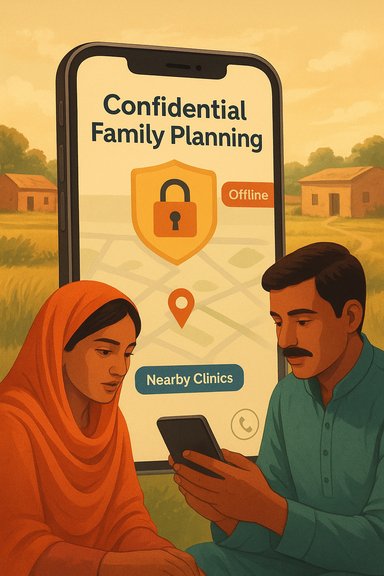
Sindh’s Population Welfare Department has rolled out a free, confidential mobile application intended to give couples discreet access to contraceptive counselling, personalised reproductive-health advice, a clinic-locator and offline educational resources — a six‑month pilot described by provincial officials as a way to reduce stigma and expand access to family‑planning services across the province.
Sindh’s new digital offering arrives against a stark public‑health backdrop: recent national studies estimate several million induced abortions annually and a persistent gap between contraceptive need and service uptake. Global reproductive‑health research groups and peer‑reviewed analyses place Pakistan’s annual induced‑abortion figure in the multi‑million range (estimates around 3.6–3.8 million in recent analyses), underscoring the scale of unmet needs and the potential impact of non‑clinical or confidential pathways to counselling. The province of Sindh has been active on family‑planning targets, participating in national and international initiatives and partnering with donor and NGO networks on FP2030 goals and related digital health pilots. Digital channels — from targeted client communication to telemedicine — are already recognized by global health authorities as useful tools when privacy, equity and data‑protection concerns are handled responsibly.
Key next steps are straightforward: publish the app’s privacy architecture and data‑handling policies; secure independent security audits; obtain formal partner confirmations from development agencies; and run a pilot that transparently measures safety, privacy incidents and reach across Sindh’s urban and rural communities. Done correctly, a confidential, offline‑capable reproductive‑health app can be a powerful complement to clinic‑based services; done without appropriate safeguards, it risks exposing some of the very people it aims to protect.
(Reporting based on provincial statements and local coverage; verification checks found consistent media reporting of the app and its features, corroborating the main claims, while some partnership and technical details remain to be publicly documented by implementing organisations.
Source: 247news.com.pk Sindh Launches Free Confidential Family Planning App for Couples - 247News
 Background
Sindh’s new digital offering arrives against a stark public‑health backdrop: recent national studies estimate several million induced abortions annually and a persistent gap between contraceptive need and service uptake. Global reproductive‑health research groups and peer‑reviewed analyses place Pakistan’s annual induced‑abortion figure in the multi‑million range (estimates around 3.6–3.8 million in recent analyses), underscoring the scale of unmet needs and the potential impact of non‑clinical or confidential pathways to counselling. The province of Sindh has been active on family‑planning targets, participating in national and international initiatives and partnering with donor and NGO networks on FP2030 goals and related digital health pilots. Digital channels — from targeted client communication to telemedicine — are already recognized by global health authorities as useful tools when privacy, equity and data‑protection concerns are handled responsibly. What the app promises: features and use cases
Core features reported by officials
- Confidential counselling and personalised medical advice — users can obtain guidance on contraceptive options and reproductive‑health questions remotely.
- Information on short‑ and long‑term contraceptive methods, including educational material, FAQs and a dedicated helpline.
- Clinic‑locator tool that uses the user’s location to display nearby family‑planning centres, services offered, clinic hours and doctor information.
- Offline functionality so that content and some features remain available in low‑connectivity or rural environments.
- Integration with the department’s electronic monitoring system to route anonymised or aggregated data into provincial dashboards for tracking service delivery and program performance. Officials state the system will feed the department’s electronic network.
Pilot: rollout plan and governance
Officials state the app is undergoing a six‑month pilot across Sindh before a wider public launch. Provincial leadership — including the Population Welfare Secretary — has framed the pilot as a controlled test to validate workflows, privacy mechanisms and uptake among married couples seeking confidential advice. Reports say the app was developed in collaboration with international development partners and has approval from the provincial Health Minister.Who is reported to be involved — and what’s verified
Multiple Pakistani media outlets report that the app was created in collaboration with Pathfinder International and the World Bank, and that it carries the approval of Sindh Health Minister Dr. Azra Fazal Pechuho and Population Welfare Secretary Hafeezullah Abbasi. These are the names and institutional partners quoted in local press coverage. Caveat and verification note: while media outlets consistently repeat these partnership claims, an independent, dated press release from either the World Bank Pakistan or Pathfinder International explicitly announcing this specific app was not found at the time of reporting. Pathfinder has a documented presence and programmatic engagement in Sindh reproductive‑health initiatives, and the World Bank is active on health systems work in Pakistan, but the explicit project page or media statement confirming the app’s development by those organisations was not located in public repositories during the verification checks. The provincial press statements and local reporting remain the primary sources for the partnership claim. Readers and implementers should treat the involvement of international partners as “reported by provincial and national media” until corroborated by a direct organisational statement.Why a confidential app matters: public‑health benefits
- Reduces social and cultural barriers. Confidential digital counselling can allow couples — especially women — to seek information without the stigma or community scrutiny that sometimes accompanies clinic visits. This is critical in conservative contexts where in‑person visits are socially sensitive.
- Increases access in remote areas. Offline functionality and locally cached educational content make the tool more usable in rural Sindh, where intermittent connectivity and lower smartphone penetration create access challenges.
- Potential to reduce unsafe practices. By providing medically framed guidance and signposting to qualified clinics, a confidential app can steer people away from unsafe self‑management or non‑clinical providers, which in turn may reduce complications and maternal morbidity. High rates of abortion and complications in Pakistan underline the need for safer access routes.
- Improved monitoring for program managers. If privacy‑protecting analytics and aggregated dashboards are used, the department can better target commodities, outreach and clinic staffing to areas with unmet need.
Major technical, privacy and ethical questions
The app’s potential is significant, but so are the technical and ethical risks that must be actively managed. These are the priority considerations for implementers, funders and civil‑society stakeholders.1) Data collection: what, how much, and why?
Any health app that provides personalised medical advice and integrates with government systems will collect at least some personal and health information. The reported clinic‑locator and helpline features imply that location data, service usage logs and possibly contact details will be handled. Minimising data collection to the smallest necessary set is a first principle of safe digital health design.2) Device storage and offline mode risks
Offline operation typically requires storing content or user inputs locally on the device. That makes the app’s local storage a potential point of vulnerability if devices are lost, shared, or accessible to others. Without robust local encryption and secure access controls (PIN, biometric lock, app‑level passphrase), confidential information can be exposed. This is especially sensitive in households where mobile devices may be monitored.3) Location data and clinic‑locator privacy concerns
Clinic location features help users, but collecting or transmitting GPS coordinates can create a de‑anonymisation risk. Even if names are not stored, repeated location pings combined with clinic visit metadata can reveal identity or sensitive behaviours. Location metadata is high‑risk in contexts with stigma and must be carefully handled: offer opt‑in permissions, store only coarse location or nearest‑facility indexes, and allow manual clinic search as a privacy‑preserving alternative.4) Integration with government electronic monitoring
Feeding data into a departmental electronic monitoring system can dramatically improve program management, but it raises governance questions: how will personal identifiers be stripped or pseudonymised, what aggregation levels will the department use, and who will have access? Without strong legal and technical safeguards, integration increases the attack surface and the chance of misuse or inadvertent disclosure. Reports indicate the app will feed the department’s network, but the mechanics and safeguards have not been publicly detailed.5) Legal and regulatory environment
Pakistan’s legal framework for data protection remains fragmented. There is no single, mature, enforceable national data‑protection regime with a dedicated regulator that mirrors GDPR‑style protections; instead, a mix of sectoral laws and cybercrime statutes applies, and courts have recently wrestled with privacy‑related surveillance issues. This regulatory gap complicates accountability for sensitive health data and places extra responsibility on implementers to adopt internationally recognised safeguards by design.6) Operational security: authentication, encryption, audits
Key technical controls that should be mandatory for any confidential health app include:- Encryption in transit (TLS) and strong encryption at rest for any stored personal health information.
- App‑level authentication options (PIN, biometric) and automatic lockouts.
- Secure key management to prevent server‑side exposure.
- Regular third‑party security audits and penetration tests, with remedial action plans and disclosure to oversight bodies.
- Minimal retention schedules: delete personally identifiable data as soon as it’s no longer needed and document retention policies.
These are industry best practices endorsed by digital‑health guidelines and should be the baseline for the Sindh app.
Equity and usability concerns
Digital tools can widen equitable access — or deepen divides.- Digital divide: smartphone ownership, digital literacy and gendered access to devices vary across Sindh. Offline functionality helps, but app design must also consider low‑literacy users, multiple languages, and non‑smartphone alternatives (SMS, voice hotlines).
- Cultural acceptability: content must be tailored for local norms while preserving medical accuracy. Community engagement, religious‑leader dialogues and user testing with women and men from diverse districts are necessary to build trust and uptake.
- Safety and coercion risks: for users in controlling relationships, using an app that leaves traces on a shared phone may create safety risks. The app should offer a “quick‑exit” feature, stealth mode, and guidance on safe usage practices.
Recommendations: technical, governance and policy
For the app to deliver public‑health value without imposing unacceptable privacy or safety risks, implementers should adopt a compact roadmap that balances usability and protection.Technical recommendations
- Data minimisation by default. Collect only what is strictly necessary for the counselling interaction; avoid storing persistent identifiers where possible.
- Local encryption & secure offline design. All locally stored data should be encrypted with keys tied to the user’s device and a user passphrase; provide clear instructions for safe deletion.
- Granular consent and privacy controls. Explicit, plain‑language consent dialogs should explain what data will be stored, for how long, and who will access aggregated or individual records. Allow users to opt out of location sharing and analytics.
- Pseudonymisation and aggregation for monitoring. Send only de‑identified or aggregated metrics to the department dashboard. If personal data are necessary for follow‑up, require additional explicit consent and secure data‑handling agreements.
- Independent security and privacy audits. Commission external third‑party audits, publish summaries, and fix findings promptly.
- Open‑source / transparency where appropriate. Publishing technical specifications or selective code can boost community trust and allow independent security reviews.
Governance and policy recommendations
- Clear data‑governance framework signed by implementing partners, defining roles (data controller, processor), retention periods, access rights and dispute resolution.
- Accountability mechanisms — oversight by provincial health authorities, civil‑society observers and data‑protection experts.
- User redress and helplines that allow deletion requests, complaint filing and support for sensitive cases.
- Community engagement and outreach to explain privacy protections and safe use to diverse communities, including women’s groups and remote districts.
Operational recommendations for rollout
- Pilot with a representative sample of districts and user groups, measuring not just uptake but safety incidents, unintended disclosures and equity metrics.
- Use iterative release cycles informed by user feedback and security test results.
- Build parallel non‑digital pathways (telephony, SMS, community outreach) for users without smartphone access.
What remains unverified and what to watch
- The precise technical architecture (where data are hosted, encryption standards used, whether user identifiers are stored) has not been publicly detailed in media reports to date. That material is essential to independently evaluate privacy risk.
- The reported involvement of international partners (World Bank, Pathfinder) appears in local press, but an independent, dated confirmation from these organisations’ official communications channels was not located during the verification checks; stakeholders should seek formal partner statements and project documentation.
Short checklist for users and local health managers
- For users: check app permissions before installing, avoid sharing highly sensitive details unless comfortable, enable device‑level security, use the helpline for urgent guidance.
- For health managers: require vendor security attestations, adopt strict data‑sharing agreements, monitor equity impact and prepare to scale non‑digital alternatives.
Conclusion
Sindh’s family‑planning app is a notable attempt to harness digital channels to tackle a longstanding public‑health and social challenge: enabling confidential access to contraception and reproductive‑health advice in a context where stigma and logistics often deter clinic visits. If the pilot translates into a securely engineered, privacy‑conscious service, the platform can expand access and bring timely clinical guidance to people who would otherwise delay care. However, the health benefits will only be realised if technical safeguards, transparent governance and equity‑focused rollout accompany the digital innovation.Key next steps are straightforward: publish the app’s privacy architecture and data‑handling policies; secure independent security audits; obtain formal partner confirmations from development agencies; and run a pilot that transparently measures safety, privacy incidents and reach across Sindh’s urban and rural communities. Done correctly, a confidential, offline‑capable reproductive‑health app can be a powerful complement to clinic‑based services; done without appropriate safeguards, it risks exposing some of the very people it aims to protect.
(Reporting based on provincial statements and local coverage; verification checks found consistent media reporting of the app and its features, corroborating the main claims, while some partnership and technical details remain to be publicly documented by implementing organisations.
Source: 247news.com.pk Sindh Launches Free Confidential Family Planning App for Couples - 247News
