

Singapore’s demand for AI-related skills has surged so sharply that SkillsFuture Singapore (SSG) reports it has more than doubled across sectors between 2022 and 2025 — a shift driven most rapidly by generative AI capabilities and accompanied by a finding that roughly one in four work tasks can already be significantly aided by AI under today's technology. (isomer-user-content.by.gov.sg)
SkillsFuture Singapore presented the findings at the 2026 Training and Adult Education Conference, where Acting Minister for Culture, Community and Youth and Senior Minister of State for Education David Neo flagged the scale and speed of change and urged a two‑pronged response: help workers learn to use AI, and help them learn beyond AI — strengthening uniquely human capabilities such as critical thinking, judgement and self‑management.
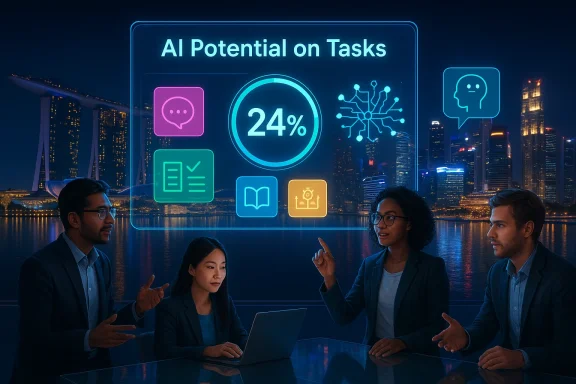
SSG released a concise factsheet describing two pilot studies underpinning these headlines. The first analysed about 37,000 work tasks spanning 2,000 job roles in 38 Skills Frameworks and concluded that about 24 percent of tasks can be significantly aided by AI today. The second pilot drilled into six sectors — accountancy, built environment, financial services, infocomm technology (ICT), retail and tourism — and grouped roles into three learning archetypes: Mastery Builders, Analytical Specialists, and Human Connectors. SSG also announced a new “AI Potential on Tasks” dashboard on its Jobs‑Skills Portal to help employers, training providers and workers interpret these results. (isomer-user-content.by.gov.sg)
The task‑level pilot used a more granular approach: rather than treating each occupation as monolithic, SSG parsed component work tasks (roughly 37,000 items) and applied an AI‑capability mapping to estimate where current AI tools can significantly aid work. This mirrors the established research strategy used in major automation studies: measuring automation potential by activities rather than by whole occupations. SSG’s estimate is therefore a task‑level feasibility assessment, not a deterministic prediction of mass job loss. (isomer-user-content.by.gov.sg)
Broad, cross‑sector evidence supports the idea that automation and AI will affect parts of most jobs rather than eliminate entire occupations. Major international analyses (for example, McKinsey Global Institute) have similarly modelled automation by activity and found that few occupations are fully automatable today, but many contain substantial automatable components. This convergent evidence strengthens the interpretation that task‑level assistance is the early and dominant effect of modern AI adoption.
The OECD and other international bodies have also documented similar structural dynamics: automation and AI change wage structures and skill demands unevenly, and policy responses that emphasise continuous learning and targeted support will be critical to managing transitions equitably. These global perspectives reinforce the prudence of SSG’s combined approach of measurement, funding reform and tool development.
For organisations and individual professionals, the immediate priorities are practical: map tasks, preserve learning experiences for junior workers, and combine AI tool fluency with robust critical thinking and governance training. For policymakers, the challenge is to align funding, quality assurance and labour market monitoring to ensure that the doubling demand in job postings translates into durable, inclusive capability building — not only short‑lived demand signals.
SSG has built the evidence and a public dashboard; the next phase is execution. For technologists and WindowsForum readers, the message is clear: learn the tools, but invest equally in the human skills that will decide whether AI becomes an augmentation of human potential or a source of brittle automation. (isomer-user-content.by.gov.sg)
Source: HardwareZone AI skills demand doubles in Singapore by 2025
 Background
SkillsFuture Singapore presented the findings at the 2026 Training and Adult Education Conference, where Acting Minister for Culture, Community and Youth and Senior Minister of State for Education David Neo flagged the scale and speed of change and urged a two‑pronged response: help workers learn to use AI, and help them learn beyond AI — strengthening uniquely human capabilities such as critical thinking, judgement and self‑management. SSG released a concise factsheet describing two pilot studies underpinning these headlines. The first analysed about 37,000 work tasks spanning 2,000 job roles in 38 Skills Frameworks and concluded that about 24 percent of tasks can be significantly aided by AI today. The second pilot drilled into six sectors — accountancy, built environment, financial services, infocomm technology (ICT), retail and tourism — and grouped roles into three learning archetypes: Mastery Builders, Analytical Specialists, and Human Connectors. SSG also announced a new “AI Potential on Tasks” dashboard on its Jobs‑Skills Portal to help employers, training providers and workers interpret these results. (isomer-user-content.by.gov.sg)
What SSG actually measured — and what those numbers mean
From job postings to tasks: the data sources
SSG’s headline on demand doubling is derived from labour‑market surveillance using online job posting data and skills cluster analysis. That is, the “doubled” figure reflects growth in the frequency with which employers mention or require AI‑related capabilities (for example, “generative AI”, “model evaluation”, “responsible AI”) in job ads and skills taxonomies used in the Skills Frameworks. This is a legitimate, widely used approach for near‑real‑time demand signals — but it is not the same thing as a census of all AI roles or an exhaustive inventory of training activity. (isomer-user-content.by.gov.sg)The task‑level pilot used a more granular approach: rather than treating each occupation as monolithic, SSG parsed component work tasks (roughly 37,000 items) and applied an AI‑capability mapping to estimate where current AI tools can significantly aid work. This mirrors the established research strategy used in major automation studies: measuring automation potential by activities rather than by whole occupations. SSG’s estimate is therefore a task‑level feasibility assessment, not a deterministic prediction of mass job loss. (isomer-user-content.by.gov.sg)
The headline numbers, verified
- Demand for AI‑related capabilities increased more than twofold between 2022 and 2025 across sectors, with generative AI skills showing the fastest growth. (isomer-user-content.by.gov.sg)
- The task study found ~24% of tasks can be significantly aided by AI given today’s technology, based on 37,000 tasks across 2,000 job roles in 38 Skills Frameworks. (isomer-user-content.by.gov.sg)
Why the findings matter: productivity, learning pathways and workforce design
Productivity upside — but not simply redundancy
If roughly one quarter of tasks can be aided by AI, the immediate implication is potential productivity gains, not automatic headcount reductions. AI is especially effective at repetitive cognitive tasks — data collection, formatting, summarisation, and pattern detection — which can free human workers for higher‑value decision, judgement and interpersonal activities. SSG frames this as an opportunity for job redesign, training investments, and productivity uplift across many industries. (isomer-user-content.by.gov.sg)Broad, cross‑sector evidence supports the idea that automation and AI will affect parts of most jobs rather than eliminate entire occupations. Major international analyses (for example, McKinsey Global Institute) have similarly modelled automation by activity and found that few occupations are fully automatable today, but many contain substantial automatable components. This convergent evidence strengthens the interpretation that task‑level assistance is the early and dominant effect of modern AI adoption.
Learning pathways: the three archetypes and their vulnerabilities
SSG’s second pilot identifies three role archetypes, each with distinct learning dynamics and distinct policy implications. The factsheet framed them as follows: (isomer-user-content.by.gov.sg)- Mastery Builders (e.g., accounting executives): progressive mastery is built by performing foundational tasks repeatedly. As AI automates these foundational tasks, entry‑level learning opportunities may decline, potentially limiting career ladders.
- Analytical Specialists (e.g., e‑commerce associates): learning is front‑loaded and heavily analytical; as AI supports analysis, the emphasis shifts to judgment and interpretation.
- Human Connectors (e.g., customer service executives): interpersonal and relationship skills are core; AI can streamline routine work but cannot replace human interaction.
Strengths of SSG’s analysis
- Granularity through task‑level measurement. By analysing 37,000 discrete tasks, SSG follows a proven methodology that produces more actionable intelligence for job redesign and training than occupation‑level statistics do. This approach aligns with international best practice and creates a practical bridge between AI capabilities and workplace tasks. (isomer-user-content.by.gov.sg)
- Action orientation: dashboard and tools. SSG accompanied findings with an “AI Potential on Tasks” dashboard on the Jobs‑Skills Portal, intended to help enterprises and training providers make informed decisions about training development and workforce planning. That moves the analysis from theory to operational use. (ssg.gov.sg)
- Policy coupling (course funding changes). SSG simultaneously tightened course funding guidelines to push training providers towards industry relevance — signalling that the agency intends to shape supply as well as map demand. This coupling of evidence and funding policy increases the likelihood that insights will translate into practice. (ssg.gov.sg)
Key risks and limits — what SSG’s data do not (yet) show
1) Demand doubling in job postings ≠ perfect picture of labour needs
Online job ads are a timely proxy for employer demand, but they can over‑represent certain sectors (e.g., tech, finance) and the language of postings can change rapidly (employers add “AI” as a desirable keyword). This can inflate measured demand without a commensurate shift in actual hiring or wage outcomes. Readers should treat the doubling figure as a strong signal of shifting employer expectations, not a literal headcount doubling. (isomer-user-content.by.gov.sg)2) “Significantly aided” is a modelled judgment
SSG’s 24 percent figure is a modelled estimate of potential aid based on current AI capabilities and task definitions. It does not mean 24 percent of work will be automated next year; adoption, integration costs, regulatory constraints, security, data quality, and human acceptance all determine the realized impact. SSG itself frames this as “potential” and positions the dashboard as a planning tool rather than a forecast. (isomer-user-content.by.gov.sg)3) Learning and progression risk for junior workers
As SSG warns, automation of foundational tasks may reduce learning opportunities for entry‑level employees who historically gained competence by doing. Unless employers redesign jobs and training pathways intentionally, we risk creating cohorts of workers with superficial tool use but weaker foundational judgement. This can lead to long‑term skill bottlenecks and fractured career ladders. (isomer-user-content.by.gov.sg)4) Measurement bias across occupations and sectors
Task taxonomies and skills frameworks are constructed artifacts. They mix employer language with expert curation and may underweight informal or on‑the‑job learning that is not easily captured in job postings. Sectors with heavy informal hiring, gig work, or internal promotion cultures can have their demand under‑represented. This is a structural limitation of the dataset that should be acknowledged in workforce planning. (isomer-user-content.by.gov.sg)Practical implications and recommended responses
SSG’s findings imply coordinated action across four actors: government, employers, training providers, and workers. Below are concise, actionable recommendations aimed at each group.For policymakers
- Prioritise funding for blended learning pathways that combine AI tool fluency with situated practice to preserve on‑the‑job learning (especially for Mastery Builders).
- Use the Jobs‑Skills Portal dashboard to identify high‑risk learning gaps by industry and target subsidies or apprenticeship slots accordingly. (ssg.gov.sg)
For employers
- Adopt a job‑redesign framework that pairs AI assistance with intentional learning tasks — deliberately reserve tasks that teach core skills for trainees.
- Create “human‑plus‑AI” competency matrices: identify which tasks will be AI‑assisted and which will require human judgement, and train staff on both tool operation and boundary conditions.
- Track outcomes (productivity but also learning and promotion rates) so you can measure whether automation improves both output and career pathways.
For training providers and educators
- Rebalance curricula: add modules in generative AI principles and tool use, but anchor them to interpretation, ethics and decision‑making so graduates possess complementary human skills. (isomer-user-content.by.gov.sg)
- Expand microcredentials and modular on‑the‑job training that explicitly map to SSG’s skills clusters and the Jobs‑Skills dashboard outputs.
- Partner with employers to co‑design placements that guarantee exposure to foundational tasks in safe, supervised settings.
For workers and professionals
- Learn to use generative AI tools practically — prompt engineering, output verification, and model limitations are core practical skills.
- Invest in critical thinking, communication, and self‑management — SSG identifies these as enduring skills that increase in value as automation grows. (isomer-user-content.by.gov.sg)
- Seek roles and training that offer scaffolded responsibilities: opportunities to practise decision‑making and receive feedback, not merely operate tools.
How employers can redesign learning on the job (a short playbook)
- Inventory tasks: break roles into discrete tasks and mark which are AI‑aidable using SSG’s task taxonomy as a reference. (isomer-user-content.by.gov.sg)
- Tag learning value: for each task, record whether performing it contributes to mastery (skill development) or is primarily transactional.
- Reallocate tasks: automate transactional tasks where appropriate, but keep high‑learning‑value tasks for trainees or rotate them through mentoring sessions.
- Embed assessment: measure not just task completion time but demonstrated skill growth and decision quality.
- Iterate: re‑run the inventory annually as tools and skills evolve.
Broader context: how Singapore’s findings fit global experience
SSG’s task‑level result (24% of tasks aided by AI today) sits comfortably within the broader international research tradition that measures automation potential by activity. For example, McKinsey’s multi‑year research found that while fewer than 5 percent of occupations are fully automatable, a large share of occupations contain tasks that are technically automatable, and many occupations could see substantial parts of their activities affected by automation. The policy takeaway is consistent: automation changes how work is done more than it simply eliminates whole jobs, and it raises the stakes for retraining and job redesign.The OECD and other international bodies have also documented similar structural dynamics: automation and AI change wage structures and skill demands unevenly, and policy responses that emphasise continuous learning and targeted support will be critical to managing transitions equitably. These global perspectives reinforce the prudence of SSG’s combined approach of measurement, funding reform and tool development.
Risks to watch closely
- Short‑term skill mismatches: firms might list “AI” skills in job ads to attract candidates or signal modernity, producing a mismatch between advertised requirements and on‑the‑ground tasks. Planners should validate posting signals with employer interviews and placement outcomes. (isomer-user-content.by.gov.sg)
- Deskilling of career pipelines: if foundational practice tasks are automated without alternative learning routes, middle‑ and senior‑level expertise formation could slow, reducing long‑term organisational resilience. (isomer-user-content.by.gov.sg)
- Access and equity gaps: smaller firms and lower‑income workers may have slower access to effective training and tools, exacerbating inequality. Public policy should prioritise targeted subsidies and practical workplace placements. (ssg.gov.sg)
- Security and governance blindspots: rapid ad‑hoc adoption of generative AI risks data leaks, IP exposure, compliance breaches and bias; training must include secure usage and governance protocols. (isomer-user-content.by.gov.sg)
What to watch next — indicators that will matter through 2026 and beyond
- Movement in promotion and progression rates for entry‑level cohorts in Mastery Builder roles (are junior staff still being promoted at historical rates?). (isomer-user-content.by.gov.sg)
- Uptake metrics for SSG’s Jobs‑Skills dashboard and corresponding course enrolments — do employers and providers act on the insights? (ssg.gov.sg)
- Wage trends in occupations with high AI‑aidable task shares — do wages rise with productivity, or stagnate due to supply and substitution effects? (This is a measure of whether AI adoption creates broadly shared economic gains.)
Conclusion — practical optimism, cautious strategy
SSG’s analysis is a clear, evidence‑based signpost: AI is reshaping the fabric of work in Singapore, with generative AI as the most rapidly growing capability in employer demand and task‑level AI potential already meaningful across many roles. The takeaways are simultaneously optimistic and cautionary. There is a genuine productivity and capability upside if employers, training providers and policymakers act deliberately to pair AI adoption with job redesign and protected learning pathways. There is also a non‑trivial risk that uncoordinated automation will hollow out crucial learning opportunities and widen inequities.For organisations and individual professionals, the immediate priorities are practical: map tasks, preserve learning experiences for junior workers, and combine AI tool fluency with robust critical thinking and governance training. For policymakers, the challenge is to align funding, quality assurance and labour market monitoring to ensure that the doubling demand in job postings translates into durable, inclusive capability building — not only short‑lived demand signals.
SSG has built the evidence and a public dashboard; the next phase is execution. For technologists and WindowsForum readers, the message is clear: learn the tools, but invest equally in the human skills that will decide whether AI becomes an augmentation of human potential or a source of brittle automation. (isomer-user-content.by.gov.sg)
Source: HardwareZone AI skills demand doubles in Singapore by 2025
