

Singapore’s building‑material distributors are at a crossroads: rising logistics and warehouse costs, stricter digital tax reporting, and the march of AI mean ERP selection is no longer a back‑office exercise but a strategic fulcrum for competitiveness and compliance. e27’s recent roundup places five platforms at the center of conversations in 2026—but beyond rankings, the real question for materials suppliers is how each system meshes with Singapore’s regulatory rails (InvoiceNow, GST), local logistics constraints (LTA permits and weight/speed rules), and the fast‑approaching requirement to make ERP data AI‑ready and interoperable across regional supply chains.
Singapore’s construction and building materials market is uniquely demanding. High land and warehousing costs make inventory turnover and cross‑docking efficiency essential. At the same time, the government’s push to digitize accounting and tax flows—through the IMDA‑backed InvoiceNow network and IRAS’s phased e‑invoicing rules—forces ERP vendors to provide native e‑invoicing and GST reporting, not bolt‑on modules. IMDA’s InvoiceNow program is the national e‑invoicing network based on the Peppol standard and is being rolled out as a default submission channel for government vendors; IRAS has also signaled mandatory InvoiceNow requirements for certain newly GST‑registered businesses from 2026.
On the logistics side, the Land Transport Authority (LTA) and Traffic Police enforce vehicle classifications, speed limiter and oversized/overweight movement rules that affect deliveries of heavy materials. LTA maintains permit regimes for oversized or overweight vehicle movements and has been active on policy updates that affect heavy goods transport, including trials and speed‑limiter rules for certain vehicle classes. ERP systems used by building‑material distributors must therefore be able to capture permit metadata, vehicle constraints, and schedule deliveries around permitted movement windows.
Finally, the AI era imposes new expectations on ERP data models: vendors that offer open APIs, modular data partitions for secure model training, and support for heterogeneous compute stacks (Linux compatibility for many LLM/agent workloads) will be best positioned to deliver future operational automation. Industry analyses and forum discussions emphasize that AI is rapidly becoming integrated into demand forecasting, procurement automation, and decision orchestration within ERP suites.
Strengths
Strengths
Strengths
Strengths
Strengths
Conclusion: ERP choice in 2026 is no longer a checkbox. It is the operational spine that defines whether a Singapore building‑material business can convert regulatory obligations and logistical constraints into reliable service, tighter margins, and the ability to scale across ASEAN. Validate localization with hard proofs, model the true TCO including renewal dynamics, and insist on data portability—these will be the decisions that separate leaders from laggards.
Source: ERP Today Top 5 ERP Software for Singapore’s Building Material Businesses in 2026
 Background / Overview
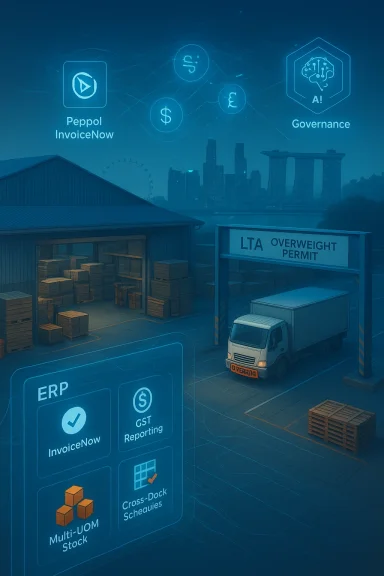
Singapore’s construction and building materials market is uniquely demanding. High land and warehousing costs make inventory turnover and cross‑docking efficiency essential. At the same time, the government’s push to digitize accounting and tax flows—through the IMDA‑backed InvoiceNow network and IRAS’s phased e‑invoicing rules—forces ERP vendors to provide native e‑invoicing and GST reporting, not bolt‑on modules. IMDA’s InvoiceNow program is the national e‑invoicing network based on the Peppol standard and is being rolled out as a default submission channel for government vendors; IRAS has also signaled mandatory InvoiceNow requirements for certain newly GST‑registered businesses from 2026.On the logistics side, the Land Transport Authority (LTA) and Traffic Police enforce vehicle classifications, speed limiter and oversized/overweight movement rules that affect deliveries of heavy materials. LTA maintains permit regimes for oversized or overweight vehicle movements and has been active on policy updates that affect heavy goods transport, including trials and speed‑limiter rules for certain vehicle classes. ERP systems used by building‑material distributors must therefore be able to capture permit metadata, vehicle constraints, and schedule deliveries around permitted movement windows.
Finally, the AI era imposes new expectations on ERP data models: vendors that offer open APIs, modular data partitions for secure model training, and support for heterogeneous compute stacks (Linux compatibility for many LLM/agent workloads) will be best positioned to deliver future operational automation. Industry analyses and forum discussions emphasize that AI is rapidly becoming integrated into demand forecasting, procurement automation, and decision orchestration within ERP suites.
What the 2026 market looks like: the five platforms in context
Below I examine each of the five platforms highlighted in recent coverage, cross‑checking vendor claims against independent sources and regulatory requirements, and highlighting where marketing and real‑world constraints diverge.1. Multiable — localized flexibility and AI‑forward posture
Multiable is ranked at the top of recent lists for Singapore’s building‑material distributors, and the vendor has an established presence in the region with a cloud‑native M18 ERP suite tailored to Asia‑Pacific customers. Multiable’s marketing emphasizes an AI‑ready data structure, multi‑unit‑of‑measure handling (critical for building materials sold by length, weight, piece, pallet), and project costing aligned with contractor pricing. Vendor materials and regional listings show Multiable positioning itself as a Singapore‑capable solution with InvoiceNow and GST support built into workflows.Strengths
- Localization: Native support claims for InvoiceNow and IRAS compliance reduce the integration drag that often bloats implementations.
- Inventory modeling: Multi‑UOM and project costing modules meet key materials‑trading needs (partial deliveries, cut‑to‑length stock).
- AI positioning: The vendor advertises data partitions and agentic features intended to accelerate automation pilots.
- Vendor claims vs. independent verification: While Multiable’s site and regional comparisons document these features, independent audits or case studies from major Singapore construction distributors remain limited in public view—treat specific AI/agentic readiness claims as vendor statements until validated in customer pilots.
- Scale and support: Large public companies and multinationals often require proven global SLAs, certified patching and audit trails—areas where global incumbents (SAP, Oracle) have longer track records.
- Ask for a proof‑of‑concept that demonstrates InvoiceNow submission, GST F5 reporting, and multi‑UOM stock transactions using your actual SKUs.
- Validate the Linux/cloud stack claims and whether AI features require separate modules or add‑on services.
- Get SLA commitments on uptime, upgrade windows, and support for cross‑border multi‑currency FX posting.
2. Oracle NetSuite — global breadth, partner ecosystem, and evolving cost dynamics
Oracle NetSuite remains a mainstream cloud ERP choice for distributors that value a broad third‑party ecosystem (warehouse automation integrations, marketplaces for connectors) and native multi‑currency accounting suited to regional sourcing. NetSuite’s global profile and deep finance tooling make it a natural selection for firms expanding across ASEAN.Strengths
- Third‑party marketplace: A mature ecosystem of adapters for WMS, TMS, and warehouse robotics.
- Multi‑currency and consolidation: Strong currency and consolidation features support imports from Malaysia, Indonesia, Vietnam.
- Renewal pricing and vendor leverage: Customer reports and community threads indicate recurring friction at renewal—customers report significant SaaS fee increases in some negotiations and pressure to retain ancillary services during contract renewals. These are recurring themes in user forums and reflect real negotiation risk for mid‑market buyers.
- Operational incidents: NetSuite status pages and user reports document intermittent incidents and upgrade failures in recent cycles—businesses with strict uptime needs should insist on specific incident response terms and test upgrade/patching in sandboxes early.
- Localization depth: NetSuite’s core strengths are global; however, country‑specific construction contract templates or very sector‑specific material‑handling workflows may require partners and customizations.
- Negotiate firm renewal caps and clarify what ancillary modules are mandatory for licensing.
- Test realistic transaction volumes in a sandbox during procurement to vet upgrade and performance behavior.
- Require a migration/rollback plan and a support escalation path to limit business disruption during upgrades.
3. Microsoft Dynamics 365 Business Central — Microsoft ecosystem convenience vs. customization needs
Microsoft Dynamics 365 Business Central is frequently chosen by firms already invested in the Microsoft stack. The platform’s close integration with Microsoft 365 (Excel, Outlook), Power BI and Power Platform can accelerate adoption and user productivity—but the platform also has known considerations for high‑volume logistics operations. Forum analyses and vendor notes have documented Business Central pricing adjustments and the need for nontrivial customization for heavy‑throughput distribution scenarios.Strengths
- Tight Microsoft integration: Excel import/export, Teams collaboration, and a broad partner ecosystem in Singapore re friction.
- Rapid partner ecosystem: Many local partners provide vertical add‑ons for distribution and logistics.
- Performance and architecture tradeoffs: Business Central’s cloud footprint commonly runs on Azure SQL and can have higher infrastructure demands when scaled; heavy customizations and complex warehouse logic may require additional architecture work and third‑party WMS integration.
- Cost trajectory: Microsoft announced pricing adjustments for Business Central in recent years; buyers should model total cost of ownership, including storage and license tier changes.
- If your operations require complex picking, cross‑docking, or high‑frequency weight conversions, plan for a two‑phase rollout: core financials first, a pilot distribution/WMS second—validating latency and API throughput against real‑worl### 4. SAP S/4HANA — the enterprise benchmark for auditability and forecasting
Strengths
- End‑to‑end traceability and audit trails: Strong for companies with public‑company audit and regulatory demands.
- Demand forecasting and manufacturing depth: Advanced planning and availability‑to‑promise (ATP) logic reduce stockouts for critical materials.
- Total cost and complexity: High implementation costs, long timelines, and heavy internal resource needs are standard.
- Change management: Significant training and process reengineering are usually required for full ROI.
- Reserve S/4 for businesses with complex manufacturing, heavy product certification needs, or public reporting obligations that demand SAP’s controls.
- Protect your program with an independent integration architecture review and a staged data migration approach.
5. ChillAccount — SMB focus, fast time‑to‑value, and constrained depth
ChillAccount (often stylized ChillAccount or Chillaccount) positions itself as a cost‑effective, Singapore‑fit ERP for smaller distributors and niche traders. Reviews and local comparison lists highlight its GST and IRAS compliance, easy onboarding, and mobile‑friendly interfaces—advantages for firms with straightforward logistics. Multiple local listings and comparison sites position ChillAccount as a pragmatic alternative for SMEs that want fast deployment and lower initial costs.Strengths
- Affordability and speed: Low cost of entry and rapid rollouts reduce time‑to‑value.
- Local compliance: Built‑in GST, payroll, and IRAS flows help small businesses avoid common tax pitfalls.
- Depth of functionality: ChillAccount lacks the advanced multi‑UOM handling, integrated WMS sophistication, and complex project costing that larger distributors require.
- Integration breadth: Smaller vendor partner networks mean more reliance on point integrations or manual workarounds as the business scales.
- Use ChillAccount if you are a small distributor focused on straightforward trading, need fast implementation, and want native GST/IRAS support with mobile workflows. Avoid it where complex cross‑dock, multi‑warehouse optimization, or advanced contract pricing is core to margins.
Regulatory and operational must‑haves: what any shortlisted ERP must prove
Singapore’s regulatory and logistics specificities mean vendors must satisfy a short list of non‑negotiables before pilot rollouts.- InvoiceNow/Peppol readiness: Systems must be able to transmit structured invoice data to the IMDA/InvoiceNow network and integrate with accredited access point providers. IRAS is moving to make InvoiceNow mandatory in stages for certain registrants, so early compliance saves rework. Validate sample InvoiceNow submission payloads during procurement.
- GST reporting and rate handling: Ensure tax logic handles historical invoices (GST rate changes) and supports IRAS reporting formats and timelines. The IRAS e‑Tax guides and InvoiceNow fact sheets outline the current technical and adoption milestones buyers must follow.
- LTA permit metadata and vehicle constraints: ERP dispatch modules must capture vehicle MLW (maximum laden weight), oversized movement permits, and speed/vehicle‑class constraints so scheduling engines can avoid illegal windows and fines. LTA guidance and government permit pages define the permit types and administrative rules.
- Multi‑currency and regional FX: Vendors should demonstrate robust multi‑currency AR/AP processing, localized bank API connectors for Singapore banks, and built‑in revaluation flows to protect margins in volatile ASEAN sourcing. This reduces manual hedging and reconciliation work.
- AI governance, data partitioning, and Linux compatibility: Because many enterprise AI workloads are run on Linux‑based stacks and require careful IP/data partitioning, verify whether the vendor provides secure data partitions for model training and whether APIs expose data in open, well‑documented formats.
Implementation playbook: a 10‑step checklist for Singapore building‑material distributors
- Define the operating envelope: capture SKUs, UOMs, lot/batch requirements, delivery vehicle profiles, and permit needs.
- Regulatory mapping: map legal flows—InvoiceNow, IRAS GST submissions, and export/import paperwork—to required ERP outputs.
- Run a vendor sandbox pilot using real SKUs and a production‑like transaction volume to test InvoiceNow submissions, multi‑UOM conversions, and cross‑docking scenarios.
- Test bank connectivity: verify direct bank API integration for reconciliation and payables automation.
- Validate LTA/permitting workflow: ingest vehicle metadata and simulate oversized/overweight movement scheduling.
- Negotiate SLA and renewal terms up front: include caps on renewal increases and defined incident‑response times.
- Data migration and reconciliation dry run: move a representative data set and reconcile P&L and inventory counts.
- Phased rollout: finance first, warehouse/WMS second, field delivery and AI‑powered forecasting third.
- Governance for AI: define data use policies, IP protection clauses, and model‑retraining agreements with the vendor.
- Post‑go‑live audit and continuous improvement cadence: measure inventory turns, delivery SLAs, and InvoiceNow error rates.
Pricing, SLA and governance traps to avoid
- Renewal shock: Cloud vendors sometimes apply license or module increases at renewal; insist on multi‑year caps or step‑pricing in contracts. NetSuite users have reported pressure around renewal add‑ons—don’t let contract language force bundled services without negotiation.
- Hidden integration costs: Basic SaaS fees rarely include regional bank connectors, InvoiceNow AP subscriptions, or premium support—account for these in TCO.
- Upgrade windows and business continuity: Confirm sandbox upgrade cadence mirrors production and demand a vendor upgrade rehearsal and rollback plan to prevent last‑minute breakage. User reports show that upgrade failures can and do occur—test thoroughly.
- AI lock‑in risk: If a vendor proposes proprietary agentic AI agents that lock your data, insist on exportable, standard data formats and portable APIs to avoid future vendor lock‑in.
Practical recommendations by company size and profile
- Small distributors and single‑warehouse operations: ChillAccount or similarly local, GST‑native platforms give the fastest path to compliance and mobile invoicing. Prioritize vendor speed of setup and IRAS/InvoiceNow compatibility.
- Mid‑market regional importers/distributors: Microsoft Dynamics 365 Business Central and Multiable strike a balance—Business Central for Microsoft‑centric IT estates and Multiable where deeper AP/InvoiceNow and Asian regional flows are required. For high pick rates and multi‑UOM, validate warehouse performance in a pilot.
- Large national players and public companies: SAP S/4HANA or NetSuite (for cloud‑native consolidation) provide enterprise controls, forecasting, and auditability—SAP for heavy manufacturing and certification workflows, NetSuite where rapid cloud consolidation and third‑party WMS integrations are prioritized. Negotiate hard on SLAs and renewal terms.
How AI readiness will reshape supplier selection in the next 24 months
AI will not remain an optional overlay. The key differentiators will be:- Open, documented APIs that allow secure data extraction to train specialized forecasting or bidding models.
- Data partitioning and governance that keep supplier IP out of shared training corpuses.
- Edge and Linux support so that agentic scheduling and on‑prem inferencing can run close to operations where needed.
Final verdict: choose integration, not features
Singapore’s regulatory and logistical environment makes localization and integration maturity the decisive factors in ERP selection for building‑material businesses. Platform rankings are useful, but buyers should prioritize:- InvoiceNow/IRAS proof of work (real transactions),
- LTA permit and vehicle metadata handling (dispatch use cases),
- Multi‑UOM and cross‑docking performance (inventory throughput),
- Contractual protections for renewal and incident handling, and
- Clear AI governance and exportable data formats.
Conclusion: ERP choice in 2026 is no longer a checkbox. It is the operational spine that defines whether a Singapore building‑material business can convert regulatory obligations and logistical constraints into reliable service, tighter margins, and the ability to scale across ASEAN. Validate localization with hard proofs, model the true TCO including renewal dynamics, and insist on data portability—these will be the decisions that separate leaders from laggards.
Source: ERP Today Top 5 ERP Software for Singapore’s Building Material Businesses in 2026
