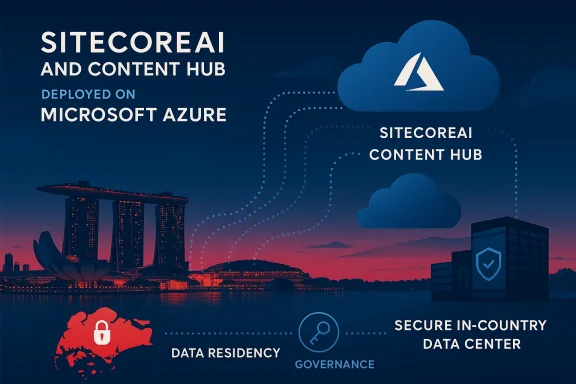
Sitecore’s decision to deploy SitecoreAI and Content Hub as a sovereign cloud option in Singapore on Microsoft Azure is a meaningful — and predictable — response to rising demand for in‑country cloud and AI hosting across regulated industries in Asia, delivering data residency, lower latency, and a governance posture that aligns with Singapore’s national digital strategy and privacy frameworks.
Sitecore has been evolving its digital experience platform toward an AI‑first, SaaS‑centric model under the SitecoreAI umbrella, folding earlier XM Cloud capabilities into a single, AI‑native platform for marketing and content teams. The vendor’s product roadmap increasd‑native, in‑region deployments and closer integration with Microsoft Azure — a partnership Sitecore has publicly deepened in recent years.
The March 5, 2026 announcement confirms a sovereign deployment of SitecoreAI and Content Hub in Singapore hosted on Microsoft Azure’s Southeast Asia (Singapore) infrastructure. Sitecore frames the move as a dmer concerns about where AI training data, logs, and content are stored and processed — especially for organisations operating under Singapore’s Personal Data Protection Act (PDPA) and sectoral guidance in healthcare, finance and critical infrastructure.
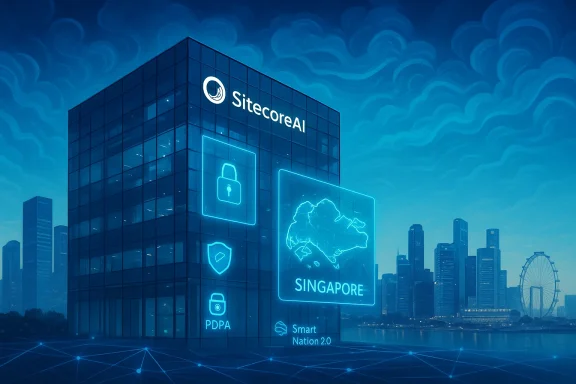
Smart Nation 2.0 — Singapore’s 2024 refresh of its national digital strategy with the pillars of Trust, Growth, and Community — increases the political and regulatory emphasis on trustworthy data handling and responsible AI. Vendors positioning adaptable, in‑country cloud options are therefore aligning product strategy with a clear national policy goal.
-shipped in Singapore — the technical snapshot
Key operational characteristics to expect:
Before committing to an in‑region SitecoreAI deployment, IT, legal and security teams should verify:
That said, the presence of a local tenancy is not a substitute for robust governance: organisations must still insist on contractual clarity, demonstrable access controls, model governance artifacts and independent assurance. When those boxes are ticked, an in‑region SitecoreAI deployment can genuinely accelerate AI‑enabled content and experience programs across Singapore’s most compliance‑sensitive sectors.
Source: CFOtech Asia https://cfotech.asia/story/sitecore-expands-sovereign-cloud-for-ai-in-singapore/
 Background
Sitecore has been evolving its digital experience platform toward an AI‑first, SaaS‑centric model under the SitecoreAI umbrella, folding earlier XM Cloud capabilities into a single, AI‑native platform for marketing and content teams. The vendor’s product roadmap increasd‑native, in‑region deployments and closer integration with Microsoft Azure — a partnership Sitecore has publicly deepened in recent years.The March 5, 2026 announcement confirms a sovereign deployment of SitecoreAI and Content Hub in Singapore hosted on Microsoft Azure’s Southeast Asia (Singapore) infrastructure. Sitecore frames the move as a dmer concerns about where AI training data, logs, and content are stored and processed — especially for organisations operating under Singapore’s Personal Data Protection Act (PDPA) and sectoral guidance in healthcare, finance and critical infrastructure.
Smart Nation 2.0 — Singapore’s 2024 refresh of its national digital strategy with the pillars of Trust, Growth, and Community — increases the political and regulatory emphasis on trustworthy data handling and responsible AI. Vendors positioning adaptable, in‑country cloud options are therefore aligning product strategy with a clear national policy goal.
-shipped in Singapore — the technical snapshot
- Products deployed: SitecoreAI (the unified AI‑native DXP) and Sitecore Content Hub (digital asset management and content operations).
- Cloud platform: Microsoft Azure, Southeast Asia (Singapore) region — enabling local storage, processing and lower latency to Singapore‑based customers. Microsoft’s Azure presence in Singapore is a long‑standing and widely used option for enterprises and public sector bodies.
- Compliance posture: Sitecore markets the sovereign deployment to meet local regulatory frameworks and data residency expectations, including PDPA and public‑sector procurement/audit requirements. The company explicitly tied the rollout to the Smart Nation 2.0 agenda.
Why sovereign cloud matters in Singapore — law, policy and procurement
Singapore’s privacy and sectoral rules do not demand blanket in‑country storage for all data, but recent and pending regulatory developments have made data locality and processing assurances a material requirement for many projects.- The Personal Data Protection Act (PDPA) remains the baseline legal framework governing private‑sector personal data. The Personal Data Protection Commission (PDPC) publishes sector‑specific advisory guidelines (for example, healthcare) that tighten expectations around how sensitive data is handled, shared and protected. Organisations that process health records, financial data, or national identifiers commonly treat in‑country hosting as a way to simplify compliance and procurement risk.
- The Health Information Bill and related advisory guidance for healthcare providers raise the stakes for health data custodians and their cloud partners — making sovereign hosting a pragmatic choice for clinics, hospitals and government‑linked healthcare entities.
- Singapore’s Smart Nation 2.0 emphasises trust as a pillar; vendors that position local hosting and mature governance controls are therefore more visible to public‑sector buyers and enterprise buyers who must demonstrate risk controls.
Who benefits — immediate and strategic use cases
The launch is marketed toward three broad buyer categories:- Public sector and government‑linked organisations — where procurement, auditability and compliance frameworks often specify local hosting or impose strict operational controls. Sitecore cites local public sector examples to signal trust and suitability.
- Healthcare and social care providers — hospitals, integrated care agencies and digital health platforms that handle sensitive personal data will find a local instance eases integration with national systems and health data governance expectations. The Health Information Bill’s trajectory reinforces this trend.
- Financial services and regulated commerce — banks, insurers and fintech firms subject to Monetary Authority of Singapore (MAS) expectations on outsourcing, data protection and operational resilience increasingly treat sovereign cloud as risk‑mitigating infrastructure. Sectoral guidance and best practice frequently require detailed contractual assurances about where data and backups are stored and who can access them.
How the technical and product model works (practical details)
Sitecore’s offering in Singapore is not a separate codebase; it is a regionally‑hosted configuration of core SitecoreAI and Content Hub services, delivered using Azure platform services and Sitecore’s cloud tooling.Key operational characteristics to expect:
- In‑region data storage and processing: Content, user data and AI artifacts are kept inside the Singapore Azure tenancy. This reduces cross‑border flows for primary workloads and shortens network paths for local users.
- Low‑latency access for digital experiences: Hosting the DXP, origin content and CDNs near customers improves performance for local audiences — critical for high‑traffic portals and real‑time personalisation.
- Azure security controls and enterprise features: By deploying on Azure, Sitecore leverages existing platform security primitives (identity, encryption at rest/in transit, key management options, audit logs, availability zones). Microsoft’s cloud for sovereignty documentation and Azure regional controls offer mechanisms for policy‑level enforcement.
- Managed service model with local SLAs: For many buyers, the combination of Sitecore managed services plus Azure SLAs and local support is the practical value prop — enabling teams to consume Sitecore as SaaS without fully owning infrastructure operations.
Benefits — why buyers will consider this deployment
- Stronger data residency guarantees reduce legal and contractual friction in procurement and cross‑border risk assessments.
- Faster time to compliance for sectors that need to meet PDPA or sectoral advisory guideline checklists.
- Lower latency for local audiences improving UX for Singapore‑based customers and citizens.
- Aligned with national digital strategy — the deployment’s explicit tie to Smart Nation 2.0 makes it easier for government agencies to justify adoption.
- Single‑vendor integration for content and AI workflows — SitecoreAI unifies content, search, personalisation and AI orchestration which simplifies governance of AI pipelines compared with stitching multiple point tools together.
Risks, limitations and what the vendor message doesn’t solve
Sovereign cloud and in‑region hosting reduce some risks but do not eliminate them. Buyers must weigh residual risks carefully.- Legal exposure to extraterritorial requests: Hosting data in‑country reduces cross‑border transfer concerns, but does not automatically eliminate the potential for foreign legal requests (for example, where vendor corporate governance or administrative access is governed by other jurisdictions). Contracts and access‑control designs must be explicit on administrative rights, key custody and law‑enforcement procedures. This is not a Sitecore‑specific limitation; it’s a universal contractual and legal issue for any multinational cloud service.
- Model provenance and data lineage for AI: Storing training and inference data in country helps with regulatory compliance, but regulators and auditors increasingly ask for demonstrable data lineage, model training logs, explainability and retraining controls. Providing a local tenancy is a first step; automation for model governance, audit trails and enforcement of purpose‑limits are still required. PDPC and Singapore advisory frameworks are increasingly focusing on this area.
- Operational complexity and cost: In‑region deployments can add cost (higher per‑region operational overhead, separate backup/DR planning and potential duplication of cross‑region services). Organisations must evaluate total cost of ownership and plan for disaster recovery, cross‑region failover, and test procedures.
- Vendor lock‑in and migration friction: Running a SaaS DXP and DAM in a sovereign model raises questions about portability. If an organisation later wants to move workloads off SitecoreAI or to another region, the practical and contractual egress costs and migration complexity can be non‑trivial. Procurement teams must negotiate exit and data export terms.
- False sense of compliance: A sovereign deployment can become marketing cover if not backed by proper technical controls, contractual commitments, and independent assurance. Buyers should insist on auditable evidence (SOC, ISO, local audits) and contractually enforceable commitments regarding data residency and access.
Before committing to an in‑region SitecoreAI deployment, IT, legal and security teams should verify:
- Data residency mechanics: Which classes of data will be stored and processed in‑country? Are backup copies or logs replicated out of Singapore for DR or analytics? Obtain an explicit, contractual statement.
- Administrative access controls: Where will administrative accounts and key management services be located? Who holds master encryption keys and what controls exist for key revocation?
- Auditability & certifications: Ask for current SOC/ISO reports, penetration test summaries, and evidence of third‑party supply‑chain assessments relevant to Singapore operations.
- Model governance features: Confirm that SitecoreAI’s platform provides training/inference logs, dataset lineage, consent artifacts and the ability to freeze or remove datasets on demand. PDPC guidance on AI practices is increasingly specific on these items.
- Disaster recovery & geography: Understand the DR strategy — is there cross‑region replication (and if so, under what protections)? Verify SLAs for recovery time and data durability.
Implementation roadmap — recommended steps for IT leaders
- Conduct a rapid data classification and mapping exercise: identify personal data, sensitive categories (health, financial), and pipeline flows.
- Define a risk‑based list of workloads that must remain in‑country versus those that may be processed elsewhere.
- Run a joint workshop with Sitecore and your cloud legal counsel to capture concrete contractual commitments on data residency, administrative access, and breach notifications.
- Design a model governance and audit plan that captures training data lineage, inference logs, and retention policies.
- Pilot a low‑risk website or content stream to benchmark latency, performance and integration with local identity/SSO and monitoring stacks.
- Validate procurement & security controls with an independent third‑party audit or penetration test before broad rollout.
Commercial and competitive context
Sovereign cloud is no longer niche in APAC. Hyperscalers and independent vendors have doubled down on region‑aware offerings:- Hyperscalers (Microsoft, AWS, Oracle and others) have explicit sovereign or in‑country programs and are building regional controls to support AI workloads. Microsoft’s own Cloud for Sovereignty materials lay out how platform policies and architectural patterns can be used to meet government and regulated‑industry needs.
- SaaS and martech vendors are following the pattern: localised data‑region instances and partnerships with regional integrators to win regulated workloads. Industry analysts note sovereign cloud momentum across APAC as a strategic trend.
What this means for CIOs, CDOs and CMOs
- CIOs and CDOs get a pragmatic option to move content and AI workloads into a locally governed tenancy — lowering legal and procurement friction. But they must insist on operational proof: access logs, key custody contracts, SLA term sheets and audit reports.
- CMOs and marketing teams gain AI‑powered content planning and delivery tools without the obvious compliance tradeoff: they can leverage AI copy, variant generation and personalization with clear data locality controls. That increases the speed of experimentation — provided the governance questions are already solved.
Final assessment — strengths, unknowns and the path forward
Sitecore’s Singapore sovereign deployment is strategically sensible and tactically useful:- Strengths:
- It removes a material procurement blocker for regulated organisations by offering in‑country hosting and mature Azure platform controls.
- Aligning the rollout with the Smart Nation 2.0 framing is a practical market signal that lowers the political and institutional friction for public sector adoption.
- Consolidating content and AI capabilities into SitecoreAI simplifies governance compared to DIY stacks of DAM + ML pipelines.
- Open questions / risks:
- Buyers must validate the operational commitments beyond marketing: where are backups held, who controls keys, and what are the mechanics for legal requests? These are not solved purely by an in‑region instance.
- Model governance — explainability, retraining controls and consent enforcement — remains a regulatory focal point and requires integration beyond simple data locality. PDPC and sectoral guidance increasingly expect demonstrable AI controls.
- Cost and vendor portability: the economics of sovereign SaaS and the ability to move off a vendor in future remain important negotiation points.
Conclusion
Sitecore’s sovereign cloud expansion into Singapore is a timely, market‑driven move that speaks to one of the clearest inflection points of enterprise cloud adoption in Asia: the need to reconcile AI innovation with tight, auditable control over where data and model processing occur. By delivering SitecoreAI and Content Hub on Microsoft Azure’s Singapore infrastructure, Sitecore removes a common barrier for regulated buyers and aligns its product strategy with Singapore’s Smart Nation 2.0 emphasis on trust.That said, the presence of a local tenancy is not a substitute for robust governance: organisations must still insist on contractual clarity, demonstrable access controls, model governance artifacts and independent assurance. When those boxes are ticked, an in‑region SitecoreAI deployment can genuinely accelerate AI‑enabled content and experience programs across Singapore’s most compliance‑sensitive sectors.
Source: CFOtech Asia https://cfotech.asia/story/sitecore-expands-sovereign-cloud-for-ai-in-singapore/