

The AI Boom Has Become a Memory Story
For most of the public, the AI hardware race still looks like a GPU race. Nvidia’s logo sits on the slide decks, its quarterly revenue gets treated as a proxy for the entire AI economy, and its product cadence is followed with the kind of intensity once reserved for Intel tick-tock roadmaps or Apple silicon launches.
But inside the machine room, the limiting factor is not only how many tensor cores can be packed onto a package. It is how quickly those cores can be fed. AI models are hungry in a very specific way: they do not merely need compute, they need sustained access to enormous volumes of data without burning too much power or wasting too much time waiting on memory.
That is where high-bandwidth memory, or HBM, comes in. HBM stacks DRAM dies vertically and places them close to the processor, using very wide interfaces to move data at rates conventional memory systems cannot match. It is expensive, difficult to manufacture, and central to the economics of large-scale AI training and inference.
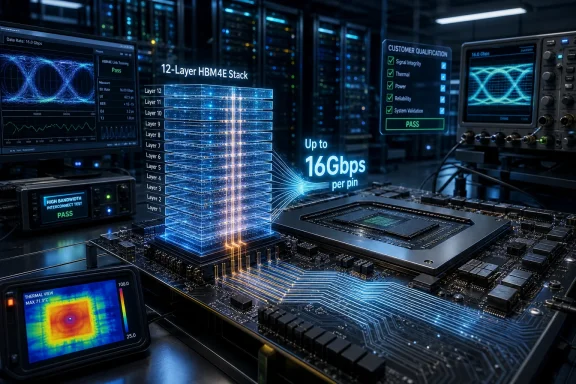
SK Hynix’s HBM4E sampling announcement matters because samples are the point where marketing claims begin the long, brutal process of becoming qualified silicon. Customers can test signal integrity, thermals, yields, packaging behavior, and power characteristics against future accelerator designs. In the AI market, sampling is not a victory lap. It is the opening round of a procurement fight that can determine who supplies billions of dollars’ worth of memory over a product generation.
SK Hynix Is Defending the Most Valuable Seat in Memory
SK Hynix has become the name most closely associated with Nvidia’s HBM supply during the current AI boom. That does not mean Nvidia buys only from one vendor, nor does it mean every future design is locked in. It means SK Hynix has occupied the premium position in a segment where qualification, consistency, and time-to-volume matter as much as raw specifications.
The company’s latest claim is straightforward. Its next-generation 12-layer HBM4E sample can reach up to 16 gigabits per second per pin and offers more than 20 percent better power efficiency than prior models. In the language of AI accelerators, that points toward higher bandwidth per stack and better performance per watt, two of the most important numbers in the data center.
The timing is equally important. Samsung announced shipments of 12-layer HBM4E samples to major customers in late May 2026, also touting up to 16Gbps operation and improved efficiency. That announcement put pressure on SK Hynix to show it was not ceding the next round before it began.
Now SK Hynix has answered. The company is not merely saying it has a roadmap; it is saying customers have silicon in hand. For a supplier defending a lead in the most lucrative corner of the memory market, that distinction matters.
Samsung’s Early Move Changed the Narrative, Not the Market Overnight
Samsung’s claim to have shipped industry-first HBM4E samples was designed to do more than impress engineers. It was a message to customers and investors that Samsung intends to recover ground in a market where SK Hynix has been viewed as the stronger Nvidia supplier.
That framing should be treated carefully. Being first to announce sample shipments is not the same as winning a production socket. HBM qualification is a slow and unforgiving process, and AI accelerator vendors do not redesign memory subsystems around a press release. The winning supplier is the one that can deliver qualified parts at volume, with acceptable yield, power, thermals, reliability, and packaging behavior.
Still, Samsung’s move mattered because it made the HBM4E race visible earlier than many expected. It suggested that the next generation of AI memory is not waiting politely for the current generation to finish monetizing. The competitive clock has been pulled forward.
That is the context for SK Hynix’s announcement. The company is defending the premium part of its franchise while Samsung tries to turn technical progress into commercial leverage and Micron works to deepen its own role in high-end AI memory. The fight is not about one sample batch. It is about who becomes indispensable to the next accelerator platform.
HBM4E Is an Incremental Name for a Major Platform Lever
The “E” in HBM4E can make the technology sound like a modest extension, the kind of suffix vendors attach when they need a mid-cycle refresh. That undersells what is at stake. In AI accelerators, memory improvements can reshape the performance envelope of an entire system.
A 12-layer stack implies a dense vertical structure, commonly associated with higher capacity per package. Higher pin speeds mean more bandwidth. Better power efficiency means less energy wasted moving data, which matters enormously when clusters are limited by rack power, cooling, and electricity costs.
The key figure in SK Hynix’s announcement is 16Gbps per pin. That number is meaningful because HBM’s advantage comes from combining wide interfaces with high signaling rates. When pin speeds climb, per-stack bandwidth rises, and accelerator designers have more room to feed compute engines without adding as many memory stacks or compromising other package constraints.
The power-efficiency claim is just as important. AI infrastructure is no longer limited only by capital spending. It is limited by electrical capacity, cooling design, and data center availability. A memory subsystem that can deliver more throughput per watt gives platform designers more flexibility, especially as GPU packages become more complex and power budgets climb.
The Customer Qualification Stage Is Where Roadmaps Meet Reality
Chipmakers love roadmaps because roadmaps are clean. They move from HBM3E to HBM4 to HBM4E in neat sequence, with bandwidth and efficiency bars climbing predictably upward. Customer qualification is where that clean story meets physics, packaging, manufacturing variation, and system design.
When SK Hynix says it has shipped samples to major customers, those customers will not simply benchmark a module and declare victory. They will stress the parts across voltage, temperature, workload, packaging, and signal conditions. They will evaluate how the memory behaves next to future accelerators, interposers, and advanced packaging schemes.
This is why supplier relationships in HBM are sticky. Once an accelerator vendor has designed, tested, and qualified a memory stack for a platform, switching suppliers is not like swapping SSD brands in a server bill of materials. Even when standards exist, implementation details matter. The cost of being late or unstable is enormous.
That is SK Hynix’s advantage. It is already deeply embedded in the current Nvidia supply chain. But it is also the company’s risk. The closer a supplier sits to the center of the AI boom, the more intense the scrutiny becomes when the next generation arrives.
Nvidia Is the Customer Everyone Is Talking Around
The Reuters framing identifies SK Hynix as Nvidia’s main HBM supplier, which is the commercial subtext behind the announcement. SK Hynix did not need to name every customer for the market to understand the stakes. If HBM4E is aimed at future AI accelerators, Nvidia is inevitably the customer everyone watches first.
Nvidia’s roadmap has become the metronome of the AI infrastructure industry. Memory vendors, packaging houses, foundries, server OEMs, and cloud operators all build around the expectation that each new Nvidia platform will demand more bandwidth, more capacity, and tighter integration. That gives Nvidia immense leverage over suppliers.
For SK Hynix, retaining Nvidia confidence is not only about winning one more purchase order. It is about remaining the default premium HBM partner as AI accelerators evolve from single chips into increasingly elaborate systems. The more complex Nvidia’s platforms become, the more valuable qualified memory capacity becomes.
That does not mean Samsung or Micron are out of the race. Quite the opposite. Nvidia has every reason to cultivate multiple suppliers in a constrained, strategic market. But supplier diversification is not the same as supplier equality. The company that qualifies early, yields well, and ramps reliably gets the better seat at the table.
The AI Supply Chain Is Learning to Fear Memory Bottlenecks
The first phase of the generative AI boom trained investors and users to think about compute scarcity. Cloud providers rationed access to GPUs, startups boasted about clusters, and enterprise buyers discovered that “AI strategy” often meant waiting for accelerator capacity. The second phase is teaching everyone to think about the full supply chain.
HBM is one of the tightest links in that chain. It requires advanced DRAM fabrication, precision stacking, through-silicon vias, packaging expertise, and close coordination with accelerator vendors. It cannot be conjured into existence simply because demand is high.
That scarcity has turned memory suppliers into strategic actors. SK Hynix, Samsung, and Micron are no longer background commodity vendors in this market. They are gatekeepers for the next wave of AI servers, and their execution can influence how quickly cloud capacity expands.
For WindowsForum readers, this matters because many of the AI features arriving in Microsoft’s ecosystem are only partly local. Copilot integrations, developer tools, enterprise agents, security analytics, and cloud-backed productivity features all depend on data center capacity somewhere. If HBM supply constrains accelerator rollout, the effects eventually show up as cost, availability, latency, or feature gating.
Copilot PCs Do Not Make the Cloud Irrelevant
Microsoft and its PC partners have spent the last two years trying to make local AI sound like the next major client-computing shift. Neural processing units are now part of the Windows hardware conversation, and Copilot+ PC branding has put TOPS figures into mainstream laptop marketing.
That shift is real, but it does not eliminate the cloud. Local AI is useful for privacy-sensitive, latency-sensitive, and battery-sensitive tasks, especially when models are small enough to run on the device. But the frontier models, enterprise-scale agents, code assistants, large-context workloads, and multimodal systems that define the current AI arms race still lean heavily on server infrastructure.
This is why an HBM sampling story belongs on a Windows site. The client may be a Surface, a Dell laptop, a gaming desktop, or a managed Windows endpoint, but the intelligence behind many experiences is provisioned from cloud infrastructure built on accelerators and HBM. The Windows desktop is increasingly the front end to a memory-bound data center.
That relationship complicates the usual consumer hardware narrative. A faster laptop NPU may make some workloads feel more responsive, but the broader AI experience is tied to whether Microsoft, OpenAI, Google, Amazon, Meta, and others can deploy enough high-end accelerator capacity. HBM4E is part of that deployment story.
Power Efficiency Is the Specification That Survives the Hype Cycle
Bandwidth is the glamorous number. It is easy to chart, easy to compare, and easy to market. But power efficiency may be the more durable advantage.
AI data centers are running into hard physical constraints. Land is scarce in the right locations, grid connections take time, cooling infrastructure is expensive, and electricity prices are no longer a footnote. A component that delivers more data movement for less power can change deployment economics in ways that raw speed alone cannot.
SK Hynix’s claim of more than 20 percent better power efficiency over previous models therefore deserves attention. Even if the final platform-level gains depend on workload, packaging, and accelerator design, memory efficiency contributes to the larger problem of how to scale AI without turning every new model release into a power-planning crisis.
This is also where enterprise IT should be skeptical of simple vendor narratives. A more efficient component does not automatically mean lower total energy use if the industry responds by deploying larger clusters and running more demanding workloads. Efficiency can reduce cost per unit of work while total consumption still rises. That is the paradox at the center of AI infrastructure.
The Race Is About Packaging as Much as DRAM
HBM is often discussed as memory, but the product customers buy is inseparable from packaging. These stacks must sit close to processors, communicate across dense interconnects, and survive the mechanical and thermal realities of advanced packages. As accelerators grow more complex, the boundary between memory innovation and packaging innovation becomes thinner.
That is one reason the supplier competition is so hard to handicap from the outside. A nominally faster HBM part is not automatically better if it complicates packaging, reduces yield, worsens thermals, or arrives too late for a platform’s design window. The best memory is the memory that the accelerator vendor can actually ship at scale.
SK Hynix has benefited from being early and reliable in recent HBM generations. Samsung has deep manufacturing scale and an obvious incentive to regain prestige in premium memory. Micron has used efficiency and execution claims to argue that it deserves a larger share of AI platforms. Each company is selling not just bits, but confidence.
For Nvidia and other accelerator makers, the ideal outcome is not a single heroic supplier. It is a resilient supply base with multiple qualified vendors. For the suppliers, however, the prize is to be the first call when capacity is tight and margins are high.
Windows Users Will Feel This Through Price, Availability, and Feature Pace
Most Windows users will never buy HBM directly. They will not install it, overclock it, or compare modules in a desktop build. Yet they will live with the downstream effects.
If high-end AI memory remains constrained, cloud AI capacity stays expensive. That cost can show up in subscription pricing, enterprise licensing, usage caps, slower rollout of compute-heavy features, or more aggressive segmentation between free and paid AI services. The economics of HBM do not stay in the data center; they travel through the software stack.
Developers may feel it through API pricing and model availability. Administrators may feel it through Microsoft 365 Copilot capacity planning, governance decisions, and the pressure to justify AI licenses. Security teams may feel it through the gradual arrival of AI-assisted detection and response tools that depend on scalable inference behind the scenes.
Even gamers and PC enthusiasts are not entirely insulated. Nvidia’s data center priorities influence silicon allocation, packaging capacity, and investor expectations across the company. The AI boom has already changed how the market thinks about GPUs. HBM4E is another reminder that the most important graphics company in the Windows ecosystem is now driven primarily by data center demand.
Sampling Announcements Are Not Shipping Reality
There is a temptation to treat SK Hynix’s announcement as a clean win: samples shipped, specs improved, next generation secured. That would be premature. The distance between samples and mass production can be long, and the distance between mass production and healthy supply can be longer still.
Customer qualification can reveal issues that do not appear in a controlled demonstration. Yield curves may improve more slowly than hoped. Packaging partners may become bottlenecks. Accelerator roadmaps may slip. Competing suppliers may qualify on parallel tracks and alter allocation decisions.
This uncertainty is not a reason to dismiss the announcement. It is a reason to read it correctly. SK Hynix has entered the next stage of the HBM4E race, not finished it. The company has put silicon into customer hands, and that is exactly where the competitive process becomes more serious.
For investors, that distinction matters because AI component stories often get priced as inevitabilities. For IT buyers, it matters because vendor roadmaps tend to assume smooth supply. For technologists, it matters because the final performance of future AI systems will depend on the messy details now being tested.
The Memory Vendors Are Becoming AI Platform Companies by Proxy
SK Hynix, Samsung, and Micron are not building foundation models, writing chatbots, or selling Windows productivity subscriptions. Yet their products increasingly define what those services can cost and how fast they can scale. That gives memory vendors a new kind of strategic importance.
Historically, DRAM has been cyclical, brutal, and often commoditized. Suppliers overbuilt, prices collapsed, demand recovered, and the cycle repeated. HBM does not abolish that history, but it changes the premium end of the market. The technical barriers are higher, the customer relationships are deeper, and the qualification cycles are more specialized.
That makes HBM less like commodity memory and more like a platform dependency. If a vendor becomes critical to Nvidia’s next accelerator or a hyperscaler’s custom AI silicon, it participates in the value chain at a much higher level than a generic DRAM supplier. The margins and strategic attention follow.
This is why the HBM4E race has attracted so much scrutiny. It is not just a contest over one specification. It is a contest over who gets to sit closest to the AI money machine while the rest of the semiconductor industry reorganizes around it.
The SK Hynix Announcement Narrows the Gap Samsung Tried to Open
Samsung’s late-May HBM4E sample shipment gave it a clean headline: first mover, next generation, major customers. SK Hynix’s June 18 announcement reduces the narrative advantage of that timing. The market now has two major Korean memory suppliers claiming 12-layer HBM4E samples are in customer hands within the same broad window.
That does not make the products identical. Stable operating speeds, peak speeds, bandwidth per stack, power behavior, thermals, yields, and customer-specific packaging all matter. Public specifications are only the visible surface of a much deeper evaluation process.
Still, the competitive message is clear. Samsung wanted to show it was back in front. SK Hynix is showing it remains in the fight for the next premium generation. Micron, meanwhile, cannot be ignored in a market where customers desperately want more qualified supply.
The result is a healthier competitive dynamic for accelerator vendors, even if it remains uncomfortable for suppliers. Nvidia and other AI chipmakers benefit when multiple HBM vendors can plausibly meet future requirements. The industry’s worst-case scenario is not fierce competition; it is a single fragile supply path for the memory every accelerator needs.
The Windows Angle Is Infrastructure, Not Branding
There is no Windows logo on an HBM stack, and there will be no consumer launch event where Microsoft celebrates 16Gbps-per-pin memory inside a cloud accelerator. But the connection is still direct. Windows is becoming an operating environment increasingly shaped by services that assume abundant AI compute.
Microsoft’s software strategy now leans heavily on AI assistance across Windows, Office, developer tooling, security, search, and cloud management. Some of that work can move to local NPUs, but much of it depends on large models and centralized infrastructure. The more capable and efficient that infrastructure becomes, the more ambitious Microsoft can be about embedding AI into everyday workflows.
For administrators, this should produce both optimism and caution. Better AI infrastructure can make advanced features more available, but it also deepens dependence on cloud services, licensing models, and vendor-controlled compute. The PC may remain personal, but many of its most marketed new capabilities are increasingly rented from the data center.
That is the larger lesson of SK Hynix’s HBM4E samples. The future of Windows experiences is being shaped not only by the next Windows build, the next Surface device, or the next x86-versus-Arm debate. It is being shaped by memory stacks sitting beside accelerators in server racks most users will never see.
The Real Winners Will Be Chosen in Qualification Labs
The next few months will likely bring more claims from every major HBM supplier. There will be more talk of bandwidth, capacity, power, thermals, and customer sampling. Some claims will be technically impressive and commercially irrelevant. Others will seem modest in public and prove decisive in qualification.
What matters now is whether SK Hynix can convert samples into production commitments. That means meeting customer timelines, proving reliability, and scaling manufacturing without losing the efficiency and performance characteristics being promised today. In AI infrastructure, the supplier that arrives late with a better slide often loses to the supplier that arrives on time with a qualified part.
Samsung’s challenge is to turn its early HBM4E announcement into trust at volume. Micron’s challenge is to expand its role in a market where customers want alternatives but will not accept weak execution. SK Hynix’s challenge is perhaps the hardest: defending leadership while the entire industry is trying to copy, flank, or displace it.
The qualification labs, not the press releases, will decide the next round.
What This HBM4E Shipment Actually Changes
SK Hynix’s announcement is best understood as a marker in a longer contest, not a final verdict. It confirms that the next HBM generation is moving into customer evaluation now, and it tightens the competitive response to Samsung’s earlier sample shipment.
- SK Hynix has shipped 12-layer HBM4E samples to major customers, moving its next-generation AI memory into customer qualification.
- The company says the new chips can reach up to 16Gbps per pin and improve power efficiency by more than 20 percent compared with previous models.
- Samsung’s earlier HBM4E sampling announcement created pressure on SK Hynix to show that it remains competitive in the next AI memory cycle.
- Nvidia remains the central commercial reference point because its accelerators drive much of the demand for premium HBM.
- Windows users and IT departments will feel the impact indirectly through AI service pricing, availability, performance, and the pace of cloud-backed feature rollouts.
- The decisive test will be volume qualification, not which supplier issues the strongest sampling headline.
The AI hardware story keeps trying to simplify itself into a contest of GPUs, but the harder truth is that modern accelerators are systems of dependencies, and HBM is one of the most consequential. SK Hynix’s HBM4E samples do not guarantee dominance in the next cycle, but they do show that the company intends to defend its position where it matters: in the hands of customers building the next generation of AI infrastructure. For Windows users, developers, and administrators, the lesson is simple enough: the future of AI on the PC will be shaped as much by invisible memory supply chains as by anything Microsoft puts in the Start menu.