

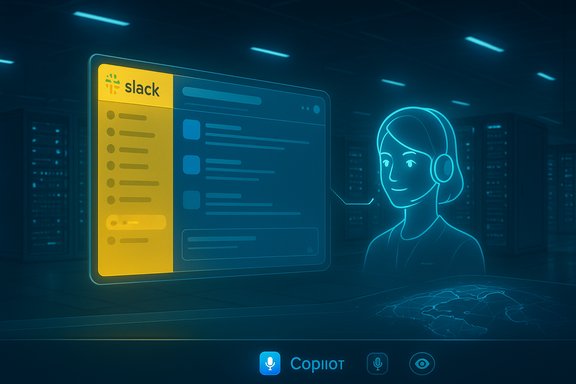
Slack’s long‑running in‑app helper has been reborn as a workspace AI that drafts messages, schedules interviews, and fetches context from Slack conversations and connected apps — even as institutional investors pour tens of billions into the physical infrastructure that makes modern generative AI possible and Microsoft pushes Copilot deeper into Windows with voice, vision and agentic actions that change how administrators must govern endpoints and data.
The past several weeks have tightened an already fast loop between product innovation at the user interface level and the enormous capital flows behind the scenes that sustain it. Vendors are shipping agentic assistants — AI that can act on behalf of users — inside the apps people use every day; strategic investors are racing to secure the compute and power resources those agents consume; and major platform vendors are folding assistants into operating systems and productivity suites so they become less a tool and more a workplace partner. That triple move — assistants at the edge, concentrated capital at infrastructure, and OS‑level integration — accelerates productivity but also concentrates governance, security and supply‑chain risk in new ways. This feature looks under the hood of the three headlines you need to understand: Slack’s Slackbot upgrade, the BlackRock‑led rush into AI data‑center capacity, and Microsoft’s Copilot advances. It verifies the central technical claims reported by vendors and independent outlets, flags where public detail is still missing, and gives practical guidance IT teams can act on today.
Why that matters: model provenance affects response characteristics (accuracy, hallucination profiles), licensing and acceptable use controls, and auditability for regulated industries. If Slack delegates inference to external LLM providers, organizations need clarity about where prompts and context are sent, what is retained, and whether models could incorporate or expose sensitive information in unexpected ways.
Key administrative considerations:
Practical action in the coming weeks — inventory, pilot, log, contract — will separate organizations that truly gain advantage from those that inherit unexpected risk. The technology is arriving; the discipline to deploy it safely remains the decisive capability.
Source: Computerworld Slackbot evolves, BlackRock bets big, Copilot advances | Ep. 6
 Background / Overview
The past several weeks have tightened an already fast loop between product innovation at the user interface level and the enormous capital flows behind the scenes that sustain it. Vendors are shipping agentic assistants — AI that can act on behalf of users — inside the apps people use every day; strategic investors are racing to secure the compute and power resources those agents consume; and major platform vendors are folding assistants into operating systems and productivity suites so they become less a tool and more a workplace partner. That triple move — assistants at the edge, concentrated capital at infrastructure, and OS‑level integration — accelerates productivity but also concentrates governance, security and supply‑chain risk in new ways. This feature looks under the hood of the three headlines you need to understand: Slack’s Slackbot upgrade, the BlackRock‑led rush into AI data‑center capacity, and Microsoft’s Copilot advances. It verifies the central technical claims reported by vendors and independent outlets, flags where public detail is still missing, and gives practical guidance IT teams can act on today.Slackbot reborn: what changed and why it matters
The product shift in plain language
Slack has rebuilt Slackbot into a native, context aware AI assistant designed to operate across an organization’s Slack content and approved external connectors. The new assistant can:- Draft and refine messages, canvases and documents using workspace context.
- Summarize threads, extract action items and surface relevant files.
- Schedule meetings and generate agendas by checking calendars and availability.
- Answer questions grounded in conversations, files and connected apps such as Google Drive, OneDrive and Salesforce, reachable from a prominent new button at the top of the Slack app.
Architecture and the important unknowns
Public materials and reporting suggest Slack uses third‑party large language models (LLMs) hosted in vendor clouds inside secure virtual private cloud (VPC) deployments, while Slack itself handles identity, access and the plumbing that injects workspace context into prompts. Slack’s blog and update notes describe native AI, Channel Expert agents and Agentforce connectors, but the company has not publicly disclosed exact model vendors or model family names for the rebuilt Slackbot. Treat vendor‑level provenance as unverified unless Slack or model providers publish specifics.Why that matters: model provenance affects response characteristics (accuracy, hallucination profiles), licensing and acceptable use controls, and auditability for regulated industries. If Slack delegates inference to external LLM providers, organizations need clarity about where prompts and context are sent, what is retained, and whether models could incorporate or expose sensitive information in unexpected ways.
Admin controls, governance and compliance
Slack’s documentation shows new admin pages for managing AI feature access, workspace‑level controls for connectors, and policies for enabling automatic AI notes in meetings (huddles). Enterprise Grid and paid plans get additional enterprise search and data‑source controls, and Slack emphasises permission‑respecting behavior for third‑party AI apps. But the breadth of connectors — Google Drive, OneDrive, Salesforce and more — increases the surfaces admins must govern.Key administrative considerations:
- Who can enable Slackbot features and connectors in your org?
- Which channels and users are allowed to be indexed for AI responses?
- How do retention and export policies interact with AI‑generated summaries?
- Can you audit which prompts were sent and which files were accessed when the assistant produced an output?
Practical IT playbook for piloting Slackbot
- Inventory: catalog workspaces, channels and existing connectors (Google Drive, OneDrive, Salesforce).
- Risk classification: mark channels with regulated data — HR, legal, finance — as AI‑restricted.
- Pilot cohort: enable Slackbot only for a small set of teams with documented KPIs (accuracy, time saved).
- Logging and audit: ensure actions by Slackbot are logged and preserved in a manner consistent with compliance requirements.
- Contract checks: add data‑handling, retention and audit SLAs to any contracts that involve external LLM providers.
BlackRock and the data‑center land grab: scale, motive, consequences
The deal and the scale
A newly‑reported consortium that includes BlackRock, Nvidia, Microsoft and other strategic investors is set to acquire Aligned Data Centers in a transaction reported to be roughly $40 billion. The acquisition is part of a broader AI Infrastructure Partnership that plans to mobilize tens of billions in equity (and potentially much more with debt) to expand AI‑optimized data‑center capacity across the U.S. and Latin America. Multiple independent outlets reported the transaction, and the parties involved and the price range are consistent across those reports. Why the number matters: building and operating AI‑optimized data centers at hyperscale requires not only racks and GPUs but also secure, high‑capacity power, cooling, land and regional interconnects. Owning or long‑leasing this capacity gives the consortium leverage in negotiating long‑term supply and pricing for latency‑sensitive inference and training workloads.Strategic implications for enterprise IT and procurement
- Capacity bargains: large buyers and platform partners may lock in multi‑year capacity contracts that look like traditional leases but for GPU‑hours, changing procurement models for AI compute.
- Energy & regulatory risk: AI data centers impose stress on local grids and water resources; expect regulatory scrutiny and environmental conditions tied to approvals and contracts.
- Geopolitical and sovereignty concerns: when a small number of consortia own critical AI capacity, data‑sovereignty and jurisdictional questions get harder — especially for regulated industries.
- Opportunity for large enterprises: companies with long procurement cycles might be able to secure predictable capacity and pricing by negotiating directly with consortium operators.
Risk and resilience
Concentrating AI capacity in fewer hands brings efficiency but also systemic risk. Outages, regulatory conditions, or a sudden change in hardware supply dynamics could ripple across many customers simultaneously. For IT leaders, that means:- Avoid single‑point capacity dependency: negotiate carve‑outs or portability clauses.
- Require SLA remedies for availability, power reliability and disaster recovery.
- Insist on transparency for energy sourcing and sustainability commitments.
Microsoft Copilot: from chat to voice, vision and actions
What Microsoft shipped
Microsoft’s recent Windows and Copilot updates pushed multimodal Copilot features deeper into the OS. The headline items include:- Voice wake word and conversational control with “Hey, Copilot.”
- Broader availability of Copilot Vision, which interprets on‑screen images and content to provide contextual help.
- Taskbar integration that turns the search box into an “Ask Copilot” chat entry point in preview builds.
- Experimental Copilot Actions — agentic features that can perform multi‑step tasks (make restaurant reservations, order groceries, manage calendar items) when granted explicit permissions.
Admin, privacy and telemetry tradeoffs
Copilot’s combination of voice, vision and connectors (OneDrive, mailboxes, third‑party clouds) increases the potential surfaces for inadvertent data exposure. Administrators must understand:- Where Copilot persists contextual memory or logs, and for how long.
- What telemetry is shared with Microsoft and third‑party model providers.
- How automatic installations of Copilot components (for organizations) are controlled — Microsoft announced an automatic rollout plan for the Microsoft 365 Copilot app for devices with Microsoft 365 desktop clients in October (outside the EEA), which creates a deployment timeline admins must prepare for.
Practical guidance for Windows admins
- Prepare for rollout: check Microsoft 365 Message Center notices and the Windows Insider channels for preview dates and opt‑out guidance.
- Pilot voice and vision on a controlled device fleet, validate telemetry and retention settings.
- Harden device groups that will not get Copilot‑enabled features (for example, high‑security workstations) with clear group policy or Intune configuration profiles.
- Treat execution provider KBs as driver‑level updates: test them in a validation ring before broad deployment.
Where the three trends converge — productivity, governance and vendor lock‑in
Slack’s new assistant, the BlackRock consortium and Microsoft’s Copilot updates are not separate stories — they are three interlocking layers of the same wave.- Edge: assistants embedded in apps and operating systems reduce context switching and speed work.
- Middle: software stacks, connectors and runtime libraries (ONNX, execution providers) determine whether those assistants run locally, in a partner cloud or on third‑party LLMs.
- Physical: large capital plays for data centers secure the underlying compute and power required by those models.
Notable strengths — why these developments are worth embracing
- Real productivity gains: automated meeting agendas, thread summarization and cross‑app context reduce low‑value work and speed decision cycles.
- Accessibility improvements: voice and vision features expand usable computing to people with mobility and vision challenges, lowering barriers to participation.
- Faster scale-up for AI: big infrastructure capital reduces the friction for enterprises and vendors to train and deploy larger, more capable models without prohibitive per‑unit cost.
Principal risks and mitigations
- Data leakage and hallucination risk: assistants synthesizing across conversations and files can output plausible but incorrect answers. Mitigation: require human review for high‑sensitivity outputs and maintain tight DLP allowlists.
- Concentration and supplier lock‑in: ownership of data centers and runtime stacks by a small number of consortia or vendors can raise costs and reduce portability. Mitigation: negotiate portability clauses, multi‑region failover and egress rights into contracts.
- Administrative complexity: the surge of AI feature toggles, connectors and EP updates increases the configuration burden. Mitigation: treat AI features as a separate release track with validation rings and documented rollback plans.
- Unverifiable technical provenance: vendors have not disclosed full model provenance (exact model vendors, training data characteristics) in all cases. Mitigation: demand model provenance statements, data‑handling attestations, and the ability to audit prompts and outputs where compliance requires it.
Tactical checklist for IT leaders (quick reference)
- Inventory all collaboration platforms, connectors and data sources.
- Classify channels/workspaces by sensitivity and enforce AI restrictions where necessary.
- Pilot new assistant features with a measurable KPI framework.
- Require vendor SLAs and contractual clauses for model provenance, data residency and egress.
- Log and retain assistant activity and decision trails in immutable audit storage.
- Test updates to execution providers and EP KBs in a validation ring before broad deployment.
- Build response playbooks for erroneous or harmful outputs and rehearse incident response.
Looking forward: what to watch in the next 90 days
- Slack will publish more integration details and expand pilot users; watch their admin docs and the Slack updates page to track connector availability and enterprise search options.
- Regulatory and antitrust review of any $40 billion‑scale infrastructure deal will surface conditions or remedies that could affect capacity markets; monitor filings and coverage in financial press.
- Microsoft’s Copilot features will move from Insider previews to staged enterprise rollouts; keep an eye on Message Center notices and Windows release notes for control plane changes that affect device management.
Conclusion
The latest wave of announcements makes plain that AI’s second act is not just about better chatbots — it is about embedding agentic intelligence into everyday workflows, financing the physical capacity to run those agents at scale, and shifting the operating system of work itself. For Windows professionals and IT leaders, the opportunity is clear: time saved, accessibility gained and new automation that can materially change productivity. The responsibility is equally clear: rigorous governance, careful pilot programs and contracts that preserve portability, auditability and resilience.Practical action in the coming weeks — inventory, pilot, log, contract — will separate organizations that truly gain advantage from those that inherit unexpected risk. The technology is arriving; the discipline to deploy it safely remains the decisive capability.
Source: Computerworld Slackbot evolves, BlackRock bets big, Copilot advances | Ep. 6
