

Qualcomm’s Snapdragon X2 Plus lands not as a footnote but as a strategic wedge between flagship ambition and mainstream reality — a chip aimed squarely at the $799–$1,299 laptop segment that could, for the first time, make high‑throughput on‑device AI and multi‑day battery life ordinary expectations for everyday Windows users. The X2 Plus keeps the headline NPU that powered Qualcomm’s premium X2 Elite family while trimming CPU and GPU resources to hit much broader price and thermal envelopes. Early hands‑on previews and Qualcomm’s own benchmarks paint a picture of a mid‑range SoC that behaves like a scaled Elite, and that makes this release one of the most consequential Windows silicon launches of early 2026.
Qualcomm unveiled the Snapdragon X2 Plus at CES 2026 as the mid‑tier member of its Snapdragon X2 family, designed to put the same class of on‑device AI hardware used in premium X2 Elite devices into laptops where volume lives. The company published relative gains — up to 35% faster single‑core CPU performance, up to 43% better power efficiency, and an 80 TOPS Hexagon NPU — and shared early engineering data showing the chip’s sustained behavior on battery and under thermal constraints. Independent coverage and early hands‑on previews broadly corroborated Qualcomm’s narrative that the X2 Plus is a purposely tuned, lower‑cost sibling of the Elite line rather than a watered‑down throwaway. This is not merely incremental marketing. Microsoft’s Copilot+ certification and the broader push toward local inference have created a hardware requirement that favors devices with meaningful NPU headroom. By offering an 80 TOPS NPU in a mid‑market SKU, Qualcomm removes a primary gating factor for OEMs that want to ship Copilot+ features more broadly, and that shift has far‑reaching implications for developers, enterprises, and consumers alike.
Practical caveat: OEM chassis tuning is everything. A given X2 Plus laptop’s real battery performance will be a function of OEM power caps, display choices (refresh rates and brightness), and memory configuration (LPDDR5x density and speed). Buyers should wait for retail battery tests on specific models rather than take “multi‑day” at face value.
Crucially, X2 Plus also brings Snapdragon Guardian remote manageability features — out‑of‑band updates, lock‑and‑wipe, device tracking — to more mainstream devices. That feature set encroaches on an area historically dominated by Intel vPro and reduces a notable barrier for enterprise adoption of Arm‑based laptops. For fleet admins, that parity in manageability can be decisive when evaluating mass deployments.
Yet the competitive landscape is dynamic. Intel’s Panther Lake brings new process advantages (18A) and modernized compute hybrids that will narrow some gaps, especially in integrated GPU performance and x86 compatibility. AMD’s upcoming Ryzen AI roadmap also aims to broaden NPU presence in client parts. This turns 2026 into one of the most competitive years for mobile and thin‑client silicon in a decade. The winners will be platforms that combine silicon capability with OEM execution (good thermals, sensible RAM choices) and software maturity (robust drivers, developer tooling, and enterprise support).
That said, buyers and IT teams should remain measured: verify retail‑unit benchmarks, confirm RAM and sustained power specs, and pilot enterprise workloads before committing at scale. Competitive responses from Intel and AMD will further refine the landscape over 2026, but for now Qualcomm has put a highly capable, efficient NPU‑centric platform squarely in the hands of mainstream buyers — and that could be the most important shift in Windows laptop silicon this year.
Key vendor and press reads used to validate claims include Qualcomm’s CES disclosures and contemporaneous coverage from major outlets reporting the X2 Plus’s 80 TOPS NPU, 10‑ and 6‑core SKUs, LPDDR5x support, and first‑half‑2026 device timing. Independent verification awaits retail device reviews, driver updates, and real‑world battery tests once OEM units ship.
Source: Windows Central New Snapdragon X2 Plus could be the most important Windows chip of 2026
 Background
Qualcomm unveiled the Snapdragon X2 Plus at CES 2026 as the mid‑tier member of its Snapdragon X2 family, designed to put the same class of on‑device AI hardware used in premium X2 Elite devices into laptops where volume lives. The company published relative gains — up to 35% faster single‑core CPU performance, up to 43% better power efficiency, and an 80 TOPS Hexagon NPU — and shared early engineering data showing the chip’s sustained behavior on battery and under thermal constraints. Independent coverage and early hands‑on previews broadly corroborated Qualcomm’s narrative that the X2 Plus is a purposely tuned, lower‑cost sibling of the Elite line rather than a watered‑down throwaway. This is not merely incremental marketing. Microsoft’s Copilot+ certification and the broader push toward local inference have created a hardware requirement that favors devices with meaningful NPU headroom. By offering an 80 TOPS NPU in a mid‑market SKU, Qualcomm removes a primary gating factor for OEMs that want to ship Copilot+ features more broadly, and that shift has far‑reaching implications for developers, enterprises, and consumers alike.What the X2 Plus actually is
Architecture and SKUs
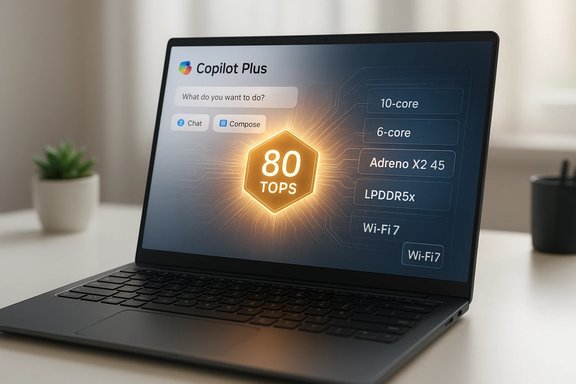
- Two primary SKUs: a 10‑core model (commonly identified as X2P‑64‑100) and a 6‑core model (X2P‑42‑100). The 10‑core part mixes prime and performance cores; the 6‑core part focuses on prime cores for fanless or lower‑power designs.
- Process node and CPU: built on a 3 nm class node (TSMC N3 family variants in Qualcomm’s disclosures) and using Qualcomm’s third‑generation Oryon CPU microarchitecture, tuned for sustained responsiveness rather than extreme short‑lived turbo bursts.
- GPU: Adreno X2‑45 family. The 10‑core SKU runs the GPU at higher clocks (Qualcomm cites ~1.7 GHz in some vendor materials) while the 6‑core uses a lower GPU clock to hit thermals and cost targets.
- NPU: the headline — 80 TOPS Hexagon NPU (INT8 class throughput). That is the same NPU class used in X2 Elite parts and the core enabler for heavier local inference workloads.
- Memory & I/O: LPDDR5x support (Qualcomm references up to 128 GB capacity and ~152 GB/s bandwidth in press materials), Wi‑Fi 7 FastConnect, optional Snapdragon X75 5G modem, AV1 encode/decode support, USB4/DisplayPort 2.1 outputs and PCIe Gen5 NVMe.
Why the “Plus” feels like an Elite
Qualcomm intentionally re‑uses the same Hexagon NPU and a modern GPU family from the Elite stack. That parity matters more than raw core counts in 2026: AI workloads often bottleneck on inference throughput and memory bandwidth rather than peak CPU MHz. By putting 80 TOPS into mainstream SKUs, Qualcomm effectively delivers the AI capabilities OEMs and Microsoft want for Copilot+ without forcing customers to buy flagship price points. Early reporting and reference‑design results showed X2 Plus units handling real on‑device AI features consistently and with low thermal strain, attributes previously limited to the Elite tier.Performance: what to expect and where the claims hold up
CPU and GPU
Qualcomm’s lab claims and early benchmarks demonstrate noticeable single‑thread gains (up to 35% vs. prior X Plus), and modest but real GPU uplifts depending on SKU. Hands‑on Geekbench runs on engineering units presented at preview events aligned with Qualcomm’s numbers and showed the 10‑core X2 Plus outperforming some current Core Ultra 2 (Intel) parts at comparable power envelopes in single‑core and sustained workloads. That said, statements comparing X2 Plus to Intel should be treated with timeline context: Intel’s new Core Ultra 3 “Panther Lake” family — built on Intel 18A — is arriving to market and introduces new P/E core mixes, an upgraded Xe3 GPU, and an improved NPU. Intel’s Panther Lake messaging positions its NPU around the 48–50 TOPS class in some product tiers, which narrows Qualcomm’s raw NPU lead while also changing the competitive calculus on integrated graphics. The practical takeaway: for everyday productivity and sustained workloads in thin designs, X2 Plus looks likely to feel faster and more consistent than many thin x86 designs under battery power, thanks to Qualcomm’s platform tuning and the chip’s thermal behavior. But if your workflows are heavily tied to the latest x86‑optimized compilers, AVX‑heavy code, or discrete GPU acceleration, x86 competitors remain compelling.AI and the Hexagon advantage
On‑device AI is the strongest argument in favor of X2 Plus. The 80 TOPS Hexagon NPU gives Qualcomm a large theoretical throughput advantage for quantized, INT8 inference tasks — the sort of workloads Copilot+ and many real‑time perceptual features rely on. Independent tool benchmarks and early demos show X2 Plus scoring dramatically higher in computer‑vision and inferencing tests than Intel Core Ultra 2 equivalents, and developer tooling for Hexagon continues to mature across popular runtimes. Two practical notes:- TOPS is necessary but not sufficient: final user experience depends heavily on memory bandwidth, model size, quantization strategy, and runtime optimizations. A high TOPS value opens possibilities; it does not by itself guarantee flawless performance across every model.
- Efficiency for always‑on agents: the Hexagon’s efficiency profile is critical for background agents and multitasking AI; Qualcomm’s combination of NPU throughput and low idle power makes continuous, local features (transcription, recall, agentic assistants) more practical without draining the battery.
Battery life and thermal behavior
One of Qualcomm’s consistent claims is that the X2 Plus enables multi‑day battery life under light use and significantly improved runtime under moderate workloads. Early engineering‑sample testing and Qualcomm’s idle‑normalized numbers suggest up to 43% lower power versus the prior X Plus generation for comparable workloads. More importantly, the platform demonstrated stable sustained clocks in thin reference builds without runaway thermals or audible fan spikes during long sessions — a crucial UX differentiator for thin‑and‑light laptops.Practical caveat: OEM chassis tuning is everything. A given X2 Plus laptop’s real battery performance will be a function of OEM power caps, display choices (refresh rates and brightness), and memory configuration (LPDDR5x density and speed). Buyers should wait for retail battery tests on specific models rather than take “multi‑day” at face value.
Ecosystem and enterprise implications
Copilot+ and manageability
Microsoft’s Copilot+ initiative sets a pragmatic hardware bar for on‑device AI. Many Copilot+ features expect local inference capability (the visible baseline is often described as NPU throughput equivalents of tens of TOPS plus modern memory configurations). By making 80 TOPS NPU available in mainstream parts, Qualcomm is directly enabling a larger pool of Copilot+‑capable machines — and that changes procurement conversations for IT departments and enterprise buyers.Crucially, X2 Plus also brings Snapdragon Guardian remote manageability features — out‑of‑band updates, lock‑and‑wipe, device tracking — to more mainstream devices. That feature set encroaches on an area historically dominated by Intel vPro and reduces a notable barrier for enterprise adoption of Arm‑based laptops. For fleet admins, that parity in manageability can be decisive when evaluating mass deployments.
Software compatibility and driver maturity
Windows on Arm has come a long way, but edge cases remain: niche enterprise tools, legacy x86 binaries under emulation, and some GPU‑heavy creative pipelines might still encounter friction. Driver maturity — especially GPU and NPU runtime libraries — will determine how smooth the transition is for many organizations. Qualcomm’s recent track record of delivering reproducible performance data and steady driver improvements is encouraging, but large enterprise rollouts should include pilot validation for mission‑critical apps before broad procurement.Risks, tradeoffs, and unanswered questions
- Competitive pressure is accelerating. Intel’s Panther Lake (Core Ultra 3) introduces architectural & process advances (Intel 18A) and NPUs in the 48–50 TOPS neighborhood in some SKUs. That will blunt part of Qualcomm’s AI advantage and could shift comparative value propositions once retail Panther Lake laptops land. Early Panther Lake messaging is already positioning it as a stronger GPU and multi‑core performer than prior Intel generations.
- Memory costs and supply risk. LPDDR5x shortages and price spikes, driven partly by data‑center and AI demand, raise the possibility that OEMs shipping X2 Plus machines may choose lower memory tiers to hit price targets. That decision would materially affect AI and multitasking performance, so buyers should verify the actual RAM type and bandwidth in retail SKUs.
- Confusing SKU fragmentation for consumers. With two X2 Plus SKUs and different OEM thermal tunings, buyers could run into inconsistent performance tiers marketed under the same family name. OEMs must be transparent about whether a laptop uses the 10‑core or 6‑core variant, the GPU clock, and the sustained power envelope. Without that, comparisons will be noisy.
- TOPS vs. real‑world throughput. High TOPS is a headline grabber, but model support, runtime integration, and memory architecture determine real application performance. Early adopters should expect driver and software optimizations to evolve over the first six months after launch.
Availability and OEM ecosystem
Qualcomm projects the first Snapdragon X2 Plus laptops will ship in the first half of 2026, with major OEMs — HP, Lenovo, ASUS and others — revealing X2 Plus‑based designs at CES and in early 2026 announcements. Expect a healthy mix of thin‑and‑lights, 2‑in‑1s, business ultrabooks, and some fanless options targeted at the education and budget professional segments. Early press and vendor slides already show device categories and pricing bands aimed at delivering Copilot+ capability in the mainstream. What to watch in OEM announcements:- Exact SKU calls (X2P‑64‑100 vs X2P‑42‑100).
- RAM configuration and memory type (LPDDR5x speed and capacity).
- Sustained power/TDP numbers and chassis thermal design.
- Driver update cadence and enterprise manageability support (Snapdragon Guardian policies).
How to evaluate an X2 Plus laptop (practical checklist)
- Confirm the exact X2 Plus SKU (10‑core or 6‑core) and GPU clock. Performance varies meaningfully between the two.
- Verify RAM type and capacity — LPDDR5x at adequate speeds (and at least 16 GB for Copilot+ workflows) is recommended.
- Look for Copilot+ certification or Microsoft‑validated device claims if on‑device AI features are required.
- Review independent battery tests using mixed day‑long workloads, not just vendor marketing sessions.
- Validate enterprise tools under emulation where applicable (line‑of‑business apps, security agents, provisioning).
Strategic implications: is this the tipping point for Arm Windows laptops?
The Snapdragon X2 Plus is Qualcomm’s clearest attempt to democratize on‑device AI for Windows. By keeping the same 80 TOPS Hexagon NPU used in premium Elite chips and delivering that into mainstream, more affordable SKUs, Qualcomm materially reduces the hardware friction that has kept advanced Copilot+ features on high‑end devices. That alone could accelerate a broader wave of Arm‑native app development and change buyer expectations around what even a $999 laptop can do locally in 2026.Yet the competitive landscape is dynamic. Intel’s Panther Lake brings new process advantages (18A) and modernized compute hybrids that will narrow some gaps, especially in integrated GPU performance and x86 compatibility. AMD’s upcoming Ryzen AI roadmap also aims to broaden NPU presence in client parts. This turns 2026 into one of the most competitive years for mobile and thin‑client silicon in a decade. The winners will be platforms that combine silicon capability with OEM execution (good thermals, sensible RAM choices) and software maturity (robust drivers, developer tooling, and enterprise support).
Conclusion
The Snapdragon X2 Plus is not an incremental mid‑range chip: it is a carefully engineered lever to move on‑device AI from flagship novelty into mainstream expectation. Qualcomm’s decision to carry the 80 TOPS Hexagon NPU into a mass‑market part changes the calculus for Microsoft, OEMs, developers, and buyers. If OEMs honor the platform’s memory, power, and thermal recommendations, we can expect genuine, widely available Copilot+ experiences in laptops priced where most consumers and businesses shop.That said, buyers and IT teams should remain measured: verify retail‑unit benchmarks, confirm RAM and sustained power specs, and pilot enterprise workloads before committing at scale. Competitive responses from Intel and AMD will further refine the landscape over 2026, but for now Qualcomm has put a highly capable, efficient NPU‑centric platform squarely in the hands of mainstream buyers — and that could be the most important shift in Windows laptop silicon this year.
Key vendor and press reads used to validate claims include Qualcomm’s CES disclosures and contemporaneous coverage from major outlets reporting the X2 Plus’s 80 TOPS NPU, 10‑ and 6‑core SKUs, LPDDR5x support, and first‑half‑2026 device timing. Independent verification awaits retail device reviews, driver updates, and real‑world battery tests once OEM units ship.
Source: Windows Central New Snapdragon X2 Plus could be the most important Windows chip of 2026
