

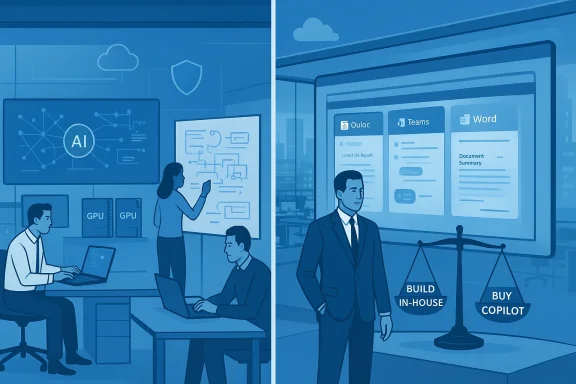
Société Générale has abandoned an internally developed AI assistant and is rolling out Microsoft Copilot across significant parts of the bank’s operations, a sudden reversal that spotlights a larger industry choice: buy the mature, integrated AI stack from hyperscalers or continue investing in costly, bespoke models that are hard to scale and govern.
Société Générale built an internal AI capability and an organizational structure to exploit AI at scale, including a dedicated unit to drive group-wide adoption. The bank’s in‑house efforts aimed to deliver tailored assistants and tooling for front‑ and back‑office teams, with the promise of tighter data control and competitive differentiation.
Despite those ambitions, the bank has pivoted. The internal project has been discontinued and the bank will deploy Microsoft Copilot—Microsoft’s branded enterprise AI assistant and companion across Microsoft 365 and Azure—rather than continue to operate or productize the homegrown system. The move follows a familiar pattern emerging across finance: organizations that once pursued bespoke LLM stacks are increasingly choosing managed solutions from major cloud and software vendors.
The tradeoff is vendor concentration. Migrating to Copilot increases dependency on Microsoft’s cloud and AI roadmap, and raises questions about long‑term negotiating leverage and portability of customizations. For many firms, however, the near‑term productivity gains and reduced engineering burden outweigh those risks.
Some banks decide their strategic differentiation lies in financial products and customer relationships—not in training base LLMs. Allocating scarce talent to product integration, compliance, and business process redesign is often a better strategic fit than chasing a full model‑building capability.
Key economic realities:
Longer term, Société Générale faces three strategic choices:
A cautionary note: while public reporting describes this specific discontinuation of an internal assistant and adoption of Microsoft Copilot, some granular details about internal deadlines, exact cost comparisons, and management deliberations are often confidential and not independently verifiable from public disclosures. Stakeholders should treat reported motivations as credible high‑level drivers but understand that precise financials and internal tradeoffs typically remain internal to the organization.
Société Générale’s decision is a bellwether. It signals that at the enterprise scale, AI procurement is becoming a boardroom — not a research lab — decision. The winners will be firms that pair pragmatic vendor selection with rigorous governance, preserve strategic capabilities in‑house, and maintain the flexibility to adapt as AI economics, regulation and technology evolve.
Source: Bloomberg.com https://www.bloomberg.com/news/arti...rosoft-s-copilot-after-scrapping-own-ai-tool/
 Background
Société Générale built an internal AI capability and an organizational structure to exploit AI at scale, including a dedicated unit to drive group-wide adoption. The bank’s in‑house efforts aimed to deliver tailored assistants and tooling for front‑ and back‑office teams, with the promise of tighter data control and competitive differentiation.Despite those ambitions, the bank has pivoted. The internal project has been discontinued and the bank will deploy Microsoft Copilot—Microsoft’s branded enterprise AI assistant and companion across Microsoft 365 and Azure—rather than continue to operate or productize the homegrown system. The move follows a familiar pattern emerging across finance: organizations that once pursued bespoke LLM stacks are increasingly choosing managed solutions from major cloud and software vendors.
Why this happened: the pragmatic drivers
Several concrete, interconnected reasons explain why a major bank would stop development of its own assistant and adopt Microsoft Copilot instead. These reasons fall into categories of cost, speed, technical capability, governance and risk management.1) Total cost and operational complexity of running LLMs at scale
Running modern large language models in production is expensive and operationally complex. Costs include:- Massive GPU compute for training and fine‑tuning, and sustained inference capacity for interactive assistants.
- A full MLOps stack: data pipelines, feature stores, model versioning, testing, deployment orchestration and observability.
- Continuous model maintenance: periodic re‑fine‑tuning, prompt engineering for new use cases, drift detection and mitigation.
- Red‑team testing, bias audits, explainability tooling and regulatory documentation.
2) Time‑to‑value and organizational adoption
Enterprises face pressure to demonstrate measurable benefits (reduced processing time, fewer errors, improved customer experience) quickly. Vendor solutions like Microsoft Copilot are designed to plug into existing productivity suites, offering:- Fast integrations with Microsoft 365 apps, Outlook, Teams, SharePoint and OneDrive.
- Out‑of‑the‑box capabilities for drafting, summarization, task extraction and workflow automation.
- Enterprise management consoles for scaling licenses and applying policies.
3) Data governance, compliance and enterprise security features
Banks operate under strict data residency, privacy and auditability requirements. Leading cloud vendors have invested heavily in features aimed at regulated industries:- Data residency controls and regional cloud deployments.
- Customer data isolation and contractual protections against model training on customer data.
- Certified compliance baselines (ISO, SOC, PCI where relevant) and detailed security whitepapers.
- Administrative controls for role‑based access, audit logs, and integration with corporate identity stores.
4) Integration with the productivity stack and vendor lock‑in tradeoffs
Microsoft leverages a unique integration advantage: Copilot is embedded across Microsoft 365 and Azure services. That tight coupling means Copilot can access context from documents, mail, calendars and corporate knowledge stores (subject to governance), enabling higher‑value workflows than a generic assistant.The tradeoff is vendor concentration. Migrating to Copilot increases dependency on Microsoft’s cloud and AI roadmap, and raises questions about long‑term negotiating leverage and portability of customizations. For many firms, however, the near‑term productivity gains and reduced engineering burden outweigh those risks.
5) Talent, skills and strategic focus
Building and maintaining LLMs requires sustained recruitment of specialized ML engineers, prompt engineers, infrastructure engineers and AI governance specialists. Banks competing for that talent find themselves bidding against technology firms and startups with higher salaries and simpler missions.Some banks decide their strategic differentiation lies in financial products and customer relationships—not in training base LLMs. Allocating scarce talent to product integration, compliance, and business process redesign is often a better strategic fit than chasing a full model‑building capability.
What the change tells us about enterprise AI economics
This move from in‑house to vendor reflects a maturing market dynamic. Early enthusiasm for bespoke models—driven by control, customization and potential IP advantages—has confronted reality: enterprise LLM projects regularly overshoot budgets, introduce risk, and take longer than planned to produce business outcomes.Key economic realities:
- Hardware and energy costs remain material for training and inference.
- Engineering and operational overheads are ongoing and often underestimated.
- Vendor products consolidate many capabilities—model hosting, security, integration, monitoring—into a single commercial SLA.
- The marginal cost of extending vendor features (e.g., adding new connectors to internal systems) can be lower than the fixed cost of building equivalent features.
Strengths of choosing Microsoft Copilot
Moving to Microsoft Copilot brings several tangible benefits for a bank like Société Générale.- Rapid deployment: Copilot’s native integration with the Microsoft 365 ecosystem shortens rollout timelines and reduces friction for end users.
- Mature enterprise controls: Prebuilt governance and compliance mechanisms reduce the legal and security review burden.
- Vendor support and SLAs: Commercial support, guaranteed availability and product roadmaps make production reliability easier to achieve.
- Continual model improvements: The vendor maintains and upgrades base models, offloading heavy R&D costs to the provider.
- Feature set for knowledge workers: Advanced summarization, draft creation, meeting recaps, and action‑item extraction map well to banking workflows.
Risks and downsides — what leaders must still manage
Adopting a vendor solution is not risk‑free. The decision trades certain internal controls for vendor‑managed features, and it introduces strategic, technical, and regulatory exposures.Concentration and vendor lock‑in
Relying on a single hyperscaler increases concentration risk. If product pricing, policy or service levels change, the bank’s operating costs and capabilities can be significantly affected. Negotiated contractual protections and exit plans are essential to mitigate this.Data leakage and model behavior
Even with enterprise contracts, technical risk remains. Models can hallucinate, inadvertently combine data sources in unexpected ways, or reproduce training artifacts. Banks must implement layered safeguards:- Strict data filtering before passing sensitive data to any model.
- Logging and monitoring of AI outputs for high‑risk use cases.
- Human‑in‑the‑loop gating for decisions affecting customers or compliance.
Regulatory and audit scrutiny
Regulators are increasingly focused on AI in financial services. Supervisory expectations center on explainability, model validation, complaint handling, bias mitigation and third‑party risk management. Using an external model requires satisfying auditors that:- The vendor’s model lifecycle processes meet validation standards.
- The bank can reproduce or explain decisions when required.
- Appropriate SLAs and indemnities exist for incidents.
Erosion of internal capability
Stopping internal build projects can lead to skill attrition. Engineers who designed the in‑house assistant may leave, causing loss of institutional knowledge. Banks should preserve expertise by redirecting teams to integration, model‑risk oversight, data engineering and custom skills that remain valuable.Pricing and long‑term costs
Vendor pricing models can be complex (per‑seat, per‑token, tiered usage). What looks cheaper in year one can escalate as adoption grows. Financial teams must model run‑rate costs under realistic adoption scenarios and insert contractual caps or volume discounts where possible.Practical steps Société Générale (or any bank) should take now
- Secure a robust contractual framework:
- Negotiate data residency, non‑training guarantees (if required), breach notification timelines, and audit rights.
- Insert price protection clauses and defined escalation mechanisms.
- Implement layered data governance:
- Classify data by sensitivity and create allow/deny lists for what can be sent to Copilot.
- Use in‑document redaction and pre‑processing to remove account identifiers and sensitive attributes.
- Build an AI risk and assurance program:
- Establish model validation, bias testing, logging, and explainability processes tailored to vendor models.
- Require periodic third‑party audits and independent validation exercises.
- Retain and repurpose in‑house talent:
- Redeploy ML engineers into data engineering, prompt engineering, model monitoring, and vendor integration work.
- Preserve documentation, IP artifacts and postmortems from the internal project for institutional learning.
- Design hybrid, exportable integrations:
- Avoid deep coupling of business logic solely to vendor APIs; implement abstraction layers that enable future portability.
- Maintain canonical data models and connectors that can be remapped if vendor strategy changes.
- Monitor costs and adoption patterns:
- Forecast token usage and per‑seat costs; build governance around experiment staging and production rollouts.
- Pilot high‑value business flows first to understand ROI and scale incrementally.
- Test adversarial and safety scenarios:
- Conduct red‑team tests for prompt injection, data exfiltration and malicious use cases.
- Validate Copilot outputs for hallucinations and misinformation in critical workflows.
Broader implications for financial services and enterprise IT
Société Générale’s pivot reflects a broader market signal: enterprises are increasingly pragmatic about where AI value is captured. The tradeoffs are clear:- Hyperscalers win where integration, governance and scale are required quickly.
- Bespoke models still make sense for unique competitive moats—when the model itself, trained on proprietary data, creates sustained differentiation.
- Many institutions will adopt a hybrid posture: vendor models for general productivity and a selective internal stack for truly differentiated, high‑value tasks that justify the cost and risk.
What this means strategically for Société Générale
From a strategic perspective, the pivot indicates a prioritization of operational efficiency and near‑term productivity gains over maintaining a homegrown model capability. Short‑term benefits are straightforward: faster rollout, less operational overhead, and access to continuous vendor improvements.Longer term, Société Générale faces three strategic choices:
- Accept vendor dependence and invest in vendor relationship management, negotiation leverage and exit planning.
- Maintain an internal “AI backbone” capability—focused on data, governance and integration—so the bank can switch vendors or insource particular capabilities later.
- Use vendor solutions as accelerators while continuing to incubate narrowly scoped, high‑value internal models that address unique banking needs.
Final assessment and cautionary notes
The move to a mainstream vendor assistant is not an admission of defeat; it is a pragmatic business decision driven by economics, speed and risk management. For many banks the right answer is not “build always” or “buy always,” but a disciplined combination: buy fast where the feature set and governance match needs, and build selectively where the bank can gain a defensible advantage.A cautionary note: while public reporting describes this specific discontinuation of an internal assistant and adoption of Microsoft Copilot, some granular details about internal deadlines, exact cost comparisons, and management deliberations are often confidential and not independently verifiable from public disclosures. Stakeholders should treat reported motivations as credible high‑level drivers but understand that precise financials and internal tradeoffs typically remain internal to the organization.
Société Générale’s decision is a bellwether. It signals that at the enterprise scale, AI procurement is becoming a boardroom — not a research lab — decision. The winners will be firms that pair pragmatic vendor selection with rigorous governance, preserve strategic capabilities in‑house, and maintain the flexibility to adapt as AI economics, regulation and technology evolve.
Source: Bloomberg.com https://www.bloomberg.com/news/arti...rosoft-s-copilot-after-scrapping-own-ai-tool/
