

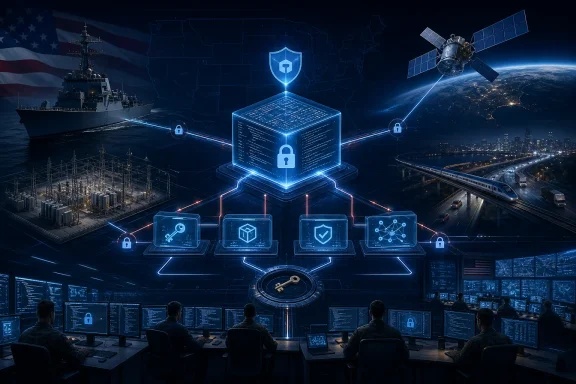
America’s push to rebuild domestic industrial capacity will remain incomplete if it treats software as an invisible service rather than a strategic component of every modern system. Ships, pipelines, power substations, military logistics platforms, satellites, transportation networks, and public-sector services increasingly rely on code that is written, built, signed, tested, deployed, and updated through a global web of developers, cloud platforms, dependencies, and automation tools.
That reality makes the case for an America-first software supply chain more serious than a slogan. It is not simply an argument for buying software from U.S. companies or hiring developers who live in the United States. It is an argument for preserving the ability to control the development environments, identities, source code, build pipelines, cryptographic keys, dependencies, telemetry, and deployment systems behind software that operates critical national functions.
The idea deserves attention. It also demands precision.
A resilient software supply chain cannot be created through a simplistic country-of-origin label, a blanket ban on foreign code, or an attempt to isolate every government system from the wider technology ecosystem. The United States depends on open-source software, global security research, international standards, and a highly distributed technology industry. The real policy challenge is to establish meaningful sovereign control over the systems whose compromise could disrupt national defense, public safety, energy, communications, water, transportation, or essential government operations.
For federal agencies and the contractors that serve them, that means moving the conversation beyond where software is used and asking where software is made.
The traditional supply-chain discussion is easy to visualize. Policymakers can point to a shipyard, a semiconductor fabrication plant, a warehouse, a foreign port, or a factory that produces a critical replacement part. Physical supply chains have obvious borders, visible equipment, and identifiable custody points.
Software does not work that way.
A single application may contain proprietary code developed by an internal government team, commercial libraries from several vendors, open-source packages maintained by volunteers, container images downloaded from public registries, build tooling delivered as a cloud service, and infrastructure hosted across multiple regions. Each layer can introduce a new dependency, a new administrator, or a new route for compromise.
That complexity is not limited to desktop applications or public websites. It extends directly into operational technology and defense systems:
This is why software supply-chain risk must be analyzed in terms of operational consequence. A compromised development system does not merely risk the theft of source code. It can enable malicious changes that are introduced upstream, signed by trusted credentials, and delivered through an apparently legitimate update process.
That is one reason software supply-chain attacks are so difficult to detect. Traditional security tools are often designed to identify unauthorized intrusion. They are less effective when attackers abuse authorized access, legitimate update mechanisms, trusted third-party tools, or compromised developer credentials.
Instead, software sovereignty should describe an organization’s practical ability to retain control over critical software throughout its lifecycle.
That lifecycle includes:
A more workable model rests on four connected principles.
The key issue is not whether developers work remotely. Remote development is now standard practice. The question is whether the developer’s endpoint is the true point of control, or whether the work happens inside a centrally governed environment that can be monitored, audited, and recovered.
A source-code repository inside a trusted tenant is not enough if the build environment downloads unverified packages, uses unmanaged credentials, or publishes artifacts through a third-party pipeline that cannot be independently audited. Sovereignty is a chain, and its strength is determined by the weakest system with authority to alter the final result.
This is where concepts such as software bills of materials, signed artifacts, reproducible builds, hardened build agents, dependency pinning, and code-signing policies become more than compliance exercises. They provide the evidence needed to answer a difficult question after an incident: What exactly was built, from what inputs, by whom, and where?
A system may be technically hosted in the United States yet still depend on globally managed support staff, foreign-operated build infrastructure, external authentication services, or software updates from third-party repositories. Those dependencies may be acceptable for low-risk workloads. They are much harder to justify for systems whose failure could affect national security or human safety.
That threat model changes how agencies should think about development systems.
An attacker who compromises a public-facing appliance, steals administrator credentials, or gains access through a managed service provider may attempt to move toward higher-value systems. In a traditional enterprise, that might mean financial systems, sensitive data, or executive communications. In a defense or critical-infrastructure environment, it may mean build systems, deployment tools, engineering networks, code-signing certificates, maintenance platforms, or operational technology interfaces.
The Viasat disruption that accompanied Russia’s full-scale invasion of Ukraine demonstrated the strategic importance of communications infrastructure. It also illustrated that cyberattacks can have immediate physical and operational consequences, even when the target is not a weapon system in the conventional sense.
For U.S. agencies, the lesson is not that every foreign supplier presents the same risk. The lesson is that digital dependencies can become strategic pressure points. Software development systems deserve protection commensurate with the consequences of the systems they produce.
But software is embedded in nearly every part of a modern maritime operation.
A vessel depends on software for propulsion monitoring, navigation, command-and-control integration, communications, maintenance scheduling, sensor processing, logistics, damage control, cybersecurity monitoring, and, increasingly, autonomous functions. A ship can be built domestically while portions of its digital lifecycle remain dependent on externally controlled cloud services, globally distributed tooling, or opaque third-party components.
That mismatch does not invalidate domestic shipbuilding policy. It exposes a missing dimension.
The answer is not to impose an arbitrary rule that prohibits every non-U.S. software component. Such an approach would be impractical, expensive, and potentially counterproductive. Much of the world’s most important software infrastructure is open source, collaboratively maintained, and deeply embedded in commercial and government systems.
Instead, policymakers should define different levels of assurance based on mission sensitivity.
Those measures matter. They have raised the cost of poor security practices and pushed agencies and vendors toward more disciplined software engineering.
However, security compliance and software sovereignty are not the same thing.
A cloud service can meet demanding security standards while still leaving an agency dependent on a vendor’s global operations, commercial roadmap, support model, service availability, or externally managed control plane. A contractor can maintain strong endpoint security while still allowing code to be built using a patchwork of unmanaged local tools and third-party services.
Likewise, a software bill of materials can identify components after the fact, but it does not necessarily prove that the build environment itself was protected from manipulation. Multifactor authentication is vital, but it does not solve the problem of overprivileged accounts, unreviewed automation tokens, or compromised code-signing keys.
The policy gap is best described this way: current frameworks tend to ask whether systems are secure enough to operate, while software sovereignty asks whether the government has enough enduring control to trust and sustain them during disruption.
Both questions are necessary.
Conversely, a technology product with internationally developed components may be deployed safely when it is properly inspected, isolated, cryptographically verified, and operated inside a tightly governed U.S. environment.
That is why country of incorporation is not a security architecture.
Effective policy must focus on verifiable operational facts:
For years, many federal programs have relied on a mixture of physical workstations, virtual desktop infrastructure, local virtual machines, and manually configured tools. These setups can meet baseline requirements, but they create inconsistency. Onboarding takes longer, patching becomes harder, secrets can leak into local files, and teams struggle to prove that every developer works from a trusted configuration.
A centrally managed development environment changes that model.
Developers can use Windows, Linux, macOS, thin clients, or approved remote endpoints to access a standardized workspace running inside a protected environment. The code, build tooling, secrets, logs, and audit trail remain under central control. Security teams can apply policy consistently without forcing every engineer to maintain an identical physical desktop.
For Windows-heavy federal and contractor environments, this can build on familiar technologies:
They can reduce the time needed to provision a new engineer, standardize development tools, simplify patching, improve access revocation, and help teams maintain consistent builds across classified, unclassified, and disconnected environments. They may also reduce support burdens created by years of customized local laptop configurations.
For agencies trying to modernize legacy applications, a standardized development platform can become an important bridge. Teams can retain necessary older tools in controlled images while introducing modern source control, automated testing, dependency management, and release practices.
That said, centralization must not create a single massive failure domain. Development platforms need segmentation, redundancy, offline recovery, separate administrative roles, and tested contingency plans. A centralized environment that is unavailable during a mission-critical period can become its own operational risk.
Trying to eliminate open source from government software would not create sovereignty. It would create cost, delay, technical debt, and a false sense of control.
The better strategy is open-source governance.
Agencies and contractors should maintain approved component inventories, validate package provenance, pin versions, scan for known vulnerabilities, track transitive dependencies, and maintain internal mirrors or artifact repositories for critical packages. Sensitive programs should be able to build from curated, reviewed, and retained dependencies rather than downloading the latest package from the public internet at build time.
This distinction matters. The risk is not that code was openly developed. The risk is that important dependencies can be changed, removed, impersonated, or compromised without adequate review.
For critical systems, the ability to retain a known-good dependency set and rebuild software from it may be as important as the ability to download the newest version of a package.
A practical policy framework would include the following elements.
The highest sovereignty requirements should apply to those systems first.
Poorly designed requirements could encourage agencies to create expensive, isolated platforms that are difficult to use and even harder to maintain. Developers will seek workarounds if official tools are slow, restrictive, or disconnected from the technologies needed to do their jobs. Shadow IT is often a symptom of inadequate official infrastructure.
But the answer is not to accept uncontrolled dependencies as the price of modern engineering.
The strongest sovereign development environments should be developer-friendly by design. They need fast startup times, modern editors, supported language runtimes, practical access to approved dependencies, integrated testing, well-documented APIs, and dependable support. Security controls that add friction without improving assurance will eventually fail.
A well-designed platform can improve both security and productivity by eliminating repetitive workstation setup, reducing configuration drift, automating compliance evidence, and giving developers consistent access to the tools they need.
The central policy question is not whether sovereignty has a cost. It does. The question is whether the cost of disciplined control is lower than the cost of discovering, during a national emergency, that critical software cannot be trusted, updated, or recovered without systems outside U.S. control.
The objective is more practical: resilience under pressure.
For critical systems, the government must be able to determine what code is running, how it was produced, who approved it, what dependencies it contains, how it can be rebuilt, and whether it can continue operating when a vendor, service, network connection, or geopolitical relationship fails.
That standard is demanding, but it is appropriate for software that controls national infrastructure and defense capabilities.
The physical world has long understood that strategic assets require secure supply lines, trusted maintenance, domestic capacity, and reliable replacement parts. Software now deserves the same level of seriousness. A secure hull, a trusted chip, and a domestic factory offer limited assurance if the code that operates the system is built through an opaque, externally dependent, and weakly governed pipeline.
The future of national resilience will be determined not only by what America builds, but by whether America can securely build, verify, operate, and recover the software inside it.
That reality makes the case for an America-first software supply chain more serious than a slogan. It is not simply an argument for buying software from U.S. companies or hiring developers who live in the United States. It is an argument for preserving the ability to control the development environments, identities, source code, build pipelines, cryptographic keys, dependencies, telemetry, and deployment systems behind software that operates critical national functions.
The idea deserves attention. It also demands precision.
A resilient software supply chain cannot be created through a simplistic country-of-origin label, a blanket ban on foreign code, or an attempt to isolate every government system from the wider technology ecosystem. The United States depends on open-source software, global security research, international standards, and a highly distributed technology industry. The real policy challenge is to establish meaningful sovereign control over the systems whose compromise could disrupt national defense, public safety, energy, communications, water, transportation, or essential government operations.
For federal agencies and the contractors that serve them, that means moving the conversation beyond where software is used and asking where software is made.
 The Software Supply Chain Is Now Critical Infrastructure
The traditional supply-chain discussion is easy to visualize. Policymakers can point to a shipyard, a semiconductor fabrication plant, a warehouse, a foreign port, or a factory that produces a critical replacement part. Physical supply chains have obvious borders, visible equipment, and identifiable custody points.Software does not work that way.
A single application may contain proprietary code developed by an internal government team, commercial libraries from several vendors, open-source packages maintained by volunteers, container images downloaded from public registries, build tooling delivered as a cloud service, and infrastructure hosted across multiple regions. Each layer can introduce a new dependency, a new administrator, or a new route for compromise.
That complexity is not limited to desktop applications or public websites. It extends directly into operational technology and defense systems:
- Combat-management and mission-planning software
- Industrial control and monitoring platforms
- Satellite communications systems
- Fleet maintenance and logistics applications
- Autonomous and unmanned-system software
- Emergency communications platforms
- Identity, access, and security management systems
- AI-assisted analytics and decision-support tools
This is why software supply-chain risk must be analyzed in terms of operational consequence. A compromised development system does not merely risk the theft of source code. It can enable malicious changes that are introduced upstream, signed by trusted credentials, and delivered through an apparently legitimate update process.
That is one reason software supply-chain attacks are so difficult to detect. Traditional security tools are often designed to identify unauthorized intrusion. They are less effective when attackers abuse authorized access, legitimate update mechanisms, trusted third-party tools, or compromised developer credentials.
Why Sovereignty Matters More Than Software Nationality
The term software sovereignty can be useful, but only when it is defined carefully. It should not mean that every line of code must be written by a U.S. citizen, every component must originate in the United States, or every foreign technology provider is inherently hostile.Instead, software sovereignty should describe an organization’s practical ability to retain control over critical software throughout its lifecycle.
That lifecycle includes:
- Planning and design
- Source-code development
- Code review and testing
- Dependency selection and verification
- Build and packaging
- Code signing
- Deployment
- Monitoring, patching, and incident response
- Archival, recovery, and retirement
A more workable model rests on four connected principles.
Controlled Development Locations
For sensitive workloads, code should be developed in environments that are owned, operated, or contractually controlled by the U.S. government and its authorized partners. This does not automatically require a physical government data center. Properly authorized domestic cloud infrastructure may be appropriate when the agency retains meaningful control over identity, access, logs, encryption, configuration, and data residency.The key issue is not whether developers work remotely. Remote development is now standard practice. The question is whether the developer’s endpoint is the true point of control, or whether the work happens inside a centrally governed environment that can be monitored, audited, and recovered.
Operational Control
Agencies need control over the systems that build and release their software. That includes source repositories, artifact repositories, build servers, signing services, secrets-management systems, and deployment pipelines.A source-code repository inside a trusted tenant is not enough if the build environment downloads unverified packages, uses unmanaged credentials, or publishes artifacts through a third-party pipeline that cannot be independently audited. Sovereignty is a chain, and its strength is determined by the weakest system with authority to alter the final result.
Toolchain Integrity
Modern development depends heavily on compilers, package managers, libraries, containers, plugins, and automated workflows. A secure software supply chain requires the ability to identify what entered a build, validate its provenance, and reproduce the resulting artifact.This is where concepts such as software bills of materials, signed artifacts, reproducible builds, hardened build agents, dependency pinning, and code-signing policies become more than compliance exercises. They provide the evidence needed to answer a difficult question after an incident: What exactly was built, from what inputs, by whom, and where?
Isolation From Uncontrolled External Dependencies
The most sensitive systems should not depend on external software-as-a-service platforms that can be disrupted, legally compelled, administratively altered, or compromised outside the government’s control. That does not mean every agency must abandon cloud services. It means that critical functions require a clear understanding of where control ends.A system may be technically hosted in the United States yet still depend on globally managed support staff, foreign-operated build infrastructure, external authentication services, or software updates from third-party repositories. Those dependencies may be acceptable for low-risk workloads. They are much harder to justify for systems whose failure could affect national security or human safety.
The Threat Model Is Not Hypothetical
Warnings about hostile cyber actors pre-positioning themselves in U.S. critical infrastructure should have ended the assumption that cyber risk is primarily about data theft. In many cases, the strategic objective may be to establish access that can be activated later during a crisis or conflict.That threat model changes how agencies should think about development systems.
An attacker who compromises a public-facing appliance, steals administrator credentials, or gains access through a managed service provider may attempt to move toward higher-value systems. In a traditional enterprise, that might mean financial systems, sensitive data, or executive communications. In a defense or critical-infrastructure environment, it may mean build systems, deployment tools, engineering networks, code-signing certificates, maintenance platforms, or operational technology interfaces.
The Viasat disruption that accompanied Russia’s full-scale invasion of Ukraine demonstrated the strategic importance of communications infrastructure. It also illustrated that cyberattacks can have immediate physical and operational consequences, even when the target is not a weapon system in the conventional sense.
For U.S. agencies, the lesson is not that every foreign supplier presents the same risk. The lesson is that digital dependencies can become strategic pressure points. Software development systems deserve protection commensurate with the consequences of the systems they produce.
The Shipbuilding Analogy Is Powerful but Incomplete
The effort to expand U.S. shipbuilding capacity provides a compelling example of the gap between physical and digital sovereignty. Requirements for domestic construction, labor, hull materials, financing, and industrial capacity are understandable because ships are visible national assets.But software is embedded in nearly every part of a modern maritime operation.
A vessel depends on software for propulsion monitoring, navigation, command-and-control integration, communications, maintenance scheduling, sensor processing, logistics, damage control, cybersecurity monitoring, and, increasingly, autonomous functions. A ship can be built domestically while portions of its digital lifecycle remain dependent on externally controlled cloud services, globally distributed tooling, or opaque third-party components.
That mismatch does not invalidate domestic shipbuilding policy. It exposes a missing dimension.
The answer is not to impose an arbitrary rule that prohibits every non-U.S. software component. Such an approach would be impractical, expensive, and potentially counterproductive. Much of the world’s most important software infrastructure is open source, collaboratively maintained, and deeply embedded in commercial and government systems.
Instead, policymakers should define different levels of assurance based on mission sensitivity.
A Risk-Based Sovereignty Model
A sensible federal framework could divide software environments into tiers:- Standard business systems could use approved commercial cloud and software-as-a-service platforms under normal federal security requirements.
- Mission-essential systems could require U.S.-hosted development, stronger identity controls, signed builds, verified dependencies, and auditable release processes.
- High-consequence defense and critical-infrastructure systems could require government-controlled or dedicated contractor-operated development enclaves, restricted external connectivity, hardened artifact flows, and independent recovery capability.
- Classified and air-gapped programs could use tightly managed environments designed to move approved code and artifacts through controlled transfer mechanisms.
Existing Federal Cybersecurity Rules Do Not Fully Solve the Problem
The federal government already has a substantial body of cybersecurity policy. Secure software development guidance, cloud authorization programs, contractor cybersecurity requirements, zero-trust initiatives, encryption mandates, multifactor authentication, and incident-reporting expectations have all improved the baseline.Those measures matter. They have raised the cost of poor security practices and pushed agencies and vendors toward more disciplined software engineering.
However, security compliance and software sovereignty are not the same thing.
A cloud service can meet demanding security standards while still leaving an agency dependent on a vendor’s global operations, commercial roadmap, support model, service availability, or externally managed control plane. A contractor can maintain strong endpoint security while still allowing code to be built using a patchwork of unmanaged local tools and third-party services.
Likewise, a software bill of materials can identify components after the fact, but it does not necessarily prove that the build environment itself was protected from manipulation. Multifactor authentication is vital, but it does not solve the problem of overprivileged accounts, unreviewed automation tokens, or compromised code-signing keys.
The policy gap is best described this way: current frameworks tend to ask whether systems are secure enough to operate, while software sovereignty asks whether the government has enough enduring control to trust and sustain them during disruption.
Both questions are necessary.
A Warning Against Compliance Theater
There is a real danger that an America-first software supply-chain policy could become another procurement label with limited security value. A vendor may be headquartered in the United States, employ U.S. personnel, and market a domestic product while still relying on global infrastructure, foreign-developed dependencies, or opaque managed services.Conversely, a technology product with internationally developed components may be deployed safely when it is properly inspected, isolated, cryptographically verified, and operated inside a tightly governed U.S. environment.
That is why country of incorporation is not a security architecture.
Effective policy must focus on verifiable operational facts:
- Where source code is stored and who can access it
- Where builds execute and what can alter them
- How dependencies are selected, scanned, approved, and archived
- Where cryptographic signing keys reside
- Which identities can authorize production releases
- Whether builds can be reproduced independently
- Whether critical services can continue during a vendor outage or geopolitical disruption
- Whether agencies can recover, maintain, and deploy systems without an unavailable external provider
Centrally Managed Development Environments Offer a Practical Path
The most promising part of the sovereignty argument is the move away from loosely managed developer laptops and toward centrally managed development environments.For years, many federal programs have relied on a mixture of physical workstations, virtual desktop infrastructure, local virtual machines, and manually configured tools. These setups can meet baseline requirements, but they create inconsistency. Onboarding takes longer, patching becomes harder, secrets can leak into local files, and teams struggle to prove that every developer works from a trusted configuration.
A centrally managed development environment changes that model.
Developers can use Windows, Linux, macOS, thin clients, or approved remote endpoints to access a standardized workspace running inside a protected environment. The code, build tooling, secrets, logs, and audit trail remain under central control. Security teams can apply policy consistently without forcing every engineer to maintain an identical physical desktop.
For Windows-heavy federal and contractor environments, this can build on familiar technologies:
- Windows 11 Enterprise managed endpoints
- Microsoft Entra-based identity controls
- Privileged access management
- Remote development over secure virtual desktop or browser-based workspaces
- Windows Server and Linux build agents
- Windows Subsystem for Linux for approved cross-platform workflows
- PowerShell automation under controlled execution policies
- Code-signing services protected by hardware security modules
- Endpoint detection and response integrated with engineering telemetry
Benefits Beyond Security
Centrally managed environments can improve software delivery when they are implemented well.They can reduce the time needed to provision a new engineer, standardize development tools, simplify patching, improve access revocation, and help teams maintain consistent builds across classified, unclassified, and disconnected environments. They may also reduce support burdens created by years of customized local laptop configurations.
For agencies trying to modernize legacy applications, a standardized development platform can become an important bridge. Teams can retain necessary older tools in controlled images while introducing modern source control, automated testing, dependency management, and release practices.
That said, centralization must not create a single massive failure domain. Development platforms need segmentation, redundancy, offline recovery, separate administrative roles, and tested contingency plans. A centralized environment that is unavailable during a mission-critical period can become its own operational risk.
Open Source Must Be Governed, Not Rejected
No credible software sovereignty plan can ignore open source. Federal systems, commercial platforms, developer tools, networking products, cloud services, and security software all depend on open-source components.Trying to eliminate open source from government software would not create sovereignty. It would create cost, delay, technical debt, and a false sense of control.
The better strategy is open-source governance.
Agencies and contractors should maintain approved component inventories, validate package provenance, pin versions, scan for known vulnerabilities, track transitive dependencies, and maintain internal mirrors or artifact repositories for critical packages. Sensitive programs should be able to build from curated, reviewed, and retained dependencies rather than downloading the latest package from the public internet at build time.
This distinction matters. The risk is not that code was openly developed. The risk is that important dependencies can be changed, removed, impersonated, or compromised without adequate review.
For critical systems, the ability to retain a known-good dependency set and rebuild software from it may be as important as the ability to download the newest version of a package.
What an Effective Federal Policy Would Require
A durable federal software sovereignty policy should not be written as a narrow procurement mandate. It should establish technical outcomes, assurance levels, accountability, and measurable evidence.A practical policy framework would include the following elements.
Define Criticality Before Mandating Controls
Not every system should receive the same requirements. Agencies should identify systems whose compromise could cause mission failure, broad public disruption, physical damage, loss of life, or serious national-security consequences.The highest sovereignty requirements should apply to those systems first.
Require Provenance for Release Artifacts
Every production release should have a traceable record linking it to an approved source revision, known build environment, dependency set, test result, approval process, and signing event. This should be machine-verifiable wherever possible.Separate Development, Build, Signing, and Deployment Authority
No single compromised developer account should be able to change source code, produce a release, sign it, and deploy it to production without independent controls. Separation of duties is an old security principle, but it remains essential in modern DevOps environments.Establish Sovereign Recovery Capability
Agencies should be able to restore critical development and deployment functions from protected backups and documented procedures. Recovery plans should include source code, build definitions, dependency archives, configuration, certificates, keys, and deployment artifacts.Audit the Control Plane, Not Just the Workload
Security reviews often focus on the application or cloud workload. They must also examine the administrative systems that control identity, policy, logging, automation, infrastructure provisioning, and release authorization.Avoid Prescribing a Single Vendor or Development Style
A sovereignty policy should support secure cloud-native development, traditional enterprise applications, embedded systems, artificial intelligence workflows, and air-gapped engineering programs. The security objective is control and verifiability, not forced uniformity.The Cost and Innovation Debate
Critics will reasonably argue that stricter sovereignty requirements could increase costs, slow procurement, limit access to talent, and fragment development workflows. Those concerns should not be dismissed.Poorly designed requirements could encourage agencies to create expensive, isolated platforms that are difficult to use and even harder to maintain. Developers will seek workarounds if official tools are slow, restrictive, or disconnected from the technologies needed to do their jobs. Shadow IT is often a symptom of inadequate official infrastructure.
But the answer is not to accept uncontrolled dependencies as the price of modern engineering.
The strongest sovereign development environments should be developer-friendly by design. They need fast startup times, modern editors, supported language runtimes, practical access to approved dependencies, integrated testing, well-documented APIs, and dependable support. Security controls that add friction without improving assurance will eventually fail.
A well-designed platform can improve both security and productivity by eliminating repetitive workstation setup, reducing configuration drift, automating compliance evidence, and giving developers consistent access to the tools they need.
The central policy question is not whether sovereignty has a cost. It does. The question is whether the cost of disciplined control is lower than the cost of discovering, during a national emergency, that critical software cannot be trusted, updated, or recovered without systems outside U.S. control.
The Real Goal Is Resilience
America-first software supply-chain policy should not be interpreted as digital isolationism. The United States will continue to participate in global software development, rely on international research, and benefit from open technical ecosystems.The objective is more practical: resilience under pressure.
For critical systems, the government must be able to determine what code is running, how it was produced, who approved it, what dependencies it contains, how it can be rebuilt, and whether it can continue operating when a vendor, service, network connection, or geopolitical relationship fails.
That standard is demanding, but it is appropriate for software that controls national infrastructure and defense capabilities.
The physical world has long understood that strategic assets require secure supply lines, trusted maintenance, domestic capacity, and reliable replacement parts. Software now deserves the same level of seriousness. A secure hull, a trusted chip, and a domestic factory offer limited assurance if the code that operates the system is built through an opaque, externally dependent, and weakly governed pipeline.
The future of national resilience will be determined not only by what America builds, but by whether America can securely build, verify, operate, and recover the software inside it.
References
- Primary source: Federal News Network
Published: 2026-07-23T20:13:51+00:00
Loading…
federalnewsnetwork.com