

SolarWinds’ emergency Serv‑U 15.5.4 update closes four high‑severity remote‑code‑execution flaws that, if left unpatched, could allow attackers to gain root‑level control of affected file‑transfer servers — and administrators should treat this as a priority patch cycle for all internet‑facing and internal Serv‑U instances.
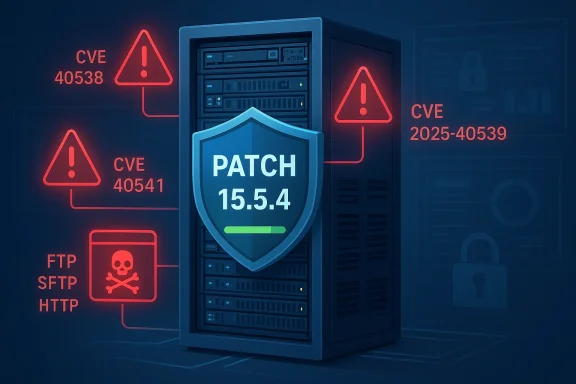
On February 24, 2026, SolarWinds released Serv‑U 15.5.4 to remediate four critical vulnerabilities (tracked as CVE‑2025‑40538, CVE‑2025‑40539, CVE‑2025‑40540 and CVE‑2025‑40541). The vendor’s release notes describe these issues as a broken‑access‑control bug, two type‑confusion memory flaws, and an insecure‑direct‑object‑reference (IDOR) weakness — each capable, under the right conditions, of allowing arbitrary native code execution with privileged (root/administrator) authority. SolarWinds reports all four carry high severity ratings and the vendor assigns a 9.1 severity to them in its advisory; independent databases and scorers may show variant assessments for some entries depending on platform and exploitation prerequisites.
These flaws matter because Serv‑U is a widely deployed multi‑protocol Managed File Transfer (MFT) server that handles FTP/FTPS, SFTP and HTTP(S) file flows. File‑transfer platforms routinely process highly sensitive data at scale and are frequent targets for threat actors seeking data exfiltration, ransomware deployment, or privileged footholds for lateral movement. The combination of privileged‑level impact and common internet exposure makes prompt remediation essential.
File‑transfer servers are high‑value targets because:
Why this is severe: creating a system admin user is a direct privilege escalation vector that can persist indefinitely unless detected and removed. From there, native payloads can be executed and the host fully controlled.
These are particularly dangerous because they can be subtle, difficult to detect until weaponized, and — in capable hands — turned into reliable exploitation chains.
Two important lessons from prior events:
Key takeaways for IT and security teams:
The fix is available now; the window to act is small. Patching, hardening administrative access, and active hunting together close the fastest route to server takeover and dramatically reduce the attack surface for your organization.
Source: Petri IT Knowledgebase SolarWinds Serv‑U Patch Blocks Full Server Takeover
 Overview
On February 24, 2026, SolarWinds released Serv‑U 15.5.4 to remediate four critical vulnerabilities (tracked as CVE‑2025‑40538, CVE‑2025‑40539, CVE‑2025‑40540 and CVE‑2025‑40541). The vendor’s release notes describe these issues as a broken‑access‑control bug, two type‑confusion memory flaws, and an insecure‑direct‑object‑reference (IDOR) weakness — each capable, under the right conditions, of allowing arbitrary native code execution with privileged (root/administrator) authority. SolarWinds reports all four carry high severity ratings and the vendor assigns a 9.1 severity to them in its advisory; independent databases and scorers may show variant assessments for some entries depending on platform and exploitation prerequisites.These flaws matter because Serv‑U is a widely deployed multi‑protocol Managed File Transfer (MFT) server that handles FTP/FTPS, SFTP and HTTP(S) file flows. File‑transfer platforms routinely process highly sensitive data at scale and are frequent targets for threat actors seeking data exfiltration, ransomware deployment, or privileged footholds for lateral movement. The combination of privileged‑level impact and common internet exposure makes prompt remediation essential.
Background: what Serv‑U does and why it’s a high‑risk target
Serv‑U is used to automate and centralize large file movements across internal networks, between partners, and with customers. Typical features that make it attractive to enterprise administrators — protocol flexibility, automation, user/group management and integration with identity stores (LDAP/AD) — are the same features attackers covet for persistence and data access.File‑transfer servers are high‑value targets because:
- They often store or transit regulated personal data, IP, contracts, and financial information.
- They may be internet‑facing to serve partners and clients, increasing attack surface.
- Administrative interfaces and integration with directory services can provide broad reach into adjacent systems once abused.
- History shows attackers weaponize file‑transfer flaws quickly (notable incidents in recent years demonstrate the speed and scale of exploitation when critical MFT bugs are disclosed).
The four flaws decoded: technical summary
CVE‑2025‑40538 — Broken access control leading to RCE
SolarWinds describes CVE‑2025‑40538 as a broken access control issue that could allow an attacker to create a system administrator account and then execute arbitrary code as root via domain‑ or group‑admin privilege abuse. The problematic behavior is an authorization bypass in Serv‑U’s management logic that, if exploited, yields immediate escalation into a full admin context. In practical terms, the bug transforms an authenticated high‑privilege misconfiguration or a targeted abuse of an account into permanent administrative control of the Serv‑U instance and its host.Why this is severe: creating a system admin user is a direct privilege escalation vector that can persist indefinitely unless detected and removed. From there, native payloads can be executed and the host fully controlled.
CVE‑2025‑40539 & CVE‑2025‑40540 — Type confusion → memory corruption → RCE
Both CVE‑2025‑40539 and CVE‑2025‑40540 are categorized as type‑confusion vulnerabilities. Type confusion typically arises when code incorrectly treats one type of data as another, producing memory‑safety faults that can be converted into code‑execution primitives on languages/runtimes that use native memory. In Serv‑U these flaws stem from memory‑handling or data‑interpretation logic; when triggered they can allow an attacker to force the application into executing arbitrary native code — effectively turning a crafted network input into root‑level code execution.These are particularly dangerous because they can be subtle, difficult to detect until weaponized, and — in capable hands — turned into reliable exploitation chains.
CVE‑2025‑40541 — IDOR leading to native code execution
CVE‑2025‑40541 is an Insecure Direct Object Reference (IDOR) issue, meaning Serv‑U failed to validate whether a caller is authorized to access or manipulate an object that’s referenced directly by an identifier. Unlike many IDOR cases that merely leak data, this specific IDOR can be abused to invoke pathways that execute native code in a privileged context. SolarWinds notes this requires privilege to abuse, but the consequence is full server compromise if an attacker can reach or impersonate a privileged administrator.Exploitation prerequisites and real world risk
A critical operational question for defenders is: do these vulnerabilities require admin privileges to exploit?- SolarWinds’ own descriptions indicate a mix: several of the flaws are linked to administrative contexts (the two type‑confusion bugs and the IDOR are described as being exploitable in scenarios where administrative privilege is present), while the broken access control weakness explicitly enables creation of a system admin user — effectively allowing privilege escalation. In short, some attack paths require admin credentials or an authenticated administrative session, while others permit escalation that leads to an admin foothold.
- The practical consequence: organizations that rely on single or weak administrative credentials, or expose management interfaces to broad networks, face far higher risk. Credential theft, phishing, stolen backups of configuration that include credentials, or reuse of admin passwords across systems can convert these “privileged‑only” bugs into immediate public risk.
Timeline and disclosure (concise)
- February 24, 2026 — SolarWinds published Serv‑U 15.5.4 release notes and security advisory documenting fixes for CVE‑2025‑40538, CVE‑2025‑40539, CVE‑2025‑40540 and CVE‑2025‑40541.
- Same day — multiple security outlets and vulnerability trackers mirrored the vendor advisory and urged immediate patching.
Immediate actions: a prioritized remediation checklist
Administrators should follow a strict, prioritized sequence to reduce exposure quickly and methodically.- Patch to Serv‑U 15.5.4 immediately
- Apply update in a maintenance window after backing up configuration and binary images.
- If you run Serv‑U in multiple environments, include staging first to verify custom plugins, scripts, or integrations.
- Verify the update
- Confirm Serv‑U reports version 15.5.4 after upgrade.
- Check release notes entry for your build to confirm the CVEs are addressed.
- Contain exposed services
- If instances are internet‑facing and an emergency patch is not immediately possible: restrict access to management interfaces and the file‑transfer endpoint via IP allow‑lists, VPN‑only access, or firewall rules.
- Harden administrative access
- Force a credential rotation for all Serv‑U administrator accounts and any accounts with domain or group admin capabilities.
- Enforce multi‑factor authentication (MFA) for admin logins where supported.
- Remove unused admin accounts and disable default or sample accounts.
- Audit and hunt for signs of compromise
- Look for new system admin users, unexpected changes to domain/group admin memberships, suspicious scheduled tasks, or new startup items.
- Review web access logs for abnormal API calls that could correlate with CVE exploitation (high‑volume or abnormal parameter sequences).
- Inspect endpoint telemetry for uncommon process creation or native modules loaded by the Serv‑U process.
- Rotate secrets and credentials
- Rotate any service accounts, API tokens, certificates and key material that Serv‑U uses — especially if any evidence of anomalous activity is found.
- Isolate and restore if compromise is confirmed
- If you detect indicators of compromise, isolate the host from the network, preserve forensic artifacts, and rebuild hosts from trusted images where possible.
- Apply compensating controls
- Enable enhanced logging and logging export to a centralized, immutable store.
- Deploy a WAF or reverse proxy to shield management and HTTP(S) endpoints.
- Consider host‑based application allow‑listing and process monitoring for the Serv‑U process.
Detection and hunting playbook
Because some of these vulnerabilities can be abused in administrative sessions or via crafted inputs, look for the following indicators:- New or unexpected accounts with administrative privileges created around the disclosure window.
- Sudden changes to group membership for domain or group admin groups.
- Abnormal API calls or requests containing unusual parameters, long query strings, or unexpected content types to the Serv‑U web interface.
- HTTP(S) requests achieving high error rates (500 series) followed by successful privileged operations.
- Unexpected child processes spawned by the Serv‑U process or native libraries loaded by that process.
- Creation of web shells, scripts in web directories, or scheduled tasks shortly after suspicious management calls.
- Search application access logs for POST/GET requests to management endpoints within the timeframe of suspicious changes.
- Query endpoint telemetry for process trees that show Serv‑U launching shell/popular interpreter binaries (cmd, powershell, bash, sh).
- Review system authentication logs for sudden password changes, failed‑to‑success patterns, or remote administrative sessions from unusual IPs.
- Export and examine configuration backups for unexpected modifications; compare to known good snapshots.
Hardening and long‑term mitigations
Short‑term patching is necessary; long‑term risk reduction requires architectural changes.- Enforce least privilege everywhere: run Serv‑U as a minimally privileged user or service account rather than SYSTEM/root on hosts where possible.
- Network segmentation: isolate file‑transfer appliances in a dedicated VLAN or subnet, with strict ACLs limiting which systems and users can reach them.
- MFA and centralized identity: integrate Serv‑U with enterprise SSO and require MFA for all admin operations.
- Centralized logging and EDR: send logs to a SIEM and enable EDR/host monitoring to detect post‑exploit behaviors quickly.
- Vulnerability management cadence: include MFT products in high‑priority patch cycles and test vendor patches in a rapid staging pipeline.
- Immutable backups and offline snapshots: maintain offline backups of configuration and critical data to speed recovery from ransomware or destructive intrusions.
- Regular privilege audits: schedule periodic reviews of admin accounts and role assignments to remove stale permissions.
Why “admin required” does not equal “low risk”
Several advisory summaries note administrative privileges are required for exploiting some of these bugs. That fact alone does not justify deprioritizing fixes.- Credentials are the single largest weak link: phishing, credential stuffing, leaked password lists, and chained compromises can provide attackers with admin context.
- Privilege escalation chains: an attacker with a low‑privilege foothold could leverage other weaknesses to gain administrative rights and then weaponize these Serv‑U flaws.
- Lateral movement risk: once Serv‑U runs code as root, attackers can move laterally, pivot to backups, domain controllers, or other infrastructure.
What to do if you can’t patch immediately
If operational constraints delay patching, apply layered mitigations to reduce attack likelihood:- Remove public exposure: block Serv‑U ports at the perimeter and make administrative interfaces reachable only from a small set of trusted management hosts or VPN channels.
- Apply strict IP allow‑lists for admin endpoints and SFTP/FTP endpoints.
- Increase monitoring sensitivity: raise alert thresholds for admin‑related actions and schedule an immediate manual review of any admin tasks.
- Host hardening: enable exploit mitigations available in the OS (ASLR, DEP, Control Flow Guard where supported) that raise the difficulty of turning memory corruption into reliable RCE.
- Prepare rollback and detection plans: stage backups, snapshot VMs and plan for immediate isolation if suspicious activity is observed.
What defenders should communicate to leadership
When briefing executives, provide a crisp risk statement:- The Serv‑U 15.5.4 update fixes multiple vulnerabilities that can yield root‑level code execution on affected servers.
- Affected systems should be patched immediately; any internet‑facing Serv‑U instance is high priority.
- Even though some issues require administrative privileges to abuse, credential theft or chained attacks can grant such privileges; history shows file‑transfer software is a favored target.
- The organization should expect an elevated level of scrutiny on logging, account hygiene, and segmentation for affected infrastructure during the patch window.
The risk landscape — broader context
This Serv‑U disclosure fits a recurring pattern: managed file‑transfer platforms are consistently targeted by financially motivated and opportunistic threat actors. Past large‑scale incidents (for example, high‑profile compromises of other MFT products) demonstrate attackers’ willingness to weaponize file‑transfer software for mass data theft and downstream monetization.Two important lessons from prior events:
- Exposure and delay matter: time between public disclosure and patching is the window attackers exploit. Organizations should assume threat actors will attempt to probe known‑vulnerable instances immediately after disclosure.
- Vendor transparency and rapid patching are essential: the quicker vendors publish clear advisories and fixes, the less time attackers have to develop reliable exploits.
Final assessment and recommendations
SolarWinds Serv‑U 15.5.4 addresses four high‑impact vulnerabilities that could produce full server takeover under the right conditions. The combination of a broken access control flaw (which directly facilitates creation of system admin users) and memory‑safety type‑confusion bugs (which can lead to native RCE) elevates the overall risk profile for affected tenants.Key takeaways for IT and security teams:
- Treat Serv‑U instances as high priority for immediate patching to 15.5.4.
- Assume administrative credential risks (compromise, reuse) and rotate admin credentials promptly.
- Harden access to management interfaces, enforce MFA, and restrict administrative access to trusted networks.
- Hunt aggressively for indicators of compromise, especially new admin accounts, privilege changes, suspicious process trees, and anomalous web requests.
- If you cannot patch immediately, apply strict network restrictions and enhanced detection as temporary compensating controls.
The fix is available now; the window to act is small. Patching, hardening administrative access, and active hunting together close the fastest route to server takeover and dramatically reduce the attack surface for your organization.
Source: Petri IT Knowledgebase SolarWinds Serv‑U Patch Blocks Full Server Takeover
