

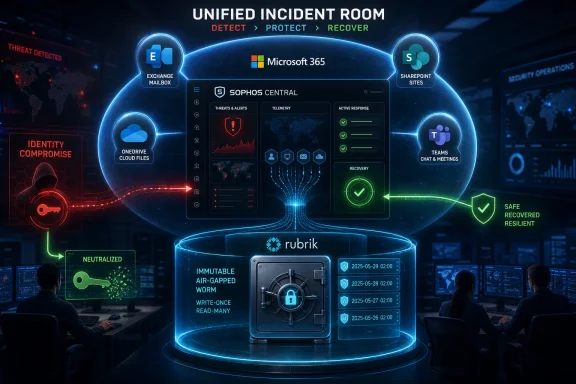
Sophos and Rubrik on June 1, 2026 made Sophos Backup and Recovery Powered by Rubrik Cyber Resilience generally available worldwide through Sophos Central, giving existing Sophos customers a Microsoft 365 backup-and-recovery add-on for Exchange Online, OneDrive, SharePoint and Teams after attacks or accidental data loss. The launch is not just another SaaS backup SKU arriving in an already crowded market. It is a bet that recovery belongs inside the security console, not in a separate administrative silo that gets opened only after the damage is done. For Windows shops and Microsoft 365-heavy organizations, that framing matters because the blast radius of a compromised cloud identity now reaches far beyond the mailbox.
The product name is unwieldy, but the strategy is simple: Sophos wants customers to treat Microsoft 365 recovery as part of day-to-day cyber defense. Sophos Central already functions as the management hub for the company’s endpoint, network, cloud, email, identity and response products. By embedding Rubrik’s Microsoft 365 protection there, Sophos is trying to collapse the gap between detecting an attack and restoring business data.
That gap is where many incidents become more expensive than they need to be. A security team may know that a credential was abused, that a mailbox was accessed, or that a SharePoint site was touched, but the recovery workflow often lives with a different team, a different console and a different set of assumptions. During a live incident, that separation becomes friction.
Rubrik’s role is to provide the SaaS data-protection engine. The joint service covers the Microsoft 365 workloads most organizations actually use to run the business: Exchange Online, OneDrive, SharePoint and Teams. It supports immutable backups, air-gapped architecture, WORM-style controls, customer-controlled encryption, granular restores and larger-scale recovery.
The pitch is therefore less about “backup” in the old file-server sense and more about operational continuity. If attackers compromise an identity, delete mail, encrypt synced files, tamper with collaboration data, or simply create uncertainty about what can be trusted, the organization needs a clean recovery path that security staff can reason about quickly.
That changes the meaning of a Microsoft 365 incident. A compromised account can expose mail, alter files, trigger malicious sharing, manipulate Teams content, and give attackers a useful map of the organization. Even where ransomware never lands on a traditional endpoint, the consequences can still look like a ransomware event: inaccessible data, broken workflows, legal uncertainty and executives asking when operations can resume.
Microsoft provides native retention, recovery and compliance capabilities, but many administrators have learned the hard way that retention is not the same thing as an independent recovery strategy. Retention policies are designed for governance and lifecycle management. Backup products are designed around restore points, isolation, search, scope control and the assumption that something has gone wrong.
That distinction is not academic. If an attacker gains privileged access, the organization’s ability to recover may depend on whether protected copies are beyond the attacker’s reach. The language in the Sophos-Rubrik announcement — immutable, air-gapped, write-once-read-many, customer-controlled encryption — is aimed directly at that fear.
That is a stronger argument than mere convenience. During an incident, teams are not just asking whether data exists in a backup. They are asking what was affected, when the compromise began, which users and workloads are suspect, what can be restored safely, and whether restoring data will reintroduce the attacker’s changes.
Sophos says Central integrates more than 350 telemetry sources across endpoint, cloud, network, identity, email and business applications. The point of bringing Rubrik into that environment is not that administrators dislike browser tabs. It is that recovery decisions improve when they are informed by security context.
There is a practical WindowsForum angle here. Many Microsoft 365 tenants are administered by lean IT teams that also handle endpoint security, identity hygiene, support tickets and compliance requests. These teams do not have the luxury of running incident response as a staged exercise across cleanly separated departments. If the same console can show the threat story and the recovery path, that can remove delay at precisely the moment delay is most expensive.
The partnership gives Rubrik access to customers that may already trust Sophos for managed detection and response, endpoint protection or broader security operations. It gives Sophos a credible recovery story without having to build a full Microsoft 365 backup platform from scratch. In market terms, this is a bundling move wrapped in a cyber-resilience narrative.
That does not make it cynical. The security market has become brutally interconnected because attackers do not respect product categories. Endpoint vendors have moved into identity. Backup vendors have moved into threat detection. Cloud-security vendors have moved into posture management and incident response. The old boundaries between “security,” “backup,” “compliance” and “operations” have been blurring for years.
Still, customers should recognize the commercial incentive behind the architecture. Sophos is selling the new service as an add-on for existing customers. That makes adoption easier for organizations already inside the Sophos ecosystem, but it also tightens the relationship between security operations and platform vendor choice.
Rubrik’s use of air-gapped architecture, WORM-style controls and customer-controlled encryption is meant to address the ugly scenario where credentials are compromised and administrative access is abused. The logic is straightforward: even if an attacker gets into the production environment, protected copies should remain tamper-resistant. That is the baseline expectation for serious recovery planning in 2026.
But immutability does not answer every question. Administrators still need to know retention windows, restore granularity, restore speed, licensing scope, data residency, auditability, role-based access controls, and how the service behaves when Entra ID itself is part of the incident. They also need to test recovery workflows before an emergency, not after a mailbox or site has already become evidence.
The uncomfortable truth is that many backup failures are not failures of storage. They are failures of planning. The data exists, but no one knows which copy is clean, how long a full restore will take, which business units should be prioritized, or who has authority to approve restoration during an active investigation.
Exchange Online mailboxes contain credentials, contracts, invoices, reset links, internal politics and customer history. OneDrive contains working documents that may never have passed through a formal records system. SharePoint contains team knowledge, project artifacts and departmental workflows. Teams contains both conversation and files, often with enough context to make stolen documents more valuable.
That is why recovery cannot be divorced from detection. Restoring a mailbox without understanding how it was compromised may bring back data while leaving the door open. Restoring files without understanding whether malicious content was planted may recreate the attacker’s foothold. Restoring a Teams workspace without understanding membership changes may preserve a compromised collaboration surface.
Sophos and Rubrik are trying to sell a workflow in which telemetry and recovery reinforce each other. In theory, security signals narrow the blast radius, while backups give responders confidence that they can recover cleanly. In practice, the value will depend on how deeply the integration exposes useful context rather than merely placing restore buttons near alert data.
The more interesting audience is the mid-market: organizations large enough to be attractive targets but not large enough to maintain specialist teams for every domain. These companies often run Microsoft 365 as their communications and collaboration backbone, rely heavily on managed detection and response, and expect a small IT staff to cover an unreasonable amount of ground.
For those teams, a recovery workflow inside Sophos Central could be more than a dashboard preference. It could determine whether the person handling an alert can immediately see recovery options, whether affected users can be restored without a handoff delay, and whether the organization can avoid improvising under pressure.
This is also where ransomware economics have shifted. Attackers do not need to cripple every system to create leverage. Disrupting email, corrupting shared files or creating uncertainty around sensitive data can be enough to force a business conversation about downtime, disclosure and payment. Microsoft 365 recovery therefore becomes part of the negotiation posture, even if no negotiation ever occurs.
The trade-off is lock-in. The more security telemetry, recovery workflows and incident operations live inside one platform, the more costly it becomes to leave that platform later. That does not make the integration bad, but it changes the procurement question from “Do we need Microsoft 365 backup?” to “Do we want our Microsoft 365 backup tied to this security ecosystem?”
Administrators should also examine how portable the operational model is. If the organization changes MDR providers, endpoint platforms or backup vendors, what happens to recovery history, audit trails and runbooks? If a future merger brings in a different Microsoft 365 protection product, can the team operate both cleanly? If Sophos Central is unavailable during a broader outage, what alternate access paths exist?
Those questions are not reasons to reject the service. They are reasons to buy it like infrastructure, not like a convenience subscription.
The answer usually comes down to independence, specialization and recovery posture. A backup service outside the production control plane may offer a cleaner separation of duties. A specialist recovery platform may provide faster search, broader restore options, stronger immutability controls or more useful cyber-recovery workflows. A security-integrated third-party service may also fit organizations that have chosen Sophos rather than Microsoft as their operational security hub.
But Microsoft’s gravity is real. Many IT buyers are under pressure to consolidate vendors, reduce overlapping products and justify every additional subscription. Sophos and Rubrik are responding to that pressure by consolidating two non-Microsoft functions — detection and recovery — into one Sophos-delivered experience.
That makes the product a competitor not only to other Microsoft 365 backup tools, but also to the idea that Microsoft-native controls are enough. The sales conversation will likely hinge on whether customers believe an independent, immutable recovery layer is worth the incremental cost and operational commitment.
A company that can recover quickly has more options. It can refuse extortion with greater confidence, isolate systems more aggressively, and make disclosure decisions with a clearer understanding of operational exposure. A company that cannot recover is forced to negotiate from weakness, even if its detection tooling worked as designed.
That is why cyber insurers, regulators and boards increasingly care about recoverability. They do not simply want to know whether an organization has endpoint protection or phishing training. They want to know whether the business can withstand the failure of those controls.
Sophos and Rubrik are packaging that idea for Microsoft 365. The service says, in effect, that your cloud collaboration data deserves the same cyber-recovery discipline that enterprises have been applying to servers, databases and virtual machines. For many organizations, that is overdue.
They also need to test the difference between granular recovery and large-scale recovery. Restoring a single deleted email is not the same as restoring hundreds of mailboxes after a malicious rule campaign. Recovering one SharePoint folder is not the same as unwinding widespread file manipulation. Restoring Teams data can be especially messy because collaboration context matters as much as the files themselves.
Security teams should also coordinate recovery with identity response. If an account was compromised, restoring its data before resetting credentials, reviewing sessions, revoking tokens and checking app consent grants may create a false sense of progress. The clean copy must return to a clean environment.
The best use of a product like this is therefore rehearsal. Run a tabletop exercise. Simulate a compromised executive mailbox. Test restoration of a SharePoint site to an alternate user. Verify that inactive accounts can be handled as expected. Measure how long recovery actually takes, not how long the brochure implies.
That is a healthier conversation, though it is less comforting. It acknowledges that identities will be compromised, users will delete important data, insiders will occasionally cause harm, and attackers will continue to aim at the systems businesses cannot easily switch off. Microsoft 365 is exactly such a system.
Sophos and Rubrik are not inventing Microsoft 365 backup, and they are not eliminating the need for careful administration. What they are doing is placing recovery where many security teams already live. If the integration proves operationally useful rather than cosmetically convenient, it could become a model for how the next generation of security platforms absorbs resilience as a first-class function.
For Windows and Microsoft 365 administrators, the launch is a reminder that the cloud did not abolish backup strategy; it moved it into a more complicated control plane. The next phase of cyber resilience will be won by teams that can connect detection, identity cleanup and trusted data restoration into one practiced motion — and lost by those that discover, during an incident, that their recovery plan was really just a retention policy with a nicer name.
 Sophos and Rubrik Move Recovery Into the Incident Room
The product name is unwieldy, but the strategy is simple: Sophos wants customers to treat Microsoft 365 recovery as part of day-to-day cyber defense. Sophos Central already functions as the management hub for the company’s endpoint, network, cloud, email, identity and response products. By embedding Rubrik’s Microsoft 365 protection there, Sophos is trying to collapse the gap between detecting an attack and restoring business data.That gap is where many incidents become more expensive than they need to be. A security team may know that a credential was abused, that a mailbox was accessed, or that a SharePoint site was touched, but the recovery workflow often lives with a different team, a different console and a different set of assumptions. During a live incident, that separation becomes friction.
Rubrik’s role is to provide the SaaS data-protection engine. The joint service covers the Microsoft 365 workloads most organizations actually use to run the business: Exchange Online, OneDrive, SharePoint and Teams. It supports immutable backups, air-gapped architecture, WORM-style controls, customer-controlled encryption, granular restores and larger-scale recovery.
The pitch is therefore less about “backup” in the old file-server sense and more about operational continuity. If attackers compromise an identity, delete mail, encrypt synced files, tamper with collaboration data, or simply create uncertainty about what can be trusted, the organization needs a clean recovery path that security staff can reason about quickly.
Microsoft 365 Has Become Too Central to Leave Recovery as an Afterthought
The appeal of Microsoft 365 is also the reason it has become such an awkward security dependency. Email, documents, meetings, chat, shared sites, identity hooks and line-of-business workflows all converge there. For many companies, Microsoft 365 is no longer a productivity suite sitting beside the business; it is the substrate on which the business runs.That changes the meaning of a Microsoft 365 incident. A compromised account can expose mail, alter files, trigger malicious sharing, manipulate Teams content, and give attackers a useful map of the organization. Even where ransomware never lands on a traditional endpoint, the consequences can still look like a ransomware event: inaccessible data, broken workflows, legal uncertainty and executives asking when operations can resume.
Microsoft provides native retention, recovery and compliance capabilities, but many administrators have learned the hard way that retention is not the same thing as an independent recovery strategy. Retention policies are designed for governance and lifecycle management. Backup products are designed around restore points, isolation, search, scope control and the assumption that something has gone wrong.
That distinction is not academic. If an attacker gains privileged access, the organization’s ability to recover may depend on whether protected copies are beyond the attacker’s reach. The language in the Sophos-Rubrik announcement — immutable, air-gapped, write-once-read-many, customer-controlled encryption — is aimed directly at that fear.
The Single Console Is the Product, Not the Convenience Feature
Vendor announcements love the phrase “single pane of glass,” and most administrators have learned to treat it with suspicion. Too often it means a dashboard that links out to five different products or hides complexity behind an integration that works well in a demo and poorly at 2 a.m. Sophos and Rubrik are making a more consequential claim here: that backup and recovery actions belong in the same operational environment as detection and response.That is a stronger argument than mere convenience. During an incident, teams are not just asking whether data exists in a backup. They are asking what was affected, when the compromise began, which users and workloads are suspect, what can be restored safely, and whether restoring data will reintroduce the attacker’s changes.
Sophos says Central integrates more than 350 telemetry sources across endpoint, cloud, network, identity, email and business applications. The point of bringing Rubrik into that environment is not that administrators dislike browser tabs. It is that recovery decisions improve when they are informed by security context.
There is a practical WindowsForum angle here. Many Microsoft 365 tenants are administered by lean IT teams that also handle endpoint security, identity hygiene, support tickets and compliance requests. These teams do not have the luxury of running incident response as a staged exercise across cleanly separated departments. If the same console can show the threat story and the recovery path, that can remove delay at precisely the moment delay is most expensive.
Rubrik Gets Distribution, Sophos Gets a Missing Resilience Layer
The business logic is as important as the technical integration. Sophos claims more than 600,000 customers worldwide, a large installed base that includes many mid-market organizations. Rubrik, meanwhile, has spent years pushing the idea that backup vendors are now cyber-resilience vendors, not just storage insurance providers.The partnership gives Rubrik access to customers that may already trust Sophos for managed detection and response, endpoint protection or broader security operations. It gives Sophos a credible recovery story without having to build a full Microsoft 365 backup platform from scratch. In market terms, this is a bundling move wrapped in a cyber-resilience narrative.
That does not make it cynical. The security market has become brutally interconnected because attackers do not respect product categories. Endpoint vendors have moved into identity. Backup vendors have moved into threat detection. Cloud-security vendors have moved into posture management and incident response. The old boundaries between “security,” “backup,” “compliance” and “operations” have been blurring for years.
Still, customers should recognize the commercial incentive behind the architecture. Sophos is selling the new service as an add-on for existing customers. That makes adoption easier for organizations already inside the Sophos ecosystem, but it also tightens the relationship between security operations and platform vendor choice.
Immutability Is Necessary, but It Is Not Magic
The most important technical promise in the launch is immutability. Backups that attackers can alter, encrypt or delete are not much of a safety net. In ransomware and account-compromise scenarios, the ability to preserve recovery points outside the attacker’s control is essential.Rubrik’s use of air-gapped architecture, WORM-style controls and customer-controlled encryption is meant to address the ugly scenario where credentials are compromised and administrative access is abused. The logic is straightforward: even if an attacker gets into the production environment, protected copies should remain tamper-resistant. That is the baseline expectation for serious recovery planning in 2026.
But immutability does not answer every question. Administrators still need to know retention windows, restore granularity, restore speed, licensing scope, data residency, auditability, role-based access controls, and how the service behaves when Entra ID itself is part of the incident. They also need to test recovery workflows before an emergency, not after a mailbox or site has already become evidence.
The uncomfortable truth is that many backup failures are not failures of storage. They are failures of planning. The data exists, but no one knows which copy is clean, how long a full restore will take, which business units should be prioritized, or who has authority to approve restoration during an active investigation.
Microsoft 365 Recovery Is Really an Identity Problem
The announcement repeatedly points to account compromise, and that emphasis is well placed. In Microsoft 365 environments, identity is the control plane. Once an attacker has the right user or administrative access, the distinction between data theft, data destruction and persistence can blur quickly.Exchange Online mailboxes contain credentials, contracts, invoices, reset links, internal politics and customer history. OneDrive contains working documents that may never have passed through a formal records system. SharePoint contains team knowledge, project artifacts and departmental workflows. Teams contains both conversation and files, often with enough context to make stolen documents more valuable.
That is why recovery cannot be divorced from detection. Restoring a mailbox without understanding how it was compromised may bring back data while leaving the door open. Restoring files without understanding whether malicious content was planted may recreate the attacker’s foothold. Restoring a Teams workspace without understanding membership changes may preserve a compromised collaboration surface.
Sophos and Rubrik are trying to sell a workflow in which telemetry and recovery reinforce each other. In theory, security signals narrow the blast radius, while backups give responders confidence that they can recover cleanly. In practice, the value will depend on how deeply the integration exposes useful context rather than merely placing restore buttons near alert data.
The Mid-Market Is Where This Could Matter Most
Large enterprises often already have separate teams for backup, security operations, identity, compliance and Microsoft 365 administration. They may also have mature runbooks, tested recovery exercises and procurement relationships with multiple vendors. The Sophos-Rubrik integration may appeal to them, but it is not built only for that world.The more interesting audience is the mid-market: organizations large enough to be attractive targets but not large enough to maintain specialist teams for every domain. These companies often run Microsoft 365 as their communications and collaboration backbone, rely heavily on managed detection and response, and expect a small IT staff to cover an unreasonable amount of ground.
For those teams, a recovery workflow inside Sophos Central could be more than a dashboard preference. It could determine whether the person handling an alert can immediately see recovery options, whether affected users can be restored without a handoff delay, and whether the organization can avoid improvising under pressure.
This is also where ransomware economics have shifted. Attackers do not need to cripple every system to create leverage. Disrupting email, corrupting shared files or creating uncertainty around sensitive data can be enough to force a business conversation about downtime, disclosure and payment. Microsoft 365 recovery therefore becomes part of the negotiation posture, even if no negotiation ever occurs.
The Add-On Model Makes Adoption Easy and Lock-In Easier
Selling the service as an add-on for Sophos customers is sensible. Customers already using Sophos Central do not need to evaluate a completely separate management plane, and Sophos partners get a cleaner story to take into renewals and security reviews. The operational barrier to entry is lower than introducing another standalone backup vendor.The trade-off is lock-in. The more security telemetry, recovery workflows and incident operations live inside one platform, the more costly it becomes to leave that platform later. That does not make the integration bad, but it changes the procurement question from “Do we need Microsoft 365 backup?” to “Do we want our Microsoft 365 backup tied to this security ecosystem?”
Administrators should also examine how portable the operational model is. If the organization changes MDR providers, endpoint platforms or backup vendors, what happens to recovery history, audit trails and runbooks? If a future merger brings in a different Microsoft 365 protection product, can the team operate both cleanly? If Sophos Central is unavailable during a broader outage, what alternate access paths exist?
Those questions are not reasons to reject the service. They are reasons to buy it like infrastructure, not like a convenience subscription.
Microsoft’s Own Platform Gravity Hangs Over the Market
Any Microsoft 365 backup discussion now sits in the shadow of Microsoft’s own expanding security and resilience portfolio. Microsoft has been steadily building deeper security, compliance, identity and recovery capabilities into its cloud stack. For customers already standardized on Microsoft Purview, Defender, Entra and native admin tooling, third-party backup vendors must explain why independent protection still matters.The answer usually comes down to independence, specialization and recovery posture. A backup service outside the production control plane may offer a cleaner separation of duties. A specialist recovery platform may provide faster search, broader restore options, stronger immutability controls or more useful cyber-recovery workflows. A security-integrated third-party service may also fit organizations that have chosen Sophos rather than Microsoft as their operational security hub.
But Microsoft’s gravity is real. Many IT buyers are under pressure to consolidate vendors, reduce overlapping products and justify every additional subscription. Sophos and Rubrik are responding to that pressure by consolidating two non-Microsoft functions — detection and recovery — into one Sophos-delivered experience.
That makes the product a competitor not only to other Microsoft 365 backup tools, but also to the idea that Microsoft-native controls are enough. The sales conversation will likely hinge on whether customers believe an independent, immutable recovery layer is worth the incremental cost and operational commitment.
Recovery Is Becoming a Security Control in Its Own Right
The cybersecurity industry spent years telling customers to prevent, detect and respond. Recovery was often implied but underdeveloped, treated as the domain of backup administrators and disaster-recovery planners. Ransomware changed that hierarchy.A company that can recover quickly has more options. It can refuse extortion with greater confidence, isolate systems more aggressively, and make disclosure decisions with a clearer understanding of operational exposure. A company that cannot recover is forced to negotiate from weakness, even if its detection tooling worked as designed.
That is why cyber insurers, regulators and boards increasingly care about recoverability. They do not simply want to know whether an organization has endpoint protection or phishing training. They want to know whether the business can withstand the failure of those controls.
Sophos and Rubrik are packaging that idea for Microsoft 365. The service says, in effect, that your cloud collaboration data deserves the same cyber-recovery discipline that enterprises have been applying to servers, databases and virtual machines. For many organizations, that is overdue.
The Console Will Not Save a Bad Runbook
For all the promise of integration, the hard work still belongs to customers. A restore feature is not a recovery strategy. Organizations need to define which Microsoft 365 workloads matter most, how far back they need to recover, what data must be preserved for legal review, and who can authorize restoration during a suspected breach.They also need to test the difference between granular recovery and large-scale recovery. Restoring a single deleted email is not the same as restoring hundreds of mailboxes after a malicious rule campaign. Recovering one SharePoint folder is not the same as unwinding widespread file manipulation. Restoring Teams data can be especially messy because collaboration context matters as much as the files themselves.
Security teams should also coordinate recovery with identity response. If an account was compromised, restoring its data before resetting credentials, reviewing sessions, revoking tokens and checking app consent grants may create a false sense of progress. The clean copy must return to a clean environment.
The best use of a product like this is therefore rehearsal. Run a tabletop exercise. Simulate a compromised executive mailbox. Test restoration of a SharePoint site to an alternate user. Verify that inactive accounts can be handled as expected. Measure how long recovery actually takes, not how long the brochure implies.
What Windows Shops Should Watch Before They Click Add-On
The most concrete value in the Sophos-Rubrik launch is that it recognizes how Microsoft 365 incidents unfold in the real world: messily, across identity and data, with security and operations forced to work together. But buyers should separate that sound architectural instinct from the usual launch-day optimism.- Organizations already using Sophos Central should evaluate whether the Rubrik-powered service reduces real incident handoffs, not merely whether it adds backup visibility to a familiar console.
- Microsoft 365 administrators should confirm coverage and restore behavior for Exchange Online, OneDrive, SharePoint and Teams before assuming all collaboration data is equally simple to recover.
- Security teams should test recovery during identity-compromise scenarios, because restoring data without cleaning up compromised access can recreate the conditions of the incident.
- Procurement teams should treat the add-on as a resilience dependency and ask about retention, encryption control, data residency, audit trails, service availability and exit options.
- IT leaders should build recovery exercises around business processes, not product features, because the board will care about restored operations more than restored objects.
The Market Is Finally Admitting That Prevention Fails
The deeper story behind this launch is a shift in security culture. Vendors used to compete on how well they could stop bad things from happening. Now they increasingly compete on how well they help customers survive when bad things happen anyway.That is a healthier conversation, though it is less comforting. It acknowledges that identities will be compromised, users will delete important data, insiders will occasionally cause harm, and attackers will continue to aim at the systems businesses cannot easily switch off. Microsoft 365 is exactly such a system.
Sophos and Rubrik are not inventing Microsoft 365 backup, and they are not eliminating the need for careful administration. What they are doing is placing recovery where many security teams already live. If the integration proves operationally useful rather than cosmetically convenient, it could become a model for how the next generation of security platforms absorbs resilience as a first-class function.
For Windows and Microsoft 365 administrators, the launch is a reminder that the cloud did not abolish backup strategy; it moved it into a more complicated control plane. The next phase of cyber resilience will be won by teams that can connect detection, identity cleanup and trusted data restoration into one practiced motion — and lost by those that discover, during an incident, that their recovery plan was really just a retention policy with a nicer name.
References
- Primary source: IT Brief UK
Published: 2026-06-03T23:12:08.923680
Loading…
itbrief.co.uk - Related coverage: rubrik.com
Loading…
www.rubrik.com - Related coverage: sophos.com

Cybersecurity as a Service Delivered | Sophos
We Deliver Superior Cybersecurity Outcomes for Real-World Organizations Worldwide with a Broad Portfolio of Advanced Security Products and Services.www.sophos.com
- Related coverage: globenewswire.com
Sophos and Rubrik Make Microsoft 365 Backup and Recovery, Powered by Rubrik Cyber Resilience, Available to Sophos Customers Worldwide
New offering connects threat detection and data recovery in a single platform, enabling organizations to detect, respond, and restore faster...www.globenewswire.com
- Related coverage: partnernews.sophos.com
Sophos Backup and Recovery for M365 – powered by Rubrik is now available – Sophos Partner News
Sophos Backup and Recovery for M365 is now generally available — giving partners a purpose-built, fully integrated backup and recovery solution to add to their M365 portfolio. partnernews.sophos.com
- Related coverage: itwire.com

Sophos and Rubrik Make Microsoft 365 Backup and Recovery, Powered by Rubrik Cyber Resilience, Available to Sophos Customers Worldwide | iTWire
New offering connects threat detection and data recovery in a single platform, enabling organisations to detect, respond, and restore faster itwire.com
- Related coverage: news.sophos.com
Loading…
news.sophos.com - Related coverage: streetinsider.com

Sophos launches Microsoft 365 backup service powered by Rubrik technology
Sophos and Rubrik (NYSE: RBRK) announced the general availability of Sophos Backup and Recovery Powered by Rubrik Cyber Resilience, a Microsoft 365 data protection service for Sophos customers worldwide.The...www.streetinsider.com
- Related coverage: community.sophos.com
Loading…
community.sophos.com