Sophos Central Adds Rubrik-Powered Microsoft 365 Backup & Recovery

Sophos launched Backup and Recovery M365 Powered by Rubrik on May 27, 2026, making a cloud-based Microsoft 365 backup and restore service available through Sophos Central for customers and partners that want Rubrik protection for Exchange, OneDrive, SharePoint, and Teams data. The launch is not just another checkbox in the crowded Microsoft 365 backup market. It is Sophos arguing that backup now belongs inside the security operations workflow, not in a separate console visited only after the damage is done. For Windows shops already living in Microsoft 365 and Sophos Central, that is a practical pitch with a larger strategic message: resilience is becoming a managed security feature.

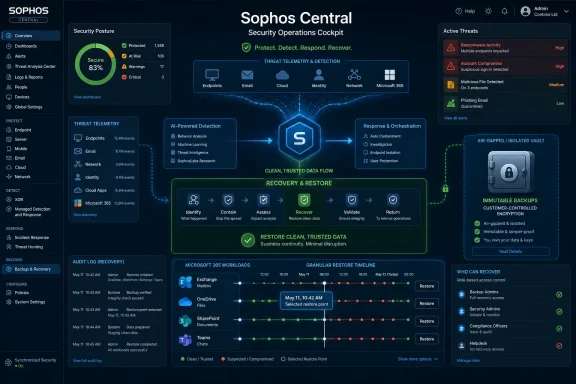
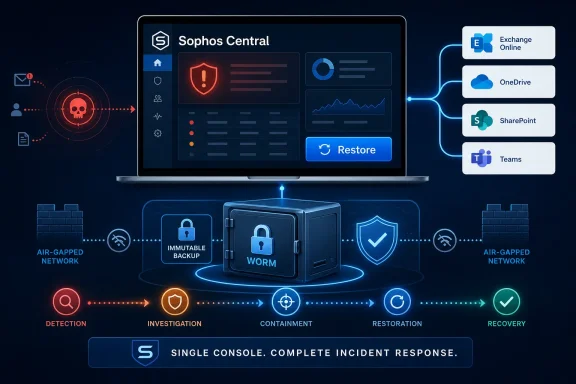
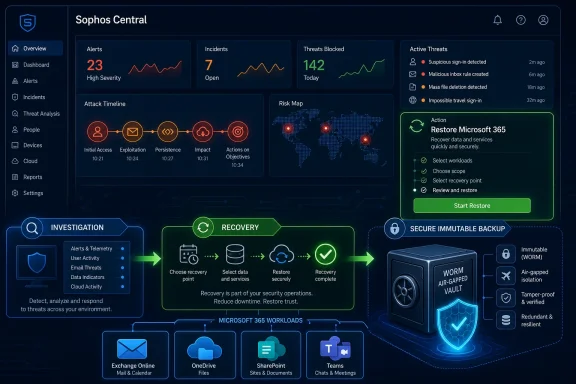
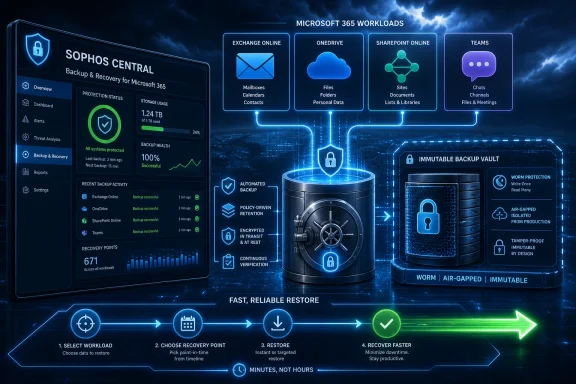
Digital dashboard shows Sophos Central backup/recovery and Microsoft 365 workload protection with an encrypted vault.Sophos Moves Backup Out of the Utility Closet​

For years, Microsoft 365 backup was treated as an insurance policy: necessary, boring, and often justified only after someone discovered the difference between retention, recycle bins, litigation holds, and a recoverable business state. Sophos and Rubrik are trying to change that framing. Their new service puts Microsoft 365 recovery into the same administrative orbit as endpoint defense, MDR, XDR, and security telemetry.
That positioning matters because Microsoft 365 is no longer merely “email and files.” It is the operational substrate for calendars, Teams conversations, SharePoint workflows, executive mailboxes, customer documents, and institutional memory. If a tenant is compromised, deleted, misconfigured, or held hostage by an attacker, the blast radius is not confined to a few lost messages.
Sophos is also making a bet about its own customers. The company says the service is aimed at organizations that already use Sophos Central and want a more integrated route to Microsoft 365 resilience. That audience is often mid-market IT: teams large enough to be targeted, but not large enough to maintain a separate specialist bench for identity, backup, security operations, and incident response.
Rubrik supplies the data protection machinery. Sophos supplies the platform, channel, and security operations context. The resulting product is less interesting as a feature list than as a sign of where the market is moving: backup is being absorbed into the language of cyber resilience.

Microsoft 365 Protection Has Become a Security Problem​

The old argument for Microsoft 365 backup was accidental deletion. A user removed a folder, a mailbox disappeared, or a SharePoint site was changed beyond easy repair. Those are still real problems, but they are not the ones driving the current wave of security-led backup products.
The modern argument is account compromise. If attackers obtain privileged credentials, they may not need to encrypt endpoints to cause chaos. They can delete content, tamper with retention settings, abuse collaboration tools, exfiltrate sensitive mail, or target the data that makes a business function day to day.
Microsoft has continued to improve native recovery and backup capabilities, including Microsoft 365 Backup as a pay-as-you-go service covering key workloads such as Exchange, OneDrive, and SharePoint. But native capability does not erase the architectural question for administrators: where should the recovery control plane live, who can alter it, and whether it remains trustworthy during an identity-driven incident.
That is where Rubrik’s vocabulary fits neatly into Sophos’ security pitch. Terms such as immutable backups, air-gapped storage, WORM locks, and customer-held encryption keys are not merely backup jargon anymore. They are answers to a specific fear: that the same compromised identity used to damage production data could also be used to poison or delete the recovery path.
The uncomfortable truth for Microsoft 365 tenants is that resilience is not the same as availability. Microsoft can keep the service running while a customer’s data, permissions, or business process is still in disarray. Sophos is using this launch to press that distinction.

Sophos Central Becomes the Battleground​

Sophos Central has always been more than a dashboard, but this launch pushes it further into platform territory. By integrating Rubrik-powered Microsoft 365 backup and recovery there, Sophos is trying to make Central the place where security teams not only detect and respond, but also recover.
That is a subtle but important expansion. Detection and response products traditionally focused on finding the intruder, isolating the endpoint, blocking the hash, and escalating the case. Backup tools lived elsewhere, often owned by infrastructure teams. In an incident, the two groups had to coordinate under pressure, usually while executives asked when email, files, and Teams would be usable again.
Sophos’ pitch is that the recovery workflow should be closer to the security workflow. If MDR analysts can see the threat and administrators can restore affected Microsoft 365 content from the same broader operational environment, the organization may shave time off the ugliest phase of an incident: the handoff between “we found it” and “we are back.”
This is also a channel play. Sophos has a large partner ecosystem, and Microsoft 365 backup is an attachable service with a clear business case. Partners can present it not as a standalone backup SKU but as an extension of managed cyber resilience, which is often easier to explain to customers than the fine print of retention policies.
Rubrik benefits as well. Its brand gains another path into the mid-market through Sophos’ console and partner network. Rather than asking every smaller customer to adopt Rubrik as a separate operational universe, the product arrives inside a platform many of them already use.

The Rubrik Deal Gives Sophos a Recovery Story It Could Not Build Overnight​

Sophos is a security company first. It has credibility in endpoint protection, MDR, network security, and threat research. But enterprise-grade SaaS backup and granular Microsoft 365 recovery are different disciplines, especially when customers expect speed, scale, and tamper resistance.
Rubrik gives Sophos a faster route to market than building comparable capability from scratch. Rubrik has spent years positioning itself around cyber recovery, immutable data protection, and the idea that backup infrastructure must be designed for adversarial conditions. That is a stronger fit for Sophos’ security narrative than a basic copy-and-restore engine would be.
The announcement emphasizes protection across Exchange, OneDrive, SharePoint, and Teams. Those workloads are not equal from a recovery standpoint. Mailboxes, sites, channels, permissions, metadata, and user state all carry different operational implications, and administrators will care less about marketing coverage than about what can be restored, how quickly, to what target, and under what identity controls.
That is why the integration details will matter. A product can be “in Sophos Central” in several ways, ranging from single sign-on and status visibility to deep workflow integration. The more the service helps administrators connect security incidents to recovery actions, the more meaningful the partnership becomes.
For now, the strategic point is clear. Sophos does not want Microsoft 365 backup to be judged as an isolated utility. It wants the service judged as part of a security architecture in which prevention, detection, response, and recovery sit on the same continuum.

The Mid-Market Is Where the Pain Is Sharpest​

Large enterprises usually know they need Microsoft 365 backup, even if their implementations vary wildly. They have compliance teams, risk committees, procurement frameworks, and enough painful history to understand that SaaS does not eliminate data responsibility. Smaller businesses may rely entirely on whatever Microsoft provides by default.
The mid-market sits in the messy middle. These organizations often have hundreds or thousands of users, regulatory exposure, cyber insurance questionnaires, and attackers who view them as valuable targets. Yet their IT teams are frequently lean, overloaded, and dependent on managed service providers or security vendors for operational depth.
That is the market Sophos is targeting. A unified console and partner-delivered service can be more attractive than another specialized backup platform with its own training curve, procurement cycle, and alert stream. If the product reduces administrative friction, it may win not because it is the only way to back up Microsoft 365, but because it is the path of least resistance for existing Sophos customers.
There is also an emotional component. Backup failures are career-limiting events. When a CEO’s mailbox, a legal SharePoint site, or a finance team’s OneDrive content cannot be restored after a breach, nobody cares that the organization had excellent endpoint telemetry. The question becomes brutally simple: can we get our business data back?
Sophos and Rubrik are selling confidence against that moment. Whether customers should buy that confidence from them depends on pricing, service terms, restore performance, supported workloads, and how well the integration works in real incidents rather than demos.

Native Microsoft Recovery Is Improving, but It Does Not End the Debate​

Microsoft’s own Microsoft 365 Backup service complicates the market in a healthy way. It gives customers a first-party option and pressures third-party vendors to prove why they deserve budget. That is good for administrators, because the old blanket claim that “Microsoft does not do backup” is now too crude to be useful.
But the more precise debate remains wide open. First-party backup can offer advantages in performance, proximity to the data, and administrative simplicity. Third-party backup can offer separation of control, different retention models, independent security assumptions, and integration with broader recovery platforms.
Sophos is clearly arguing for the latter, with Rubrik as the engine. The value proposition is not merely that data can be restored. It is that protected copies are insulated from some classes of tenant compromise and surfaced inside a security operations environment.
Administrators should not treat that as magic. Backup architecture must be tested, not trusted. Recovery points, restore targets, role delegation, encryption key handling, inactive user recovery, Teams coverage, and audit trails all need scrutiny before an organization assumes it has solved the Microsoft 365 resilience problem.
The launch should also push WindowsForum readers to revisit their own assumptions about Microsoft 365 retention. Retention policies are often designed for compliance, discovery, or lifecycle management. Backup is designed for recovery. Those goals overlap, but they are not interchangeable, especially when the incident involves malicious deletion or administrative compromise.

Recovery Speed Is Now a Board-Level Metric​

Ransomware changed the politics of backup. Ten years ago, backups were often judged by whether they existed. Today they are judged by whether they can restore the right systems quickly enough to keep the business alive.
That pressure has reached Microsoft 365. A company can survive a brief endpoint outage more easily than a prolonged loss of email, shared documents, Teams collaboration, and executive communications. The Microsoft 365 tenant is where work happens, and recovery time there has become a business continuity metric.
Sophos’ integration with Rubrik is designed to appeal to that urgency. The promise is fast, flexible recovery of Microsoft 365 data, including restoration to original or alternate users and support for inactive accounts. Those details matter because real-world incidents rarely present clean recovery scenarios.
An employee may have left. A mailbox may be compromised. A department may need data restored somewhere safe for review before it returns to production. A SharePoint site may need a point-in-time recovery that does not overwrite everything users have done since the incident began. The difference between a useful backup service and a decorative one is found in those edge cases.
The real test will be operational. Customers should run recovery drills, not just enable policies. They should measure restore times, document authority chains, and confirm who can initiate restores during a security incident. A backup product that has never been exercised is a theory with a monthly invoice.

Security Vendors Are Rebundling the Microsoft 365 Stack​

The Sophos-Rubrik launch fits a broader pattern: security vendors are rebuilding around Microsoft 365 because Microsoft 365 is where the risk has concentrated. Email security, identity monitoring, endpoint telemetry, cloud app visibility, data loss prevention, and backup are increasingly part of one conversation.
That does not mean every function should come from one vendor. Consolidation can reduce complexity, but it can also create dependency. A single console is convenient until the organization discovers that convenience has narrowed its options or hidden important controls behind simplified workflows.
Still, the re-bundling trend is rational. Attackers do not respect product categories. A phishing email becomes an identity compromise, which becomes mailbox access, which becomes SharePoint discovery, which becomes data theft, deletion, or extortion. Defenders who organize their tools in disconnected silos are already a step behind.
Sophos is trying to turn that reality into product gravity. If Central becomes the place where customers manage security operations and recovery, Sophos becomes harder to displace. Rubrik, meanwhile, gets embedded in customer environments where backup may previously have been postponed or handled by a lighter-weight tool.
For Microsoft, this ecosystem activity is both validation and competition. The more vendors build around Microsoft 365 backup, the more they reinforce the idea that Microsoft 365 data protection is a necessary category. But they also challenge Microsoft’s own first-party backup ambitions by arguing that independence and security integration still matter.

Administrators Should Read the Fine Print Before They Read the Branding​

The phrase “powered by Rubrik” will reassure some buyers, but administrators still need to evaluate the service as deployed through Sophos. Branding does not answer operational questions. It does not define retention duration, regional storage options, restore granularity, tenant onboarding steps, or the exact boundary between Sophos support and Rubrik infrastructure.
The service being cloud-based is convenient, but cloud-based backup raises familiar questions. Where is the data stored? How are encryption keys controlled? What administrative roles can alter protection? What logs exist when someone changes policies? How does the service behave if the Microsoft 365 tenant itself is under active compromise?
Customers should also evaluate licensing and scope. Microsoft 365 environments are rarely tidy. Shared mailboxes, inactive users, guests, Teams data, SharePoint permissions, archived mail, and departed employees all introduce complexity. A backup plan that covers only the easy parts will look good until the first ugly restore.
The product’s appeal to Sophos MDR and XDR customers should also be examined carefully. If the integration meaningfully improves incident response, that is valuable. If it is mostly a procurement and console convenience, it may still be useful, but buyers should price it accordingly.
None of this makes the launch less important. It simply means the correct response from IT pros is neither cynicism nor blind adoption. It is a structured proof of recovery.

The Real Product Is Trust Under Compromise​

The most interesting part of this launch is not that Sophos now sells Microsoft 365 backup. Many vendors do. The interesting part is the implied threat model: what if the tenant, the identity layer, or the administrator account cannot be fully trusted?
That is the scenario that separates modern cyber recovery from traditional backup. In a routine deletion event, ordinary administrative tools may be enough. In an adversarial event, the defender needs protected copies, independent controls, strong authentication, and confidence that the restore path has not been sabotaged.
Sophos and Rubrik are positioning their service around that adversarial model. The language of immutable backups and air-gapped protection is meant to reassure customers that recovery remains possible even when attackers have done more than delete a few files. It is a message shaped by ransomware, business email compromise, and the long tail of identity attacks.
For WindowsForum readers, the practical lesson is broader than this specific product. Microsoft 365 recovery planning should be treated as part of incident response, not as a storage chore. The people who investigate attacks and the people who restore data need shared runbooks, shared assumptions, and shared deadlines.
That may be the biggest cultural shift Sophos is trying to sell. Backup is no longer the last chapter of the disaster recovery binder. It is part of the security posture.
The Launch Gives IT Teams a Concrete Checklist​

Sophos’ new service will appeal most to organizations already invested in Sophos Central, but the launch is useful even for those that never buy it. It gives administrators a reason to ask sharper questions about Microsoft 365 resilience and to stop confusing retention with recovery.
  • Organizations using Sophos Central now have a Rubrik-powered Microsoft 365 backup option integrated into the same platform they use for security operations.
  • The service is aimed at protecting Exchange, OneDrive, SharePoint, and Teams data against scenarios such as accidental deletion, ransomware, insider activity, and account compromise.
  • The strongest argument for the product is not basic backup, but recovery control that remains credible when privileged Microsoft 365 identities are abused.
  • Microsoft’s own backup and retention capabilities should be evaluated alongside third-party options, not ignored or treated as automatically sufficient.
  • IT teams should test restores, role delegation, inactive-user recovery, and incident runbooks before assuming any Microsoft 365 backup product will meet business continuity needs.
  • Existing Sophos MDR and XDR customers should compare the operational value of Central integration against pricing, retention terms, restore performance, and support boundaries.
The market will decide whether Sophos and Rubrik have packaged the right mix of convenience, separation, and recovery power. But the direction is hard to miss: Microsoft 365 backup is being pulled into the security stack because the risks around Microsoft 365 are no longer merely administrative. The next phase of cloud resilience will be measured not by whether data is copied somewhere, but by whether organizations can prove they can recover when the account, the tenant, and the clock are all working against them.

References​

  1. Primary source: Investing.com Canada
    Published: Mon, 01 Jun 2026 13:25:06 GMT
  2. Related coverage: sophos.com
  3. Related coverage: rubrik.com
  4. Related coverage: news.sophos.com
  5. Related coverage: community.sophos.com
  6. Related coverage: msspalert.com
  1. Related coverage: s203.q4cdn.com
  2. Official source: learn.microsoft.com
  3. Official source: microsoft.com
  4. Related coverage: avepoint.com
  5. Related coverage: xen.com.tr
  6. Related coverage: acronis.com
  7. Related coverage: techtarget.com
  8. Related coverage: techradar.com
  9. Official source: adoption.microsoft.com
  10. Related coverage: cspire.com
 

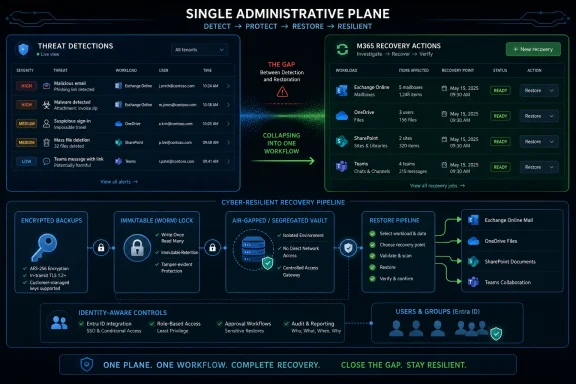
Sophos and Rubrik on June 1, 2026 made Sophos Backup and Recovery Powered by Rubrik Cyber Resilience generally available worldwide, bringing Microsoft 365 data recovery for Exchange Online, OneDrive, SharePoint, and Teams into the Sophos Central security platform. The launch matters less because it adds another Microsoft 365 backup SKU and more because it collapses a long-standing operational gap between detecting an attack and restoring the collaboration data the attack damaged. For WindowsForum readers, the interesting part is not the branding exercise; it is the way endpoint security, managed detection, SaaS backup, and identity-aware recovery are converging into one administrative plane.

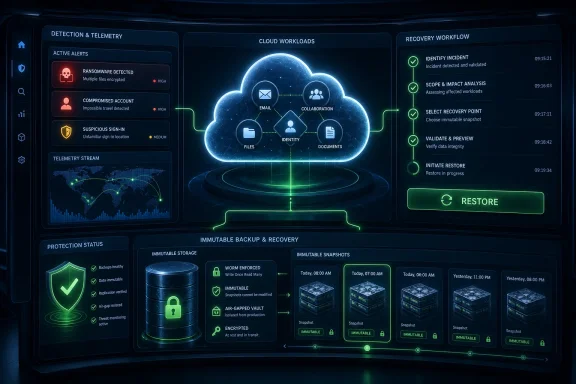
Cyber-resilient recovery dashboard showing threat detection, recovery actions, and a restore pipeline for single administrative plane.Sophos Is Selling Recovery as Part of Detection, Not as an Afterthought​

The product’s pitch is deliberately simple: if Sophos Central is where a security team sees ransomware, account compromise, insider abuse, or suspicious activity, it should also be where that same team begins restoring Microsoft 365 data. That sounds obvious until you compare it with how many organizations actually operate. Detection is often in one console, backup in another, identity in a third, and the incident bridge is where everyone discovers which of those tools can talk to the others under pressure.
Sophos is not pretending to have invented Microsoft 365 backup. Rubrik brings the underlying cyber-resilience machinery, including immutable backups, air-gapped architecture, WORM-style locking, and customer-controlled encryption claims. Sophos brings the customer interface, the MDR and XDR context, and a channel into organizations that may already be using Sophos Central as their security operations hub.
That division of labor is the story. The market has moved past the idea that SaaS backup is merely an insurance policy for someone deleting the wrong mailbox. In 2026, Microsoft 365 backup is increasingly being sold as an incident-response capability, and Sophos wants to make sure that recovery is attached to the same workflow as alert triage.
The announcement follows a strategic partnership the companies disclosed in August 2025. Back then, the message was integration; now the message is availability. That distinction matters because administrators have heard many promises about unified security platforms, only to find that “integration” means a dashboard tile and a separate contract. General availability turns the partnership into something customers can evaluate against restore-time objectives, audit requirements, and the messy permissions reality of Microsoft 365 tenants.

Microsoft 365 Became the Soft Underbelly of the Windows Estate​

For years, Windows administrators treated Microsoft 365 as a cloud service adjacent to the desktop estate. That mental model no longer works. Outlook, Teams, OneDrive sync, SharePoint-backed collaboration, Entra ID sign-in, Defender telemetry, and endpoint policy now form a single operational fabric for many organizations.
That fabric is convenient, but it is also an attractive target. A compromised Microsoft 365 account can expose mail, documents, Teams conversations, SharePoint sites, and file histories without ever touching a traditional file server. A compromised administrator account can be worse, especially if attackers tamper with retention, delete content, or attempt to reduce the organization’s ability to reconstruct events.
This is why the Sophos-Rubrik integration is more interesting than a conventional backup launch. It treats Microsoft 365 data as part of the security blast radius. In that model, a malicious inbox rule, an encrypted SharePoint library, a deleted Teams channel, and a suspicious endpoint are not separate incidents; they are symptoms of the same campaign.
Microsoft itself has improved native backup options, and Microsoft 365 Backup is now part of the broader conversation. But native platform resilience and operational recovery are not the same thing. Microsoft keeps the service running, offers retention and recovery mechanisms, and sells its own backup service; customers still have to decide how much independence, granularity, retention, and incident-driven restore workflow they need.
That is the opening Sophos and Rubrik are walking through. They are not saying Microsoft 365 lacks resilience. They are saying resilience inside the productivity platform is not enough if the attack path, the investigation, and the restore decision all live elsewhere.

The Shared-Responsibility Model Finally Has Teeth​

The shared-responsibility model used to be one of those cloud-computing phrases that appeared in procurement decks and compliance paperwork. Now it has become a practical pain point. Microsoft operates the platform, but customers remain responsible for the governance, access, retention, and protection choices that determine what can be recovered after a bad day.
That responsibility is easy to underestimate because Microsoft 365 feels like infrastructure. Users do not think of Exchange Online or SharePoint Online as something that needs backup in the way an old on-premises file server needed backup. Admins know better, but even seasoned IT teams can be lulled by recycle bins, litigation holds, retention labels, and version history into assuming they have a coherent recovery strategy.
Those tools are useful, but they are not a complete answer to every destructive scenario. Retention policies can be misconfigured. Holds can be too broad for operational recovery and too narrow for forensic reconstruction. Recycle-bin windows are not a cyber-resilience strategy. Version history can help with accidental changes but is not the same as an immutable, separately controlled recovery point.
The rise of third-party Microsoft 365 backup is therefore not just vendor opportunism. It reflects a real shift in how organizations understand SaaS risk. Productivity data has become too important to rely solely on platform-native defaults, especially when attackers increasingly target identity and collaboration systems rather than only encrypting endpoints.
Sophos is betting that many midsize organizations want the benefit of a dedicated backup product without building another operational silo. Rubrik is betting that its cyber-recovery credibility becomes more valuable when surfaced inside a security platform that customers already use. Both bets are plausible.

The Rubrik Layer Gives the Launch Its Security Posture​

Rubrik’s role is not cosmetic. Sophos is leaning on Rubrik for the pieces that make this more than a restore button inside Sophos Central. The companies describe the service as using air-gapped architecture, immutable backups, WORM-locked technology, multifactor controls, and customer-controlled encryption.
Those are the right buzzwords, but the details will matter in customer evaluations. Immutability is only as useful as the administrative model around it. Air-gapping can mean different things depending on architecture. Customer-controlled encryption is reassuring, but it also raises questions about key management, recovery procedures, and who can perform emergency actions during an incident.
Still, the emphasis is directionally correct. The old backup model assumed failure, corruption, or accidental deletion. The modern cyber-resilience model assumes an adversary may have credentials and may deliberately try to destroy recovery options. That changes the architecture from “can we restore?” to “can we restore after the attacker tried to prevent restoration?”
For Microsoft 365, that distinction is especially important. Attackers who obtain high-value credentials may be able to alter mailbox rules, delete data, change sharing, or interfere with retention. If the backup control plane uses the same compromised identity paths and lacks strong separation, the backup becomes part of the target surface.
Rubrik’s brand has been built around that problem. Sophos is now packaging it for customers who may not have the appetite to manage a separate enterprise backup environment for Microsoft 365. The promise is that security teams can detect, investigate, and restore without switching mental contexts at the worst possible moment.

The Console War Comes for Backup​

Sophos Central is the strategic asset here. Every security vendor wants its console to become the place where the customer lives. Endpoint protection became EDR, EDR became XDR, XDR became MDR, and MDR now wants to absorb recovery.
This is not merely a user-interface preference. Console ownership shapes budget ownership. If Microsoft 365 backup is purchased and operated as a security capability, the CISO and security operations team gain influence over what used to be a backup-admin decision. If it remains an infrastructure function, it competes with storage, disaster recovery, and compliance tooling.
Sophos is aiming at the former. The product is available as an add-on for Sophos customers and is managed through Sophos Central alongside threat detection and response. That packaging is designed for organizations that want fewer portals, fewer vendors in the incident bridge, and fewer moments where someone asks who actually has permission to restore the CEO’s mailbox.
The risk, of course, is platform gravity. Consolidation can reduce friction, but it can also hide complexity. A unified console does not automatically produce a unified incident process. Administrators still need to know which workloads are protected, what restore granularity is available, how long backups are retained, who can authorize a restore, and whether recovery to alternate users or inactive accounts behaves as expected.
Sophos and Rubrik say the service supports restoration of emails, files, mailboxes, OneDrive accounts, SharePoint sites, and Teams data to original or alternate users, including inactive accounts. That is exactly the sort of capability that becomes valuable during account compromise or employee offboarding investigations. It is also the sort of feature that should be tested before an incident, not discovered during one.

Teams Recovery Remains the Most Complicated Promise​

It is easy to say “Microsoft 365 backup” as if all workloads behave alike. They do not. Exchange mailboxes, OneDrive files, SharePoint sites, and Teams data have different structures, dependencies, permissions, and recovery expectations.
Teams is the hardest for many admins to reason about because Teams is not a single repository. It is a collaboration surface that touches SharePoint, Exchange, OneDrive, Entra ID, and underlying Microsoft 365 group structures. A user may think a deleted Teams channel is one object; an administrator may have to consider files, messages, membership, permissions, tabs, and connected resources.
That is why claims about Teams recovery deserve scrutiny. Restoring files associated with Teams is useful, but it is not the same as reconstructing every user-visible element of a Teams workspace exactly as it appeared before an incident. Vendors have improved here, but the architecture of Teams makes perfect semantic recovery difficult.
Sophos and Rubrik include Teams data in the protected scope, which is necessary in 2026 because Teams has become the operational memory of many organizations. But IT teams should read the fine print around what “Teams recovery” means in practice. A restore that recovers files and channel-associated content may still require administrative cleanup before users feel whole again.
This is not a knock on Sophos or Rubrik specifically. It is a reminder that Microsoft 365 is a suite, not a monolith. Backup products can smooth the restore experience, but they cannot erase the complexity of the underlying service.

Entra ID Policy Awareness Is the Quietly Important Bit​

One of the more practical parts of the announcement is automatic discovery of new users, sites, and workloads, with policy-driven protection tied to Entra ID-based controls. That may sound like administrative plumbing, but it is essential for Microsoft 365 backup at scale.
Manual backup selection fails in dynamic tenants. New users arrive, shared mailboxes appear, Teams sites proliferate, departments spin up SharePoint locations, and project data moves faster than the backup administrator’s checklist. A backup product that depends on manual enrollment will eventually miss something important.
Policy-driven protection is the antidote. If an organization can align backup coverage with Entra ID groups, roles, departments, or other identity-driven structures, protection becomes part of the lifecycle rather than a quarterly cleanup task. That is particularly important for midsize companies that have grown into enterprise-style Microsoft 365 complexity without enterprise-sized IT staffing.
It also connects backup to identity governance. If the identity system defines who and what matters, backup policy can follow that map. The danger is that bad identity hygiene then becomes bad backup hygiene. Stale groups, inconsistent attributes, and unmanaged shared resources can undermine automated protection.
That is another reason this launch belongs in the security conversation. Microsoft 365 recovery is no longer only about storage. It depends on identity, permissions, policy, and the operational discipline of keeping tenant structure intelligible.

The Mid-Market Is Where the Pain Is Sharpest​

Large enterprises often already have a backup strategy, a security operations center, a disaster-recovery team, and enough procurement complexity to make any new platform decision slow. Small businesses may rely on MSP bundles or basic retention defaults, for better or worse. The most interesting target for Sophos and Rubrik is the middle.
Mid-market organizations are big enough to be targeted, regulated, and dependent on Microsoft 365, but not always big enough to staff separate experts for every domain. They may have Sophos MDR or XDR, a lean internal IT team, and a Microsoft 365 tenant that has become mission-critical by accumulation rather than by design.
For those customers, a backup product embedded in Sophos Central has obvious appeal. It reduces the number of tools a small team must learn and may shorten the path from incident detection to recovery. It also gives Sophos a stronger argument that its platform is not just about blocking attacks, but about keeping the business running after attackers get through.
That business-continuity framing is important. Security vendors have spent years telling customers that prevention is not enough. The logical next step is to own the recovery workflow. If Sophos can say its MDR analysts can identify the incident while the customer restores the affected Microsoft 365 data from the same ecosystem, the company has a cleaner resilience story than endpoint protection alone.
The tradeoff is dependency. Customers that standardize security operations and SaaS recovery around one vendor relationship may gain speed but lose optionality. That does not make the model wrong, but it does make exit planning, contractual clarity, and restore testing more important.

Microsoft’s Own Backup Push Makes the Market More Competitive, Not Less​

Microsoft’s entry into Microsoft 365 Backup changed the psychology of the market. For years, third-party backup vendors had to convince customers that Microsoft 365 data needed separate protection. Microsoft’s own backup service effectively validated the category, even as it created a new competitor.
That puts Sophos and Rubrik in a more nuanced position. They are not competing against a vacuum; they are competing against native Microsoft capabilities, established SaaS backup vendors, MSP offerings, and the inertia of doing nothing. The argument can no longer be simply “back up Microsoft 365.” It has to be “back it up in a way that fits your incident-response model.”
Microsoft’s native service has advantages. It lives close to the data, aligns with Microsoft administration, and may appeal to customers who prefer first-party tooling. Third-party offerings can counter with independent control planes, broader security integrations, different retention models, cross-platform recovery workflows, and vendor-specific cyber-resilience features.
Sophos and Rubrik are making the third-party argument through security integration. Their point is not that Microsoft cannot protect Microsoft 365 data. Their point is that a security team responding to a live incident may want recovery actions tied to the same platform where detection, response, and operational triage are already happening.
That argument will resonate with some customers and not with others. Microsoft-centric shops may prefer native backup and Sentinel-driven workflows. Sophos-heavy environments may find the new add-on more natural. The right answer depends less on vendor loyalty than on tested recovery outcomes.

Administrators Should Judge the Service by Restore Drills, Not Launch Language​

The announcement uses the language every cyber-resilience launch now uses: immutable, air-gapped, rapid recovery, unified platform, ransomware resilience. Those terms are meaningful only when translated into restore drills.
A practical evaluation should start with scenarios. Can the organization restore a VIP mailbox to an alternate user for legal review? Can it recover a OneDrive after mass deletion? Can it restore SharePoint content after ransomware-like file corruption? Can it recover Teams-associated data in a way users can understand? Can it do these things when the original user is inactive, the admin account is suspect, or the tenant is under investigation?
The best time to answer those questions is before procurement signs off. The second-best time is immediately after deployment. The worst time is during an incident, when executives are asking why “we bought backup” did not mean “everything returns exactly as it was in fifteen minutes.”
Administrators should also examine role-based access control inside Sophos Central. Backup restore permissions are powerful. A tool that can restore mailboxes and files can also expose sensitive data if authorization is sloppy. The integration of security and backup workflows should not become an excuse to hand broad restore powers to everyone who can triage alerts.
Finally, customers should demand clarity on retention, geography, encryption, logging, and data export. Microsoft 365 data often includes regulated content, legal evidence, HR records, financial documents, and customer information. Moving backup operations into a managed security platform can simplify operations, but it does not reduce compliance obligations.

The Real Win Is Time, If the Integration Works​

In an incident, time is the scarce resource. Not just elapsed time, but decision time: who owns the problem, who has authority, which system has the clean copy, which account can safely perform the restore, and which data matters first.
Sophos and Rubrik are trying to compress that decision chain. If a security team can identify affected users or workloads and then initiate targeted recovery from the same operational environment, the organization may avoid the handoff delays that often turn a contained incident into a prolonged outage.
That is particularly relevant for ransomware and business email compromise cases. Modern attacks often combine endpoint activity, credential abuse, mailbox manipulation, and SaaS data access. Recovery needs to be granular enough to avoid rolling back unaffected users and broad enough to restore business functions quickly.
The Rubrik side of the partnership also brings the language of prioritized recovery, which has become increasingly important as SaaS estates grow. Not all data is equally urgent. Restoring the finance team’s SharePoint site before an archive of old project files can be the difference between resuming operations and merely checking a recovery box.
But the product will have to prove that the integration is operationally deep, not just commercially convenient. A single pane of glass is useful only if it reduces the number of panes that matter. If administrators still have to bounce between consoles for identity, audit, backup policy, and restore verification, the claimed simplicity will be thinner than the marketing suggests.

The Launch Leaves Buyers With Five Tests Sophos Cannot Answer for Them​

The Sophos-Rubrik service is a credible response to a real problem, but no vendor announcement can determine whether it fits a particular tenant, risk model, or recovery objective. The practical question for IT teams is whether this integration improves their ability to recover the Microsoft 365 workloads users actually depend on.
  • Organizations already using Sophos Central should evaluate the service as an incident-response extension, not merely as another backup subscription.
  • Administrators should test Exchange Online, OneDrive, SharePoint, and Teams restores separately because each workload has different recovery behavior and user expectations.
  • Security teams should verify that backup administration, restore authority, encryption control, and audit logging remain appropriately separated even inside a unified console.
  • Microsoft 365 tenants with fast-changing users, groups, and sites should pay close attention to Entra ID-based policy automation because manual protection lists will drift.
  • Buyers should compare the service against Microsoft 365 Backup and other third-party tools using restore drills, not feature matrices.
Sophos and Rubrik are not announcing the end of Microsoft 365 backup complexity. They are acknowledging where the complexity now lives: in the gap between compromise and recovery, between identity and data, between the security console and the backup console. If the integration works as advertised, it gives Sophos customers a shorter path through that gap; if it does not, it will be another reminder that resilience is not purchased in a press release but proven in the restore window after something breaks.

References​

  1. Primary source: investing.com
    Published: Mon, 01 Jun 2026 13:26:08 GMT
  2. Related coverage: sophos.com
  3. Related coverage: globenewswire.com
  4. Related coverage: rubrik.com
  5. Related coverage: community.sophos.com
  6. Related coverage: news.sophos.com
  1. Related coverage: s203.q4cdn.com
  2. Related coverage: aemcloud.stage.rubrik.com
  3. Official source: learn.microsoft.com
  4. Official source: microsoft.com
  5. Related coverage: datastrive.com
  6. Related coverage: avepoint.com
  7. Related coverage: acronis.com
  8. Related coverage: comnexia.com
  9. Related coverage: centrexit.com
  10. Related coverage: xen.com.tr
  11. Official source: adoption.microsoft.com
  12. Related coverage: tesserent.com
  13. Related coverage: ramsac.com
  14. Official source: download.microsoft.com
  15. Related coverage: druva.com
 

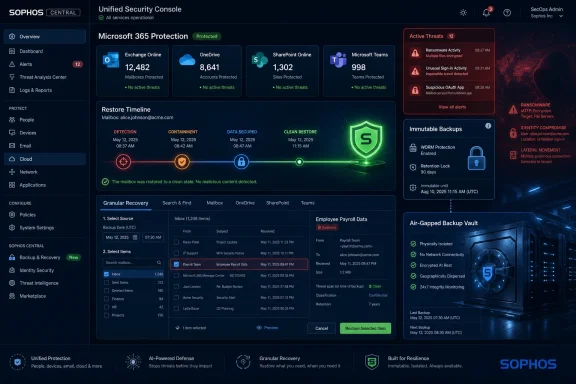
Sophos and Rubrik made Sophos Backup and Recovery Powered by Rubrik Cyber Resilience generally available worldwide on June 1, 2026, giving Sophos customers Microsoft 365 backup and restore for Exchange Online, OneDrive, SharePoint, and Teams directly inside Sophos Central. The announcement is not just another channel partnership in the crowded backup market. It is a bet that recovery has become part of security operations, not a separate task waiting in another console after the fire is out. For Windows shops living in Microsoft 365 all day, that distinction matters.

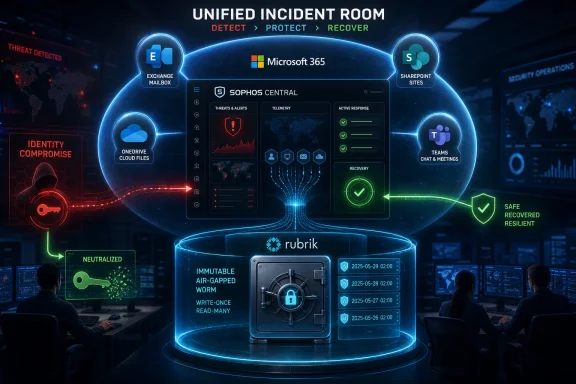
Sophos Central unified security console dashboard showing Microsoft 365 protection and active threat status.Recovery Moves Into the Security Console​

For years, Microsoft 365 backup has been sold as insurance: necessary, prudent, and too often discussed only after someone deletes the wrong mailbox or an attacker encrypts the wrong SharePoint library. Sophos and Rubrik are reframing it as incident response infrastructure. The new offering brings Rubrik’s SaaS-based Microsoft 365 protection into Sophos Central, where many customers already manage endpoint security, detection and response, email protection, and related telemetry.
That positioning is deliberate. Sophos is not trying to become a backup company from scratch, and Rubrik is not trying to build a full security operations platform overnight. Instead, the two companies are stitching together the two halves of the ransomware story that vendors usually sell separately: finding the attack and getting the business running again.
The integration covers the usual Microsoft 365 crown jewels: Exchange Online, OneDrive, SharePoint, and Teams. Those workloads have become the working memory of the modern organization. A decade ago, losing access to email was bad enough; today, the same identity compromise can expose chat history, shared files, project documentation, customer records, HR material, and the collaboration fabric that tells employees what to do next.
That is why this announcement lands differently from an ordinary product availability note. Backup is no longer merely about restoring a deleted file. In a Microsoft 365 incident, recovery is about determining what changed, what was touched, what can be trusted, and how quickly the organization can resume normal operations without restoring the attacker’s mess along with the data.

Microsoft 365 Became Too Important to Treat as Someone Else’s Problem​

Microsoft 365’s success created a strange complacency. Because the service is cloud-hosted, highly available, and run by Microsoft, many organizations still blur the line between platform resilience and customer data recoverability. The distinction is easy to ignore until an admin account is compromised, retention settings are changed, files are purged, or a malicious actor uses legitimate access to cause damage that does not look like a traditional infrastructure failure.
Microsoft keeps the service running. That is not the same thing as guaranteeing that every tenant can roll back every business-impacting mistake or malicious change on the customer’s preferred timeline. Retention policies, recycle bins, legal holds, versioning, and native recovery features all have value, but they are not a universal substitute for an independent, tested backup and restore strategy.
Sophos and Rubrik are exploiting that gap, but the gap is real. The more deeply Microsoft 365 becomes embedded in daily work, the more the recovery conversation shifts from “Can we get the file back?” to “Can we reconstruct a trusted operating state?” That is a harder problem, especially when attackers arrive through identity rather than malware alone.
The press release leans on familiar threats: ransomware, account compromise, insider threats, and accidental deletion. The interesting part is that all four can look similar from a recovery perspective. Whether the damage came from a criminal, a disgruntled employee, a misconfigured retention policy, or a well-meaning user with too much access, the business still needs clean data restored quickly and precisely.

The Partnership Has Been Moving Toward This Since Black Hat​

The June 2026 general availability follows the strategic partnership Sophos and Rubrik announced in August 2025 at Black Hat USA. At the time, the pitch was that Sophos would offer a Microsoft 365 backup and recovery add-on powered by Rubrik, optimized for Sophos MDR and XDR customers and integrated into Sophos Central. Now that promise has moved from roadmap language into a product customers can activate through Sophos partners or sales representatives.
The timing is worth noting. Sophos has spent years pushing Sophos Central as more than a dashboard, presenting it as the connective tissue across endpoint, cloud, network, identity, email, and business application telemetry. Rubrik, meanwhile, has been recasting backup as cyber resilience: not just storing copies, but helping organizations survive data attacks, recover cleanly, and understand blast radius.
The companies are meeting in the middle because the old division of labor is increasingly artificial. Security teams identify compromised accounts, suspicious behavior, malicious inbox rules, mass deletions, abnormal file activity, and lateral movement. Backup teams restore mailboxes, sites, channels, and drives. During an incident, however, the business experiences all of this as one event.
That is the operational promise of the Sophos-Rubrik integration. If the security console already knows which user account was compromised, which endpoint was involved, which mailbox showed suspicious activity, and which cloud resources were accessed, then recovery should not begin with a separate team manually translating incident notes into restore jobs. It should begin with context.

The Console War Comes for Backup​

Every security vendor wants to own the console. Every platform vendor wants to reduce the number of panes of glass. Every administrator has heard those promises before and has the browser tabs to prove they rarely come true.
Still, the Sophos-Rubrik move reflects a real market pressure. Mid-market organizations, managed service providers, and lean IT teams often do not have separate departments for endpoint detection, Microsoft 365 administration, identity governance, backup operations, and incident response. The same small group may be triaging alerts in the morning, restoring SharePoint files at lunch, and explaining risk posture to executives by the afternoon.
For those teams, integration is not a luxury. It is how work gets done under pressure. A backup product that requires separate authentication, separate policy management, separate investigation, and separate reporting may be technically strong but operationally slow. In a ransomware or identity compromise event, slow is expensive.
Sophos Central already has a large installed base. The company says it defends more than 600,000 organizations worldwide, and the earlier partnership announcement emphasized more than 75,000 MDR and XDR customers as a natural audience for the Rubrik-powered add-on. That gives Rubrik a distribution path into organizations that might not be shopping for a standalone enterprise backup platform but are already buying managed detection and response.
The flip side is lock-in by gravity rather than contract. Once recovery workflows sit inside the security platform, moving away from that platform becomes more complicated. That may be good business for Sophos and Rubrik, but customers should recognize the architectural trade: unified operations can reduce friction, but it can also concentrate operational dependency.

Immutable Backups Are Now Table Stakes, Not Magic​

The feature list reads like modern backup marketing because modern backup marketing has been shaped by ransomware. Sophos and Rubrik promise isolated Microsoft 365 backups using air-gapped architecture, WORM-locked immutability, and customer-controlled encryption. The idea is simple: even if an attacker compromises credentials in the production environment, protected backup data should remain tamper-resistant.
That is important, but it should not be treated as a spell. Immutability reduces a major class of risk, especially when attackers try to delete or corrupt backups before detonating ransomware. It does not eliminate the need for careful identity design, least privilege, multifactor authentication, restore testing, retention planning, or incident playbooks.
The phrase air-gapped also deserves scrutiny in cloud services. In traditional infrastructure, an air gap evoked physical or network separation. In SaaS backup, it usually means logical isolation, separate control planes, restricted access paths, and architectural barriers designed to prevent production compromise from becoming backup compromise. Those controls can be strong, but customers should still ask exactly how isolation works, who can administer it, how encryption keys are controlled, and what happens if Sophos Central access itself is abused.
WORM locking is similarly valuable but not self-explanatory. Write once, read many controls are meant to prevent alteration or deletion during a defined retention period. That helps against malicious tampering, but it also requires policy discipline. Keep too little, and you may miss the clean restore point. Keep too much, and costs, compliance obligations, and e-discovery exposure can grow.
Rubrik’s involvement gives the offering credibility because this is its home turf. Sophos gains a recovery engine without reinventing one; Rubrik gains a front door inside active security operations. Customers gain a more coherent workflow, assuming the integration is deep enough to matter in real incidents rather than simply embedding backup screens in a familiar shell.

Granular Recovery Is Where the Product Will Prove Itself​

The most important capability may not be immutability. It may be granular restore at scale. The announcement says teams can search and restore emails, files, mailboxes, OneDrive accounts, SharePoint sites, and Teams data to original or alternate users, including inactive accounts.
That sounds mundane until you imagine a real Microsoft 365 incident. A compromised account might delete or alter files across multiple SharePoint sites. A malicious inbox rule might redirect sensitive mail. A Teams channel might contain files stored in SharePoint, conversations stored elsewhere, and permissions inherited through group membership. A departing employee’s inactive account might suddenly become relevant because it holds the last clean copy of a critical conversation or file history.
Restoring all of Microsoft 365 to yesterday is rarely the right answer. Restoring one message, one mailbox, one folder, one site, one channel, or one user’s OneDrive may be the difference between a contained incident and a business-wide interruption. The practical value is not just whether the data exists in backup; it is whether the team can find the right object, identify a clean restore point, and put it back without breaking something else.
That is where security context matters. If Sophos Central can help map suspicious activity to recovery scope, then recovery becomes less of a guessing game. If it cannot, the integration risks becoming cosmetic: useful for procurement, less transformative during an attack.
The announcement’s language about understanding what was affected and restoring clean, trusted data is therefore the center of the story. The hard part is not saying “restore clean data.” The hard part is determining what clean means when identity, permissions, mail flow, files, and collaboration history are all entangled.

Automated Protection Addresses the Problem Nobody Wants to Own​

The offering also promises automated discovery of new users, sites, and workloads, with policy-driven protection using Entra ID-based controls. That is less flashy than ransomware recovery, but it may be the feature that saves administrators from the most common failure mode: drift.
Microsoft 365 environments do not sit still. Users join and leave. Shared mailboxes appear. Teams are created for temporary projects and then become permanent repositories. SharePoint sites multiply. OneDrive becomes the default dumping ground for work-in-progress documents. If backup coverage depends on someone remembering to add every new object manually, gaps are inevitable.
Policy-based automation is the right direction because identity and group structure already define much of the Microsoft 365 operating model. If backup follows those controls, organizations can reduce the lag between business creation and data protection. That matters especially for MSPs and mid-sized IT teams managing many tenants or fast-changing environments.
But automation also inherits the quality of the identity design beneath it. If Entra ID groups are messy, roles are overbroad, naming conventions are inconsistent, and lifecycle management is weak, policy-driven backup can protect broadly but not necessarily elegantly. The integration may reduce manual effort, but it will not rescue a tenant from years of governance neglect.
This is where the announcement intersects with a broader truth about Microsoft 365 administration. Security, compliance, backup, and collaboration are all downstream of identity hygiene. A recovery product can help restore data after a bad day. It cannot fully compensate for an environment where no one knows who owns a Team, which sites are business critical, or why a former contractor still has access.

Sophos Is Selling Resilience to the Mid-Market’s Real Staffing Model​

The customer implied by this product is not a Fortune 50 enterprise with a dedicated cyber recovery team, a separate Microsoft 365 governance office, and a 24-hour security operations center. It is more likely a school district, a manufacturer, a legal practice, a regional healthcare provider, a local government, or a fast-growing business whose Microsoft 365 tenant is more complex than its staffing model can comfortably support.
That is Sophos’ sweet spot. The company’s MDR and XDR business has long appealed to organizations that need security operations capability without building everything themselves. Adding Microsoft 365 recovery to that operational model is a logical extension. If Sophos or a Sophos partner is already helping detect and respond to threats, the customer may reasonably ask why recovery is still in a disconnected tool.
Rubrik gets something equally valuable: a route into the mid-market without forcing every customer through a standalone enterprise data protection sales motion. Its brand is strong among larger organizations and security-conscious buyers, but Microsoft 365 backup is crowded with specialists, MSP-oriented platforms, and Microsoft’s own native backup offering. Being embedded in Sophos Central gives Rubrik a differentiated channel.
The phrase “available as an add-on” is doing a lot of work. It signals that this is not a free entitlement and not a replacement for Microsoft 365’s native features. Customers will need to evaluate licensing, retention needs, protected workload scope, restore performance, administrative roles, and how the integration fits existing backup contracts.
That evaluation should include the uncomfortable question of whether the organization has ever tested a Microsoft 365 restore under realistic conditions. Many have not. They have retention policies, assumptions, and vendor brochures. They do not have measured restore times, documented authority to approve restores, or a rehearsed process for recovering after an identity-led attack.

Microsoft’s Own Backup Push Changes the Competitive Context​

This announcement also lands in a market Microsoft itself has entered more directly. Microsoft 365 Backup gives customers a native, pay-as-you-go backup option for certain Microsoft 365 workloads, with Microsoft emphasizing fast restore and data kept within the tenant boundary. That changes the conversation for third-party vendors.
The old third-party pitch was straightforward: Microsoft provides the platform, but you need someone else for backup. The new pitch has to be sharper. If Microsoft offers native backup, partners must explain why their recovery workflow, isolation model, security context, retention flexibility, cross-workload visibility, or operational integration is superior for the customer’s risk model.
Sophos and Rubrik appear to be answering with workflow rather than raw backup capability alone. Their case is that recovery belongs next to detection and response, not merely inside the Microsoft admin ecosystem. For organizations already using Sophos Central as their security operating layer, that may be persuasive.
Microsoft still has structural advantages. It owns the platform, the APIs, the tenant boundary, the product roadmap, and the customer relationship at massive scale. Native backup can be simpler to justify for organizations standardizing on Microsoft tools, especially those that prefer fewer vendors and tight alignment with Microsoft 365 administration.
But third-party recovery still has a strong argument in cyber incidents. Independence matters when the tenant itself is compromised. So do immutable controls, externalized recovery workflows, and vendor diversity. The best choice will depend less on brand loyalty than on threat modeling: what kind of failure are you trying to survive, and who has authority when the failure occurs?

The Real Test Is Not the Press Release, but the Restore Drill​

The phrase cyber resilience has become a vendor favorite because it sounds broader and more strategic than backup. It is also easy to abuse. A product is not resilient because the marketing team says so; it is resilient if it shortens downtime, reduces uncertainty, and gives administrators confidence during an ugly incident.
For Sophos and Rubrik, the product’s credibility will depend on how well it performs in drills and real events. Can a customer identify all affected Microsoft 365 objects tied to a compromised account? Can they restore a mailbox or SharePoint library to a clean point without overwriting legitimate recent work? Can they recover Teams-related data in a way users understand? Can delegated admins perform the right tasks without being granted dangerous levels of access?
The managed service provider angle is equally important. Sophos’ channel ecosystem is large, and many customers will experience this offering through a partner rather than directly through either vendor. That means documentation, role-based access, multi-tenant management, alerting, billing clarity, and support escalation will shape the product’s real-world reputation as much as the underlying Rubrik technology.
There is also a cultural issue. Security teams often think in incidents, indicators, containment, and threat actor behavior. Backup teams think in restore points, retention windows, recovery objectives, and data integrity. Putting the tools in one console does not automatically merge those disciplines. Organizations still need runbooks that say who declares an incident, who freezes retention changes, who authorizes restore, who validates data cleanliness, and who communicates with users.
If the product encourages those conversations, it will have value beyond the restore button. If it lets organizations pretend that buying an add-on is the same as building resilience, it will become another checkbox in a long line of security purchases that looked better in procurement than in practice.

Windows Shops Should Read This as an Identity Story​

For WindowsForum readers, the Microsoft 365 angle is obvious, but the deeper issue is identity. Modern Windows environments increasingly revolve around Entra ID, conditional access, cloud mail, Teams, SharePoint, OneDrive, endpoint management, and SaaS integrations. The old perimeter has dissolved into account privileges, tokens, session controls, device posture, and cloud data permissions.
That makes recovery harder because the attacker may not need to deploy malware in the classic sense. A compromised account can search mail, alter forwarding rules, delete files, modify sharing links, create persistence, and exploit trust relationships. The damage can be subtle, distributed, and perfectly valid from the platform’s point of view.
Backup and recovery products must therefore adapt to identity-led incidents. Restoring data is only one part of the response. Administrators must also revoke sessions, reset credentials, rotate secrets, review app consents, inspect mailbox rules, audit sharing, examine Teams and SharePoint permissions, and determine whether restored data will be exposed again the moment it comes back.
Sophos has an advantage if it can connect endpoint and identity signals to Microsoft 365 recovery decisions. Rubrik has an advantage if its recovery model can preserve clean copies even when the production tenant is under duress. The integration’s value lies in whether those advantages actually reinforce each other.
This is why the announcement is more interesting than a simple “backup now available” headline. It reflects a shift in how the industry talks about Microsoft 365 risk. The question is no longer whether cloud collaboration needs backup. The question is whether backup can keep up with cloud-native attacks.

The Restore Button Is Now Part of the Incident Timeline​

The practical lesson from Sophos and Rubrik’s launch is that Microsoft 365 recovery should be planned as part of security operations, not discovered during a crisis. The product may not be right for every tenant, but the assumptions behind it are increasingly hard to dispute.
  • Sophos Backup and Recovery Powered by Rubrik Cyber Resilience is now generally available as an add-on for Sophos customers through Sophos partners or sales representatives.
  • The offering protects Microsoft 365 data across Exchange Online, OneDrive, SharePoint, and Teams from within Sophos Central.
  • Rubrik supplies the underlying SaaS-based backup and recovery capabilities, including immutable, isolated backups and granular restore options.
  • The integration is aimed at incidents where ransomware, account compromise, insider activity, or accidental deletion affects Microsoft 365 data.
  • Customers should test restore workflows, validate administrative roles, and confirm retention policies before treating the product as operational insurance.
  • The competitive question is not whether Microsoft 365 needs recovery, but whether recovery is more effective inside the security workflow, inside Microsoft’s native tooling, or in a separate backup platform.
Sophos and Rubrik are not solving every Microsoft 365 resilience problem with one general availability announcement. They are, however, pointing at the right battlefield: the moment after detection, when the business stops asking what happened and starts asking what can be trusted. The vendors that win that moment will not be the ones with the loudest resilience slogans, but the ones that help administrators move from compromised identity to clean recovery with fewer guesses, fewer consoles, and fewer hours lost to organizational panic.

References​

  1. Primary source: GlobeNewswire
    Published: Mon, 01 Jun 2026 13:00:00 GMT
  2. Related coverage: sophos.com
  3. Related coverage: news.sophos.com
  4. Related coverage: msspalert.com
  5. Related coverage: avepoint.com
  6. Related coverage: community.sophos.com
  1. Official source: learn.microsoft.com
  2. Related coverage: windowsforum.com
  3. Official source: microsoft.com
  4. Related coverage: xen.com.tr
  5. Related coverage: rubrik.com
  6. Official source: adoption.microsoft.com
 

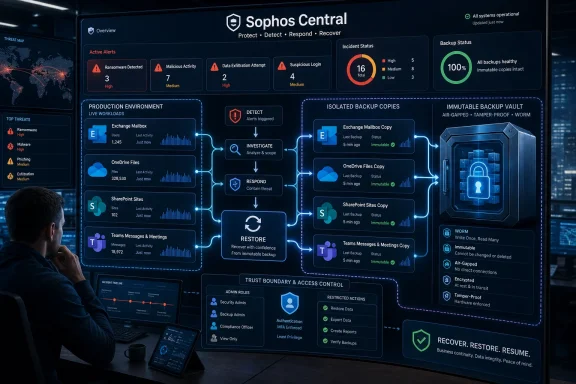
Sophos and Rubrik on June 1, 2026, made Sophos Backup and Recovery Powered by Rubrik Cyber Resilience generally available worldwide, giving Sophos customers Microsoft 365 backup and recovery inside Sophos Central for Exchange Online, OneDrive, SharePoint, and Teams data after ransomware, account compromise, insider threats, or accidental deletion. The announcement is not just another channel partnership dressed up as resilience theater. It is a bet that recovery belongs in the same operational console as detection and response, because the moment of crisis is exactly when tool-hopping hurts most. For Windows shops built around Microsoft 365, the move is a reminder that cloud productivity has become business infrastructure — and infrastructure needs a recovery plan that is tested before the breach.

A cybersecurity analyst monitors a Sophos Central dashboard showing alerts, incident status, and immutable backups.Sophos Turns Backup Into a Security Workflow​

The most interesting part of the Sophos-Rubrik deal is not that it protects Microsoft 365 data. The market already has a long list of vendors selling Microsoft 365 backup for Exchange, SharePoint, OneDrive, and Teams. The shift is that Sophos is treating recovery as part of security operations rather than a neighboring IT chore.
That sounds like marketing until you sit inside a real incident. A ransomware investigation does not unfold as a clean handoff from the SOC to the backup administrator. It is a scramble to understand which identities were abused, which mailboxes were touched, which files were encrypted or deleted, which Teams and SharePoint locations matter, and which restore points can be trusted.
Sophos Central is already the command center for many organizations using Sophos endpoint, MDR, XDR, email, network, cloud, and identity-related telemetry. By embedding Rubrik’s Microsoft 365 protection there, Sophos is trying to collapse the distance between the person who sees the attack and the person who has to put the business back on its feet.
That matters especially for mid-market IT teams, which often have enterprise-grade exposure and small-team staffing. They may run Microsoft 365 as the daily nervous system of the company, but they do not necessarily have separate specialists for identity, email security, SaaS backup, forensic response, and business continuity. A unified console does not solve every problem, but it can remove one of the most common incident-response tax burdens: figuring out which system has the answer.
The vendor language here is predictable — cyber resilience, rapid recovery, unified operations — but the underlying operational point is real. Security tools have spent years getting better at telling teams what went wrong. The next competitive frontier is helping them reverse the damage without waiting for a parallel backup process to catch up.

Microsoft 365 Is Too Central to Be Treated as Someone Else’s Problem​

Microsoft 365’s success has created a dangerous psychological shortcut. Because the service is cloud-hosted, highly available, and backed by Microsoft’s own engineering muscle, many organizations still blur the line between platform durability and customer-controlled recovery. Those are related ideas, but they are not the same thing.
Microsoft is responsible for operating the service, maintaining its infrastructure, and providing built-in retention and recovery capabilities. Customers remain responsible for their data governance, deletion policies, account security, privileged access, and the ability to recover from their own mistakes or adversaries operating inside their tenant. That shared-responsibility reality is not new, but it becomes more visible every time an attacker uses valid credentials instead of exotic malware.
Modern Microsoft 365 incidents often begin as identity incidents. An attacker compromises an account, abuses OAuth permissions, changes forwarding rules, downloads sensitive files, deletes data, or uses trusted collaboration channels to move deeper into the organization. In those scenarios, the platform may be functioning exactly as designed while the tenant is being abused.
That is the uncomfortable gap Sophos and Rubrik are targeting. If a user deletes a folder by accident, native recovery may be enough. If a privileged account is compromised and an attacker tampers with mailboxes, SharePoint content, or collaboration data, the organization needs more than a recycle bin and hope. It needs restore points that are insulated from the attacker’s permissions and a way to determine what should be restored.
This is why the announcement leans heavily on immutable backups, air-gapped architecture, WORM locking, and customer-controlled encryption. Those phrases can become vendor confetti, but in context they speak to a basic principle: the backup system must not be just another reachable asset in the same blast radius as the compromised tenant.

Rubrik Gets Closer to the Moment of Detection​

Rubrik has spent years repositioning backup from a storage function into a cyber-resilience function. That repositioning has been helped by ransomware, which made old-fashioned backup suddenly look like a board-level concern again. But backup vendors still face a practical problem: being essential during recovery does not automatically make them central during detection.
The Sophos partnership helps solve that problem. Rubrik gets its Microsoft 365 protection placed inside a security console that many teams already use daily. Instead of asking customers to remember yet another portal during an incident, Rubrik becomes part of a workflow that starts with alerts, telemetry, investigation, and response.
That is strategically useful for Sophos, too. Endpoint and MDR vendors are under pressure to show that they can do more than detect threats and open tickets. Customers increasingly ask what happens after containment. If the answer is “call your backup vendor,” the security platform feels incomplete at the exact moment executives are watching.
The joint offering gives Sophos a cleaner story: detect, investigate, and restore from within Sophos Central. Whether every deployment will be that smooth depends on configuration, licensing, identity hygiene, restore testing, and data scale. But as a product thesis, it is persuasive because it maps to how incidents actually feel.
There is also a channel angle. Sophos has a large partner ecosystem and a customer base that includes many organizations without huge internal security teams. For MSPs and resellers, a Microsoft 365 recovery add-on managed through Sophos Central is easier to explain than a separate backup platform bolted on after the fact. The integration makes resilience more sellable, and in mid-market security, sellable often means deployable.

The Console Is Convenient, but the Trust Boundary Still Matters​

A single console can be powerful, but it is not automatically safer. One of the risks in security platform consolidation is that convenience can disguise dependency. If too many functions sit behind one administrative plane, that plane becomes more important to protect, monitor, and govern.
Sophos and Rubrik appear aware of that concern, which is why the announcement emphasizes isolated backups, immutability, and customer-controlled encryption rather than merely saying “now in Sophos Central.” The distinction matters. A unified management experience should not mean that the same compromised credentials can alter production data and destroy recovery copies.
Administrators should read this announcement through that lens. The useful question is not simply whether the backup button appears in Sophos Central. It is how roles are separated, how restore authority is granted, how encryption keys are managed, how administrative actions are logged, and how recovery workflows behave when identity systems are degraded or under active suspicion.
Microsoft 365 recovery also has a granularity problem. Restoring an email is not the same as restoring a mailbox. Restoring a Teams-linked SharePoint site is not the same as restoring a standalone file library. Restoring data to an alternate user, including inactive accounts, can be vital during investigations, but it also creates governance and chain-of-custody questions.
The product’s promise of fast, flexible recovery is therefore important, but it should be tested in realistic scenarios. A tabletop exercise that restores one deleted file proves very little. A useful test asks whether the team can identify an affected executive mailbox, locate a clean restore point, recover selected items to a safe location, preserve evidence, and avoid reintroducing malicious content.

The Real Customer Is the Lean IT Team​

The strongest case for this offering is not the Fortune 100 security operations center. Large enterprises may already have dedicated backup teams, complex Microsoft Purview policies, mature incident response retainers, and separate tooling for SaaS recovery. They may still consider the integration, but they are not the obvious emotional target.
The obvious target is the lean IT team running Microsoft 365, Sophos endpoint protection, maybe Sophos MDR, and a stack of admin portals that has grown faster than headcount. These teams live in the gap between enterprise expectations and small-team reality. They are asked to prevent ransomware, satisfy cyber-insurance questionnaires, support hybrid work, manage identity, and keep collaboration data recoverable.
For them, the promise of unified operations is not aesthetic. It is survival. Every extra portal, credential set, policy model, and restore workflow becomes a source of delay and error when a compromise is underway. If the Sophos-Rubrik integration can make recovery policy visible to the same operators handling threat response, it may reduce the odds that backup is configured once and forgotten.
There is also a training benefit. Security teams tend to practice inside the tools they use most. If Microsoft 365 recovery is buried in a separate platform that only one administrator touches, organizational muscle memory will be weak. If recovery is exposed inside Sophos Central, it has a better chance of becoming part of regular operational review.
That said, integration should not become an excuse for underinvestment. A button in Sophos Central does not define retention strategy, classify critical data, clean up sprawling permissions, or decide which workloads need the fastest recovery. The product can simplify execution, but customers still have to decide what resilience means for their business.

Microsoft’s Own Backup Push Makes the Market More Serious, Not Less​

The timing is notable because Microsoft itself has been pushing Microsoft 365 Backup as a native option. That might seem to weaken the case for third-party offerings, but in practice it validates the category. If Microsoft is selling faster backup and restore as a distinct service, the old assumption that standard Microsoft 365 retention is enough becomes harder to defend.
Native Microsoft 365 Backup has advantages. It operates inside Microsoft’s cloud boundary, promises rapid restore for supported workloads, and fits naturally into Microsoft’s administrative ecosystem. For organizations committed to a Microsoft-first operating model, that is attractive.
Third-party offerings compete on different axes. They can provide separate administrative control planes, broader cyber-recovery workflows, cross-platform governance, independent storage architecture, or tighter integration with non-Microsoft security operations. The right answer will vary by customer, but the debate has moved beyond whether Microsoft 365 data needs deliberate protection.
Sophos and Rubrik are making a specific argument inside that broader market: the restore workflow should be close to threat detection. Microsoft’s own tooling may be close to the tenant and the data plane. Rubrik brings backup architecture and recovery features. Sophos brings security telemetry and operational context. The customer has to decide which proximity matters most.
For WindowsForum readers, the practical takeaway is that Microsoft 365 backup has entered the same phase endpoint security entered years ago. The baseline capability is becoming expected. The differentiator is no longer “does it back up Exchange Online?” but how quickly a team can use it under pressure, how isolated the backups are, and whether recovery maps to the actual incident.

Teams and SharePoint Make Recovery Messier Than the Brochure Suggests​

Exchange Online backup is conceptually easy to understand because mailboxes feel discrete. OneDrive is also relatively straightforward because it maps to users. SharePoint and Teams are where Microsoft 365 recovery becomes organizational archaeology.
Teams conversations, channel files, SharePoint sites, permissions, guest access, and retention policies all intersect in ways that can surprise administrators. A department may treat a Team as its operating hub, while the underlying files live in SharePoint and the relevant identities sit in Entra ID groups. Recovering “the Finance Team” after an incident may require understanding more than one workload boundary.
That is why automated discovery of new users, sites, and workloads is a meaningful feature. Microsoft 365 environments are constantly changing. New Teams appear, projects spin up, users leave, shared mailboxes linger, and permissions accumulate. A backup policy that depends on an administrator manually remembering every new location will drift out of relevance.
Policy-driven protection via Entra ID-based controls also fits the way modern Microsoft 365 environments are managed. If the backup scope can follow identity groups and workload discovery, coverage is less likely to depend on heroic manual bookkeeping. That is particularly important for organizations where Microsoft 365 growth is driven by business users rather than central IT planning.
Still, automated protection is only as good as the identity and information architecture beneath it. If Entra ID groups are chaotic, if Teams sprawl is unmanaged, or if SharePoint sites lack ownership, backup tooling can protect a mess but not make the mess intelligible. Recovery is easier when the environment has been governed before the incident.

Immutable Backups Are Not a Magic Spell​

The announcement’s emphasis on immutable backups is well placed, but immutability is often oversold in security marketing. An immutable backup can prevent tampering with protected copies, but it does not decide which copy is clean. It does not know whether restored data contains stolen secrets, malicious files, poisoned documents, or sensitive material that should not be returned to the same location.
Good recovery requires context. When did the compromise begin? Which accounts were used? Which files changed? Were forwarding rules added? Were permissions altered? Did the attacker delete data, encrypt it, exfiltrate it, or quietly modify it? These questions sit at the intersection of backup, identity, endpoint, email, and cloud telemetry.
That is the stronger argument for the Sophos-Rubrik integration. The value is not only that backups are protected. It is that recovery decisions may be made with richer security context from Sophos Central. If the platform can help teams understand the affected scope before they restore, it can reduce both downtime and the risk of restoring the wrong thing.
The word “if” matters. Integration announcements often describe the destination before customers see the day-to-day reality. Administrators should expect to validate how alerts, backup inventory, restore workflows, audit trails, and role-based access actually interact. The difference between a unified interface and a unified operating model can be large.
Even so, the direction is right. Cyber recovery should not be a blind rollback. It should be a measured act based on evidence, priority, and trust in the restore point. The more that evidence is available where recovery is triggered, the better the odds of a clean outcome.

The Add-On Model Keeps the Door Open but Raises Procurement Questions​

Sophos is positioning the service as an add-on for existing customers. That is commercially sensible because not every Sophos customer will want Microsoft 365 backup from Rubrik, and many will already have a preferred vendor. It also gives partners a clean expansion path without forcing a bundle on customers who do not need it.
But add-ons create their own friction. Security teams may see the operational logic immediately, while finance sees another subscription. Backup may belong to infrastructure, while Sophos Central belongs to security. Procurement may ask whether the company is duplicating Microsoft 365 Backup, an existing SaaS backup tool, or cyber-insurance controls already in place.
The answer should come from recovery requirements, not vendor affinity. What data must be restored first? How quickly? To what point in time? Under whose authority? With what evidence that the restore point is clean? If the organization cannot answer those questions, comparing backup products becomes a feature checklist exercise disconnected from actual risk.
There is also the issue of lock-in. A recovery workflow inside Sophos Central is convenient for Sophos-centric shops, but less compelling for organizations standardizing on another security operations platform. Buyers should be honest about whether Sophos Central is their durable operating hub or just one console among many.
That does not diminish the announcement. It clarifies its best fit. This is likely most attractive for organizations already invested in Sophos Central and looking to bring Microsoft 365 recovery closer to security operations without deploying a separate, standalone process.

The Cyber-Resilience Pitch Finally Meets the SaaS Reality​

For years, vendors have used cyber resilience to mean almost anything adjacent to security and continuity. Sometimes it meant backup. Sometimes it meant incident response. Sometimes it meant a dashboard showing a risk score with suspicious precision. The Sophos-Rubrik integration is more concrete because it addresses a specific SaaS reality: attackers increasingly damage the business by abusing the tools the business already trusts.
Microsoft 365 is a perfect example. Email is where phishing starts, where executives approve payments, where legal conversations live, and where identity resets flow. SharePoint and OneDrive hold project data, customer files, finance documents, and operational records. Teams is where decisions are made quickly, often with less formality than email.
An outage or destructive incident in that environment is not merely an IT problem. It is a business interruption. If users cannot access mail, recover files, trust collaboration spaces, or reconstruct decisions, the company’s ability to operate degrades quickly.
This is why backup belongs in the security conversation. The traditional separation between “protect” and “restore” made sense when threats were more clearly bounded and systems were more static. In a SaaS-first workplace, the attack path and the recovery path often run through the same identities, the same collaboration spaces, and the same administrative decisions.
Sophos and Rubrik are not alone in recognizing this. The broader market is converging on security-informed recovery because ransomware changed the meaning of restore. It is no longer enough to bring data back. Teams need to bring back the right data, from the right moment, into a tenant they can trust.

Windows Shops Should Audit Their Assumptions Before Buying Anything​

The announcement should prompt Windows and Microsoft 365 administrators to ask uncomfortable questions before they evaluate the add-on. The first is whether they actually know where their critical Microsoft 365 data lives. Many organizations think they do until an incident reveals abandoned SharePoint sites, unmanaged Teams, executive OneDrives full of business records, and shared mailboxes nobody owns.
The second is whether restore roles are clear. In a crisis, vague authority wastes time. If security detects the compromise, infrastructure owns backup, legal wants preservation, and business leaders demand immediate access, a restore can become a political process disguised as a technical one.
The third is whether the organization has tested recovery at the workload level. Restoring a single deleted email is not a meaningful proxy for restoring a department’s collaboration space after malicious deletion. Nor is a successful lab restore proof that recovery will work under identity compromise, regulatory pressure, or executive panic.
The fourth is whether backup is isolated enough from the likely attack path. If an attacker compromises an administrator, can they alter retention, delete backup copies, disable protection, or interfere with recovery? Immutable and air-gapped designs are intended to answer that question, but customers should verify the operational details.
This is where the Sophos-Rubrik package could earn its keep. If it helps organizations turn those questions into routine checks inside a familiar console, it is more than another SKU. If it becomes shelfware bought to satisfy a questionnaire, it will be no better than any other neglected backup product.

The Useful Verdict Is Written in Restore Tests, Not Press Releases​

The Sophos-Rubrik announcement lands because it fits the way Microsoft 365 risk has evolved. The business suite has become too important to protect only with platform availability and retention defaults, and security teams are increasingly judged by how quickly operations resume after compromise. The integration is promising precisely because it treats recovery as part of response.
  • Sophos Backup and Recovery Powered by Rubrik Cyber Resilience is now generally available as an add-on for Sophos customers using Sophos Central.
  • The service covers Microsoft 365 workloads including Exchange Online, OneDrive, SharePoint, and Teams.
  • The integration is designed to put backup and recovery workflows beside Sophos threat detection and response operations.
  • Rubrik’s role is to provide SaaS-based Microsoft 365 protection with immutable, isolated backups and granular restore capabilities.
  • The strongest fit is likely for Sophos-centric mid-market organizations and managed-service environments that need simpler recovery operations.
  • Buyers should validate role separation, restore testing, retention policy, identity assumptions, and clean-restore procedures before treating the integration as a resilience strategy.
The partnership is best understood as part of a larger correction in cloud security thinking. Microsoft 365 may be delivered as a service, but the business data inside it remains the customer’s problem when accounts are compromised, files are destroyed, or collaboration systems become evidence scenes. Sophos and Rubrik are betting that the next phase of security platforms will be judged not only by how quickly they spot the attacker, but by how confidently they help the business stand back up. That is the right bet — provided customers remember that resilience is not purchased on June 1, 2026, but proven the next time someone has to press restore.

References​

  1. Primary source: cxotoday.com
    Published: Wed, 03 Jun 2026 09:50:30 GMT
  2. Related coverage: rubrik.com
  3. Related coverage: sophos.com
  4. Related coverage: globenewswire.com
  5. Related coverage: news.sophos.com
  6. Related coverage: docs.sophos.com
  1. Related coverage: streetinsider.com
  2. Related coverage: secure2.sophos.com
  3. Related coverage: community.sophos.com
  4. Official source: learn.microsoft.com
  5. Official source: microsoft.com
  6. Official source: enablement.microsoft.com
  7. Related coverage: datastrive.com
  8. Related coverage: avepoint.com
  9. Official source: techcommunity.microsoft.com
  10. Official source: adoption.microsoft.com
  11. Official source: download.microsoft.com
  12. Related coverage: ramsac.com
  13. Related coverage: druva.com
 

Sophos and Rubrik made Sophos Backup and Recovery Powered by Rubrik Cyber Resilience generally available worldwide on June 1, 2026, giving Sophos customers Microsoft 365 backup and restore for Exchange Online, OneDrive, SharePoint, and Teams directly inside Sophos Central. The announcement is not just another channel partnership dressed up as “cyber resilience.” It is a bet that recovery has become part of security operations, not a separate administrative chore performed after the breach team has gone home. For Windows shops living inside Microsoft 365, that shift matters because the blast radius of a compromised account is now measured in mailboxes, Teams chats, SharePoint libraries, and business process paralysis.

Sophos Central security operations dashboard showing active threats, telemetry, response, and restore timelines.Sophos and Rubrik Move Backup Into the Incident Room​

The most important word in the announcement is not backup. It is inside. Sophos is not merely reselling Rubrik capacity to customers that already know they need a third-party Microsoft 365 protection layer; it is putting recovery workflows into Sophos Central, the console many of those customers already use for detection, response, endpoint protection, and managed services.
That sounds like an interface decision, but for an incident it is an operational decision. The old model assumes one team detects the compromise, another determines scope, a third checks whether the data still exists, and someone eventually opens the backup console to begin restoration. The new pitch is that a security team should be able to detect, scope, and restore from the same operational cockpit.
Sophos and Rubrik are describing the offering as generally available after announcing the partnership in August 2025. The product covers Microsoft 365 data in Exchange Online, OneDrive, SharePoint, and Teams, and it is sold as an add-on for Sophos customers. Rubrik supplies the SaaS-based backup and recovery machinery; Sophos supplies the console, customer base, channel relationships, and security context.
That division of labor is telling. Sophos has spent years trying to make Central the place where smaller security teams and managed service providers live. Rubrik, meanwhile, has worked to push backup beyond the image of disaster recovery plumbing and into the louder market category of cyber recovery. This product is where those narratives meet: backup as an action triggered by security operations rather than a quarterly audit artifact.

Microsoft 365 Is Too Important to Be Protected Like an Add-On​

Microsoft 365 has become the nervous system of many organizations. Exchange Online carries the corporate memory, Teams carries the informal decision trail, OneDrive carries personal work product, and SharePoint carries the departmental filing cabinet that replaced the file server nobody quite misses until litigation arrives.
That centrality creates a dangerous illusion. Because Microsoft runs the service, many users assume Microsoft also provides the same kind of recoverability they would expect from a dedicated backup platform. Microsoft provides durability, availability, retention features, recycle bins, legal hold mechanisms, and compliance tooling. Those are not the same thing as a clean, independent recovery path after a hostile administrator account, ransomware crew, rogue insider, or badly automated deletion event has altered the tenant.
This distinction is not pedantry. Cloud service resilience protects the provider’s ability to keep the platform running. Customer data resilience protects the organization’s ability to recover the right version of the right data after the wrong identity did the wrong thing at the worst possible time.
Sophos and Rubrik are aiming directly at that gap. Their messaging calls out ransomware, account compromise, insider threats, and accidental deletion — a useful spread because the modern Microsoft 365 disaster is rarely a single movie-plot ransomware detonation. It is more often a credential compromise followed by mailbox access, rule changes, lateral movement, SharePoint tampering, privilege abuse, data staging, and selective destruction.
The uncomfortable reality for administrators is that Microsoft 365 has collapsed several old boundaries. The email system is also an identity attack surface. The collaboration platform is also an evidence trail. The file repository is also a synchronization engine that can spread bad changes very efficiently. If recovery remains detached from detection, the organization risks restoring too little, too late, or restoring data that is still contaminated by the assumptions of a compromised environment.

The Console Is the Product Strategy​

Sophos Central is the fulcrum of this release. The product’s concrete features matter — immutable backups, air-gapped architecture, customer-controlled encryption, granular recovery, automated discovery — but the strategic claim is that administrators should not need a separate recovery workflow when they are already under pressure.
That is a reasonable argument. Incident response punishes context switching. Every additional console introduces another permissions model, another audit trail, another place where the person on call may or may not know the right button to press. For managed service providers, the problem compounds across tenants; for lean internal IT teams, it compounds across job descriptions.
By embedding Rubrik-backed recovery inside Sophos Central, Sophos is turning its security console into a broader continuity console. That is commercially useful because it makes Sophos stickier. It is also operationally useful if the integration does what it promises: connecting threat telemetry with the recovery task instead of forcing an admin to translate incident notes into backup search queries by hand.
The release says Sophos Central integrates more than 350 telemetry sources across endpoint, cloud, network, identity, email, and business applications. The promise is not merely that backups exist, but that security context helps teams understand what to restore and how far back to go. That is the practical frontier in cyber recovery: not “can we restore a mailbox?” but “can we identify the trusted restore point before the attacker changed the rules, deleted the evidence, poisoned the files, or compromised the administrator who is now requesting the restore?”
There is a difference between a backup catalog and an incident-aware recovery workflow. The former tells you what copies exist. The latter helps decide which copies still deserve trust.

Immutability Is Necessary, but It Is Not Magic​

Rubrik’s role brings the expected cyber-recovery vocabulary: air-gapped backups, WORM-locked immutability, customer-controlled encryption, and protection isolated from the Microsoft 365 tenant. These are not empty features. If an attacker gains sufficient control inside a tenant, backups that depend entirely on that tenant’s administrative trust boundary can become part of the incident rather than the escape route.
Immutability matters because attackers have learned to attack backups. Air-gapping matters because compromised credentials should not automatically confer the ability to erase the recovery path. Customer-held or customer-controlled encryption matters because it narrows who can make protected data intelligible. These are table stakes for serious recovery in 2026.
But immutability can become its own kind of marketing fog. An immutable bad copy is still a bad copy. A perfectly preserved mailbox does not tell an organization whether restoring it will reintroduce malicious forwarding rules, compromised OAuth app grants, poisoned files, or evidence gaps. Cyber resilience depends on policy design, monitoring, identity hygiene, restore testing, and decision-making under stress.
That is where the Sophos-Rubrik approach has its best shot at being more than a bundle. If Sophos telemetry can help identify when compromise began and Rubrik can help recover the affected Microsoft 365 objects to a clean state, the combination is materially better than two separate tools that never exchange context. If the integration is mostly a launcher and billing relationship, it will be less transformative.
The announcement’s language suggests ambitions closer to the former. It says teams can understand what was affected and restore clean, trusted data without leaving Sophos Central. That is the sentence to watch in practice, because “trusted” is the hardest word in recovery.

The Microsoft 365 Backup Market Is Entering Its Security Phase​

Microsoft 365 backup used to be a hygiene purchase. Administrators bought it because retention settings were misunderstood, users deleted things, compliance teams asked uncomfortable questions, and everyone eventually learned that “the cloud” did not mean “infinite undo.” That era is not over, but it is no longer the growth story.
The growth story is security. Backup vendors are increasingly selling recovery as part of ransomware resilience, identity incident response, and business continuity. Security vendors are moving the other direction, adding recovery because detection without restoration is an incomplete promise. Sophos and Rubrik are not inventing this convergence, but their product is a clean example of it.
For WindowsForum readers, the pattern should look familiar. Endpoint detection and response absorbed antivirus. XDR absorbed telemetry correlation. Identity security absorbed pieces of access management, posture management, and attack path analysis. Now backup is being pulled into the same orbit because attackers do not respect the old distinction between “security incident” and “data protection incident.”
Microsoft’s own ecosystem also pushes this conversation forward. As Microsoft 365 becomes more central and Microsoft introduces more native backup and recovery capabilities across its cloud, third-party vendors must justify themselves with speed, independence, cross-workload scope, security context, and operational simplicity. A generic promise to back up mailboxes is not enough.
Sophos and Rubrik are therefore selling not just recoverability but separation. The backups are described as isolated from the Microsoft 365 tenant. That is a critical architectural claim because many Microsoft 365 incidents begin with identity compromise. If the same compromised identity plane governs both the production data and the recovery path, the recovery plan may be more fragile than the administrator thinks.

Managed Service Providers Are the Real Beachhead​

This announcement is framed for Sophos customers worldwide, but the most natural early audience is the MSP and midmarket security team. Large enterprises already have backup architects, security operations centers, identity teams, legal hold processes, and enough internal politics to make any new console integration a committee sport. Smaller organizations often have one overloaded IT lead, a Sophos partner, and a Microsoft 365 tenant that quietly became mission critical.
That is exactly where an integrated recovery button has appeal. MSPs do not want to train every technician on a different backup product for every customer, nor do they want breach response to depend on tribal knowledge. They want repeatable workflows, delegated administration, policy-based onboarding, and fewer places to make a mistake during an incident.
The product’s automated protection claims speak to that audience. It can discover new users, sites, and workloads and apply policy-driven protection using Entra ID-based controls. In plain English, the pitch is that new Microsoft 365 objects should not fall through the cracks simply because nobody remembered to add a mailbox or SharePoint site to a backup job.
That matters because Microsoft 365 sprawl is not hypothetical. Teams channels proliferate. SharePoint sites appear behind collaboration workflows. Users join, leave, return, and shift departments. Shared mailboxes and inactive accounts linger because business processes depend on them. A backup product that requires constant manual curation will drift out of alignment with the tenant it is supposed to protect.
For MSPs, drift is the enemy of both security and margin. Every manual exception is a support ticket waiting to happen. Every unprotected workload is a future root-cause paragraph in a post-incident report. Sophos and Rubrik are packaging the integration as a way to reduce that burden, and the claim is plausible if the policy model is flexible enough for real customer environments.

The Windows Admin’s Problem Is No Longer the Server​

There is an irony here for old-school Windows administrators. The file server once gave IT a clear object to protect: volumes, shares, NTFS permissions, snapshots, tapes, replication targets. Microsoft 365 replaced much of that with a distributed mesh of cloud services whose failure modes are less visible and often more identity-driven.
The admin’s job did not get simpler; the center of gravity moved. Instead of restoring a directory from last night’s job, the team may need to restore a SharePoint library, preserve audit evidence, unwind malicious inbox rules, recover deleted Teams artifacts, and prove that the recovered data came from a clean point in time. The technical work is different, and so is the organizational pressure.
Sophos and Rubrik are entering this world with a product that recognizes Microsoft 365 as a security domain rather than a productivity subscription. That framing is overdue. Too many organizations still treat Microsoft 365 backup as an optional insurance policy, only to discover during a breach that the service contains the documents, communications, and workflows required to coordinate the recovery itself.
There is also a cultural shift. Backup teams traditionally optimized for recovery point objectives and recovery time objectives. Security teams optimize for containment, eradication, evidence, and assurance. A Microsoft 365 recovery after compromise needs both disciplines. Restore too aggressively and you may destroy evidence or revive attacker-created artifacts. Restore too cautiously and the business remains frozen.
The product’s success will depend on whether it helps reconcile those priorities. A single console can reduce friction, but it cannot eliminate the need for tested runbooks, role clarity, retention decisions, and identity recovery planning. The best recovery tooling still fails if nobody has rehearsed the moment when legal, security, IT, and the business all want different things.

The Partnership Also Reveals Vendor Anxiety​

There is a competitive subtext in this announcement. Sophos wants to be more than an endpoint and MDR vendor. Rubrik wants to be more than a backup vendor. Microsoft wants to make its own cloud more self-protecting. Customers want fewer tools but better outcomes. Every vendor in this triangle is trying to own the moment after compromise.
Sophos benefits by extending Central into a workflow that historically lived outside security operations. That makes its platform more relevant after detection, where customers judge vendors less by alerts and more by whether the business kept running. Rubrik benefits by reaching Sophos’ large installed base and by having its recovery capabilities presented in the language of active defense rather than storage administration.
The risk is that “single platform” becomes a euphemism for “single procurement motion.” Security teams have been promised unified consoles for years, and many still live with tab sprawl, inconsistent permissions, partial integrations, and dashboards that look impressive until the incident starts. Customers should ask hard questions before assuming the integration collapses every workflow into one coherent experience.
Those questions are not hostile; they are the difference between architecture and brochureware. How are restore permissions separated from detection permissions? How are restore actions logged? Can an MSP enforce least privilege across tenants? How quickly are new Microsoft 365 workloads discovered? What happens when Entra ID itself is under investigation? Can the team restore to alternate users without creating new exposure? How does the product help identify the clean restore point?
The announcement provides the direction, not the full operating manual. That is normal for a general availability press release. But buyers should treat the security claims as prompts for validation, not as substitutes for testing.

Recovery Is Becoming a Security Control​

The most useful way to understand this launch is to stop thinking of backup as a passive archive. In a hostile cloud environment, recovery is an active security control. It constrains extortion, reduces attacker leverage, preserves operational continuity, and gives defenders options beyond negotiation or prolonged outage.
That is why the phrase cyber resilience keeps appearing, despite being overused enough to make some administrators roll their eyes. The phrase survives because it names a real requirement: organizations must assume some controls will fail and still be able to continue. Prevention remains essential, but prevention alone is an optimism strategy.
Sophos and Rubrik are trying to productize that assumption for Microsoft 365. If an attacker compromises an account and tampers with mail, files, or collaboration data, the organization should not have to discover at that moment that its recovery process depends on the same compromised administrative plane. Nor should the response team have to manually reconstruct the incident in a separate backup system with limited security context.
This is especially relevant as identity becomes the preferred path into cloud environments. Endpoint malware still matters, but many Microsoft 365 incidents begin with stolen credentials, token abuse, consent phishing, weak conditional access, or compromised admin accounts. Once inside, attackers can alter data without ever deploying the kind of payload that older backup strategies were designed around.
In that model, recovery must be granular. Restoring “everything” is rarely the right answer. Teams may need a specific mailbox, a set of SharePoint documents, a user’s OneDrive, an inactive account, or an alternate destination for legal and operational reasons. Rubrik’s support for granular and large-scale restores is therefore not a convenience feature; it is central to making recovery usable during a real investigation.

Microsoft Still Owns the Platform Risk​

None of this should be read as an indictment of Microsoft 365 itself. Microsoft runs one of the most important productivity clouds in the world, and its native security, compliance, and retention capabilities are extensive. The issue is not that Microsoft 365 is uniquely reckless. The issue is that its ubiquity makes it uniquely consequential.
When a platform becomes the place where an organization communicates, stores documents, manages meetings, and authenticates users, every security failure becomes a business-continuity event. That is the price of consolidation. The same integration that makes Microsoft 365 productive also means an account compromise can ripple across systems that used to be more separate.
Third-party backup remains attractive because it creates a second control plane. That is a familiar principle in security: do not let the failure of one trust boundary automatically defeat every recovery option. In practical terms, administrators want backups that an attacker cannot delete merely by becoming powerful inside the Microsoft 365 tenant.
Sophos and Rubrik lean hard into that point with claims about isolation, immutability, WORM locking, and encryption controls. The architectural details will matter, but the principle is sound. A recovery system must be resilient not only to hardware failure or accidental deletion, but to administrative hostility.
The next battleground will be how well these systems integrate with identity recovery. Microsoft 365 data recovery is only one part of recovering from a tenant compromise. Administrators may also need to rotate credentials, revoke sessions, remove malicious app grants, rebuild conditional access, validate privileged roles, and assess whether Entra ID objects or policies were altered. Backup vendors and security vendors are moving toward that larger problem because data without trusted identity is only half a recovery.

Buyers Should Test the Boring Parts​

The flashy demo will almost certainly show a compromised Microsoft 365 object being restored through Sophos Central. The real evaluation should focus on the boring parts: licensing, restore limits, role separation, auditability, onboarding, data residency, inactive users, shared mailboxes, Teams edge cases, and how long large restores take when everyone is watching the clock.
Teams data, in particular, tends to complicate backup conversations because Teams is not a single data store in the way users imagine. It touches Exchange, SharePoint, OneDrive, chats, channels, membership, and metadata. Any vendor claiming Teams protection deserves careful scrutiny about exactly what is protected, what can be restored, and what the user experience looks like after restoration.
SharePoint is another practical test. Many organizations have messy permissions, sprawling sites, external sharing, abandoned libraries, and business-critical documents living in locations nobody would design on purpose. A recovery product that works beautifully in a clean demo tenant can still struggle with the archaeology of a real Microsoft 365 environment.
Administrators should also test restore destinations. The ability to restore to original or alternate users is important, especially when accounts are inactive, under investigation, or suspected of compromise. But alternate-location restores raise their own governance questions. Who can perform them? Who can access the restored content? How is the action recorded? How does the organization prevent recovery from becoming a quiet data-exfiltration channel?
The strongest version of this product will make those controls visible and manageable inside Sophos Central. The weaker version will hide complexity until the first serious restore. The difference will determine whether this is genuinely incident-ready or merely procurement-friendly.

The Rubrik-Sophos Deal Rewrites the Admin Checklist​

This launch gives Microsoft 365 administrators and security leads a practical reason to revisit assumptions that often sit untouched after tenant deployment. The headline is a new product, but the underlying message is broader: Microsoft 365 data protection now belongs in the same conversation as identity defense, MDR coverage, and ransomware planning.
  • Organizations using Sophos Central can now evaluate Microsoft 365 backup and recovery as an integrated Sophos add-on powered by Rubrik, rather than as a completely separate backup platform.
  • The service covers Exchange Online, OneDrive, SharePoint, and Teams, which are the Microsoft 365 workloads most likely to contain the communications and files needed during a business disruption.
  • The architecture is pitched around isolated, immutable, air-gapped backups with customer-controlled encryption, reflecting the assumption that attackers may gain meaningful access inside the tenant.
  • Automated discovery and Entra ID-based policy controls are important because Microsoft 365 environments change too quickly for manual backup enrollment to remain reliable.
  • The product’s real value will depend on whether Sophos security context and Rubrik recovery capabilities work together during messy incidents, not merely whether the restore button exists in the same console.
  • Buyers should validate restore scope, permissions, audit logs, inactive-account handling, Teams behavior, and large-scale recovery performance before treating the integration as a resilience guarantee.
Sophos and Rubrik are not declaring the end of the standalone backup console, and Microsoft is not going to stop being the gravitational center of the productivity stack. But this release captures where the market is heading: recovery is being pulled closer to detection, identity, and response because attackers have made the old separation untenable. The next few years of Microsoft 365 defense will not be won by the vendor with the prettiest archive; it will be won by the teams that can prove, under pressure, that their clean data, trusted identities, and operational playbooks still exist when the tenant has become a crime scene.

References​

  1. Primary source: iTWire
    Published: Thu, 04 Jun 2026 00:10:30 GMT
  2. Independent coverage: SecurityBrief Australia
    Published: Wed, 03 Jun 2026 23:10:00 GMT
  3. Related coverage: rubrik.com
  4. Related coverage: globenewswire.com
  5. Related coverage: sophos.com
  6. Related coverage: streetinsider.com
  1. Related coverage: investing.com
  2. Related coverage: vmblog.com
  3. Related coverage: news.sophos.com
  4. Related coverage: windowsforum.com
  5. Related coverage: community.sophos.com
  6. Related coverage: s203.q4cdn.com
  7. Related coverage: aucyber.com.au
 

Sophos and Rubrik made Sophos Backup and Recovery Powered by Rubrik Cyber Resilience generally available worldwide on June 1, 2026, bringing Microsoft 365 backup and recovery into Sophos Central for Exchange Online, OneDrive, SharePoint, and Teams. The launch is not just another channel bundle in the crowded Microsoft 365 protection market. It is a bet that recovery has become too important to live in a separate console from detection and response. For Windows shops and Microsoft 365-heavy businesses, the message is blunt: the breach plan now has to include the restore button.

Sophos Central security dashboard on a laptop showing incident response steps with connected Exchange and cloud apps.Sophos Turns Backup Into a Security Control​

The old enterprise split was tidy on paper. Security teams detected compromise, infrastructure teams restored systems, and backup administrators guarded the vault. That division made sense when “backup” mostly meant recovering a file server after disk failure or rolling back a VM after a botched change.
Microsoft 365 broke that neat model. Exchange Online, SharePoint, OneDrive, and Teams are no longer just productivity tools; they are the operating memory of the business. A compromised identity can touch mailboxes, documents, shared sites, chats, and collaboration spaces before anyone has fully understood the blast radius.
That is why the Sophos-Rubrik announcement matters. The companies are positioning Microsoft 365 recovery as part of active cyber defense, not as a post-incident clerical process. If Sophos Central is already where a team triages endpoint, identity, email, network, and cloud telemetry, then bringing Microsoft 365 recovery into that same workflow is an attempt to shorten the distance between “we know what happened” and “we are back in business.”
The product’s full name — Sophos Backup and Recovery Powered by Rubrik Cyber Resilience — is as long as the category shift it represents. Sophos gets a recovery layer inside its platform. Rubrik gets access to Sophos’s customer base and operational context. Customers get one fewer console to open when the room is already hot.

Microsoft 365 Is Now Too Central to Treat as Someone Else’s Problem​

For many organizations, Microsoft 365 is the default workplace. Email lives in Exchange Online, files live in OneDrive and SharePoint, meetings and coordination live in Teams, and identity is tied into Microsoft Entra ID. That concentration is convenient until it becomes the attacker’s map.
The attacker does not need to “take down Microsoft 365” in the cinematic sense to create operational pain. A phished account can forward mail, delete messages, alter shared files, expose confidential documents, tamper with Teams data, or use trusted collaboration channels to spread malicious links. The damage can be selective, quiet, and difficult to unwind.
Microsoft provides retention, versioning, litigation hold, recycle bins, and native recovery features across parts of Microsoft 365, but those mechanisms are not the same thing as an independent cyber-recovery strategy. They are useful, sometimes essential, and often misunderstood. A determined or privileged adversary, a misconfigured policy, or an insider event can still leave administrators looking for a trusted point-in-time copy outside the normal operational plane.
That is the opening for Rubrik, Veeam, AvePoint, Commvault, Cohesity, Acronis, Druva, HYCU, and others in the Microsoft 365 backup market. Sophos is entering that arena through a partner rather than by building a backup stack from scratch. The interesting part is not that Sophos now sells a Microsoft 365 backup add-on; it is that it sells it as a security operations feature.

The Partnership Has Moved From Stagecraft to Production​

Sophos and Rubrik first announced the partnership in August 2025 around Black Hat, describing an MDR-optimized Microsoft 365 backup and recovery service integrated into Sophos Central. The June 2026 announcement moves that from strategic promise to general availability. According to the companies, the integrated capability is already in production for thousands of organizations.
That timeline matters because the security market is full of alliances that sound inevitable and then disappear into procurement limbo. “Powered by” offerings can be little more than reseller packaging. In this case, the companies are claiming platform-level integration: management through Sophos Central, Rubrik’s SaaS-based Microsoft 365 protection underneath, and recovery operations tied to the same place where Sophos customers already run detection and response.
The launch also lands at a moment when cyber resilience has become the industry’s preferred term for admitting prevention is not enough. Vendors still sell prevention, detection, and response, but the more honest pitch now includes the assumption that something will get through. Recovery is the test of whether a security program can absorb that failure.
Rubrik has spent years pushing immutable backup and recovery as a ransomware-era discipline. Sophos brings MDR, endpoint, email, network, identity, and cloud security into a single management narrative. Together, they are selling the idea that the backup catalogue and the incident timeline should not be strangers.

The Single Console Pitch Is Really About Incident Time​

The obvious benefit of putting recovery in Sophos Central is convenience. The more important benefit is time. During an incident, every context switch costs attention, and every handoff introduces a chance for delay or misunderstanding.
A security analyst may know which user account was compromised, when suspicious activity began, what endpoint was involved, which mailboxes received malicious content, or which cloud application activity looked abnormal. A backup administrator may know where restore points exist and what recovery options are available. If those two pictures live in disconnected tools, the organization has to reconcile them under pressure.
Sophos is arguing that its platform can reduce that gap. Sophos Central already aggregates telemetry from hundreds of sources across endpoint, cloud, network, identity, email, and business applications. If that context can help determine what Microsoft 365 data was affected and which restore point is trustworthy, recovery becomes less of a blind rollback and more of a targeted response.
The promise should not be overstated. A console integration does not magically solve incident command, legal review, user communications, retention policy complexity, or the hard judgment calls about what constitutes a clean restore. But it can remove friction from the part of the process that is often maddeningly mechanical: finding the affected data, selecting a recovery point, and restoring it without bouncing among tools and teams.

Immutable Backups Are the Minimum Price of Admission​

The service includes immutable backups, air-gapped architecture, write-once-read-many controls, and customer-controlled encryption. Those terms have become common in ransomware marketing, but they are not decorative. They reflect a basic reality: if attackers can alter, encrypt, or delete the backups, the organization may discover too late that its safety net was part of the blast radius.
Immutability is meant to prevent backup data from being changed during a defined retention period. WORM controls are designed to enforce that write-once, read-many behavior. Air-gapping, in the logical or architectural sense used by cloud backup vendors, aims to separate backup data from the compromised production environment. Customer-controlled encryption is meant to limit who can access or tamper with protected data.
For Microsoft 365, those controls are especially relevant because identity compromise is often the doorway. If an attacker obtains administrative access or abuses OAuth permissions, the question is not merely whether production content can be damaged. It is whether the recovery layer can be reached using the same stolen trust.
Rubrik’s value proposition has long been that backup infrastructure should be hardened as a security asset. Sophos’s value proposition is that security teams should have recovery close at hand. The overlap is the new product’s central argument: the restore copy must be both protected from the attacker and operationally visible to the defenders.

Granular Recovery Is Where the Real Work Happens​

The announcement emphasizes both granular and larger-scale recovery. That distinction matters because Microsoft 365 incidents rarely fit cleanly into one category. Sometimes the right answer is to restore a single mailbox item, a handful of OneDrive files, or a SharePoint library. Sometimes a broader rollback is necessary because the affected surface is uncertain or widespread.
Granular recovery sounds mundane until you need it. Restoring an entire site or mailbox when only a subset of data was affected can create business disruption of its own. Restoring too little can leave poisoned data in place. The ability to search and restore emails, files, mailboxes, OneDrive accounts, SharePoint sites, and Teams data gives administrators more room to act precisely.
The service also supports restoring to original or alternative users, including inactive accounts. That is the sort of detail that matters in real incidents. An employee may have left the company, an account may have been disabled, or a compromised mailbox may need to be reconstructed somewhere safe before being returned to normal service.
Automated protection for new users, sites, and workloads is another practical feature. Microsoft 365 environments are not static; users join, Teams appear, SharePoint sites proliferate, and business units create new collaboration spaces faster than central IT can document them. A backup service that requires constant manual enrollment will eventually miss something important.

The Add-On Model Makes This a Channel Play as Much as a Product Launch​

Sophos says the service is available as an add-on for Sophos customers. That packaging is predictable, but it shapes the likely adoption curve. This is not a standalone product asking customers to rethink their entire security stack; it is a new option placed in front of organizations already using Sophos Central.
That matters because Sophos claims more than 600,000 customers worldwide. Even a modest attachment rate would give Rubrik a larger footprint in the mid-market and managed security ecosystem. For Sophos partners, the offer creates a natural upsell from endpoint, MDR, XDR, or email security into Microsoft 365 resilience.
The channel angle is also why the product is framed around operational simplicity. Many Sophos customers are not Fortune 100 security organizations with separate teams for every discipline. They are mid-market companies, lean IT departments, schools, healthcare providers, local governments, and service providers that need fewer moving parts, not more.
The risk is that add-on convenience can blur due diligence. Microsoft 365 backup is not a checkbox; buyers still need to understand retention, recovery objectives, data residency, licensing, restore performance, administrative roles, encryption handling, and how the service behaves during tenant-wide incidents. A familiar console should lower operational friction, not replace architectural scrutiny.

Security Vendors Are Rebuilding the Backup Market Around Breach Reality​

Backup used to be sold with the language of continuity: hardware failure, accidental deletion, natural disaster, compliance retention. Ransomware rewrote the script. Now backup vendors talk about malware dwell time, identity compromise, clean-room recovery, immutable snapshots, and attacker-resistant architecture.
Security vendors noticed. The boundary between backup and detection has been eroding because customers increasingly judge both by the same outcome: can the business keep operating after an attack? If detection finds the compromise but recovery takes days, the security program still failed in the eyes of executives. If backups exist but the team cannot identify a clean point or restore the right data quickly, the backup program also failed.
Sophos and Rubrik are not alone in chasing this convergence. The broader market has been moving toward platforms that combine telemetry, response automation, posture management, backup, and recovery orchestration. Whether those platforms truly integrate or simply bundle adjacent tools is the question buyers should keep asking.
The Sophos-Rubrik launch is credible because each company brings a distinct piece. Sophos is already present in the security operations workflow for many customers. Rubrik has an established data protection and cyber-recovery story. The integration’s success will depend on whether the combined experience is genuinely smoother during an incident, not merely easier to procure.

Windows Administrators Should Read This as a Microsoft 365 Warning Shot​

For WindowsForum readers, the launch is a reminder that Microsoft 365 administration is now a frontline security function. The old separation between “Windows admin,” “Exchange admin,” “SharePoint admin,” and “security analyst” has been compressed by cloud identity and SaaS collaboration. A compromised account can create a recovery problem across all of them.
Administrators should also resist the comforting but dangerous idea that cloud means someone else owns restore readiness. Microsoft operates the platform, but customers remain responsible for many data governance, access, retention, and recovery decisions. Shared responsibility is not a slogan invented by lawyers; it is the daily reality of SaaS administration.
The most important operational question is not “Do we have a backup product?” It is “Can we restore the right data fast enough, from a copy the attacker could not corrupt, using a process our team has actually tested?” That question applies whether the tool is Rubrik through Sophos, Microsoft’s own backup capabilities, or a competing third-party service.
Testing is where many plans get exposed. A restore workflow that looks simple in a sales demo can become complicated when legal hold, retention labels, eDiscovery needs, disabled accounts, external sharing, Teams data dependencies, and executive urgency collide. Microsoft 365 recovery is not just a storage problem; it is a governance problem with a timer running.

The Microsoft 365 Backup Market Is Getting More Political​

There is also a platform politics angle. Microsoft has been expanding its own backup and recovery capabilities for Microsoft 365, while third-party vendors continue to build on Microsoft APIs and, in some cases, Microsoft 365 Backup Storage. Customers now face a layered marketplace in which Microsoft, backup specialists, and security platform vendors all claim part of the resilience story.
That competition can be healthy if it produces better recovery performance, clearer controls, and more transparent pricing. It can also create confusion. A customer may have native retention features, a Microsoft backup capability, a third-party backup service, an MDR provider, and a cyber-insurance questionnaire all describing “recovery” in slightly different ways.
Sophos’s move is to make the buying decision less abstract for its installed base. If the customer already trusts Sophos Central as the operational hub, then Microsoft 365 backup becomes another module in that environment. Rubrik’s role is to supply the recovery engine and hardened backup design beneath the Sophos experience.
The unresolved question is how much customers will value integration over independence. Some organizations prefer best-of-breed backup tools managed separately from security operations. Others want fewer consoles and tighter workflows. The right answer depends on staff model, regulatory pressure, incident maturity, and how deeply the organization has standardized on Sophos.

The Real Differentiator Will Be the Bad Day​

Press releases are written for launch day. Backup products are judged on the bad day. The value of this integration will become clear when a customer has a compromised Microsoft 365 tenant, uncertain attacker dwell time, executives demanding restoration, and analysts trying to separate malicious activity from ordinary business noise.
In that moment, the service has to answer practical questions quickly. Which accounts and sites were affected? What changed during the compromise window? Which restore points are known-good? Can data be restored without overwriting legitimate work? Can recovery happen at the scale required? Can inactive or alternate users receive restored data for investigation?
The Sophos-Rubrik design is meant to make those questions easier to answer inside a single operational environment. That is a stronger argument than simply saying the product backs up Exchange, OneDrive, SharePoint, and Teams. Coverage is table stakes. Incident usefulness is the differentiator.
There is a cultural shift here too. Backup teams have long been judged by whether scheduled jobs completed. Security teams have been judged by alerts, containment, and response speed. Cyber resilience forces both groups to share a harsher metric: whether the organization can return to trusted operations after compromise.

The Restore Button Moves Closer to the Alert Queue​

For organizations already in the Sophos ecosystem, the launch creates a concrete decision point rather than an abstract trend. The service is not a universal answer to Microsoft 365 resilience, but it is a sign of where the market is heading: recovery is being pulled into the security console because the consequences of SaaS compromise are too immediate to hand off later.
  • Sophos Backup and Recovery Powered by Rubrik Cyber Resilience is generally available worldwide as an add-on for Sophos customers.
  • The service protects Microsoft 365 data across Exchange Online, OneDrive, SharePoint, and Teams through Sophos Central.
  • Rubrik supplies the underlying SaaS-based protection, including immutable backups, air-gapped architecture, WORM controls, and customer-controlled encryption.
  • The recovery model supports granular and larger-scale restores, including restoration to original or alternate users and inactive accounts.
  • Automated protection for new users, sites, and workloads is intended to reduce the chance that fast-changing Microsoft 365 environments leave data uncovered.
  • The bigger strategic move is the merger of detection, response, and recovery workflows inside the same platform rather than another isolated backup console.
The Sophos-Rubrik launch will not end the debate over native versus third-party Microsoft 365 backup, nor will it remove the need for tested recovery plans, clean identity practices, and disciplined governance. But it does mark another step toward a more realistic model of enterprise security, one that assumes attackers may reach the collaboration layer and asks how quickly the business can recover trusted data when they do. The next phase of Microsoft 365 security will be fought not only in the inbox and the identity provider, but in the restore workflow that determines whether a bad day becomes a business interruption or a business crisis.

References​

  1. Primary source: channellife.co.nz
    Published: 2026-06-03T23:12:09.328918
  2. Related coverage: rubrik.com
  3. Related coverage: sophos.com
  4. Related coverage: globenewswire.com
  5. Related coverage: news.sophos.com
  6. Related coverage: streetinsider.com
  1. Related coverage: partnernews.sophos.com
  2. Related coverage: itbrief.news
  3. Related coverage: aemcloud.stage.rubrik.com
 

Sophos and Rubrik made Sophos Backup and Recovery Powered by Rubrik Cyber Resilience generally available worldwide on June 1, 2026, giving Sophos customers a Microsoft 365 backup and recovery service managed through Sophos Central. The launch is not just another channel deal for a SaaS backup product. It is a bet that recovery has become part of security operations rather than a back-office insurance policy. For Windows shops whose business now lives in Exchange Online, Teams, SharePoint, OneDrive, and Entra ID, that distinction matters.

Cloud cybersecurity dashboard showing detection alerts and immutable backup restore workflow with icons and charts.Recovery Moves Into the Security Console​

The most important part of the Sophos-Rubrik announcement is not that Microsoft 365 can be backed up. That market is already crowded, and any competent administrator can name a half-dozen vendors willing to protect mailboxes, files, and Teams data for a per-user fee.
The meaningful shift is where the recovery workflow lives. Sophos is putting Rubrik’s Microsoft 365 protection inside Sophos Central, the same cloud console many customers already use for endpoint, email, firewall, MDR, XDR, and related security operations. That changes the product from “backup you remember during a crisis” into “recovery you see while handling the crisis.”
That is the pitch, at least. Security teams investigating account compromise, ransomware, malicious deletion, or insider activity should not have to pivot between one dashboard that shows the attack and another that restores the business. In a clean incident-response diagram, those functions are separate. In the real world, they collapse into one frantic sequence of questions: what happened, what was touched, what can be trusted, and how quickly can we put it back?
Sophos and Rubrik are trying to turn that sequence into a single workflow. If it works as advertised, it gives mid-market IT teams something enterprises have been trying to build for years: security context feeding recovery decisions, without a custom integration project or another console to babysit.

Microsoft 365 Became Too Important to Treat as Someone Else’s Problem​

The lazy view of Microsoft 365 resilience is that Microsoft already runs the platform, so Microsoft must already have the data recovery story covered. That misunderstanding has survived for years because the service itself is impressively resilient. Exchange Online rarely looks like an old on-premises mail server with a failed disk and a blinking amber light.
But platform resilience is not the same as tenant-level recovery. Microsoft can keep the cloud service running while a customer’s own data is deleted, encrypted elsewhere, manipulated by a compromised administrator, or polluted by an attacker who has gained access through identity theft. Availability of the platform does not guarantee integrity of the organization’s data.
That distinction has become sharper as Microsoft 365 has absorbed more of corporate life. Email is still there, but so are Teams conversations, SharePoint libraries, OneDrive folders, group memberships, shared links, meeting artifacts, and the messy sprawl of collaboration that accumulates when users are trying to get work done. An attacker who compromises one account may not merely read a mailbox. They may search for financial files, alter shared content, create persistence, exfiltrate data, or stage business email compromise from inside a trusted identity.
That makes backup less like archival hygiene and more like operational survival. The question is no longer whether an organization can restore a deleted message from last Tuesday. It is whether the business can reconstruct a trusted version of its working environment after a cloud identity incident.
Sophos and Rubrik are entering that argument at the right time. Microsoft 365 has become the place where identity, communication, files, and workflow converge. Any serious security platform that claims to manage modern attacks eventually has to answer what happens after the attacker has already touched the data.

The Partnership Is a Shortcut Around a Hard Product Problem​

Sophos could have built a Microsoft 365 backup platform itself. Rubrik could have continued selling Microsoft 365 protection as a separate data-security product. Instead, the companies have chosen the faster and more revealing path: combine Sophos’s security operations footprint with Rubrik’s backup and recovery machinery.
That tells us something about the state of the market. Security vendors increasingly want to sell cyber resilience, but building credible recovery infrastructure is difficult. Backup vendors, meanwhile, have spent years learning that “we can restore your data” sounds more urgent when paired with “we can help you understand what data was hit.”
The Sophos-Rubrik product follows a strategic partnership first announced in August 2025 and is now generally available for Sophos customers as an add-on. It covers Exchange Online, OneDrive, SharePoint, and Teams. It is designed for recovery after ransomware, compromised accounts, insider incidents, and accidental deletion. Those categories are deliberately broad because Microsoft 365 incidents are often hybrid messes rather than neat single-cause failures.
Rubrik brings the recovery architecture: SaaS-based protection, immutable backups, air-gapped design, write-once-read-many controls, customer-controlled encryption, granular restore, large-scale restore, and automated discovery of new users, sites, and workloads. Sophos brings the operating surface: Sophos Central, its managed detection and response ecosystem, and a customer base the company says exceeds 600,000 organizations worldwide.
The product is also a channel move. Sophos customers can buy it through the Sophos ecosystem rather than source, deploy, and operationalize an independent Microsoft 365 backup service. For MSPs and lean IT departments, that procurement simplicity may matter almost as much as the technical feature list.

The Single Console Is Useful Only If It Changes the Incident​

The phrase “single pane of glass” deserves the suspicion it gets. Vendors have used it for decades to describe dashboards that mostly unify invoices, not operations. A console that contains more icons is not automatically a console that reduces work.
The Sophos-Rubrik integration will be judged by whether it changes the incident itself. During a Microsoft 365 compromise, defenders need to know which accounts were affected, which files or mailboxes were touched, which data has to be preserved for investigation, and what restoration point is clean enough to trust. Backup without context can restore bad data. Security alerts without recovery can leave the business frozen.
The promise here is that Sophos Central’s security telemetry can sit alongside Rubrik’s recovery actions. Sophos says Central integrates more than 350 telemetry sources across endpoint, cloud, network, identity, email, and business applications. If that telemetry helps administrators make better restore decisions, the integration becomes more than packaging.
For example, a compromised account incident may begin as a suspicious login, escalate into malicious inbox rules or file access, and then force recovery of selected emails, OneDrive content, or SharePoint documents. A backup tool can restore those objects. A security platform can show the suspicious behavior. The useful product is the one that helps an analyst connect both without building a timeline by hand across multiple tabs.
This matters especially for smaller security teams. Large enterprises can assign separate groups to identity, endpoint, messaging, forensics, backup, compliance, and executive communications. Many Sophos customers cannot. They need tools that collapse complexity because the same administrator may be handling the firewall alert, the helpdesk ticket, the legal hold, and the restore request.

Immutability Is the Feature Buyers Now Ask For by Name​

The old backup conversation was about retention windows, storage costs, and recovery time. The new one starts with a harsher question: can the attacker delete or corrupt the backups too?
That is why Sophos and Rubrik are emphasizing immutable backups, air-gapped architecture, WORM controls, and customer-controlled encryption. These are not decorative enterprise features. They are the response to a decade of ransomware crews learning that backups are the first thing to attack once they gain sufficient access.
In Microsoft 365 incidents, the threat model is slightly different from the classic domain-wide ransomware event, but the principle is the same. If an attacker can compromise privileged credentials, they may be able to delete data, alter retention, remove evidence, or interfere with recovery paths. A backup service that depends too heavily on the same trust boundary as the compromised tenant may not be enough.
Rubrik’s value proposition has long leaned on the idea that protected data should be isolated from the production environment and resistant to tampering. Bringing that posture to Sophos Central gives Sophos a stronger recovery story than a native export, retention policy, or recycle-bin workflow can offer on its own.
Still, immutability should not be treated as magic. It protects a recovery copy from alteration, but it does not decide which restore point is safe, whether the restored data contains malicious content, or whether the identity weakness that caused the incident has been fixed. It is a foundation, not a cure.

Microsoft 365 Backup Is Becoming an Identity Problem​

The announcement is nominally about Microsoft 365 data. But the deeper story is identity.
Most cloud collaboration incidents begin with access. A phished user, a stolen token, a malicious OAuth app, an over-permissioned administrator account, or a poorly controlled service principal can create the conditions for data exposure and manipulation. Once the attacker is operating as a legitimate identity, the line between normal collaboration and malicious activity becomes harder to draw.
That is why recovery must be tied to detection. Restoring a mailbox or SharePoint site does not help much if the same compromised credentials remain active. Likewise, revoking sessions and resetting passwords does not repair deleted files or manipulated content. The practical response crosses identity, security, and data protection.
Sophos and Rubrik appear to understand that the Microsoft 365 recovery problem is not merely about objects. The service includes automated protection for new users, sites, and workloads, with policy-driven coverage. That matters because Microsoft 365 environments are not static. New Teams, groups, mailboxes, and SharePoint sites appear constantly, often without central IT planning each one.
The danger in Microsoft 365 backup is not only a failed restore. It is the quiet assumption that everything important was being protected when, in fact, the newest collaboration space or user population slipped through the cracks. Automated discovery and policy-based protection are the unglamorous features that often decide whether a restore is available when the business asks for it.

The Mid-Market Is Where This Integration Could Bite​

Sophos has always had a strong story with small and mid-sized organizations, MSPs, and companies that want capable security without assembling a giant internal security program. Rubrik has increasingly positioned itself around cyber resilience rather than old-fashioned backup. The overlap is obvious: customers who know they need better recovery but do not want another standalone platform to integrate.
That mid-market context explains the product shape. Sophos Central is already the daily operating plane for many customers and partners. Adding Microsoft 365 backup there reduces procurement friction, training overhead, and incident-response context switching. It also gives Sophos partners another service to attach to existing security accounts.
For MSPs, the appeal is particularly direct. Microsoft 365 backup is a common managed service, but it can become operationally awkward when each customer has a different backup vendor, retention policy, and restore interface. A Sophos-integrated option gives partners a more standardized path, especially if they already manage endpoint, MDR, email, or firewall services through Sophos Central.
That does not mean every Sophos customer should automatically buy it. Organizations already deeply invested in another Microsoft 365 backup platform may have retention, compliance, eDiscovery, or workflow reasons to stay where they are. Enterprises with complex data governance may require more detailed validation than a console integration can demonstrate on day one.
But the direction is clear. Sophos is not trying to win a feature-by-feature spreadsheet battle against every SaaS backup vendor. It is trying to make Microsoft 365 recovery feel like part of the security stack its customers already use.

The Product Also Exposes a Microsoft Gap Customers Still Have to Fill​

Microsoft offers retention, litigation hold, versioning, recycle bins, native recovery features, and its own backup-related capabilities. Those tools matter, and for some scenarios they are sufficient. But the continuing growth of third-party Microsoft 365 backup is evidence that many customers do not see native controls as a complete answer.
Some of that is technical. Customers want separate administrative control, independent recovery paths, granular restore, long retention, or protection against malicious actions inside the tenant. Some of it is organizational. Backup teams, security teams, compliance teams, and MSPs often need workflows that are not identical to Microsoft’s native administration model.
The Sophos-Rubrik launch does not mean Microsoft 365 is unsafe. It means Microsoft 365 is now so central that customers are treating it like a tier-one business system requiring independent resilience. That is the same pattern that played out with on-premises Exchange, file servers, databases, and virtualization platforms. Once a system becomes indispensable, native recovery becomes only one layer.
Microsoft’s challenge is that shared responsibility remains easy to misunderstand. The cloud provider can secure and operate the service, but customers still own many choices about identity, access, data lifecycle, retention, and recovery. Attackers exploit that seam. Backup vendors sell into it.
Sophos and Rubrik are packaging that reality for security buyers rather than backup buyers. That is the notable part.

Recovery Speed Is Now a Security Metric​

Security programs traditionally measured prevention and detection: blocked malware, phishing catch rates, endpoint isolation, mean time to detect, mean time to respond. Recovery sat elsewhere, often in disaster recovery plans and business continuity exercises.
Ransomware changed that. Cloud compromise is changing it again.
If a company cannot restore trusted data quickly, the attack is still succeeding even after the attacker has been removed. Downtime, corrupted workflows, lost communications, and uncertainty about data integrity all extend the blast radius. Recovery speed becomes part of the security outcome.
Sophos and Rubrik are leaning into that idea with language around staying operational, restoring clean data, and managing response and recovery together. The marketing is polished, but the underlying point is right. A security operation that ends with “open a ticket with the backup team” is incomplete.
The practical test will be how well the product supports real restore pressure. Can teams search across Microsoft 365 objects quickly? Can they restore at mailbox, file, site, and Teams scope without creating new confusion? Can they redirect recovery to alternate users, including inactive accounts, in ways that fit legal and operational needs? Can they prove what was restored, when, and by whom?
Those details determine whether “cyber resilience” is a slogan or a measurable capability.

The Risk Is Platform Comfort Becoming Platform Dependence​

There is an obvious upside to managing security and recovery in one console. There is also a risk: the more operational functions move into a single vendor plane, the more organizations may depend on that plane during a crisis.
That does not make the Sophos-Rubrik approach wrong. In fact, consolidated tooling is often the only realistic path for smaller teams. But administrators should ask hard questions about role separation, audit logs, emergency access, restore authorization, and what happens if Sophos Central access itself is disrupted.
The best version of this product will preserve the convenience of integration without collapsing all control into one fragile dependency. Recovery systems need strong administrative boundaries. They also need tested break-glass procedures, especially when the incident involves identity compromise.
Customers should also inspect retention policies and licensing assumptions closely. Microsoft 365 backup products can vary in how they handle shared mailboxes, inactive users, Teams data, private channels, deleted accounts, archives, and large SharePoint estates. “Covers Microsoft 365” is not enough detail for a serious deployment.
The buying motion may be simple. The design review should not be.

Sophos Wants to Sell Resilience, Not Just Alerts​

The launch fits a broader industry shift away from point products that merely report bad news. Security buyers are tired of alert volume. Boards are tired of hearing that tools detected an incident while the business still went offline. The market is rewarding vendors that can claim to reduce operational consequences.
Sophos has been moving in that direction with MDR, XDR, endpoint, firewall, email, cloud, and identity-related integrations inside Central. Adding recovery gives the company a stronger story after detection. It also makes Sophos Central more of an operational hub and less of a security console narrowly defined.
For Rubrik, the benefit is distribution and context. Rubrik’s technology gains access to Sophos’s installed base and partner ecosystem, while the recovery function becomes visible at the moment security teams are already investigating. That is a better position than being remembered only after someone asks whether backups exist.
This is how the security market keeps absorbing adjacent categories. Endpoint detection absorbed response. Network tools absorbed identity signals. Backup absorbed ransomware defense. Now security platforms are absorbing recovery workflows because the buyer increasingly sees the incident as one continuum.
The question is whether vendors can integrate deeply enough to justify the convergence. A button that opens another product is not convergence. A shared workflow that helps an analyst identify affected data and restore the right version is.

Administrators Should Read the Fine Print Before the Incident​

For WindowsForum readers, the operational lesson is not “buy this product.” It is “do not wait until a Microsoft 365 incident to discover what recovery actually means in your tenant.”
A Microsoft 365 recovery plan has to be tested against the way the organization really uses the platform. That includes shared mailboxes, executive mailboxes, OneDrive shortcuts, Teams-backed SharePoint sites, external sharing, guest users, retention labels, legal holds, and abandoned collaboration spaces that still contain important data. The messy edge cases are usually where restore plans fail.
Administrators evaluating the Sophos-Rubrik service should run tabletop exercises, not just demos. Simulate a compromised finance user. Simulate malicious deletion in a SharePoint document library. Simulate restoring a departing employee’s OneDrive to a manager. Simulate a Teams recovery where users expect conversations, files, and permissions to make sense afterward.
They should also test restore speed at realistic scale. Granular recovery is useful, but so is knowing what happens when hundreds of users or many sites need attention. Recovery performance is not an abstract benchmark during an incident. It is the difference between a contained disruption and a business-wide crisis.
Finally, teams should decide who owns the recovery decision. Security may identify the affected data, but legal, compliance, business owners, and IT operations may all have a say in what gets restored and where. A single console can reduce friction, but it cannot replace governance.

The Real Win Is a Shorter Distance Between Alarm and Restore​

Sophos and Rubrik’s new service is best understood as a reduction in distance: fewer steps between detecting a Microsoft 365 problem and restoring trusted data. That distance is where incidents become expensive.
The concrete takeaways are straightforward:
  • Sophos Backup and Recovery Powered by Rubrik Cyber Resilience is now generally available worldwide as an add-on for Sophos customers through Sophos Central.
  • The service protects Microsoft 365 workloads including Exchange Online, OneDrive, SharePoint, and Teams.
  • The integration is designed to bring backup and recovery into the same operational environment as Sophos threat detection and response.
  • Rubrik’s role is to provide SaaS-based Microsoft 365 protection with immutable backups, air-gapped architecture, WORM controls, customer-controlled encryption, and flexible restore options.
  • The strongest use case is not ordinary file recovery, but incident response after ransomware, account compromise, insider activity, or destructive deletion.
  • Customers should still validate retention scope, restore behavior, administrative separation, and emergency access before relying on the service during a real incident.
The launch is a reminder that the center of gravity in Windows and Microsoft administration has moved decisively into cloud identity and SaaS data. The workstation still matters, the endpoint agent still matters, and the firewall has not vanished. But when the business breaks, it is increasingly because trust in Microsoft 365 data has been damaged. Sophos and Rubrik are betting that the next phase of security is not merely finding the attacker faster, but making the path back to clean operations short enough that the business can survive the hit.

References​

  1. Primary source: ChannelLife Australia
    Published: 2026-06-03T23:12:10.494267
  2. Related coverage: rubrik.com
  3. Related coverage: globenewswire.com
  4. Related coverage: sophos.com
  5. Related coverage: streetinsider.com
  6. Related coverage: docs.sophos.com
  1. Related coverage: partnernews.sophos.com
  2. Related coverage: itbrief.news
  3. Related coverage: vmblog.com
 

Sophos and Rubrik on June 1, 2026 made Sophos Backup and Recovery Powered by Rubrik Cyber Resilience generally available worldwide through Sophos Central, giving existing Sophos customers a Microsoft 365 backup-and-recovery add-on for Exchange Online, OneDrive, SharePoint and Teams after attacks or accidental data loss. The launch is not just another SaaS backup SKU arriving in an already crowded market. It is a bet that recovery belongs inside the security console, not in a separate administrative silo that gets opened only after the damage is done. For Windows shops and Microsoft 365-heavy organizations, that framing matters because the blast radius of a compromised cloud identity now reaches far beyond the mailbox.

Cybersecurity dashboard unifying Microsoft 365 services for detect, protect, and recover with Rubrik backup vault.Sophos and Rubrik Move Recovery Into the Incident Room​

The product name is unwieldy, but the strategy is simple: Sophos wants customers to treat Microsoft 365 recovery as part of day-to-day cyber defense. Sophos Central already functions as the management hub for the company’s endpoint, network, cloud, email, identity and response products. By embedding Rubrik’s Microsoft 365 protection there, Sophos is trying to collapse the gap between detecting an attack and restoring business data.
That gap is where many incidents become more expensive than they need to be. A security team may know that a credential was abused, that a mailbox was accessed, or that a SharePoint site was touched, but the recovery workflow often lives with a different team, a different console and a different set of assumptions. During a live incident, that separation becomes friction.
Rubrik’s role is to provide the SaaS data-protection engine. The joint service covers the Microsoft 365 workloads most organizations actually use to run the business: Exchange Online, OneDrive, SharePoint and Teams. It supports immutable backups, air-gapped architecture, WORM-style controls, customer-controlled encryption, granular restores and larger-scale recovery.
The pitch is therefore less about “backup” in the old file-server sense and more about operational continuity. If attackers compromise an identity, delete mail, encrypt synced files, tamper with collaboration data, or simply create uncertainty about what can be trusted, the organization needs a clean recovery path that security staff can reason about quickly.

Microsoft 365 Has Become Too Central to Leave Recovery as an Afterthought​

The appeal of Microsoft 365 is also the reason it has become such an awkward security dependency. Email, documents, meetings, chat, shared sites, identity hooks and line-of-business workflows all converge there. For many companies, Microsoft 365 is no longer a productivity suite sitting beside the business; it is the substrate on which the business runs.
That changes the meaning of a Microsoft 365 incident. A compromised account can expose mail, alter files, trigger malicious sharing, manipulate Teams content, and give attackers a useful map of the organization. Even where ransomware never lands on a traditional endpoint, the consequences can still look like a ransomware event: inaccessible data, broken workflows, legal uncertainty and executives asking when operations can resume.
Microsoft provides native retention, recovery and compliance capabilities, but many administrators have learned the hard way that retention is not the same thing as an independent recovery strategy. Retention policies are designed for governance and lifecycle management. Backup products are designed around restore points, isolation, search, scope control and the assumption that something has gone wrong.
That distinction is not academic. If an attacker gains privileged access, the organization’s ability to recover may depend on whether protected copies are beyond the attacker’s reach. The language in the Sophos-Rubrik announcement — immutable, air-gapped, write-once-read-many, customer-controlled encryption — is aimed directly at that fear.

The Single Console Is the Product, Not the Convenience Feature​

Vendor announcements love the phrase “single pane of glass,” and most administrators have learned to treat it with suspicion. Too often it means a dashboard that links out to five different products or hides complexity behind an integration that works well in a demo and poorly at 2 a.m. Sophos and Rubrik are making a more consequential claim here: that backup and recovery actions belong in the same operational environment as detection and response.
That is a stronger argument than mere convenience. During an incident, teams are not just asking whether data exists in a backup. They are asking what was affected, when the compromise began, which users and workloads are suspect, what can be restored safely, and whether restoring data will reintroduce the attacker’s changes.
Sophos says Central integrates more than 350 telemetry sources across endpoint, cloud, network, identity, email and business applications. The point of bringing Rubrik into that environment is not that administrators dislike browser tabs. It is that recovery decisions improve when they are informed by security context.
There is a practical WindowsForum angle here. Many Microsoft 365 tenants are administered by lean IT teams that also handle endpoint security, identity hygiene, support tickets and compliance requests. These teams do not have the luxury of running incident response as a staged exercise across cleanly separated departments. If the same console can show the threat story and the recovery path, that can remove delay at precisely the moment delay is most expensive.

Rubrik Gets Distribution, Sophos Gets a Missing Resilience Layer​

The business logic is as important as the technical integration. Sophos claims more than 600,000 customers worldwide, a large installed base that includes many mid-market organizations. Rubrik, meanwhile, has spent years pushing the idea that backup vendors are now cyber-resilience vendors, not just storage insurance providers.
The partnership gives Rubrik access to customers that may already trust Sophos for managed detection and response, endpoint protection or broader security operations. It gives Sophos a credible recovery story without having to build a full Microsoft 365 backup platform from scratch. In market terms, this is a bundling move wrapped in a cyber-resilience narrative.
That does not make it cynical. The security market has become brutally interconnected because attackers do not respect product categories. Endpoint vendors have moved into identity. Backup vendors have moved into threat detection. Cloud-security vendors have moved into posture management and incident response. The old boundaries between “security,” “backup,” “compliance” and “operations” have been blurring for years.
Still, customers should recognize the commercial incentive behind the architecture. Sophos is selling the new service as an add-on for existing customers. That makes adoption easier for organizations already inside the Sophos ecosystem, but it also tightens the relationship between security operations and platform vendor choice.

Immutability Is Necessary, but It Is Not Magic​

The most important technical promise in the launch is immutability. Backups that attackers can alter, encrypt or delete are not much of a safety net. In ransomware and account-compromise scenarios, the ability to preserve recovery points outside the attacker’s control is essential.
Rubrik’s use of air-gapped architecture, WORM-style controls and customer-controlled encryption is meant to address the ugly scenario where credentials are compromised and administrative access is abused. The logic is straightforward: even if an attacker gets into the production environment, protected copies should remain tamper-resistant. That is the baseline expectation for serious recovery planning in 2026.
But immutability does not answer every question. Administrators still need to know retention windows, restore granularity, restore speed, licensing scope, data residency, auditability, role-based access controls, and how the service behaves when Entra ID itself is part of the incident. They also need to test recovery workflows before an emergency, not after a mailbox or site has already become evidence.
The uncomfortable truth is that many backup failures are not failures of storage. They are failures of planning. The data exists, but no one knows which copy is clean, how long a full restore will take, which business units should be prioritized, or who has authority to approve restoration during an active investigation.

Microsoft 365 Recovery Is Really an Identity Problem​

The announcement repeatedly points to account compromise, and that emphasis is well placed. In Microsoft 365 environments, identity is the control plane. Once an attacker has the right user or administrative access, the distinction between data theft, data destruction and persistence can blur quickly.
Exchange Online mailboxes contain credentials, contracts, invoices, reset links, internal politics and customer history. OneDrive contains working documents that may never have passed through a formal records system. SharePoint contains team knowledge, project artifacts and departmental workflows. Teams contains both conversation and files, often with enough context to make stolen documents more valuable.
That is why recovery cannot be divorced from detection. Restoring a mailbox without understanding how it was compromised may bring back data while leaving the door open. Restoring files without understanding whether malicious content was planted may recreate the attacker’s foothold. Restoring a Teams workspace without understanding membership changes may preserve a compromised collaboration surface.
Sophos and Rubrik are trying to sell a workflow in which telemetry and recovery reinforce each other. In theory, security signals narrow the blast radius, while backups give responders confidence that they can recover cleanly. In practice, the value will depend on how deeply the integration exposes useful context rather than merely placing restore buttons near alert data.

The Mid-Market Is Where This Could Matter Most​

Large enterprises often already have separate teams for backup, security operations, identity, compliance and Microsoft 365 administration. They may also have mature runbooks, tested recovery exercises and procurement relationships with multiple vendors. The Sophos-Rubrik integration may appeal to them, but it is not built only for that world.
The more interesting audience is the mid-market: organizations large enough to be attractive targets but not large enough to maintain specialist teams for every domain. These companies often run Microsoft 365 as their communications and collaboration backbone, rely heavily on managed detection and response, and expect a small IT staff to cover an unreasonable amount of ground.
For those teams, a recovery workflow inside Sophos Central could be more than a dashboard preference. It could determine whether the person handling an alert can immediately see recovery options, whether affected users can be restored without a handoff delay, and whether the organization can avoid improvising under pressure.
This is also where ransomware economics have shifted. Attackers do not need to cripple every system to create leverage. Disrupting email, corrupting shared files or creating uncertainty around sensitive data can be enough to force a business conversation about downtime, disclosure and payment. Microsoft 365 recovery therefore becomes part of the negotiation posture, even if no negotiation ever occurs.

The Add-On Model Makes Adoption Easy and Lock-In Easier​

Selling the service as an add-on for Sophos customers is sensible. Customers already using Sophos Central do not need to evaluate a completely separate management plane, and Sophos partners get a cleaner story to take into renewals and security reviews. The operational barrier to entry is lower than introducing another standalone backup vendor.
The trade-off is lock-in. The more security telemetry, recovery workflows and incident operations live inside one platform, the more costly it becomes to leave that platform later. That does not make the integration bad, but it changes the procurement question from “Do we need Microsoft 365 backup?” to “Do we want our Microsoft 365 backup tied to this security ecosystem?”
Administrators should also examine how portable the operational model is. If the organization changes MDR providers, endpoint platforms or backup vendors, what happens to recovery history, audit trails and runbooks? If a future merger brings in a different Microsoft 365 protection product, can the team operate both cleanly? If Sophos Central is unavailable during a broader outage, what alternate access paths exist?
Those questions are not reasons to reject the service. They are reasons to buy it like infrastructure, not like a convenience subscription.

Microsoft’s Own Platform Gravity Hangs Over the Market​

Any Microsoft 365 backup discussion now sits in the shadow of Microsoft’s own expanding security and resilience portfolio. Microsoft has been steadily building deeper security, compliance, identity and recovery capabilities into its cloud stack. For customers already standardized on Microsoft Purview, Defender, Entra and native admin tooling, third-party backup vendors must explain why independent protection still matters.
The answer usually comes down to independence, specialization and recovery posture. A backup service outside the production control plane may offer a cleaner separation of duties. A specialist recovery platform may provide faster search, broader restore options, stronger immutability controls or more useful cyber-recovery workflows. A security-integrated third-party service may also fit organizations that have chosen Sophos rather than Microsoft as their operational security hub.
But Microsoft’s gravity is real. Many IT buyers are under pressure to consolidate vendors, reduce overlapping products and justify every additional subscription. Sophos and Rubrik are responding to that pressure by consolidating two non-Microsoft functions — detection and recovery — into one Sophos-delivered experience.
That makes the product a competitor not only to other Microsoft 365 backup tools, but also to the idea that Microsoft-native controls are enough. The sales conversation will likely hinge on whether customers believe an independent, immutable recovery layer is worth the incremental cost and operational commitment.

Recovery Is Becoming a Security Control in Its Own Right​

The cybersecurity industry spent years telling customers to prevent, detect and respond. Recovery was often implied but underdeveloped, treated as the domain of backup administrators and disaster-recovery planners. Ransomware changed that hierarchy.
A company that can recover quickly has more options. It can refuse extortion with greater confidence, isolate systems more aggressively, and make disclosure decisions with a clearer understanding of operational exposure. A company that cannot recover is forced to negotiate from weakness, even if its detection tooling worked as designed.
That is why cyber insurers, regulators and boards increasingly care about recoverability. They do not simply want to know whether an organization has endpoint protection or phishing training. They want to know whether the business can withstand the failure of those controls.
Sophos and Rubrik are packaging that idea for Microsoft 365. The service says, in effect, that your cloud collaboration data deserves the same cyber-recovery discipline that enterprises have been applying to servers, databases and virtual machines. For many organizations, that is overdue.

The Console Will Not Save a Bad Runbook​

For all the promise of integration, the hard work still belongs to customers. A restore feature is not a recovery strategy. Organizations need to define which Microsoft 365 workloads matter most, how far back they need to recover, what data must be preserved for legal review, and who can authorize restoration during a suspected breach.
They also need to test the difference between granular recovery and large-scale recovery. Restoring a single deleted email is not the same as restoring hundreds of mailboxes after a malicious rule campaign. Recovering one SharePoint folder is not the same as unwinding widespread file manipulation. Restoring Teams data can be especially messy because collaboration context matters as much as the files themselves.
Security teams should also coordinate recovery with identity response. If an account was compromised, restoring its data before resetting credentials, reviewing sessions, revoking tokens and checking app consent grants may create a false sense of progress. The clean copy must return to a clean environment.
The best use of a product like this is therefore rehearsal. Run a tabletop exercise. Simulate a compromised executive mailbox. Test restoration of a SharePoint site to an alternate user. Verify that inactive accounts can be handled as expected. Measure how long recovery actually takes, not how long the brochure implies.

What Windows Shops Should Watch Before They Click Add-On​

The most concrete value in the Sophos-Rubrik launch is that it recognizes how Microsoft 365 incidents unfold in the real world: messily, across identity and data, with security and operations forced to work together. But buyers should separate that sound architectural instinct from the usual launch-day optimism.
  • Organizations already using Sophos Central should evaluate whether the Rubrik-powered service reduces real incident handoffs, not merely whether it adds backup visibility to a familiar console.
  • Microsoft 365 administrators should confirm coverage and restore behavior for Exchange Online, OneDrive, SharePoint and Teams before assuming all collaboration data is equally simple to recover.
  • Security teams should test recovery during identity-compromise scenarios, because restoring data without cleaning up compromised access can recreate the conditions of the incident.
  • Procurement teams should treat the add-on as a resilience dependency and ask about retention, encryption control, data residency, audit trails, service availability and exit options.
  • IT leaders should build recovery exercises around business processes, not product features, because the board will care about restored operations more than restored objects.
The product’s success will not be measured by whether Sophos and Rubrik can market a more unified dashboard. It will be measured by whether customers can make better recovery decisions under pressure.

The Market Is Finally Admitting That Prevention Fails​

The deeper story behind this launch is a shift in security culture. Vendors used to compete on how well they could stop bad things from happening. Now they increasingly compete on how well they help customers survive when bad things happen anyway.
That is a healthier conversation, though it is less comforting. It acknowledges that identities will be compromised, users will delete important data, insiders will occasionally cause harm, and attackers will continue to aim at the systems businesses cannot easily switch off. Microsoft 365 is exactly such a system.
Sophos and Rubrik are not inventing Microsoft 365 backup, and they are not eliminating the need for careful administration. What they are doing is placing recovery where many security teams already live. If the integration proves operationally useful rather than cosmetically convenient, it could become a model for how the next generation of security platforms absorbs resilience as a first-class function.
For Windows and Microsoft 365 administrators, the launch is a reminder that the cloud did not abolish backup strategy; it moved it into a more complicated control plane. The next phase of cyber resilience will be won by teams that can connect detection, identity cleanup and trusted data restoration into one practiced motion — and lost by those that discover, during an incident, that their recovery plan was really just a retention policy with a nicer name.

References​

  1. Primary source: IT Brief UK
    Published: 2026-06-03T23:12:08.923680
  2. Related coverage: rubrik.com
  3. Related coverage: sophos.com
  4. Related coverage: globenewswire.com
  5. Related coverage: partnernews.sophos.com
  6. Related coverage: itwire.com
  1. Related coverage: news.sophos.com
  2. Related coverage: streetinsider.com
  3. Related coverage: community.sophos.com
 

On June 1, 2026, Sophos and Rubrik made Sophos Backup and Recovery Powered by Rubrik Cyber Resilience generally available worldwide, giving Sophos customers Microsoft 365 backup and recovery for Exchange Online, OneDrive, SharePoint, and Teams from inside the Sophos Central security console. The announcement is not simply another channel partnership in the crowded SaaS backup market. It is a bet that recovery has become part of security operations, not a post-incident chore handed off to a separate infrastructure team. For WindowsForum readers, the important shift is that Microsoft 365 resilience is being pulled closer to the same place where alerts, investigations, and response decisions already happen.

Cybersecurity dashboard screenshot showing Sophos Central alerts, threats, and Microsoft 365 recovery workflow.Sophos and Rubrik Are Selling Recovery as a Security Control​

The security industry has spent years telling customers that prevention is not enough, but it has often treated recovery as a different buying motion. Endpoint protection, email defense, identity monitoring, and managed detection live in one budget conversation; backup lives in another. Sophos and Rubrik are trying to collapse that divide.
The new offering is available as an add-on for Sophos customers and integrates Rubrik’s SaaS-based Microsoft 365 protection into Sophos Central. That matters because Sophos Central is already the operational cockpit for many organizations using Sophos endpoint, MDR, XDR, email, network, cloud, and identity-adjacent security products. If the integration works as advertised, the person triaging an account compromise or ransomware incident can move more naturally from “what happened?” to “what do we restore?”
That is the real thesis behind the launch. Sophos and Rubrik are not claiming that Microsoft 365 suddenly lacks native resilience, nor are they presenting backup as a magic shield against compromise. They are arguing that in a world where attackers routinely abuse identity and cloud collaboration tools, recovery speed and recovery confidence belong inside the security workflow.
This is especially relevant to mid-market organizations, the segment both companies have repeatedly emphasized. Large enterprises may already have separate security operations, backup engineering, compliance, and disaster recovery teams. Smaller IT shops often have the same risks with fewer people, fewer consoles they can tolerate, and far less patience for handoffs when the CEO’s mailbox or a SharePoint document library is suddenly unavailable.

Microsoft 365 Became the Blast Radius​

Microsoft 365 is no longer just hosted email with some storage attached. For many organizations, it is the practical nervous system of the company: Exchange Online for communications, OneDrive for user files, SharePoint for departmental knowledge, Teams for collaboration, and Entra ID as the identity fabric connecting everything. When an attacker compromises a cloud identity, the target is rarely a single inbox.
That is why SaaS backup has become a more urgent category. The traditional mental model of backup was built around servers, databases, and file shares. Microsoft 365 moved much of that working data into a service Microsoft operates, but it did not eliminate the customer’s need to recover from user error, malicious deletion, retention misconfiguration, ransomware-driven synchronization, or account takeover.
The uncomfortable reality for administrators is that Microsoft’s platform resilience and an organization’s recoverability are related but not identical. Microsoft has enormous redundancy for keeping its service running. That does not automatically mean a customer can instantly rewind its own tenant to a clean, trusted state after a compromised administrator, malicious insider, or destructive app has done damage.
The Sophos-Rubrik release leans into precisely that gap. It frames Microsoft 365 as both essential infrastructure and a high-value target, with attackers exploiting compromised identities to access data, move laterally, and disrupt operations before detection. That phrasing is vendor positioning, but it is also directionally aligned with what defenders see every week: identity is the new perimeter, and collaboration data is often where the business impact lands.

The August Partnership Has Turned Into a Product​

This general availability announcement follows the strategic partnership Sophos and Rubrik announced in August 2025 at Black Hat USA. At the time, the companies positioned the project as an MDR-optimized Microsoft 365 backup and recovery solution integrated into Sophos Central. The June 2026 launch is the point where that positioning becomes a purchasable production offering.
That chronology matters because backup integrations are easy to announce and hard to operationalize. A button in a console is not the same as a recovery workflow. Security teams need clear scope, predictable restore behavior, useful identity-aware policy controls, and a way to validate that the data being restored is the data they actually want.
The new service covers Exchange Online, OneDrive, SharePoint, and Teams, the core quartet administrators expect in any serious Microsoft 365 backup conversation. Sophos says the product can automatically discover new users, sites, and workloads and apply policy-driven protection through Entra ID-based controls. If implemented cleanly, that could reduce one of the most common SaaS backup failure modes: newly created users or sites that quietly fall outside protection until someone asks for a restore.
Rubrik brings the data protection machinery, including immutable backups, WORM-locked retention, customer-controlled encryption, and what the companies describe as air-gapped architecture. Sophos brings the security operations surface and telemetry context. The value proposition is not that either company invented Microsoft 365 backup in 2026. It is that the integration attempts to make backup operationally visible at the moment of incident response.

The Console Is the Product​

Security vendors love the phrase “single pane of glass,” usually right before asking customers to buy another pane. Sophos has a stronger argument here because Sophos Central is already the daily workspace for many of its customers. Folding recovery into that interface is not just a cosmetic decision; it is a bet that incident response time is lost in the gaps between tools.
In a typical Microsoft 365 incident, the investigation and the recovery path can diverge quickly. The security team may identify compromised accounts, suspicious mail rules, malicious OAuth app consent, mass deletion, or file encryption activity. The backup administrator then has to determine what data exists, which restore point is clean, and how much can be restored without overwriting good data or reintroducing contaminated content.
That handoff is where minutes become hours and hours become business disruption. A unified console does not remove the need for judgment, but it can put investigation context and recovery action closer together. For lean IT teams, that may be more valuable than another exotic detection feature.
There is also a psychological point here. When backup is visible in the same place as detection and response, organizations are more likely to treat recoverability as a live control rather than a policy document. The question changes from “Do we have a backup product?” to “Can we restore the right Microsoft 365 data, at the right granularity, after the specific incident we are investigating?”

Immutability Is Useful, but It Is Not a Force Field​

The announcement emphasizes secure, immutable backups isolated through air-gapped architecture, WORM-locked immutability, and customer-controlled encryption. Those are important design claims, especially in ransomware and account-compromise scenarios. Attackers increasingly try to disable, delete, encrypt, or corrupt backups before detonating the visible part of an attack.
Still, immutability should not be mistaken for incident resolution. An immutable copy of bad data is still bad data. A clean restore point is only useful if the organization can identify it, restore it at the needed granularity, and avoid leaving the compromised identity, malicious rule, rogue app, or persistence mechanism in place.
This is where the Sophos side of the integration becomes strategically important. Detection telemetry can help narrow the restoration window and determine which users, sites, files, or mailboxes were affected. Rubrik’s recovery capability can then be aimed with more precision. The promise is not just faster restore; it is less blind restore.
The hard part will be proving that in production. Customers should look past the marketing adjectives and test realistic scenarios: a deleted executive mailbox folder, a compromised OneDrive account, encrypted SharePoint libraries, a Teams-related data loss event, and restoration to alternate users or inactive accounts. In backup, the demo is never the whole story; the restore test is.

The Microsoft 365 Backup Market Is No Longer Optional​

For years, some organizations treated Microsoft 365 backup as a nice-to-have. Native retention, recycle bins, litigation hold, version history, and Microsoft’s own platform resiliency created a sense that the cloud had made traditional backup less urgent. That view has become harder to defend as Microsoft 365 has absorbed more business-critical data.
Microsoft itself now offers Microsoft 365 Backup, focused on rapid backup and restore for SharePoint, OneDrive, and Exchange. That development validates the category but also complicates the competitive landscape. Customers now have to compare Microsoft’s native option, third-party services such as Rubrik, Veeam, AvePoint, Acronis, HYCU, Commvault, and others, and bundled security-platform integrations like the Sophos-Rubrik offering.
The Sophos-Rubrik angle is not simply “we back up Microsoft 365.” It is “we back up Microsoft 365 inside the security operating model you already use.” That distinction may resonate with organizations that have standardized on Sophos MDR or XDR and want recovery to be visible to the same team handling detection and response.
But customers should still ask practical procurement questions. How is licensing calculated? What retention options exist? Where is backup data stored? How are restores audited? What Microsoft 365 objects are fully supported, partially supported, or dependent on Microsoft APIs? How does the product handle Teams data, which can span Exchange, SharePoint, OneDrive, and Teams-specific metadata? The partnership reduces console sprawl, but it does not eliminate due diligence.

Teams Recovery Remains the Test Case Everyone Should Watch​

Exchange, OneDrive, and SharePoint backup are mature enough that most enterprise backup vendors can describe their coverage confidently. Teams is trickier because Teams is not a single data store. A channel conversation, a meeting recording, a file, a tab, and a user chat can involve different underlying Microsoft 365 services and different recovery expectations.
That makes Teams a useful test of whether “Microsoft 365 backup” means what a customer thinks it means. Restoring a file stored in a SharePoint-backed Teams channel is not the same as reconstructing the full collaboration context of a team, including conversations, membership, permissions, tabs, and app integrations. Vendors often support meaningful slices of Teams recovery while leaving edge cases or metadata limitations in the fine print.
Sophos and Rubrik say the new service covers Teams data, which is an important claim for buyers to validate. Administrators should test the exact Teams scenarios they care about rather than assuming blanket coverage. A legal team, a project management office, and an engineering department may each mean something different when they say, “restore Teams.”
This is not a criticism unique to Rubrik or Sophos. It is a structural challenge of Microsoft 365. The platform’s convenience comes from integration across services; recovery inherits that complexity.

For MSPs and Mid-Market IT, Packaging May Matter as Much as Technology​

The channel implications are obvious. Sophos has a large partner ecosystem, and Microsoft 365 backup is a service MSPs already understand how to sell. By placing Rubrik-powered recovery inside Sophos Central, the companies are giving partners a more coherent story: protect the customer, detect the compromise, respond to the incident, and restore the affected data from one security-aligned platform.
That is attractive in the mid-market because tool fragmentation is not just annoying; it is operational risk. A 200-person company may not have a dedicated backup specialist. A 1,000-person company may have one overworked admin responsible for Microsoft 365, endpoint security, identity, compliance exports, and user support. In that environment, the best product is often the one that gets used correctly under stress.
There is a commercial advantage for Sophos, too. Backup and recovery is a durable add-on because the need does not disappear after an incident. It also deepens customer dependency on Sophos Central as the administrative hub. For Rubrik, the integration extends reach into accounts that may not have been shopping for a standalone enterprise cyber recovery platform.
The open question is whether customers will view this as useful consolidation or another security bundle. The answer will depend on price, restore performance, partner execution, and whether the integration feels native or merely embedded.

The Security Story Is Strongest After the Breach​

The most persuasive use case is not accidental deletion, even though accidental deletion remains common and important. The stronger case is post-compromise recovery. If an attacker gets into Microsoft 365, deletes or encrypts data, tampers with mailboxes, abuses SharePoint, or compromises collaboration workflows, the organization needs to know what changed and how to get back to a trustworthy state.
That is where “cyber resilience” becomes more than branding. It means the organization assumes some controls will fail and designs for operational continuity anyway. It also means recovery cannot be a vague promise buried in a disaster recovery plan last tested before the current IT team was hired.
Sophos’ telemetry claims are part of this story. The company says Sophos Central integrates more than 350 telemetry sources across endpoint, cloud, network, identity, email, and business applications. In theory, that context can help teams understand the scope of an attack before they restore. In practice, customers will need to see how much of that context is actually surfaced in the backup workflow and how much remains elsewhere in the platform.
A restore button without investigation context can create new problems. Restoring too broadly can overwrite legitimate changes. Restoring too narrowly can leave business-critical data missing. Restoring from the wrong point in time can resurrect compromised or corrupted data. The more security context the platform can bring to that decision, the better the integration becomes.

Administrators Should Treat This as a Workflow Change, Not Just a License​

The biggest mistake buyers can make is treating Microsoft 365 backup as a checkbox. Buying the add-on is the easy part. The operational work begins after activation: defining policies, confirming coverage, mapping restore roles, testing recovery scenarios, and deciding who can approve destructive or large-scale restores.
Sophos and Rubrik’s automated protection claims may reduce manual effort, but automation always deserves verification. Administrators should confirm that new Entra ID users, SharePoint sites, OneDrive accounts, and relevant Teams workloads are discovered and protected according to policy. They should also test what happens when users are disabled, deleted, renamed, or moved between groups.
Role-based access control will matter. A security analyst may need visibility into protected data and restore status, but not unlimited power to restore an entire tenant. A backup administrator may need restore authority but not broad access to security investigations. A compliance officer may need audit trails and reporting. The integrated console has to serve those boundaries, not flatten them.
The same applies to customer-controlled encryption and backup isolation. Those features are valuable only if key management, administrative separation, and emergency access procedures are understood before an incident. Nobody wants to discover during a ransomware event that the one person who knows the recovery workflow is on vacation and the required approval path is unclear.

The Competitive Pressure Now Falls on Microsoft-Centric Security Suites​

This announcement also hints at a broader market movement. Security platforms are expanding into recovery, while backup platforms are expanding into threat detection, posture analysis, and cyber recovery orchestration. The old dividing line between “security vendor” and “backup vendor” is becoming less useful.
Microsoft is the unavoidable center of gravity. Its security suite, identity platform, productivity cloud, and backup services all compete for customer attention. Third-party vendors must either add clear value around Microsoft or risk being viewed as redundant. Sophos and Rubrik are choosing integration and specialization: Sophos keeps the security operations relationship, Rubrik supplies data resilience depth, and both aim at customers who want Microsoft 365 protection without living entirely inside Microsoft’s own administrative stack.
That is a rational strategy, especially for organizations that prefer vendor diversity. Relying on Microsoft for productivity, identity, security, and backup may simplify procurement, but it can also concentrate operational dependency. A third-party backup layer can provide separation, independent retention policy, and a different administrative plane when Microsoft 365 itself is part of the incident.
At the same time, Microsoft’s native backup offering will force third-party vendors to justify price and complexity. Integrations like this are one answer: the value is not only storage and restore, but the combination of security telemetry, operational context, partner delivery, and workflow consolidation.

The Fine Print Will Decide the Real-World Value​

Sophos and Rubrik have made a strong strategic move, but customers should read the fine print with the skepticism of people who have restored data at 2 a.m. The words “air-gapped,” “immutable,” “granular,” and “at scale” are meaningful, but they are not self-defining. Every backup product has boundaries.
Recovery speed can vary by workload, data volume, Microsoft API behavior, throttling, tenant size, and restore target. Granular recovery can mean different things across Exchange, SharePoint, OneDrive, and Teams. Alternate-user restore is useful, but organizations must understand permissions and chain-of-custody implications. Support for inactive accounts is valuable, but it must align with retention, licensing, and identity lifecycle practices.
Administrators should also ask how the product handles audit evidence. After an incident, recovery is not only a technical task; it is often part of legal, regulatory, insurance, and executive reporting. A useful platform should show what was protected, what changed, what was restored, who approved it, and whether any recovery actions failed.
The announcement says customers can contact a Sophos partner or sales representative to activate the offering. That partner motion may be a strength, but it also means implementation quality will vary. A well-run MSP can turn this into a disciplined resilience service. A weak deployment can turn it into another icon in a console that nobody has tested.

The Restore Button Moves Closer to the Alert Queue​

The practical lesson for WindowsForum readers is that Microsoft 365 backup has moved from the edge of IT hygiene into the center of cyber response. Sophos and Rubrik are packaging that shift for organizations already committed to Sophos Central, and the result deserves attention even from shops that ultimately choose a different provider.
  • Sophos Backup and Recovery Powered by Rubrik Cyber Resilience is now generally available as an add-on for Sophos customers.
  • The service protects Microsoft 365 data across Exchange Online, OneDrive, SharePoint, and Teams from within Sophos Central.
  • The integration is designed to connect detection, response, and restore workflows rather than leaving backup in a separate operational silo.
  • Immutable, isolated backups are valuable, but customers still need tested procedures for identifying clean restore points.
  • Teams recovery should be validated carefully because Teams data spans multiple Microsoft 365 services and recovery expectations vary.
  • Buyers should evaluate licensing, retention, storage location, auditability, role-based access, and restore performance before treating the offering as a finished resilience strategy.
The deeper significance of this launch is that recovery is becoming a first-class security workflow. Sophos and Rubrik are not alone in seeing that shift, and Microsoft’s own backup investments ensure the market will remain competitive. But for organizations that live in Microsoft 365 and run security operations through Sophos Central, this offering turns a long-standing best practice into something more operationally reachable: the ability to investigate an incident and restore the affected business data without treating backup as someone else’s problem.

References​

  1. Primary source: varindia.com
    Published: 2026-06-05T11:48:11.848677
  2. Related coverage: rubrik.com
  3. Related coverage: sophos.com
  4. Related coverage: globenewswire.com
  5. Related coverage: news.sophos.com
  6. Related coverage: itwire.com
  1. Official source: learn.microsoft.com
  2. Official source: microsoft.com
  3. Related coverage: avepoint.com
  4. Related coverage: xen.com.tr
  5. Official source: enablement.microsoft.com
  6. Official source: directionsonmicrosoft.com
  7. Related coverage: techradar.com
  8. Official source: adoption.microsoft.com
  9. Related coverage: insight.com
  10. Related coverage: cspire.com
  11. Official source: download.microsoft.com
  12. Official source: azure.microsoft.com
 

Back
Top