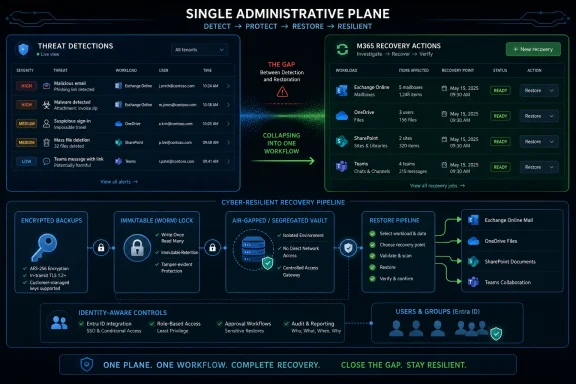
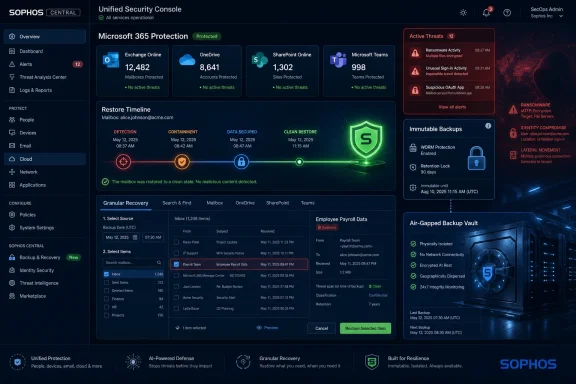
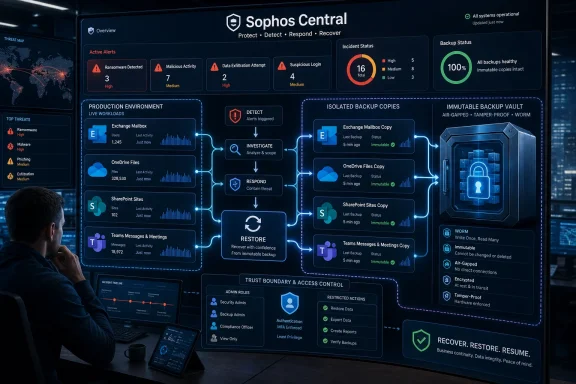
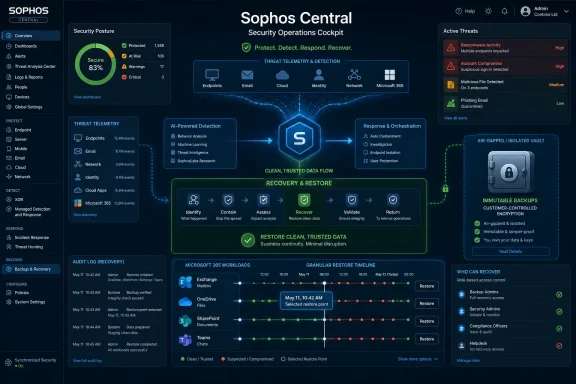
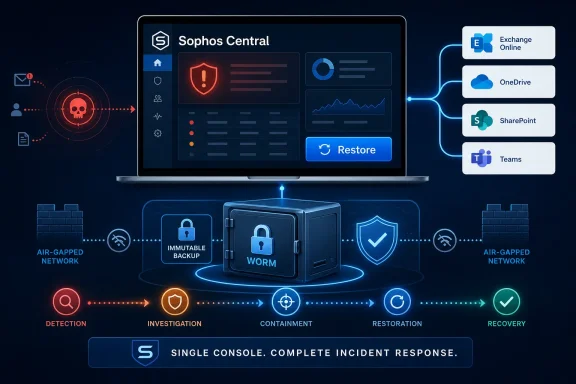
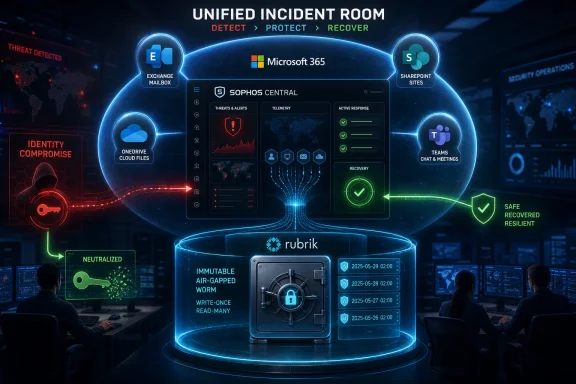
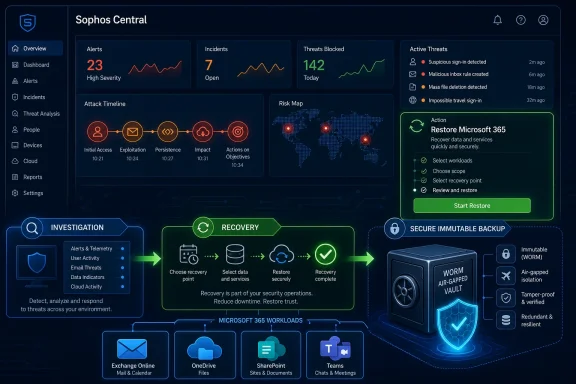
Sophos launched Backup and Recovery M365 Powered by Rubrik on May 27, 2026, making a cloud-based Microsoft 365 backup and restore service available through Sophos Central for customers and partners that want Rubrik protection for Exchange, OneDrive, SharePoint, and Teams data. The launch is not just another checkbox in the crowded Microsoft 365 backup market. It is Sophos arguing that backup now belongs inside the security operations workflow, not in a separate console visited only after the damage is done. For Windows shops already living in Microsoft 365 and Sophos Central, that is a practical pitch with a larger strategic message: resilience is becoming a managed security feature.
For years, Microsoft 365 backup was treated as an insurance policy: necessary, boring, and often justified only after someone discovered the difference between retention, recycle bins, litigation holds, and a recoverable business state. Sophos and Rubrik are trying to change that framing. Their new service puts Microsoft 365 recovery into the same administrative orbit as endpoint defense, MDR, XDR, and security telemetry.
That positioning matters because Microsoft 365 is no longer merely “email and files.” It is the operational substrate for calendars, Teams conversations, SharePoint workflows, executive mailboxes, customer documents, and institutional memory. If a tenant is compromised, deleted, misconfigured, or held hostage by an attacker, the blast radius is not confined to a few lost messages.
Sophos is also making a bet about its own customers. The company says the service is aimed at organizations that already use Sophos Central and want a more integrated route to Microsoft 365 resilience. That audience is often mid-market IT: teams large enough to be targeted, but not large enough to maintain a separate specialist bench for identity, backup, security operations, and incident response.
Rubrik supplies the data protection machinery. Sophos supplies the platform, channel, and security operations context. The resulting product is less interesting as a feature list than as a sign of where the market is moving: backup is being absorbed into the language of cyber resilience.
The modern argument is account compromise. If attackers obtain privileged credentials, they may not need to encrypt endpoints to cause chaos. They can delete content, tamper with retention settings, abuse collaboration tools, exfiltrate sensitive mail, or target the data that makes a business function day to day.
Microsoft has continued to improve native recovery and backup capabilities, including Microsoft 365 Backup as a pay-as-you-go service covering key workloads such as Exchange, OneDrive, and SharePoint. But native capability does not erase the architectural question for administrators: where should the recovery control plane live, who can alter it, and whether it remains trustworthy during an identity-driven incident.
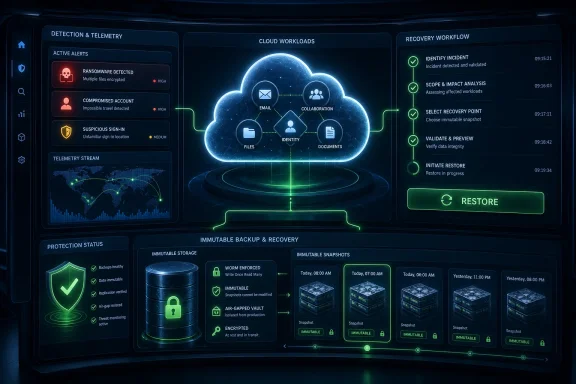
That is where Rubrik’s vocabulary fits neatly into Sophos’ security pitch. Terms such as immutable backups, air-gapped storage, WORM locks, and customer-held encryption keys are not merely backup jargon anymore. They are answers to a specific fear: that the same compromised identity used to damage production data could also be used to poison or delete the recovery path.
The uncomfortable truth for Microsoft 365 tenants is that resilience is not the same as availability. Microsoft can keep the service running while a customer’s data, permissions, or business process is still in disarray. Sophos is using this launch to press that distinction.
That is a subtle but important expansion. Detection and response products traditionally focused on finding the intruder, isolating the endpoint, blocking the hash, and escalating the case. Backup tools lived elsewhere, often owned by infrastructure teams. In an incident, the two groups had to coordinate under pressure, usually while executives asked when email, files, and Teams would be usable again.
Sophos’ pitch is that the recovery workflow should be closer to the security workflow. If MDR analysts can see the threat and administrators can restore affected Microsoft 365 content from the same broader operational environment, the organization may shave time off the ugliest phase of an incident: the handoff between “we found it” and “we are back.”
This is also a channel play. Sophos has a large partner ecosystem, and Microsoft 365 backup is an attachable service with a clear business case. Partners can present it not as a standalone backup SKU but as an extension of managed cyber resilience, which is often easier to explain to customers than the fine print of retention policies.
Rubrik benefits as well. Its brand gains another path into the mid-market through Sophos’ console and partner network. Rather than asking every smaller customer to adopt Rubrik as a separate operational universe, the product arrives inside a platform many of them already use.
Rubrik gives Sophos a faster route to market than building comparable capability from scratch. Rubrik has spent years positioning itself around cyber recovery, immutable data protection, and the idea that backup infrastructure must be designed for adversarial conditions. That is a stronger fit for Sophos’ security narrative than a basic copy-and-restore engine would be.
The announcement emphasizes protection across Exchange, OneDrive, SharePoint, and Teams. Those workloads are not equal from a recovery standpoint. Mailboxes, sites, channels, permissions, metadata, and user state all carry different operational implications, and administrators will care less about marketing coverage than about what can be restored, how quickly, to what target, and under what identity controls.
That is why the integration details will matter. A product can be “in Sophos Central” in several ways, ranging from single sign-on and status visibility to deep workflow integration. The more the service helps administrators connect security incidents to recovery actions, the more meaningful the partnership becomes.
For now, the strategic point is clear. Sophos does not want Microsoft 365 backup to be judged as an isolated utility. It wants the service judged as part of a security architecture in which prevention, detection, response, and recovery sit on the same continuum.
The mid-market sits in the messy middle. These organizations often have hundreds or thousands of users, regulatory exposure, cyber insurance questionnaires, and attackers who view them as valuable targets. Yet their IT teams are frequently lean, overloaded, and dependent on managed service providers or security vendors for operational depth.
That is the market Sophos is targeting. A unified console and partner-delivered service can be more attractive than another specialized backup platform with its own training curve, procurement cycle, and alert stream. If the product reduces administrative friction, it may win not because it is the only way to back up Microsoft 365, but because it is the path of least resistance for existing Sophos customers.
There is also an emotional component. Backup failures are career-limiting events. When a CEO’s mailbox, a legal SharePoint site, or a finance team’s OneDrive content cannot be restored after a breach, nobody cares that the organization had excellent endpoint telemetry. The question becomes brutally simple: can we get our business data back?
Sophos and Rubrik are selling confidence against that moment. Whether customers should buy that confidence from them depends on pricing, service terms, restore performance, supported workloads, and how well the integration works in real incidents rather than demos.
But the more precise debate remains wide open. First-party backup can offer advantages in performance, proximity to the data, and administrative simplicity. Third-party backup can offer separation of control, different retention models, independent security assumptions, and integration with broader recovery platforms.
Sophos is clearly arguing for the latter, with Rubrik as the engine. The value proposition is not merely that data can be restored. It is that protected copies are insulated from some classes of tenant compromise and surfaced inside a security operations environment.
Administrators should not treat that as magic. Backup architecture must be tested, not trusted. Recovery points, restore targets, role delegation, encryption key handling, inactive user recovery, Teams coverage, and audit trails all need scrutiny before an organization assumes it has solved the Microsoft 365 resilience problem.
The launch should also push WindowsForum readers to revisit their own assumptions about Microsoft 365 retention. Retention policies are often designed for compliance, discovery, or lifecycle management. Backup is designed for recovery. Those goals overlap, but they are not interchangeable, especially when the incident involves malicious deletion or administrative compromise.
That pressure has reached Microsoft 365. A company can survive a brief endpoint outage more easily than a prolonged loss of email, shared documents, Teams collaboration, and executive communications. The Microsoft 365 tenant is where work happens, and recovery time there has become a business continuity metric.
Sophos’ integration with Rubrik is designed to appeal to that urgency. The promise is fast, flexible recovery of Microsoft 365 data, including restoration to original or alternate users and support for inactive accounts. Those details matter because real-world incidents rarely present clean recovery scenarios.
An employee may have left. A mailbox may be compromised. A department may need data restored somewhere safe for review before it returns to production. A SharePoint site may need a point-in-time recovery that does not overwrite everything users have done since the incident began. The difference between a useful backup service and a decorative one is found in those edge cases.
The real test will be operational. Customers should run recovery drills, not just enable policies. They should measure restore times, document authority chains, and confirm who can initiate restores during a security incident. A backup product that has never been exercised is a theory with a monthly invoice.
That does not mean every function should come from one vendor. Consolidation can reduce complexity, but it can also create dependency. A single console is convenient until the organization discovers that convenience has narrowed its options or hidden important controls behind simplified workflows.
Still, the re-bundling trend is rational. Attackers do not respect product categories. A phishing email becomes an identity compromise, which becomes mailbox access, which becomes SharePoint discovery, which becomes data theft, deletion, or extortion. Defenders who organize their tools in disconnected silos are already a step behind.
Sophos is trying to turn that reality into product gravity. If Central becomes the place where customers manage security operations and recovery, Sophos becomes harder to displace. Rubrik, meanwhile, gets embedded in customer environments where backup may previously have been postponed or handled by a lighter-weight tool.
For Microsoft, this ecosystem activity is both validation and competition. The more vendors build around Microsoft 365 backup, the more they reinforce the idea that Microsoft 365 data protection is a necessary category. But they also challenge Microsoft’s own first-party backup ambitions by arguing that independence and security integration still matter.
The service being cloud-based is convenient, but cloud-based backup raises familiar questions. Where is the data stored? How are encryption keys controlled? What administrative roles can alter protection? What logs exist when someone changes policies? How does the service behave if the Microsoft 365 tenant itself is under active compromise?
Customers should also evaluate licensing and scope. Microsoft 365 environments are rarely tidy. Shared mailboxes, inactive users, guests, Teams data, SharePoint permissions, archived mail, and departed employees all introduce complexity. A backup plan that covers only the easy parts will look good until the first ugly restore.
The product’s appeal to Sophos MDR and XDR customers should also be examined carefully. If the integration meaningfully improves incident response, that is valuable. If it is mostly a procurement and console convenience, it may still be useful, but buyers should price it accordingly.
None of this makes the launch less important. It simply means the correct response from IT pros is neither cynicism nor blind adoption. It is a structured proof of recovery.
That is the scenario that separates modern cyber recovery from traditional backup. In a routine deletion event, ordinary administrative tools may be enough. In an adversarial event, the defender needs protected copies, independent controls, strong authentication, and confidence that the restore path has not been sabotaged.
Sophos and Rubrik are positioning their service around that adversarial model. The language of immutable backups and air-gapped protection is meant to reassure customers that recovery remains possible even when attackers have done more than delete a few files. It is a message shaped by ransomware, business email compromise, and the long tail of identity attacks.
For WindowsForum readers, the practical lesson is broader than this specific product. Microsoft 365 recovery planning should be treated as part of incident response, not as a storage chore. The people who investigate attacks and the people who restore data need shared runbooks, shared assumptions, and shared deadlines.
That may be the biggest cultural shift Sophos is trying to sell. Backup is no longer the last chapter of the disaster recovery binder. It is part of the security posture.
 Sophos Moves Backup Out of the Utility Closet
For years, Microsoft 365 backup was treated as an insurance policy: necessary, boring, and often justified only after someone discovered the difference between retention, recycle bins, litigation holds, and a recoverable business state. Sophos and Rubrik are trying to change that framing. Their new service puts Microsoft 365 recovery into the same administrative orbit as endpoint defense, MDR, XDR, and security telemetry.That positioning matters because Microsoft 365 is no longer merely “email and files.” It is the operational substrate for calendars, Teams conversations, SharePoint workflows, executive mailboxes, customer documents, and institutional memory. If a tenant is compromised, deleted, misconfigured, or held hostage by an attacker, the blast radius is not confined to a few lost messages.
Sophos is also making a bet about its own customers. The company says the service is aimed at organizations that already use Sophos Central and want a more integrated route to Microsoft 365 resilience. That audience is often mid-market IT: teams large enough to be targeted, but not large enough to maintain a separate specialist bench for identity, backup, security operations, and incident response.
Rubrik supplies the data protection machinery. Sophos supplies the platform, channel, and security operations context. The resulting product is less interesting as a feature list than as a sign of where the market is moving: backup is being absorbed into the language of cyber resilience.
Microsoft 365 Protection Has Become a Security Problem
The old argument for Microsoft 365 backup was accidental deletion. A user removed a folder, a mailbox disappeared, or a SharePoint site was changed beyond easy repair. Those are still real problems, but they are not the ones driving the current wave of security-led backup products.The modern argument is account compromise. If attackers obtain privileged credentials, they may not need to encrypt endpoints to cause chaos. They can delete content, tamper with retention settings, abuse collaboration tools, exfiltrate sensitive mail, or target the data that makes a business function day to day.
Microsoft has continued to improve native recovery and backup capabilities, including Microsoft 365 Backup as a pay-as-you-go service covering key workloads such as Exchange, OneDrive, and SharePoint. But native capability does not erase the architectural question for administrators: where should the recovery control plane live, who can alter it, and whether it remains trustworthy during an identity-driven incident.
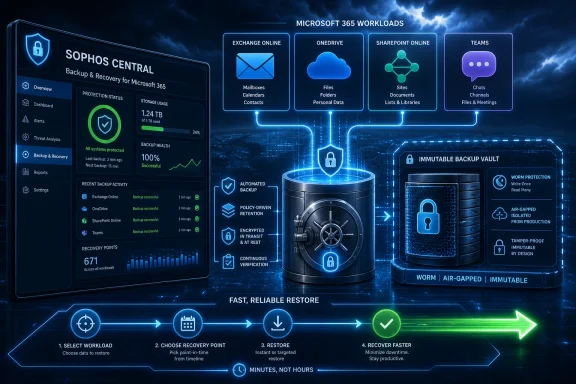
That is where Rubrik’s vocabulary fits neatly into Sophos’ security pitch. Terms such as immutable backups, air-gapped storage, WORM locks, and customer-held encryption keys are not merely backup jargon anymore. They are answers to a specific fear: that the same compromised identity used to damage production data could also be used to poison or delete the recovery path.
The uncomfortable truth for Microsoft 365 tenants is that resilience is not the same as availability. Microsoft can keep the service running while a customer’s data, permissions, or business process is still in disarray. Sophos is using this launch to press that distinction.
Sophos Central Becomes the Battleground
Sophos Central has always been more than a dashboard, but this launch pushes it further into platform territory. By integrating Rubrik-powered Microsoft 365 backup and recovery there, Sophos is trying to make Central the place where security teams not only detect and respond, but also recover.That is a subtle but important expansion. Detection and response products traditionally focused on finding the intruder, isolating the endpoint, blocking the hash, and escalating the case. Backup tools lived elsewhere, often owned by infrastructure teams. In an incident, the two groups had to coordinate under pressure, usually while executives asked when email, files, and Teams would be usable again.
Sophos’ pitch is that the recovery workflow should be closer to the security workflow. If MDR analysts can see the threat and administrators can restore affected Microsoft 365 content from the same broader operational environment, the organization may shave time off the ugliest phase of an incident: the handoff between “we found it” and “we are back.”
This is also a channel play. Sophos has a large partner ecosystem, and Microsoft 365 backup is an attachable service with a clear business case. Partners can present it not as a standalone backup SKU but as an extension of managed cyber resilience, which is often easier to explain to customers than the fine print of retention policies.
Rubrik benefits as well. Its brand gains another path into the mid-market through Sophos’ console and partner network. Rather than asking every smaller customer to adopt Rubrik as a separate operational universe, the product arrives inside a platform many of them already use.
The Rubrik Deal Gives Sophos a Recovery Story It Could Not Build Overnight
Sophos is a security company first. It has credibility in endpoint protection, MDR, network security, and threat research. But enterprise-grade SaaS backup and granular Microsoft 365 recovery are different disciplines, especially when customers expect speed, scale, and tamper resistance.Rubrik gives Sophos a faster route to market than building comparable capability from scratch. Rubrik has spent years positioning itself around cyber recovery, immutable data protection, and the idea that backup infrastructure must be designed for adversarial conditions. That is a stronger fit for Sophos’ security narrative than a basic copy-and-restore engine would be.
The announcement emphasizes protection across Exchange, OneDrive, SharePoint, and Teams. Those workloads are not equal from a recovery standpoint. Mailboxes, sites, channels, permissions, metadata, and user state all carry different operational implications, and administrators will care less about marketing coverage than about what can be restored, how quickly, to what target, and under what identity controls.
That is why the integration details will matter. A product can be “in Sophos Central” in several ways, ranging from single sign-on and status visibility to deep workflow integration. The more the service helps administrators connect security incidents to recovery actions, the more meaningful the partnership becomes.
For now, the strategic point is clear. Sophos does not want Microsoft 365 backup to be judged as an isolated utility. It wants the service judged as part of a security architecture in which prevention, detection, response, and recovery sit on the same continuum.
The Mid-Market Is Where the Pain Is Sharpest
Large enterprises usually know they need Microsoft 365 backup, even if their implementations vary wildly. They have compliance teams, risk committees, procurement frameworks, and enough painful history to understand that SaaS does not eliminate data responsibility. Smaller businesses may rely entirely on whatever Microsoft provides by default.The mid-market sits in the messy middle. These organizations often have hundreds or thousands of users, regulatory exposure, cyber insurance questionnaires, and attackers who view them as valuable targets. Yet their IT teams are frequently lean, overloaded, and dependent on managed service providers or security vendors for operational depth.
That is the market Sophos is targeting. A unified console and partner-delivered service can be more attractive than another specialized backup platform with its own training curve, procurement cycle, and alert stream. If the product reduces administrative friction, it may win not because it is the only way to back up Microsoft 365, but because it is the path of least resistance for existing Sophos customers.
There is also an emotional component. Backup failures are career-limiting events. When a CEO’s mailbox, a legal SharePoint site, or a finance team’s OneDrive content cannot be restored after a breach, nobody cares that the organization had excellent endpoint telemetry. The question becomes brutally simple: can we get our business data back?
Sophos and Rubrik are selling confidence against that moment. Whether customers should buy that confidence from them depends on pricing, service terms, restore performance, supported workloads, and how well the integration works in real incidents rather than demos.
Native Microsoft Recovery Is Improving, but It Does Not End the Debate
Microsoft’s own Microsoft 365 Backup service complicates the market in a healthy way. It gives customers a first-party option and pressures third-party vendors to prove why they deserve budget. That is good for administrators, because the old blanket claim that “Microsoft does not do backup” is now too crude to be useful.But the more precise debate remains wide open. First-party backup can offer advantages in performance, proximity to the data, and administrative simplicity. Third-party backup can offer separation of control, different retention models, independent security assumptions, and integration with broader recovery platforms.
Sophos is clearly arguing for the latter, with Rubrik as the engine. The value proposition is not merely that data can be restored. It is that protected copies are insulated from some classes of tenant compromise and surfaced inside a security operations environment.
Administrators should not treat that as magic. Backup architecture must be tested, not trusted. Recovery points, restore targets, role delegation, encryption key handling, inactive user recovery, Teams coverage, and audit trails all need scrutiny before an organization assumes it has solved the Microsoft 365 resilience problem.
The launch should also push WindowsForum readers to revisit their own assumptions about Microsoft 365 retention. Retention policies are often designed for compliance, discovery, or lifecycle management. Backup is designed for recovery. Those goals overlap, but they are not interchangeable, especially when the incident involves malicious deletion or administrative compromise.
Recovery Speed Is Now a Board-Level Metric
Ransomware changed the politics of backup. Ten years ago, backups were often judged by whether they existed. Today they are judged by whether they can restore the right systems quickly enough to keep the business alive.That pressure has reached Microsoft 365. A company can survive a brief endpoint outage more easily than a prolonged loss of email, shared documents, Teams collaboration, and executive communications. The Microsoft 365 tenant is where work happens, and recovery time there has become a business continuity metric.
Sophos’ integration with Rubrik is designed to appeal to that urgency. The promise is fast, flexible recovery of Microsoft 365 data, including restoration to original or alternate users and support for inactive accounts. Those details matter because real-world incidents rarely present clean recovery scenarios.
An employee may have left. A mailbox may be compromised. A department may need data restored somewhere safe for review before it returns to production. A SharePoint site may need a point-in-time recovery that does not overwrite everything users have done since the incident began. The difference between a useful backup service and a decorative one is found in those edge cases.
The real test will be operational. Customers should run recovery drills, not just enable policies. They should measure restore times, document authority chains, and confirm who can initiate restores during a security incident. A backup product that has never been exercised is a theory with a monthly invoice.
Security Vendors Are Rebundling the Microsoft 365 Stack
The Sophos-Rubrik launch fits a broader pattern: security vendors are rebuilding around Microsoft 365 because Microsoft 365 is where the risk has concentrated. Email security, identity monitoring, endpoint telemetry, cloud app visibility, data loss prevention, and backup are increasingly part of one conversation.That does not mean every function should come from one vendor. Consolidation can reduce complexity, but it can also create dependency. A single console is convenient until the organization discovers that convenience has narrowed its options or hidden important controls behind simplified workflows.
Still, the re-bundling trend is rational. Attackers do not respect product categories. A phishing email becomes an identity compromise, which becomes mailbox access, which becomes SharePoint discovery, which becomes data theft, deletion, or extortion. Defenders who organize their tools in disconnected silos are already a step behind.
Sophos is trying to turn that reality into product gravity. If Central becomes the place where customers manage security operations and recovery, Sophos becomes harder to displace. Rubrik, meanwhile, gets embedded in customer environments where backup may previously have been postponed or handled by a lighter-weight tool.
For Microsoft, this ecosystem activity is both validation and competition. The more vendors build around Microsoft 365 backup, the more they reinforce the idea that Microsoft 365 data protection is a necessary category. But they also challenge Microsoft’s own first-party backup ambitions by arguing that independence and security integration still matter.
Administrators Should Read the Fine Print Before They Read the Branding
The phrase “powered by Rubrik” will reassure some buyers, but administrators still need to evaluate the service as deployed through Sophos. Branding does not answer operational questions. It does not define retention duration, regional storage options, restore granularity, tenant onboarding steps, or the exact boundary between Sophos support and Rubrik infrastructure.The service being cloud-based is convenient, but cloud-based backup raises familiar questions. Where is the data stored? How are encryption keys controlled? What administrative roles can alter protection? What logs exist when someone changes policies? How does the service behave if the Microsoft 365 tenant itself is under active compromise?
Customers should also evaluate licensing and scope. Microsoft 365 environments are rarely tidy. Shared mailboxes, inactive users, guests, Teams data, SharePoint permissions, archived mail, and departed employees all introduce complexity. A backup plan that covers only the easy parts will look good until the first ugly restore.
The product’s appeal to Sophos MDR and XDR customers should also be examined carefully. If the integration meaningfully improves incident response, that is valuable. If it is mostly a procurement and console convenience, it may still be useful, but buyers should price it accordingly.
None of this makes the launch less important. It simply means the correct response from IT pros is neither cynicism nor blind adoption. It is a structured proof of recovery.
The Real Product Is Trust Under Compromise
The most interesting part of this launch is not that Sophos now sells Microsoft 365 backup. Many vendors do. The interesting part is the implied threat model: what if the tenant, the identity layer, or the administrator account cannot be fully trusted?That is the scenario that separates modern cyber recovery from traditional backup. In a routine deletion event, ordinary administrative tools may be enough. In an adversarial event, the defender needs protected copies, independent controls, strong authentication, and confidence that the restore path has not been sabotaged.
Sophos and Rubrik are positioning their service around that adversarial model. The language of immutable backups and air-gapped protection is meant to reassure customers that recovery remains possible even when attackers have done more than delete a few files. It is a message shaped by ransomware, business email compromise, and the long tail of identity attacks.
For WindowsForum readers, the practical lesson is broader than this specific product. Microsoft 365 recovery planning should be treated as part of incident response, not as a storage chore. The people who investigate attacks and the people who restore data need shared runbooks, shared assumptions, and shared deadlines.
That may be the biggest cultural shift Sophos is trying to sell. Backup is no longer the last chapter of the disaster recovery binder. It is part of the security posture.
The Launch Gives IT Teams a Concrete Checklist
Sophos’ new service will appeal most to organizations already invested in Sophos Central, but the launch is useful even for those that never buy it. It gives administrators a reason to ask sharper questions about Microsoft 365 resilience and to stop confusing retention with recovery.- Organizations using Sophos Central now have a Rubrik-powered Microsoft 365 backup option integrated into the same platform they use for security operations.
- The service is aimed at protecting Exchange, OneDrive, SharePoint, and Teams data against scenarios such as accidental deletion, ransomware, insider activity, and account compromise.
- The strongest argument for the product is not basic backup, but recovery control that remains credible when privileged Microsoft 365 identities are abused.
- Microsoft’s own backup and retention capabilities should be evaluated alongside third-party options, not ignored or treated as automatically sufficient.
- IT teams should test restores, role delegation, inactive-user recovery, and incident runbooks before assuming any Microsoft 365 backup product will meet business continuity needs.
- Existing Sophos MDR and XDR customers should compare the operational value of Central integration against pricing, retention terms, restore performance, and support boundaries.
References
- Primary source: Investing.com Canada
Published: Mon, 01 Jun 2026 13:25:06 GMT
Sophos launches Microsoft 365 backup service with Rubrik By Investing.com
Sophos launches Microsoft 365 backup service with Rubrikca.investing.com - Related coverage: sophos.com
Cybersecurity as a Service Delivered | Sophos
We Deliver Superior Cybersecurity Outcomes for Real-World Organizations Worldwide with a Broad Portfolio of Advanced Security Products and Services.www.sophos.com
- Related coverage: rubrik.com
Rubrik and Sophos to Deliver Microsoft 365 Cyber Resilience with New Partnership | Rubrik
New offering will provide streamlined security and data protection capabilities for Sophos MDR and XDR mid-market customerswww.rubrik.com - Related coverage: news.sophos.com
- Related coverage: community.sophos.com
- Related coverage: msspalert.com
Sophos and Rubrik Launch Integrated Microsoft 365 Backup and Recovery for MDR Customers | news | MSSP Alert
Sophos and Rubrik bring Microsoft 365 recovery into Sophos Central, uniting threat detection and data restoration in one console.www.msspalert.com
- Related coverage: s203.q4cdn.com
- Official source: learn.microsoft.com
Overview of Microsoft 365 Backup | Microsoft Learn
Learn about the backup and recovery capabilities for OneDrive, SharePoint, and Exchange Online using Microsoft 365 Backup.learn.microsoft.com - Official source: microsoft.com
Your request has been blocked. This could be due to several reasons.
www.microsoft.com
- Related coverage: avepoint.com
Shared Responsibility Model for Microsoft 365 (2026) | AvePoint
The shared responsibility model is a framework that divides security and data protection duties between a cloud provider and the customer. In Microsoft 365, Microsoft covers physical infrastructure, platform uptime, and service-level security.www.avepoint.com - Related coverage: xen.com.tr
Microsoft 365 Backup: The 2026 Shared Responsibility Guide | Xen Bilişim
Last week an Istanbul accounting office called: an intern accidentally deleted the entire team's OneDrive folder, can we restore it? "We use Microsoft 365, surely there's an automatic cloud backup?" No, there isn't. Microsoft promises uptime — not backup. www.xen.com.tr
- Related coverage: acronis.com
Microsoft 365 Retention vs Backup: Why Retention Is Not Enough for Data Protection
Learn the key differences between Microsoft 365 retention and backup, understand Microsoft’s Shared Responsibility Model, and see how Acronis Cyber Protect Cloud ensures full M365 data recovery and compliance. www.acronis.com
- Related coverage: techtarget.com
Build a Microsoft 365 backup policy with these 4 components | TechTarget
Organizations should have a Microsoft 365 backup policy, just as they have policies for backing up other important data sets. Make sure to account for data retention, backup frequency and these other essential elements.www.techtarget.com - Related coverage: techradar.com
The four shifts reshaping Microsoft 365 security and resilience | TechRadar
Why organizations are rethinking security and resilience in Microsoft 365www.techradar.com - Official source: adoption.microsoft.com
- Related coverage: cspire.com
508133492
Full length shot of a group of coworkers standing in the boardroomhttp://195.154.178.81/DATA/i_collage/pi/shoots/806284.jpgwww.cspire.com