

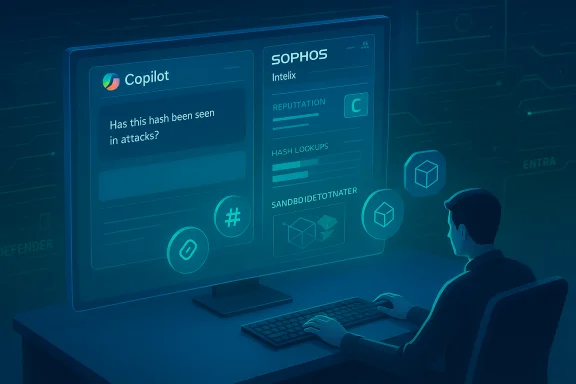
Sophos’ decision to surface its Sophos Intelix threat‑intelligence platform directly inside Microsoft’s Copilot ecosystem — including Microsoft Security Copilot, Microsoft 365 Copilot (Teams and Chat), and the Copilot agent framework (Copilot Studio / Agent 365) — represents a clear shift in how threat context is delivered to analysts and everyday users: real‑time reputation checks, sandbox detonation results, and prevalence telemetry can now be invoked in plain English without leaving Microsoft’s productivity and investigation surfaces.
Background / Overview
Sophos announced general availability of Sophos Intelix integrations for Microsoft Copilot following demonstrations at Microsoft Ignite, positioning Intelix as an agent that Copilot can discover and call via the Model Context Protocol (MCP). The vendor frames the move as “democratizing” SOC‑grade intelligence — putting reputation lookups, dynamic analysis summaries and telemetry‑driven prevalence inside Security Copilot and Microsoft 365 Copilot so analysts, IT admins and even business users can query threat context inline. Microsoft’s Copilot platform now includes an integrated Security Store, Copilot Studio, and an Agent 365 control plane that together provide discovery, distribution and governance for third‑party agents. That control plane gives agents Entra‑based identities, audit trails and lifecycle controls — the mechanics that make third‑party threat‑intel agents manageable inside an enterprise tenant. Sophos publicly states that Sophos Central processes more than 223 terabytes of telemetry per day, generates 34+ million detections, and automatically blocks 11+ million threats daily, and that Sophos protects 600,000 organizations — numbers the company uses to describe the scale backing Intelix. These are company‑reported metrics and useful for understanding scale, but procurement teams should treat them as vendor disclosures that require validation in pilots and contracts.What the integration actually delivers
Core capabilities exposed inside Copilot
- Reputation lookups — instant checks for file hashes, URLs, IPs and domains surfaced inline inside Security Copilot investigations or Microsoft 365 Copilot chat. This avoids manual switching to external portals for quick truth checks.
- Dynamic sandbox detonation — behavioral summaries and verdicts from Sophos’ dynamic analysis systems returned to enrichment flows to help explain what a suspicious binary does when executed.
- Prevalence & telemetry context — signals from Sophos X‑Ops showing where an indicator has been observed, timelines, and possible campaign attribution to aid triage.
- Natural‑language queries & explainability — analysts and non‑technical users can ask Copilot plain‑English questions (for example, “Has this hash been seen in attacks?”) and receive explainable, narrative answers that combine Microsoft telemetry and Sophos context.
- Agentic automation — Intelix can be composed into Copilot agent playbooks in Copilot Studio, feeding enrichment, tagging and suggested remediation steps into automated response flows under tenant governance.
Where users will see it
- Security Copilot: alert enrichment panels and investigation chat, where Intelix context shortens the analyst loop.
- Microsoft 365 Copilot / Teams: inline safety checks in Chat and Teams for admins and knowledge workers to validate suspicious links and attachments before clicking or escalating.
- Copilot Studio / Agent 365: discoverable as an agent in the Security Store and composable within agent playbooks and workflows for managed automation.
Technical mechanics — how the plumbing works
Model Context Protocol (MCP) is the glue
Sophos implements the Intelix agent as an MCP‑capable server so Copilot agents can issue typed queries (e.g., “lookup URL reputation”, “detonate file”) and receive structured, auditable responses. MCP is an emerging open protocol intended to standardize how generative AI assistants request external data, reducing ad‑hoc prompt engineering and improving provenance. This design lets Copilot present both human‑readable summaries and structured artifacts (IOCs, confidence scores, sandbox traces) that downstream automation and playbooks can use.Agent identity, governance and billing
- Agents in Microsoft’s ecosystem are discoverable in a Security Store and registered under Agent 365, which supplies identity, RBAC, inventory and observability controls for agent lifecycles. Administrators can audit and revoke agent access through Entra identity controls.
- Using third‑party agents inside Security Copilot may incur Security Compute Units (SCUs) or meter‑based costs for Copilot compute and sandboxing; the Security Store documentation highlights that agent use and associated compute are billed separately. Plan for FinOps governance.
Data flow patterns and tenant choices
- Many lookups can be hash‑only (no content leaves the tenant).
- Optional sandbox detonations may require uploading artifacts to Sophos analysis infrastructure — a tenant decision that triggers data‑residency, retention and privacy review.
- The MCP approach reduces the need to embed large unstructured blobs in prompts; instead Copilot requests specific operations and receives structured results, supporting better audit trails and least‑privilege designs.
Practical benefits — what organizations gain
For SOCs and incident responders
- Faster triage: inline enrichment reduces context switching and shortens mean time to triage.
- Richer incident context: combining Microsoft telemetry (Defender, Sentinel, Intune, Entra) with Intelix enrichments makes evidence summaries more actionable and reduces uncertain escalations.
- Repeatable playbooks: structured intel from Intelix feeds automated playbook steps, improving response consistency.
For IT admins, helpdesk and knowledge workers
- Democratized checks: non‑specialists can validate suspicious links, files or domains within Teams or Copilot Chat rather than escalating to SOC, improving hygiene and reducing false positives.
For MSPs and SMBs
- Access to SOC‑grade telemetry: smaller teams get enterprise‑grade enrichment without building a full threat‑intel stack, which is a core part of Sophos’ pitch for Intelix in Copilot. Sophos and Microsoft both highlight this as beneficial for resource‑constrained small and mid‑sized businesses.
Risks, tradeoffs and governance considerations
Sophisticated integrations bring value — and a fresh set of attack surfaces and governance obligations. The practical concerns fall into a few buckets.1) Data handling and privacy
Sending binaries, attachments or URLs for sandbox detonation to an external provider is a policy decision. Organizations must map:- What artifacts are allowed to leave tenant boundaries?
- How long are detonation traces retained?
- What logging and audit trails are preserved for compliance purposes?
2) Agentic attack surface and automation risk
Agents expand the surface area for attackers: misconfigured agents, over‑permissive playbooks or rogue prompts in Copilot agent chains can trigger unwanted actions. Treat agents like service accounts:- Enforce least privilege access.
- Restrict high‑impact automation to require human review.
- Log all agent actions and include provenance in SIEM.
3) Explainability & model hallucination risks
Copilot synthesizes answers from multiple sources. When an analyst asks for an Intelix verdict, Copilot will combine Microsoft telemetry with Intelix data. Ensure provenance appears alongside recommendations and that confidence levels, raw artifacts and structured IOC outputs remain available to humans for verification. Relying on narrative answers without access to the underlying data invites error.4) Cost and FinOps
Sandbox detonations, Copilot compute and multi‑tenant agent usage can produce metered costs. Microsoft’s Security Store documentation notes separate billing for agents and SCU consumption; plan pilots with cost ceilings and telemetry on per‑request charges.5) Vendor‑reported metrics vs independent validation
Sophos’ telemetry figures are headline‑worthy but are vendor‑reported. When such numbers become central to procurement decisions, insist on trial evidence and SLAs — and capture representative telemetry samples during pilots. Treat the numbers as context, not a contractual guarantee unless included in the contract.Implementation checklist — practical steps for adoption
- Prepare: review internal policies for external artifact sharing and update DLP / Purview rules to control what Copilot agents may upload.
- Pilot: enable Intelix agent in a sandbox tenant, log all agent activity, and run a 2–4 week sample of real alerts to measure false positives, enrichment latency and helpfulness.
- Configure: set agent RBAC, approve allowed operations (hash lookups vs full detonation), and pinplaybooks that require human approval for containment actions.
- Validate: compare Intelix verdicts with existing internal tooling on a representative sample and measure time saved per ticket. Document discrepancies and tune enrichment thresholds.
- Govern: integrate agent activity into SIEM retention, require per‑query provenance, and enable alerts for any agent requesting escalations or data egress.
- FinOps: collect per‑request cost metrics, set budget alerts for SCU usage and sandbox detonation, and build cost SLAs into the managed service agreement if you use an MSP.
Critical analysis — strengths, blind spots and strategic fit
Strengths
- Context where work happens: The most immediate win is workflow continuity. Enrichment that appears in Copilot or Teams removes time‑consuming console switches and accelerates decisions. That operational productivity gain is real and multiplies across heavy‑alert SOCs.
- Democratization of triage: Allowing IT admins and helpdesk staff to run authoritative checks reduces unnecessary escalations and improves security hygiene across the organization.
- Ecosystem governance: Microsoft’s Agent 365 and Security Store provide the necessary control plane and lifecycle artifacts required for enterprise adoption — a meaningful difference versus early ad‑hoc connectors.
Blind spots & unresolved questions
- Provenance and auditability at scale: While MCP and Agent 365 promise structured responses and agent identities, organizations must validate that the returned intelligence includes sufficient provenance (timestamps, dataset IDs, sandbox traces) for regulatory and forensic needs. Early adopters should insist on data‑level logging exports.
- Interoperability outside Microsoft stacks: The integration is compelling for Microsoft‑centric organizations, but cross‑platform shops must evaluate whether relying on Copilot agent flows fragments their tooling or duplicates investable telemetry.
- Attackers weaponizing agent chains: Agentic automation brings benefits but also the potential for chain‑of‑actions that an attacker could attempt to manipulate. Guardrails and human‑in‑the‑loop defaults are critical.
Recommended approach for Windows teams and IT leaders
- Treat Sophos Intelix in Copilot as a force‑multiplier — not a replacement — for existing detection and response processes. Use it to reduce time on repetitive enrichment tasks while preserving human judgment for containment decisions.
- Start small: run a short, measurable pilot focused on a single use case (e.g., email attachment triage or phishing link validation in Teams). Capture KPIs: time to triage, false positive rate, and cost per detonation.
- Harden governance first: align Copilot agent policies with DLP, update incident playbooks to require human sign‑off for high‑impact actions, and log agent calls to your SIEM for auditing and compliance.
- Negotiate contractual clarity: ensure retention, data residency, SLA and audit rights are explicit if you plan to route artifacts to Sophos for detonation. Vendor numbers about telemetry scale are useful context but are not a substitute for contractual guarantees.
Conclusion
Sophos’ Intelix integration with Microsoft Copilot marks a significant operational evolution: threat intelligence moves from standalone portals into the conversational and agentic workflows where defenders and users already spend their time. The upside is tangible — faster triage, broader access to SOC‑grade context, and the ability for MSPs to scale consistent enrichment across customer estates. The downside is equally real: new data‑flow choices, metered compute costs, and a broadened attack surface that must be governed deliberately.Organizations that will get the most value are the ones that pair early adoption with disciplined pilots, explicit governance controls, per‑request logging and clear FinOps boundaries. Where Sophos and Microsoft promise speed and convenience, responsible IT teams must demand provenance, auditability and contractual clarity before flipping the integration broadly across production tenants. When deployed with those safeguards, Sophos Intelix for Microsoft Copilot can be a practical and powerful tool in the defender’s toolkit — accelerating decisions while preserving the human judgment that ultimately determines correct outcomes.
Source: SC Media Sophos integrates threat intel with Microsoft Copilot
