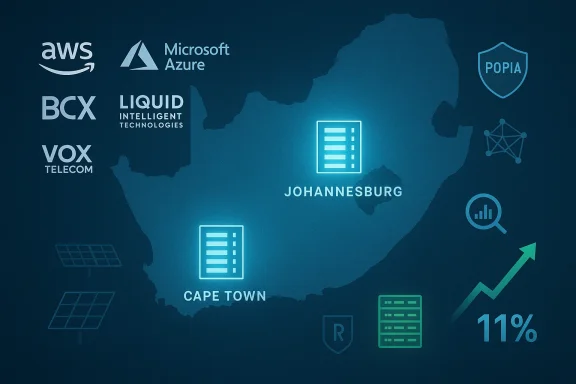
South Africa’s cloud storage market is no longer a niche play — it’s a fast-moving battleground where global hyperscalers and domestic specialists compete to solve the same core problems: data sovereignty, resilience in an energy-constrained environment, cost predictability for rand-based businesses, and the sudden demand surge from AI and analytics workloads. Analytics Insight’s recent roundup captures that dynamic and places a specific value on the sector: roughly USD 573.28 million and an annual growth rate north of 11%, driven by hyperscaler expansion and an increasingly sophisticated local services ecosystem. (analyticsinsight.net)
South Africa’s cloud story over the past five years has been about infrastructure arriving at scale. Global hyperscalers opened local regions (AWS in Cape Town, Google Cloud in Johannesburg, Microsoft with enterprise-grade data centres), while local players built complementary offerings: colocation, managed services, billing in rand, and specialist compliance help for POPIA. That mix has created a two-track market where global reach and tooling meet local operational pragmatism.
Hyperscalers brought low-latency regions and AI-ready infrastructure, making rapid adoption by enterprises and fintechs possible. Local providers, in contrast, offer practical advantages for SMEs — simpler contracts, local support, and protection against foreign-exchange exposure. The result is a complementary market rather than a zero-sum game, but with real trade-offs for buyers depending on their priorities. (analyticsinsight.net)
Caveat: exact market-share splits inside South Africa are rarely published by the hyperscalers themselves. Reports that place AWS, Azure and Google at particular South Africa percentages are useful directional guides, but should be treated as estimates unless supported by vendor disclosures or audited market research. Independent sources do confirm the global ranking (AWS lead, followed by Microsoft and Google) and that local region openings materially shift enterprise adoption patterns.
Important verification points:
If you’re evaluating providers today, start with a clear classification of your data (regulatory vs non-regulatory), model your expected ingress/egress behaviour to catch hidden costs, insist on documented POPIA and SLA evidence, and run a short-lived pilot that stresses both performance and cost. Treat skills and change management as first-order items in your migration budget — the platform is rarely the hardest part; the processes and people are.
Finally, use published market studies and vendor announcements to validate strategic assumptions (region availability, local investments, and certified partnerships). Analytics Insight’s Top‑10 list provides a useful snapshot of who’s active and why — but complement it with vendor documentation and independent research (market reports, local data-centre analyses, and hyperscaler press releases) before you sign anything. (analyticsinsight.net)
Source: Analytics Insight Top 10 Cloud Storage Companies in South Africa
 Background / Overview
South Africa’s cloud story over the past five years has been about infrastructure arriving at scale. Global hyperscalers opened local regions (AWS in Cape Town, Google Cloud in Johannesburg, Microsoft with enterprise-grade data centres), while local players built complementary offerings: colocation, managed services, billing in rand, and specialist compliance help for POPIA. That mix has created a two-track market where global reach and tooling meet local operational pragmatism.Hyperscalers brought low-latency regions and AI-ready infrastructure, making rapid adoption by enterprises and fintechs possible. Local providers, in contrast, offer practical advantages for SMEs — simpler contracts, local support, and protection against foreign-exchange exposure. The result is a complementary market rather than a zero-sum game, but with real trade-offs for buyers depending on their priorities. (analyticsinsight.net)
The Numbers: Market Size, Growth, and What They Mean
Analytics Insight reports a market value of USD 573.28 million for South African cloud storage and a growth rate above 11%, positioning the country as Africa’s storage bellwether. That figure aligns closely with independent market analysis that projects similar base values and double-digit CAGR for the data-centre storage market in South Africa. These figures reflect investment in hyperscale regions, enterprise digital transformation, and a surge in analytics/AI workloads that drive demand for high-performance storage. (analyticsinsight.net)Caveat: exact market-share splits inside South Africa are rarely published by the hyperscalers themselves. Reports that place AWS, Azure and Google at particular South Africa percentages are useful directional guides, but should be treated as estimates unless supported by vendor disclosures or audited market research. Independent sources do confirm the global ranking (AWS lead, followed by Microsoft and Google) and that local region openings materially shift enterprise adoption patterns.
Hyperscalers vs Local Providers: The Competitive Map
The hyperscalers (global infrastructure + local presence)
- Amazon Web Services (AWS) — Local region: Cape Town (af-south-1). AWS is commonly cited as the dominant global IaaS provider and remains the first choice for startups and companies needing the widest service breadth (S3 object storage, Glacier archival, SageMaker, etc.). Its Cape Town region launched in 2020 and is the anchor for many African deployments.
- Microsoft Azure — Strong enterprise integration (Office 365, Teams, Active Directory) and hybrid tooling make Azure the natural choice for corporate IT shops. Microsoft has announced multi-hundred-million-rand investments to expand cloud and AI capacity in South Africa, underlining a sustained local commitment.
- Google Cloud Platform (GCP) — Opened a Johannesburg region in January 2024. GCP has carved a niche for data-first businesses and AI workloads (BigQuery, Vertex AI), often favored by analytics-heavy firms and organisations prioritizing AI-native tooling.
- Oracle, Huawei, Alibaba and others — Each is active: Oracle targets mission-critical databases and ERP workloads; Huawei has gained traction in certain public-sector and telco engagements; Alibaba Cloud entered via partnership routes and local distributors to provide alternatives. (analyticsinsight.net)
The local champions (practicality, billing, and support)
- BCX (Business Connexion) — Local systems integrator that distributes Alibaba Cloud in South Africa under the ALP (Africa Local Public) Cloud model; strong in government and regulated sectors that demand sovereignty and localised SLAs.
- Dimension Data / NTT — Data-centre operator and managed service provider with high-security facilities and financial-services pedigree. Their footprint supports enterprise-class workloads requiring robust compliance and physical security.
- Vox Telecom — Positioned for SMEs: integrated backup and managed-storage bundles, reselling Veeam-based backup-to-cloud and other practical, turn-key solutions that remove the cloud-architecture burden from small IT teams.
- Tarsus On Demand / Cloud On Demand — Cloud aggregator and distributor that helps local MSPs resell and manage major platform services, delivering partner-focused enablement and billing tools.
- Liquid Intelligent Technologies / Africa Data Centres — Provides the physical colocation and green-energy initiatives that underpin resilient cloud deployments, important in a market where power instability is a real operational risk.
Analytics Insight’s Top-10 — Quick, Verified Summary and Notes
The Analytics Insight article lists the leading providers shaping the market in 2026 — highlighting AWS, Microsoft Azure, Google Cloud, Huawei Cloud, Oracle Cloud, BCX, Dimension Data (NTT), Vox Telecom, Tarsus On Demand (Cloud On Demand), and Liquid Intelligent Technologies (Africa Data Centres). It frames the market around three key forces: hyperscaler infrastructure, local sovereignty & support, and increasing demand from AI workloads. That framing is consistent with independent industry reporting and market research. (analyticsinsight.net)Important verification points:
- AWS Cape Town (af-south-1) and Google Johannesburg region openings are public, widely reported events and materially explain the timing of enterprise migrations to local cloud regions.
- Microsoft’s ZAR 5.4 billion (≈ USD 297M) commitment to expand cloud/AI capacity and certifying tens of thousands of people in digital skills has been reported by reputable outlets and reflects hyperscaler spending linked to local expansion.
- BCX’s exclusive Alibaba distribution for South Africa (ALP Cloud) and its two AZ deployment are documented by BCX and independent reporting.
What’s Driving Demand: Trends That Matter
1. The AI surge and performance storage
Generative AI and large-scale analytics consume IOPS and capacity differently from traditional web apps. Organisations are moving to all-flash arrays and low-latency network fabrics to feed training and inference cycles; this is changing procurement cycles in local data centres and hyperscaler storage tiers. Analytics Insight and market reports both identify AI as a primary growth engine. (analyticsinsight.net)2. Data sovereignty and POPIA
POPIA has changed the checklist for enterprise buyers: data residency, legal controls, and auditability now rank high. Providers that can prove in-country storage and strong governance frameworks are favoured by finance, healthcare and government customers. Local regions and sovereign-cloud offers (e.g., BCX ALP Cloud) address this requirement. (analyticsinsight.net)3. Power resilience and sustainability
South Africa’s energy constraints (load-shedding) force providers to invest in renewable-backed microgrids, battery/Li-ion UPS systems, and liquid cooling. Operators with firm supply strategies — and those able to guarantee uptime during grid outages — gain a competitive edge. Liquid Intelligent Technologies and Africa Data Centres are explicit about solar and energy investments; this is now a procurement criterion.4. Currency and cost predictability
Rand volatility makes USD‑billed cloud a budget risk for SMEs. Local providers that offer ZAR billing and straightforward bundled services reduce that foreign-exchange exposure and attract smaller businesses. BCX, Vox and local aggregators repeatedly market rand-based contracts for that reason.Strengths and Risks — Provider-by-Provider (Practical Analysis)
Amazon Web Services (AWS)
- Strengths: Broadest service catalog, mature object/archival storage (S3/Glacier), rich partner ecosystem.
- Risks: Complexity can increase costs; egress and tooling choices require careful architecture to avoid surprise bills. Hyperscaler SLAs are strong, but vendor-lock is a real consideration for architects.
Microsoft Azure
- Strengths: Enterprise fit (Active Directory, M365 integration), hybrid tooling (Azure Stack/Arc).
- Risks: Enterprises may find cloud governance drift if they lift-and-shift without a refactor; integration benefits can entice long-term dependency. Microsoft’s large local investments reduce infrastructure risk.
Google Cloud (GCP)
- Strengths: AI and analytics platform strength; BigQuery/Vertex AI for data-first workloads.
- Risks: Relative enterprise tooling gap vs Azure can increase migration effort for traditional ERP systems; GCP’s pricing can be favourable for analytics-heavy workloads but needs skilled budgeting.
BCX (Alibaba ALP Cloud)
- Strengths: Sovereign-cloud model, ZAR billing, local AZ footprint for POPIA compliance.
- Risks: Dependency on channel ecosystem and resellers can create service variability; organisations must verify SLAs and support procedures.
Vox, Tarsus/Cloud On Demand, Dimension Data/NTT, Liquid
- Strengths: Practical bundles (Vox), partner enablement and billing (Tarsus), secure enterprise-grade colocation (Dimension Data), resilient/green power strategies (Liquid).
- Risks: For very large, AI-heavy workloads, local providers may need to partner with hyperscalers for scale economics or to provide GPU capacity on demand.
Choosing the Right Provider: A Practical Checklist
When evaluating cloud storage providers in South Africa, use this checklist as a minimum:- Data residency and POPIA compliance — where are primary and backup copies stored? (analyticsinsight.net)
- Billing currency — ZAR vs USD and exposure to FX risk.
- Egress and ingress pricing — calculate typical and worst-case egress costs for expected workloads.
- Performance profile — IOPS, throughput and latency for production vs backup workloads (flash vs HDD). (analyticsinsight.net)
- SLA and support model — 24/7 local support vs global ticketing; escalation paths.
- Power and resilience — documented backup power, renewable energy use, and emergency procedures.
- Security controls — encryption at rest/in transit, key management, certifications (ISO, SOC2, etc.).
- Managed services and migration support — for SMEs without deep cloud expertise.
Migration Roadmap — 10 Practical Steps for South African Organisations
- Inventory and classification — tag data by sensitivity and compliance needs.
- Define the target architecture — single-region, multi-region, hybrid, or sovereign-cloud.
- Cost model and FX mitigation — specify allowed USD exposure and pick ZAR-billed options where necessary.
- Proof of concept — run pilot workloads to validate latency, IOPS, and egress behaviour.
- Security baseline — KMS usage, VPC designs, POPIA mapping and audit trails.
- Data transfer plan — offline import (Snowball-type appliances), high-bandwidth syncs, or staged cutover.
- Backup and retention — determine RPO/RTO and choose archival tiers appropriately.
- Cutover schedule — phased migration with rollback plans.
- Cost and usage monitoring — set budgets, alerts, and tagging.
- Ongoing optimisation — rightsizing, reserved capacity, and storage lifecycle policies.
Practical Recommendations by Buyer Type
- Small business / SME: start with Vox Telecom or a local managed provider for backup and simple storage bundles; prioritise ZAR billing and phone-based support to minimize management overhead.
- Mid-market with compliance needs: evaluate BCX ALP Cloud or a hybrid architecture with a local colocation partner to satisfy POPIA while keeping flexibility.
- Enterprise with global footprint: consider Azure or AWS for breadth and hybrid tools; budget for migration and ongoing governance to control egress and lock-in risks. Microsoft’s local investment in capacity strengthens the enterprise case.
- AI/data-first businesses: GCP or AWS depending on toolchains; ensure high-performance all‑flash tiers and GPU access are available locally or via low-latency peering.
Risks to Watch — Governance, Cost, and Operational Threats
- Vendor lock-in — architecture choices like proprietary serverless or managed database services accelerate time-to-market but increase migration cost later.
- Egress shocks — poorly modelled cross-region replication or analytics exports can create large monthly bills. Always simulate and stress-test your likely access patterns.
- POPIA and legal exposure — ensure contractual rights, subprocessor lists and data transfer controls are explicit in your provider agreements. (analyticsinsight.net)
- Energy and continuity — load-shedding events require providers to show verified microgrid/UPS capabilities and documented recovery times. Local colocation providers are increasingly differentiating on this front.
- Skills gap — cloud-native skill shortages make managed services and distributor enablement valuable assets; plan training (and use vendor/local-academy programs) as part of migration budgets. Microsoft’s announced certification support is an example of hyperscaler-led skills investment.
Final Assessment — Where the Market Is Heading
- Expect further specialization: hyperscalers will own the high-end, global-scale tooling and AI infrastructure; local players will continue to refine the human value — billing, compliance, and in-country support. That co-existence suits a market where different buyer needs coexist across size and regulatory sensitivity. (analyticsinsight.net)
- The AI workload transition is accelerating investments in all-flash storage tiers and higher-density compute inside local regions and colo facilities. This will magnify the importance of power strategy, cooling, and sustainability credentials for any provider seeking hyperscaler-like customers.
- Financial prudence and governance will shift purchasing patterns: ZAR pricing, fixed-commitment contracts, and managed migration packages will win share among risk-averse buyers.
Conclusion — How South African Organisations Should Move Forward
South Africa’s cloud storage market in 2026 is mature enough to present genuine choices: global hyperscalers with deep platform capabilities, and local specialists that remove real barriers to cloud adoption (currency, compliance, local support). The best outcome for most organisations will be a pragmatic, hybrid posture: use hyperscalers where their unique services are indispensable (AI, global scale, advanced analytics), and partner with local providers or aggregators for sovereignty-sensitive data, predictable rand pricing, and hands‑on support.If you’re evaluating providers today, start with a clear classification of your data (regulatory vs non-regulatory), model your expected ingress/egress behaviour to catch hidden costs, insist on documented POPIA and SLA evidence, and run a short-lived pilot that stresses both performance and cost. Treat skills and change management as first-order items in your migration budget — the platform is rarely the hardest part; the processes and people are.
Finally, use published market studies and vendor announcements to validate strategic assumptions (region availability, local investments, and certified partnerships). Analytics Insight’s Top‑10 list provides a useful snapshot of who’s active and why — but complement it with vendor documentation and independent research (market reports, local data-centre analyses, and hyperscaler press releases) before you sign anything. (analyticsinsight.net)
Source: Analytics Insight Top 10 Cloud Storage Companies in South Africa